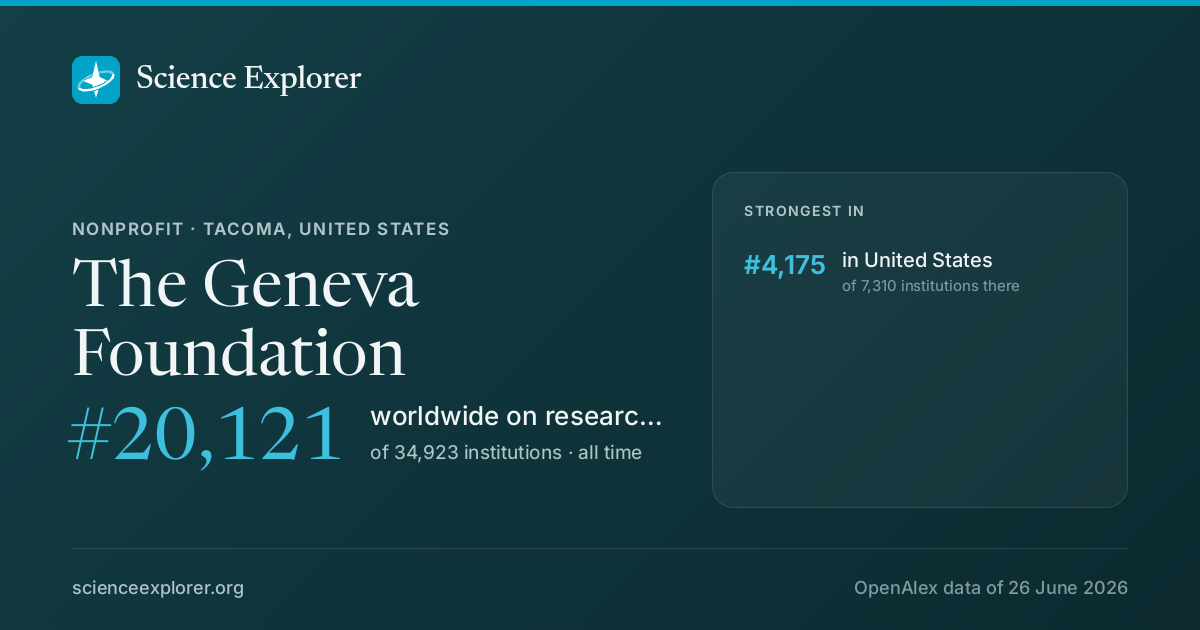
- World rank, all time
- #20,121 of 34,923
- Rank in United States
- #4,175 of 7,310
- Research works
- 170 ▲ 30% vs 2018-21
- Citations
- 2.2k 13.0 per fractional work
- Top-10% rate
- 10.4% all institutions 10.0%
- vs its own fields
- 0.95× 1.00× is exactly expected
- Open access
- 69% world 40%
- International
- 10% world 18%
Which fields of science does The Geneva Foundation work in?
In 2022-now, 61% of research at The Geneva Foundation is in Health Sciences, 16% in Physical Sciences. Its largest fields are Medicine (54%), Engineering (11%), Biochemistry, Genetics and Molecular Biology (8%). It does 2.4× the world's share of Health Sciences.
Each ring splits the one inside it: the four domains of science, their fields, their subfields. Size is fractional works in 2022-now. Every slice is a page; the interactive view zooms down to single topics and colours each by how much more of it this institution does than the world.
Its 4 domains and 24 fields, with their numbers
- Health Sciences4161.0%
- Medicine3654.2%
- Health Professions34.8%
- Nursing11.2%
- Veterinary00.7%
- Dentistry00.1%
- Physical Sciences1115.8%
- Engineering710.6%
- Computer Science12.1%
- Environmental Science11.3%
- Materials Science11.1%
- Energy00.3%
- Physics and Astronomy00.2%
- Chemistry00.2%
- Mathematics00.1%
- Life Sciences1015.1%
- Social Sciences58.1%
Field profile
Location quotient across every field it publishes in: outside the ring is more than an institution of this size would be expected to publish, inside it is less.
Rings at 0.5×, 1× and 2×. Widest outward: Veterinary, 5.2×. Every wedge is a field page.
All 24 fields, with their numbers
- Veterinary5.22×0 works
- Medicine2.82×36 works
- Neuroscience2.70×3 works
- Nursing2.38×1 works
- Health Professions1.82×3 works
- Immunology and Microbiology1.65×1 works
- Biochemistry, Genetics and Molecular Biology1.45×5 works
- Psychology0.94×2 works
- Decision Sciences0.73×0 works
- Engineering0.71×7 works
- Arts and Humanities0.45×1 works
- Pharmacology, Toxicology and Pharmaceutics0.35×0 works
- Materials Science0.31×1 works
- Computer Science0.27×1 works
- Energy0.27×0 works
- Environmental Science0.26×1 works
- Agricultural and Biological Sciences0.25×1 works
- Social Sciences0.24×2 works
- Dentistry0.17×0 works
- Chemistry0.11×0 works
- Mathematics0.11×0 works
- Physics and Astronomy0.09×0 works
- Business, Management and Accounting0.05×0 works
- Economics, Econometrics and Finance0.02×0 works
- Veterinary 5.2×
- Medicine 2.8×
- Neuroscience 2.7×
- Nursing 2.4×
- Health Professions 1.8×
- Immunology and Microbiology 1.6×
- Biochemistry, Genetics and Molecular Biology 1.4×
- Psychology 0.9×
- Decision Sciences 0.7×
- Engineering 0.7×
- Arts and Humanities 0.5×
- Pharmacology, Toxicology and Pharmaceutics 0.3×
- Materials Science 0.3×
- Computer Science 0.3×
- Energy 0.3×
- Environmental Science 0.3×
- Agricultural and Biological Sciences 0.2×
- Social Sciences 0.2×
- Dentistry 0.2×
- Chemistry 0.1×
- Mathematics 0.1×
- Physics and Astronomy 0.1×
- Business, Management and Accounting 0.1×
- Economics, Econometrics and Finance 0.0×
Who are the top researchers at The Geneva Foundation?
Ranked on the quality score, Ian Steed, Seid Y Muhie and Bintu Sowe lead among researchers whose main affiliation is The Geneva Foundation.
- 1
Ian Steed
 United States · #2,230,212 worldwide
59 citations · 31 works
- 2
Seid Y Muhie
United States · #2,256,684 worldwide
1.3k citations · 88 works
- 3
Bintu Sowe
United States · #2,458,904 worldwide
229 citations · 25 works
- 4
Allison Violet Hoke
United States · #2,688,570 worldwide
888 citations · 45 works
- 5
Yanyi Zang
United States · #2,847,259 worldwide
162 citations · 16 works
- 6
Daniel S. Wendorff
United States · #3,510,921 worldwide
206 citations · 21 works
- 7
Victoria Tepe
United States · #3,555,941 worldwide
204 citations · 22 works
- 8
Brendan M. Beely
United States · #3,684,485 worldwide
175 citations · 24 works
- 9
George T. Harea
United States · #3,707,179 worldwide
200 citations · 26 works
- 10
Teryn R. Roberts
United States · #3,853,351 worldwide
397 citations · 53 works
Which keywords describe research at The Geneva Foundation?
By fractional works in 2022-now, weighted toward what it does more of than the world: Epidemiology, Resuscitation, Sepsis, Trauma, Hemorrhage, Quality Improvement, Health Outcomes and Injury Severity.
- Measurement Properties
- Disability
- Recovery
- Left Ventricular Assist Device
- Wound Healing
- Chronic Pain
- Percutaneous Coronary Intervention
- Low Back Pain
- Psychological Factors
- Hypothermia
- Firefighters
- Cardiac Arrest
- Pathogenesis
- Coagulopathy
- Trauma Center
- Quality Improvement
- Mortality
- Hemorrhage
- Sepsis
- Resuscitation
- Epidemiology
- Inflammation
- Trauma
- Management
- Health Outcomes
- Injury Severity
- Clinical Trials
- Glycocalyx
- Survival Rates
- Emergency Responders
- Global Burden
- Out-of-Hospital
- Heart Failure
- Neuropathology
- Thrombosis
- Regenerative Medicine
- Extracorporeal Membrane Oxygenation
- Pathophysiology
- Concussion
- Encephalopathy
Size is fractional works in 2022-now in the topics tagged with each word; colour is the word's share of this institution's work against its share of the world's. The 40 words are chosen for being large and distinctive. Each links to the topic it comes from most.
All 40 words, with their numbers
- Epidemiology12▲ 4.4×44 topics
- Resuscitation4▲ 50×4 topics
- Inflammation3▲ 2.4×18 topics
- Sepsis3▲ 25×3 topics
- Trauma3▲ 20×4 topics
- Hemorrhage3▲ 57×2 topics
- Management3▲ 5.0×8 topics
- Mortality2▲ 6.5×4 topics
- Health Outcomes2▲ 13×2 topics
- Quality Improvement2▲ 18×2 topics
- Injury Severity2▲ 42×1 topic
- Trauma Center2▲ 84×1 topic
- Clinical Trials2▲ 4.8×7 topics
- Coagulopathy2▲ 41×1 topic
- Glycocalyx2▲ 121×1 topic
- Pathogenesis2▲ 6.3×6 topics
- Survival Rates2▲ 32×2 topics
- Cardiac Arrest2▲ 54×1 topic
- Emergency Responders2▲ 166×1 topic
- Firefighters2▲ 166×1 topic
- Global Burden2▲ 5.4×6 topics
- Hypothermia2▲ 41×2 topics
- Out-of-Hospital2▲ 54×1 topic
- Psychological Factors2▲ 15×3 topics
- Heart Failure2▲ 6.2×2 topics
- Low Back Pain2▲ 16×3 topics
- Neuropathology2▲ 20×2 topics
- Percutaneous Coronary Intervention2▲ 18×3 topics
- Thrombosis2▲ 9.4×3 topics
- Chronic Pain2▲ 11×3 topics
- Regenerative Medicine2▲ 9.6×4 topics
- Wound Healing2▲ 9.2×5 topics
- Extracorporeal Membrane Oxygenation2▲ 30×1 topic
- Left Ventricular Assist Device2▲ 47×1 topic
- Pathophysiology2▲ 7.6×5 topics
- Recovery2▲ 21×2 topics
- Concussion1▲ 48×1 topic
- Disability1▲ 20×1 topic
- Encephalopathy1▲ 31×1 topic
- Measurement Properties1▲ 29×1 topic
Which research topics does The Geneva Foundation publish most on?
By volume in 2022-now: Trauma and Emergency Care Studies, Trauma, Hemostasis, Coagulopathy, Resuscitation, Cardiac Arrest and Resuscitation and Occupational Health and Performance.
Area is fractional works; colour is the subfield each topic belongs to.
- 1 Trauma and Emergency Care Studies Emergency Medicine 2 works
- 2 Trauma, Hemostasis, Coagulopathy, Resuscitation Critical Care and Intensive Care Medicine 2 works
- 3 Cardiac Arrest and Resuscitation Emergency Medicine 2 works
- 4 Occupational Health and Performance Occupational Therapy 2 works
- 5 Mechanical Circulatory Support Devices Biomedical Engineering 2 works
- 6 Traumatic Brain Injury Research Epidemiology 1 works
- 7 Musculoskeletal pain and rehabilitation Pharmacology 1 works
- 8 Traumatic Brain Injury and Neurovascular Disturbances Neurology 1 works
- 9 3D Printing in Biomedical Research Biomedical Engineering 1 works
- 10 Viral Infections and Vectors Infectious Diseases 1 works
How open and international is its research?
Against the world's own shares: the tick on each track. Both are shares of its output, so they sit on one scale and can be read against each other as well as against the world.
World: 40% of research is openly available.
World: 18% is written across borders.
How has The Geneva Foundation's research output changed?
Output in 2022-2025 was 30% higher than in 2018-2021.
The same series as a ribbon: one cell per year, darker for more. The line above answers how much; this answers when.
Its share of all research
Growing output can still be a shrinking share: all of science grows. This is The Geneva Foundation as a percentage of every work published that year, 0.00029% in 2024.
Fractional works of The Geneva Foundation over all fractional works that year. How the balance of science has shifted.
Other research institutions in Tacoma
- University of Puget Sound
- Pacific Lutheran University
- Spectrum Research (United States)
- St. Joseph Medical Center in Tacoma
- Tacoma Community College
- MultiCare Health System
- Northwest Medical Specialties
- Mary Bridge Children's Health Center

Share The Geneva Foundation's ranking
Badges for a website1Each links back here and updates with every snapshot

Research measures only: rankings here say nothing about teaching, admissions or student experience. Comparable institutions and collaboration partners have tabs of their own, above.
Discussion
Ask a question or share a note about The Geneva Foundation. Keep it to the research: no personal attacks, advertising or links. Any reader can report a post, which collapses it for everyone until it is opened.