Trudeau Institute
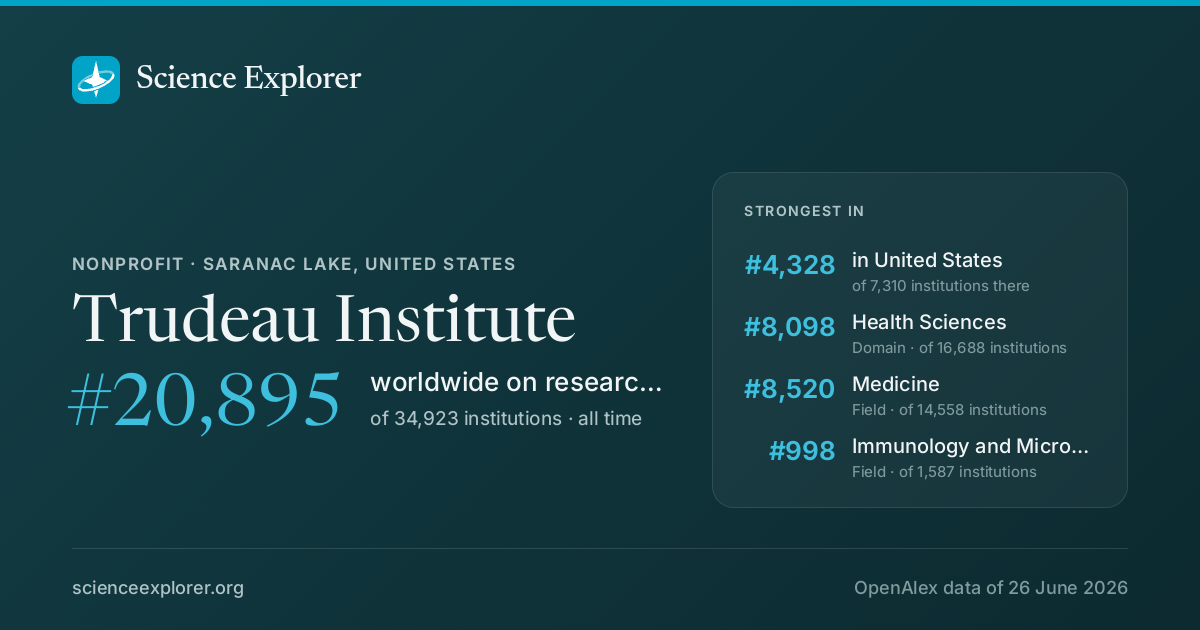
In research, Trudeau Institute stands highest in Health Sciences (#8,098 of 16,688 worldwide), Medicine (#8,520 of 14,558 worldwide) and Immunology and Microbiology (#998 of 1,587 worldwide), over all time.
- World rank, all time
- #20,895 of 34,923
- Rank in United States
- #4,328 of 7,310
- Research works
- 854 ▼ 27% vs 2018-21
- Citations
- 67k 78.1 per fractional work
- Top-10% rate
- 10.0% all institutions 10.0%
- vs its own fields
- 1.51× 1.00× is exactly expected
- Open access
- 52% world 40%
- International
- 7% world 18%
What is Trudeau Institute known for in research?
The fields where it stands highest, over all time, ranked among every institution above the floor in each field.
| Field | World rank | Where that sits | Top-10% rate | Works |
|---|---|---|---|---|
| Health SciencesDomain | #8,098 of 16,688 | 25.7% | 342 | |
| MedicineField | #8,520 of 14,558 | 25.5% | 324 | |
| Immunology and MicrobiologyField | #998 of 1,587 | 24.5% | 360 | |
| ImmunologySubfield | #789 of 1,141 | 24.5% | 331 | |
| Life SciencesDomain | #8,739 of 11,023 | 23.4% | 483 |
Each strip is that field's whole ranked pool, with the notch where Trudeau Institute sits in it, in the colour of the band that rank falls in. The track under the rate is the rate itself: it carries no average mark, because the average differs by field (from about 6% in Dentistry to 21% in Economics).
Which fields of science does Trudeau Institute work in?
In all years, 56% of research at Trudeau Institute is in Life Sciences, 40% in Health Sciences. Its largest fields are Immunology and Microbiology (42%), Medicine (38%), Biochemistry, Genetics and Molecular Biology (10%). It does 3.7× the world's share of Life Sciences.
Each ring splits the one inside it: the four domains of science, their fields, their subfields. Size is fractional works in all years. Every slice is a page; the interactive view zooms down to single topics and colours each by how much more of it this institution does than the world.
Its 4 domains and 23 fields, with their numbers
- Life Sciences48356.5%
- Health Sciences34240.0%
- Medicine32438.0%
- Veterinary60.7%
- Health Professions60.7%
- Nursing50.6%
- Physical Sciences202.4%
- Chemistry80.9%
- Environmental Science40.5%
- Computer Science30.3%
- Engineering30.3%
- Materials Science20.2%
- Physics and Astronomy00.1%
- Mathematics00.0%
- Chemical Engineering00.0%
- Social Sciences101.1%
Field profile
Location quotient across every field it publishes in: outside the ring is more than an institution of this size would be expected to publish, inside it is less.
Rings at 0.5×, 1× and 2×. Widest outward: Immunology and Microbiology, 10.3×. Every wedge is a field page.
All 14 fields, with their numbers
- Immunology and Microbiology10.32×2 works
- Pharmacology, Toxicology and Pharmaceutics6.49×0 works
- Medicine2.59×7 works
- Chemistry2.19×0 works
- Biochemistry, Genetics and Molecular Biology1.49×1 works
- Psychology1.19×0 works
- Health Professions0.72×0 works
- Business, Management and Accounting0.71×0 works
- Agricultural and Biological Sciences0.70×0 works
- Environmental Science0.43×0 works
- Social Sciences0.38×1 works
- Neuroscience0.35×0 works
- Engineering0.34×1 works
- Computer Science0.29×0 works
- Immunology and Microbiology 10.3×
- Pharmacology, Toxicology and Pharmaceutics 6.5×
- Medicine 2.6×
- Chemistry 2.2×
- Biochemistry, Genetics and Molecular Biology 1.5×
- Psychology 1.2×
- Health Professions 0.7×
- Business, Management and Accounting 0.7×
- Agricultural and Biological Sciences 0.7×
- Environmental Science 0.4×
- Social Sciences 0.4×
- Neuroscience 0.3×
- Engineering 0.3×
- Computer Science 0.3×
Who are the top researchers at Trudeau Institute?
Ranked on the quality score, Andrea May Cooper, Susan L. Swain and William W. Reiley lead among researchers whose main affiliation is Trudeau Institute.
- 1
Andrea May Cooper
 United States · #37,744 worldwide
21k citations · 194 works
- 2
Susan L. Swain
United States · #79,073 worldwide
28k citations · 315 works
- 3
William W. Reiley
United States · #104,065 worldwide
3.1k citations · 41 works
- 4
John E. Pearl
United States · #169,136 worldwide
5.8k citations · 56 works
- 5
Katja Mohrs
United States · #174,290 worldwide
3.4k citations · 44 works
- 6
Markus Mohrs
United States · #316,167 worldwide
12k citations · 120 works
- 7
Laura Haynes
United States · #328,521 worldwide
11k citations · 171 works
- 8
George B. Mackaness
United States · #517,941 worldwide
9k citations · 89 works
- 9
Marcia A. Blackman
United States · #526,945 worldwide
10k citations · 199 works
- 10
Jeffrey J. Fountain
United States · #613,952 worldwide
3.1k citations · 30 works
Which keywords describe research at Trudeau Institute?
By fractional works in all years, weighted toward what it does more of than the world: Epidemiology, Diagnosis, Treatment, Inflammation, Immune Response, Innate Immunity, Natural Killer Cells and NK Cell Recognition.
- Transplant Recipients
- Virulence Factors
- Pathogenesis
- Nontuberculous Mycobacteria
- Cystic Fibrosis
- Antibiotic Resistance
- Tuberculosis
- Innate Antiviral Responses
- Pathogen Recognition
- Pattern Recognition Receptors
- Vaccine Adjuvants
- Dendritic Cells
- Antigen Presentation
- CD4+CD25+
- Autoimmunity
- TGF-ß
- Natural Killer Cells
- Innate Immunity
- Inflammation
- Diagnosis
- Epidemiology
- Treatment
- Immune Response
- NK Cell Recognition
- Vaccine
- Immunity
- Cancer Immunotherapy
- Foxp3
- Genetic Diversity
- Tumor Antigen
- Drug Resistance
- Toll-like Receptors
- Cytokine-Mediated Link
- Mycobacterium tuberculosis
- Cancer
- Genomic Studies
- Mycobacterium avium
- Vaccine Development
- Infection
- Genomics
Size is fractional works in all years in the topics tagged with each word; colour is the word's share of this institution's work against its share of the world's. The 40 words are chosen for being large and distinctive. Each links to the topic it comes from most.
All 40 words, with their numbers
- Epidemiology206▲ 6.0×50 topics
- Diagnosis122▲ 14×17 topics
- Treatment116▲ 10×16 topics
- Inflammation114▲ 5.7×40 topics
- Immune Response95▲ 18×17 topics
- Innate Immunity91▲ 31×10 topics
- NK Cell Recognition88▲ 102×1 topic
- Natural Killer Cells88▲ 102×1 topic
- Vaccine73▲ 21×10 topics
- TGF-ß71▲ 49×3 topics
- Immunity71▲ 25×9 topics
- Autoimmunity70▲ 40×5 topics
- Cancer Immunotherapy70▲ 58×3 topics
- CD4+CD25+66▲ 104×1 topic
- Foxp366▲ 104×1 topic
- Antigen Presentation61▲ 72×2 topics
- Genetic Diversity61▲ 14×6 topics
- Dendritic Cells60▲ 61×2 topics
- Tumor Antigen58▲ 83×1 topic
- Vaccine Adjuvants58▲ 83×1 topic
- Drug Resistance57▲ 21×6 topics
- Pattern Recognition Receptors55▲ 44×2 topics
- Toll-like Receptors50▲ 35×4 topics
- Pathogen Recognition49▲ 66×2 topics
- Cytokine-Mediated Link49▲ 83×1 topic
- Innate Antiviral Responses49▲ 83×1 topic
- Mycobacterium tuberculosis48▲ 86×1 topic
- Tuberculosis48▲ 103×1 topic
- Cancer46▲ 3.8×18 topics
- Antibiotic Resistance45▲ 13×9 topics
- Genomic Studies41▲ 55×2 topics
- Cystic Fibrosis40▲ 58×3 topics
- Mycobacterium avium40▲ 103×1 topic
- Nontuberculous Mycobacteria40▲ 103×1 topic
- Vaccine Development35▲ 13×8 topics
- Pathogenesis34▲ 7.0×15 topics
- Infection29▲ 12×6 topics
- Virulence Factors26▲ 16×7 topics
- Genomics25▲ 8.4×5 topics
- Transplant Recipients22▲ 30×2 topics
Which research topics does Trudeau Institute publish most on?
By volume in 2022-now: Tuberculosis Research and Epidemiology, Mycobacterium research and diagnosis, Infection Control and Ventilation and Mosquito-borne diseases and control.
Area is fractional works; colour is the subfield each topic belongs to.
- 1 Tuberculosis Research and Epidemiology Infectious Diseases 1 works
- 2 Mycobacterium research and diagnosis Epidemiology 1 works
- 3 Infection Control and Ventilation Pulmonary and Respiratory Medicine 1 works
- 4 Mosquito-borne diseases and control Public Health, Environmental and Occupational Health 1 works
- 5 Inhalation and Respiratory Drug Delivery Pulmonary and Respiratory Medicine 1 works
- 6 Quinazolinone synthesis and applications Organic Chemistry 0 works
- 7 Immune Response and Inflammation Immunology 0 works
- 8 SARS-CoV-2 and COVID-19 Research Infectious Diseases 0 works
- 9 Influenza Virus Research Studies Epidemiology 0 works
- 10 Bioinformatics and Genomic Networks Molecular Biology 0 works
How open and international is its research?
Against the world's own shares: the tick on each track. Both are shares of its output, so they sit on one scale and can be read against each other as well as against the world.
World: 40% of research is openly available.
World: 18% is written across borders.
How has Trudeau Institute's research output changed?
Output in 2022-2025 was 27% lower than in 2018-2021.
The same series as a ribbon: one cell per year, darker for more. The line above answers how much; this answers when.
Its share of all research
Growing output can still be a shrinking share: all of science grows. This is Trudeau Institute as a percentage of every work published that year, 0.000035% in 2024.
Fractional works of Trudeau Institute over all fractional works that year. How the balance of science has shifted.
How much of it reaches the world top 10%
Year by year, against all institutions in the same year.
Of each year's output, the share that reached the world's 10% most cited for its field and year. Peak 37.9% in 2008.
Other research institutions in Saranac Lake
Share Trudeau Institute's ranking
Badges for a website1Each links back here and updates with every snapshot

Research measures only: rankings here say nothing about teaching, admissions or student experience. Comparable institutions and collaboration partners have tabs of their own, above.
Discussion
Ask a question or share a note about Trudeau Institute. Keep it to the research: no personal attacks, advertising or links. Any reader can report a post, which collapses it for everyone until it is opened.