Science Explorer Back to mapMap
Discussion
Hospital / health system · Oslo · Norway

Ullevål Sykehusapotek

In research, Ullevål Sykehusapotek stands highest in Medicine (#11,705 of 14,558 worldwide), Health Sciences (#13,888 of 16,688 worldwide) and Surgery (#2,765 of 3,248 worldwide), over all time.

World rank, all time
#23,284
of 34,923
Rank in Norway
#157
of 215
Research works
1.3k
▲ 59% vs 2018-21
Citations
8.3k
6.3 per fractional work
Top-10% rate
4.5%
all institutions 10.0%
vs its own fields
0.51×
1.00× is exactly expected
Open access
14%
world 40%
International
4%
world 18%

What is Ullevål Sykehusapotek known for in research?

The fields where it stands highest, over all time, ranked among every institution above the floor in each field.

FieldWorld rankWhere that sitsTop-10% rateWorks
MedicineField #11,705 of 14,558 4.1%829
Health SciencesDomain #13,888 of 16,688 4.1%948
SurgerySubfield #2,765 of 3,248 4.6%134
Life SciencesDomain #9,733 of 11,023 4.9%156
Social SciencesDomain #13,769 of 14,833 3.6%168

Each strip is that field's whole ranked pool, with the notch where Ullevål Sykehusapotek sits in it, in the colour of the band that rank falls in. The track under the rate is the rate itself: it carries no average mark, because the average differs by field (from about 6% in Dentistry to 21% in Economics).

Which fields of science does Ullevål Sykehusapotek work in?

In 2022-now, 68% of research at Ullevål Sykehusapotek is in Health Sciences, 17% in Social Sciences. Its largest fields are Medicine (58%), Psychology (10%), Health Professions (9%). It does 2.5× the world's share of Health Sciences.

Health Sciences: 31 fractional works · 68.0% of its workMedicine: 27 fractional works · 58.1% of its workSurgery: 4 fractional works · 8.2% of its workCardiology and Cardiovascular Medicine: 3 fractional works · 5.4% of its workPhysiology: 2 fractional works · 4.9% of its workEpidemiology: 2 fractional works · 4.6% of its workPediatrics, Perinatology and Child Health: 2 fractional works · 3.9% of its workNeurology: 2 fractional works · 3.9% of its workPulmonary and Respiratory Medicine: 1 fractional works · 3.0% of its workInfectious Diseases: 1 fractional works · 2.7% of its workEmergency Medicine: 1 fractional works · 2.4% of its workPsychiatry and Mental health: 1 fractional works · 2.4% of its workOncology: 1 fractional works · 2.0% of its workPublic Health, Environmental and Occupational Health: 1 fractional works · 1.8% of its workRheumatology: 1 fractional works · 1.5% of its workEndocrinology, Diabetes and Metabolism: 1 fractional works · 1.4% of its workFamily Practice: 1 fractional works · 1.3% of its workPathology and Forensic Medicine: 0 fractional works · 1.1% of its workAnesthesiology and Pain Medicine: 0 fractional works · 1.1% of its workCritical Care and Intensive Care Medicine: 0 fractional works · 1.0% of its workGeriatrics and Gerontology: 0 fractional works · 1.0% of its workOphthalmology: 0 fractional works · 0.9% of its workRadiology, Nuclear Medicine and Imaging: 0 fractional works · 0.5% of its workHepatology: 0 fractional works · 0.4% of its workComplementary and alternative medicine: 0 fractional works · 0.4% of its workHealth Informatics: 0 fractional works · 0.4% of its workImmunology and Allergy: 0 fractional works · 0.4% of its workOrthopedics and Sports Medicine: 0 fractional works · 0.4% of its workGastroenterology: 0 fractional works · 0.2% of its workGenetics: 0 fractional works · 0.2% of its workReproductive Medicine: 0 fractional works · 0.2% of its workSmaller subfields together: 0 fractional works · 0.6% of its workHealth Professions: 4 fractional works · 9.3% of its workGeneral Health Professions: 3 fractional works · 6.0% of its workEmergency Medical Services: 1 fractional works · 1.1% of its workSpeech and Hearing: 0 fractional works · 1.0% of its workRadiological and Ultrasound Technology: 0 fractional works · 0.5% of its workHealth Information Management: 0 fractional works · 0.4% of its workComplementary and Manual Therapy: 0 fractional works · 0.2% of its workDentistry: 0 fractional works · 0.5% of its workOral Surgery: 0 fractional works · 0.2% of its workOrthodontics: 0 fractional works · 0.2% of its workNursing: 0 fractional works · 0.2% of its workSocial Sciences: 8 fractional works · 17.2% of its workPsychology: 5 fractional works · 10.2% of its workSocial Psychology: 3 fractional works · 6.3% of its workClinical Psychology: 1 fractional works · 3.0% of its workExperimental and Cognitive Psychology: 0 fractional works · 0.4% of its workApplied Psychology: 0 fractional works · 0.4% of its workSmaller subfields together: 0 fractional works · 0.1% of its workSocial Sciences: 1 fractional works · 3.1% of its workEducation: 1 fractional works · 1.9% of its workSociology and Political Science: 0 fractional works · 0.7% of its workHuman Factors and Ergonomics: 0 fractional works · 0.5% of its workSmaller subfields together: 0 fractional works · 0.0% of its workArts and Humanities: 1 fractional works · 2.5% of its workLiterature and Literary Theory: 1 fractional works · 1.8% of its workHistory: 0 fractional works · 0.4% of its workHistory and Philosophy of Science: 0 fractional works · 0.4% of its workBusiness, Management and Accounting: 0 fractional works · 0.9% of its workManagement of Technology and Innovation: 0 fractional works · 0.5% of its workOrganizational Behavior and Human Resource Management: 0 fractional works · 0.4% of its workEconomics, Econometrics and Finance: 0 fractional works · 0.6% of its workFinance: 0 fractional works · 0.4% of its workEconomics and Econometrics: 0 fractional works · 0.2% of its workLife Sciences: 6 fractional works · 12.3% of its workImmunology and Microbiology: 3 fractional works · 5.8% of its workApplied Microbiology and Biotechnology: 1 fractional works · 2.3% of its workParasitology: 1 fractional works · 1.8% of its workMicrobiology: 1 fractional works · 1.5% of its workImmunology: 0 fractional works · 0.3% of its workBiochemistry, Genetics and Molecular Biology: 3 fractional works · 5.5% of its workMolecular Biology: 1 fractional works · 2.6% of its workGenetics: 1 fractional works · 1.8% of its workCancer Research: 0 fractional works · 0.6% of its workClinical Biochemistry: 0 fractional works · 0.4% of its workNeuroscience: 0 fractional works · 0.8% of its workNeurology: 0 fractional works · 0.4% of its workSensory Systems: 0 fractional works · 0.2% of its workSmaller subfields together: 0 fractional works · 0.2% of its workPharmacology, Toxicology and Pharmaceutics: 0 fractional works · 0.2% of its workAgricultural and Biological Sciences: 0 fractional works · 0.1% of its workPhysical Sciences: 1 fractional works · 2.4% of its workEnvironmental Science: 1 fractional works · 1.6% of its workEcology: 0 fractional works · 1.0% of its workNature and Landscape Conservation: 0 fractional works · 0.5% of its workSmaller subfields together: 0 fractional works · 0.1% of its workChemistry: 0 fractional works · 0.4% of its workPhysical and Theoretical Chemistry: 0 fractional works · 0.2% of its workSmaller subfields together: 0 fractional works · 0.2% of its workMathematics: 0 fractional works · 0.2% of its workStatistics and Probability: 0 fractional works · 0.2% of its workEngineering: 0 fractional works · 0.2% of its workALL ITS WORKUllevålSykehusapotek46fractional works, 2022-now
Life Sciences12%Physical Sciences2%Health Sciences68%Social Sciences17%

Each ring splits the one inside it: the four domains of science, their fields, their subfields. Size is fractional works in 2022-now. Every slice is a page; the interactive view zooms down to single topics and colours each by how much more of it this institution does than the world.

Its 4 domains and 18 fields, with their numbers
    1. Medicine2758.1%
    2. Health Professions49.3%
    3. Dentistry00.5%
    4. Nursing00.2%
    1. Psychology510.2%
    2. Social Sciences13.1%
    3. Arts and Humanities12.5%
    4. Business, Management and Accounting00.9%
    5. Economics, Econometrics and Finance00.6%
    1. Immunology and Microbiology35.8%
    2. Biochemistry, Genetics and Molecular Biology35.5%
    3. Neuroscience00.8%
    4. Pharmacology, Toxicology and Pharmaceutics00.2%
    5. Agricultural and Biological Sciences00.1%
    1. Environmental Science11.6%
    2. Chemistry00.4%
    3. Mathematics00.2%
    4. Engineering00.2%
All of science, and how each field's share has moved since 1950: the Science domain explorer

Field profile

Location quotient across every field it publishes in: outside the ring is more than an institution of this size would be expected to publish, inside it is less.

Agricultural and Biological Sciences: 0.02× its world share, 0 worksAgricultural and Bio…Biochemistry, Genetics and Molecular Biology: 1.03× its world share, 2 worksBiochemistry, Geneti…Immunology and Microbiology: 5.80× its world share, 3 worksImmunology and Micro…Neuroscience: 0.48× its world share, 0 worksNeurosciencePharmacology, Toxicology and Pharmaceutics: 0.41× its world share, 0 worksPharmacology, Toxico…Chemistry: 0.25× its world share, 0 worksChemistryEngineering: 0.01× its world share, 0 worksEngineeringEnvironmental Science: 0.32× its world share, 1 worksEnvironmental ScienceMathematics: 0.20× its world share, 0 worksMathematicsDentistry: 0.99× its world share, 0 worksDentistryHealth Professions: 3.54× its world share, 4 worksHealth ProfessionsMedicine: 3.02× its world share, 27 worksMedicineNursing: 0.30× its world share, 0 worksNursingArts and Humanities: 0.86× its world share, 1 worksArts and HumanitiesBusiness, Management and Accounting: 0.28× its world share, 0 worksBusiness, Management…Economics, Econometrics and Finance: 0.28× its world share, 0 worksEconomics, Econometr…Psychology: 3.33× its world share, 5 worksPsychologySocial Sciences: 0.24× its world share, 1 worksSocial Sciences1×world share
more than its size predictsabout as predictedless

Rings at 0.5×, 1× and 2×. Widest outward: Immunology and Microbiology, 5.8×. Every wedge is a field page.

All 18 fields, with their numbers
  1. Immunology and Microbiology5.80×3 works
  2. Health Professions3.54×4 works
  3. Psychology3.33×5 works
  4. Medicine3.02×27 works
  5. Biochemistry, Genetics and Molecular Biology1.03×2 works
  6. Dentistry0.99×0 works
  7. Arts and Humanities0.86×1 works
  8. Neuroscience0.48×0 works
  9. Pharmacology, Toxicology and Pharmaceutics0.41×0 works
  10. Environmental Science0.32×1 works
  11. Nursing0.30×0 works
  12. Business, Management and Accounting0.28×0 works
  13. Economics, Econometrics and Finance0.28×0 works
  14. Chemistry0.25×0 works
  15. Social Sciences0.24×1 works
  16. Mathematics0.20×0 works
  17. Agricultural and Biological Sciences0.02×0 works
  18. Engineering0.01×0 works

Who are the top researchers at Ullevål Sykehusapotek?

Ranked on the quality score, R. Gjessing, Torgeir Rokkones and Sverre E. Kjeldsen lead among researchers whose main affiliation is Ullevål Sykehusapotek.

  1. 1 R. Gjessing Norway · #3,000,563 worldwide 753 citations · 17 works
  2. 2 Torgeir Rokkones Norway · #4,553,104 worldwide 269 citations · 17 works
  3. 3 Sverre E. Kjeldsen Norway · #5,114,246 worldwide 43 citations · 23 works
  4. 4 Steen Pa Norway · #5,225,250 worldwide 61 citations · 30 works
  5. 5 Boye Np Norway · #5,361,915 worldwide 56 citations · 20 works
  6. 6 R Opsahl Norway · #5,383,092 worldwide 83 citations · 26 works
  7. 7 Henrik Dedichen Norway · #5,506,357 worldwide 303 citations · 40 works
  8. 8 S Hertzenberg Norway · #5,508,601 worldwide 4 citations · 15 works
  9. 9 I W Mair Norway · #5,661,556 worldwide 121 citations · 23 works
  10. 10 H Thomstad Norway · #5,718,559 worldwide 9 citations · 27 works
All ranked researchers at Ullevål Sykehusapotek

What are the most cited papers from Ullevål Sykehusapotek?

The most cited paper from Ullevål Sykehusapotek is "Prevention of coronary and stroke events with atorvastatin in hypertensive patients who have average or lower-than-average cholesterol concentrations, in the Anglo-Scandinavian Cardiac Outcomes Trial—Lipid Lowering Arm (ASCOT-LLA): a multicentre randomised controlled trial" (Peter Sever, Björn Dahlöf, Neil R Poulter et al., 2003), with 3,799 citations. Next come "Prevention of cardiovascular events with an antihypertensive regimen of amlodipine adding perindopril as required versus atenolol adding bendroflumethiazide as required, in the Anglo-Scandinavian Cardiac Outcomes Trial-Blood Pressure Lowering Arm (ASCOT-BPLA): a multicentre randomised controlled trial" (2,928) and "High apolipoprotein B, low apolipoprotein A-I, and improvement in the prediction of fatal myocardial infarction (AMORIS study): a prospective study" (1,246).

Most cited papers
#PaperReleasedCitations
1 Prevention of coronary and stroke events with atorvastatin in hypertensive patients who have average or lower-than-average cholesterol concentrations, in the Anglo-Scandinavian Cardiac Outcomes Trial—Lipid Lowering Arm (ASCOT-LLA): a multicentre randomised controlled trial Peter Sever, Björn Dahlöf, Neil R Poulter et al. · The Lancet Apr 2003 3,799
2 Prevention of cardiovascular events with an antihypertensive regimen of amlodipine adding perindopril as required versus atenolol adding bendroflumethiazide as required, in the Anglo-Scandinavian Cardiac Outcomes Trial-Blood Pressure Lowering Arm (ASCOT-BPLA): a multicentre randomised controlled trial Björn Dahlöf, Peter Sever, Neil R Poulter et al. · The Lancet Sep 2005 2,928
3 High apolipoprotein B, low apolipoprotein A-I, and improvement in the prediction of fatal myocardial infarction (AMORIS study): a prospective study Göran Walldius, Ingmar Jungner, Ingar Holme et al. · The Lancet Dec 2001 1,246
4 Cardiovascular pre-participation screening of young competitive athletes for prevention of sudden death: proposal for a common European protocol Domenico Corrado et al. · European Heart Journal 2 Feb 2005 1,096
5 Prevention of Coronary and Stroke Events with Atorvastatin in Hypertensive Patients who have Average or Lower-than-Average Cholesterol Concentrations, in the Anglo-Scandinavian Cardiac Outcomes Trial???Lipid Lowering Arm (ASCOT-LLA) Peter Sever, Bj??rn Dahl??f, Neil R Poulter et al. · Drugs 2004 524
All 60 most cited papers, with filters and sorting

Which keywords describe research at Ullevål Sykehusapotek?

By fractional works in 2022-now, weighted toward what it does more of than the world: Epidemiology, Public Health, Treatment, Tacit Knowledge, Embodiment, Ethical Guidelines, Interactional Expertise and Neurological Disorders.

▲ more of its work than of the world's◆ about the world's share▼ less than the world's

Size is fractional works in 2022-now in the topics tagged with each word; colour is the word's share of this institution's work against its share of the world's. The 31 words are chosen for being large and distinctive. Each links to the topic it comes from most.

All 31 words, with their numbers
  1. Epidemiology6▲ 3.0×35 topics
  2. Public Health3▲ 4.4×11 topics
  3. Treatment3▲ 4.8×13 topics
  4. Inflammation2▲ 2.1×12 topics
  5. Tacit Knowledge2▲ 100×2 topics
  6. Embodiment2▲ 23×2 topics
  7. Ethical Guidelines2▲ 79×1 topic
  8. Interactional Expertise2▲ 387×1 topic
  9. Neurological Disorders2▲ 7.2×5 topics
  10. Diagnosis2▲ 3.8×10 topics
  11. Oxidative Stress2▲ 2.1×5 topics
  12. Quality of Life2▲ 2.4×9 topics
  13. Guidelines1▲ 6.5×6 topics
  14. Metabolic Syndrome1▲ 3.6×4 topics
  15. Neuroimaging1▲ 11×6 topics
  16. Antibiotic Resistance1▲ 7.2×2 topics
  17. Anxiety1▲ 5.8×6 topics
  18. Infection1▲ 11×4 topics
  19. Infectious Diseases1▲ 8.4×3 topics
  20. Rehabilitation1▲ 7.2×7 topics
  21. Alzheimer's Disease1▲ 9.3×2 topics
  22. Drug Resistance1▲ 9.3×2 topics
  23. Education1▲ 1.56×5 topics
  24. Risk Factors1▲ 2.4×7 topics
  25. Stroke1▲ 14×6 topics
  26. Antimicrobial Stewardship1▲ 52×1 topic
  27. Global Health1▲ 15×1 topic
  28. Ketogenic Diet1▲ 27×1 topic
  29. Low-Carbohydrate Diet1▲ 30×1 topic
  30. Patient Safety1▲ 15×5 topics
  31. Complications1▲ 4.4×9 topics

Which research topics does Ullevål Sykehusapotek publish most on?

By volume in 2022-now: Education, Healthcare and Sociology Research, Antibiotic Use and Resistance, Diet and metabolism studies and Pharmacological Effects and Toxicity Studies.

  1. 1 Education, Healthcare and Sociology Research Social Psychology 2 works
  2. 2 Antibiotic Use and Resistance Applied Microbiology and Biotechnology 1 works
  3. 3 Diet and metabolism studies Physiology 1 works
  4. 4 Pharmacological Effects and Toxicity Studies Pediatrics, Perinatology and Child Health 1 works
  5. 5 Medical Device Sterilization and Disinfection Microbiology 1 works
  6. 6 Pericarditis and Cardiac Tamponade Cardiology and Cardiovascular Medicine 1 works
  7. 7 Clinical Reasoning and Diagnostic Skills Family Practice 0 works
  8. 8 Vascular Malformations and Hemangiomas Surgery 0 works
  9. 9 Alcoholism and Thiamine Deficiency Neurology 0 works
  10. 10 Muscle and Compartmental Disorders Surgery 0 works

How open and international is its research?

Against the world's own shares: the tick on each track. Both are shares of its output, so they sit on one scale and can be read against each other as well as against the world.

openly available14.1%not open85.9%

World: 40% of research is openly available.

with international co-authors4.5%domestic only95.5%

World: 18% is written across borders.

How has Ullevål Sykehusapotek's research output changed?

Output in 2022-2025 was 59% higher than in 2018-2021.

still counting1990200020102020
grewheldshrank

The same series as a ribbon: one cell per year, darker for more. The line above answers how much; this answers when.

Its share of all research

Growing output can still be a shrinking share: all of science grows. This is Ullevål Sykehusapotek as a percentage of every work published that year, 0.00014% in 2024.

still counting0.0050%0.010%0.015%Ullevål Sykehusapotek0.00020% in 202519801990200020102020

Fractional works of Ullevål Sykehusapotek over all fractional works that year. How the balance of science has shifted.

How much of it reaches the world top 10%

Year by year, against all institutions in the same year.

5%10%15%all institutions10.0% in 2010Ullevål Sykehusapotek2.0% in 201020002010

Of each year's output, the share that reached the world's 10% most cited for its field and year. Peak 5.8% in 2001.

Other research institutions in Oslo

All research institutions in Oslo

Share Ullevål Sykehusapotek's ranking
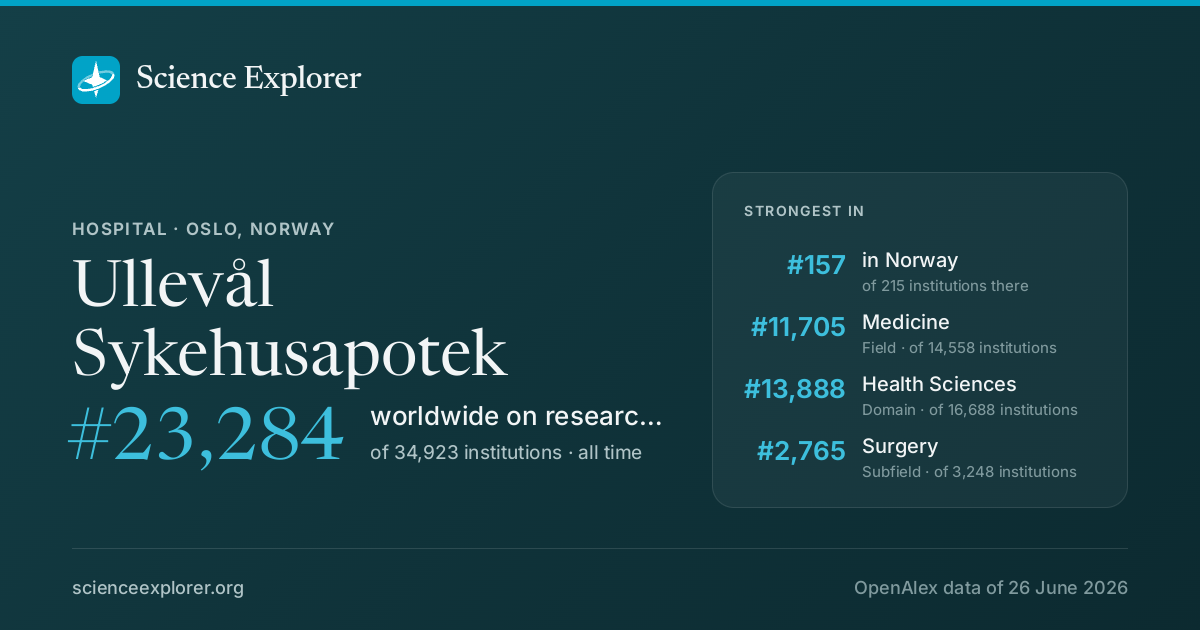
Ullevål Sykehusapotek on Science Explorer

A card with Ullevål Sykehusapotek's standing and the fields it leads in, for a post or a slide. A link to this page previews as the same card.

Download the card

1200 × 630 PNG, sized for social posts, drawn from the latest snapshot.

Badges for a website1Each links back here and updates with every snapshot

Research measures only: rankings here say nothing about teaching, admissions or student experience. Comparable institutions and collaboration partners have tabs of their own, above.

Discussion

Ask a question or share a note about Ullevål Sykehusapotek. Posts are plain text and can be reported.