Universitas PGRI Palembang
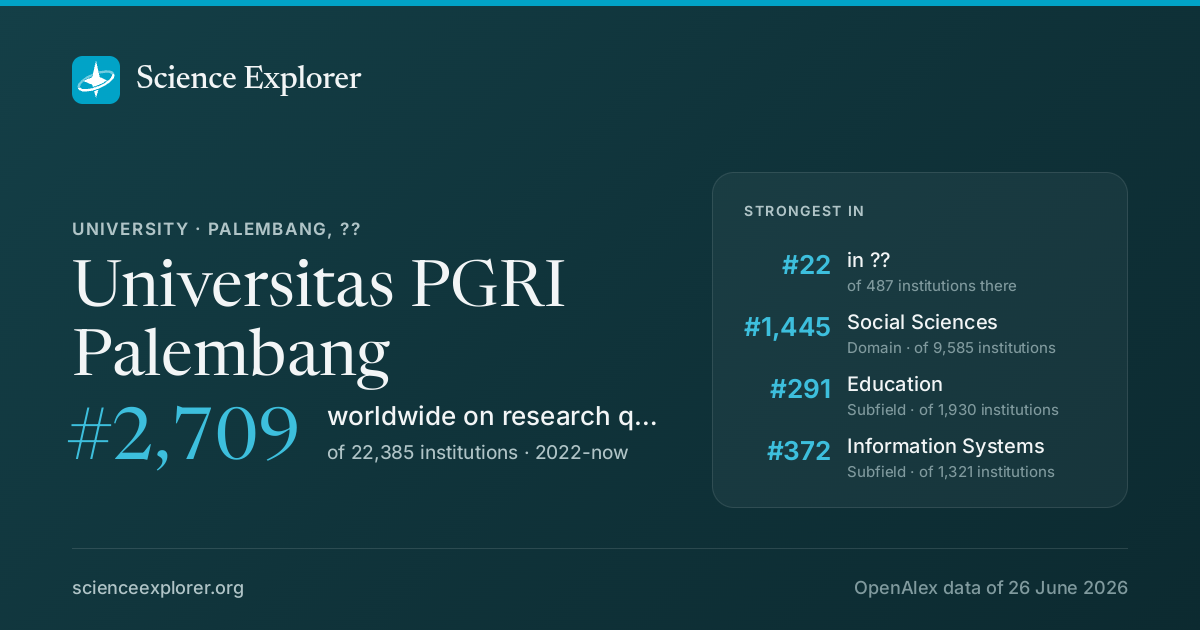
In research, Universitas PGRI Palembang stands highest in Social Sciences (#1,445 of 9,585 worldwide), Education (#291 of 1,930 worldwide) and Social Sciences (#1,335 of 5,988 worldwide), 2022-now. Relative to its size it is most specialised in Physical Therapy, Sports Therapy and Rehabilitation, Education and Applied Mathematics (Physical Therapy, Sports Therapy and Rehabilitation is 21.1× its share of world research).
- World rank, 2022-now
- #2,709 of 22,385 · #4,981 all time
- Rank in ??
- #22 of 487
- Research works
- 3.1k ▲ 53% vs 2018-21
- Citations
- 6.9k 2.2 per fractional work
- Top-10% rate
- 5.9% all institutions 10.0%
- vs its own fields
- 0.68× 1.00× is exactly expected
- Open access
- 93% world 40%
- International
- 3% world 18%
What is Universitas PGRI Palembang known for in research?
The fields where it stands highest, 2022-now, ranked among every institution above the floor in each field.
| Field | World rank | Where that sits | Top-10% rate | Works | All time |
|---|---|---|---|---|---|
| Social SciencesDomain | #1,445 of 9,585 | 5.7% | 1,154 | #2299 | |
| EducationSubfield | #291 of 1,930 | 5.5% | 790 | #420 | |
| Social SciencesField | #1,335 of 5,988 | 5.8% | 949 | #2084 | |
| Information SystemsSubfield | #372 of 1,321 | 7.1% | 257 | #773 | |
| Physical SciencesDomain | #3,173 of 10,670 | 6.3% | 420 | #5870 | |
| Computer ScienceField | #1,626 of 4,417 | 7.0% | 278 | #2752 | |
| Physical Therapy, Sports Therapy and RehabilitationSubfield | #36 of 55 | 3.2% | 68 | - | |
| Business, Management and AccountingField | #1,867 of 2,581 | 5.3% | 106 | #2605 | |
| Health ProfessionsField | #1,705 of 1,895 | 3.9% | 83 | #3070 | |
| Health SciencesDomain | #9,544 of 9,902 | 3.7% | 94 | #16112 |
Each strip is that field's whole ranked pool, with the notch where Universitas PGRI Palembang sits in it, in the colour of the band that rank falls in. The track under the rate is the rate itself: it carries no average mark, because the average differs by field (from about 6% in Dentistry to 21% in Economics).
Which of those standings moved
The same fields on both windows: where it stood over the whole record, and where it stands in 2022-now. The distance is the story, and it is the one thing the two rank columns above cannot show.
- Social Sciences#2,299 #1,445
- Education#420 #291
- Social Sciences#2,084 #1,335
- Information Systems#773 #372
- Physical Sciences#5,870 #3,173
- Computer Science#2,752 #1,626
- Business, Management and Accounting#2,605 #1,867
- Health Professions#3,070 #1,705
- Health Sciences#16,112 #9,544
A dot further right is a better standing. Fields it was not ranked in over the whole record are left out.
Which fields of science does Universitas PGRI Palembang work in?
In 2022-now, 68% of research at Universitas PGRI Palembang is in Social Sciences, 24% in Physical Sciences. Its largest fields are Social Sciences (56%), Computer Science (15%), Business, Management and Accounting (6%). It does 2.7× the world's share of Social Sciences.
Each ring splits the one inside it: the four domains of science, their fields, their subfields. Size is fractional works in 2022-now. Every slice is a page; the interactive view zooms down to single topics and colours each by how much more of it this institution does than the world.
Its 4 domains and 24 fields, with their numbers
- Social Sciences1,25167.9%
- Social Sciences1,02455.5%
- Business, Management and Accounting1156.2%
- Psychology583.1%
- Arts and Humanities372.0%
- Economics, Econometrics and Finance120.7%
- Decision Sciences50.3%
- Physical Sciences43423.5%
- Computer Science28515.5%
- Mathematics613.3%
- Environmental Science412.2%
- Engineering392.1%
- Materials Science50.3%
- Chemistry20.1%
- Energy10.0%
- Physics and Astronomy00.0%
- Chemical Engineering00.0%
- Earth and Planetary Sciences00.0%
- Health Sciences995.4%
- Health Professions874.7%
- Medicine100.5%
- Nursing20.1%
- Life Sciences593.2%
What does Universitas PGRI Palembang specialise in?
Where its research is concentrated relative to its size: Physical Therapy, Sports Therapy and Rehabilitation takes 21.1× the share of its output that it takes of world research.
- Physical Therapy, Sports Therapy and RehabilitationSubfield · 71.1 works21×
- EducationSubfield · 855.5 works15×
- Applied MathematicsSubfield · 59.9 works11×
- Human Factors and ErgonomicsSubfield · 20.7 works10×
- Information SystemsSubfield · 263.7 works8.1×
- Cultural StudiesSubfield · 47.4 works6.3×
- Developmental and Educational PsychologySubfield · 48.9 works5.8×
Location quotient, a volume reading rather than an impact one. It surfaces small, lopsided specialities.
Field profile
Location quotient across every field it publishes in: outside the ring is more than an institution of this size would be expected to publish, inside it is less.
Rings at 0.5×, 1× and 2×. Widest outward: Social Sciences, 4.4×. Every wedge is a field page.
All 22 fields, with their numbers
- Social Sciences4.39×1,024 works
- Mathematics2.81×61 works
- Computer Science1.99×285 works
- Business, Management and Accounting1.93×115 works
- Health Professions1.80×87 works
- Psychology1.03×58 works
- Arts and Humanities0.70×37 works
- Agricultural and Biological Sciences0.63×55 works
- Environmental Science0.45×41 works
- Economics, Econometrics and Finance0.31×12 works
- Decision Sciences0.30×5 works
- Nursing0.25×2 works
- Engineering0.14×39 works
- Pharmacology, Toxicology and Pharmaceutics0.10×1 works
- Materials Science0.07×5 works
- Chemistry0.06×2 works
- Energy0.03×1 works
- Medicine0.03×10 works
- Biochemistry, Genetics and Molecular Biology0.02×2 works
- Neuroscience0.02×1 works
- Chemical Engineering0.02×0 works
- Immunology and Microbiology0.01×0 works
- Social Sciences 4.4×
- Mathematics 2.8×
- Computer Science 2.0×
- Business, Management and Accounting 1.9×
- Health Professions 1.8×
- Psychology 1.0×
- Arts and Humanities 0.7×
- Agricultural and Biological Sciences 0.6×
- Environmental Science 0.5×
- Economics, Econometrics and Finance 0.3×
- Decision Sciences 0.3×
- Nursing 0.2×
- Engineering 0.1×
- Pharmacology, Toxicology and Pharmaceutics 0.1×
- Materials Science 0.1×
- Chemistry 0.1×
- Energy 0.0×
- Medicine 0.0×
- Biochemistry, Genetics and Molecular Biology 0.0×
- Neuroscience 0.0×
- Chemical Engineering 0.0×
- Immunology and Microbiology 0.0×
Who are the top researchers at Universitas PGRI Palembang?
Ranked on the quality score, Linda Lia, Destiniar Destiniar and Artanti Puspita Sari lead among researchers whose main affiliation is Universitas PGRI Palembang.
- 1 Linda Lia #2,161,786 worldwide 142 citations · 34 works
- 2 Destiniar Destiniar #2,527,753 worldwide 327 citations · 83 works
- 3 Artanti Puspita Sari #2,674,219 worldwide 213 citations · 43 works
- 4 Asnurul Isroqmi #3,295,855 worldwide 83 citations · 27 works
- 5 Happy Fitria #3,493,064 worldwide 1.6k citations · 281 works
- 6 Santi Mayasari #3,561,633 worldwide 47 citations · 29 works
- 7 Evi Rosmiyati #3,636,680 worldwide 54 citations · 32 works
- 8 Edi Harapan #3,720,371 worldwide 786 citations · 163 works
- 9 Nova Pratiwi #3,725,968 worldwide 70 citations · 38 works
- 10 Tanzimah Tanzimah #3,738,787 worldwide 95 citations · 39 works
Which keywords describe research at Universitas PGRI Palembang?
By fractional works in 2022-now, weighted toward what it does more of than the world: Local Wisdom, E-Learning, Character Education, Mobile Learning, Educational Technology, Curriculum Development, Media Literacy and Digital Learning.
- Digital Media
- Transformational Leadership
- Physical Activity
- Multicultural Education
- Physics Education
- Learning Outcomes
- Interactive Multimedia
- Character Development
- Motivation
- Merdeka Belajar
- Parental Involvement
- 21st Century Skills
- Qualitative Research
- School Literacy Movement
- Information Literacy
- Digital Literacy
- Digital Learning
- Curriculum Development
- Mobile Learning
- E-Learning
- Local Wisdom
- Character Education
- Educational Technology
- Media Literacy
- STEM Education
- Online Learning
- Reading Interest
- Teacher Performance
- Student Motivation
- Educational Policy
- Kampus Merdeka
- Teaching Strategies
- Critical Thinking Skills
- Virtual Reality
- Problem Based Learning
- Technology Integration
- Student Attitudes
- Organizational Commitment
- Islamic Education
- Inclusive Education
Size is fractional works in 2022-now in the topics tagged with each word; colour is the word's share of this institution's work against its share of the world's. The 40 words are chosen for being large and distinctive. Each links to the topic it comes from most.
All 40 words, with their numbers
- Local Wisdom302▲ 35×9 topics
- E-Learning293▲ 17×13 topics
- Character Education289▲ 33×6 topics
- Mobile Learning244▲ 39×6 topics
- Educational Technology242▲ 11×21 topics
- Curriculum Development239▲ 19×11 topics
- Media Literacy222▲ 23×5 topics
- Digital Learning218▲ 23×7 topics
- STEM Education206▲ 25×12 topics
- Digital Literacy199▲ 19×9 topics
- Online Learning196▲ 13×15 topics
- Information Literacy176▲ 38×2 topics
- Reading Interest174▲ 47×1 topic
- School Literacy Movement174▲ 47×1 topic
- Teacher Performance174▲ 67×2 topics
- Qualitative Research164▲ 10×15 topics
- Student Motivation154▲ 43×5 topics
- 21st Century Skills136▲ 26×6 topics
- Educational Policy136▲ 30×4 topics
- Parental Involvement131▲ 39×4 topics
- Kampus Merdeka123▲ 47×1 topic
- Merdeka Belajar123▲ 47×1 topic
- Teaching Strategies120▲ 23×5 topics
- Motivation119▲ 16×4 topics
- Critical Thinking Skills115▲ 36×2 topics
- Character Development113▲ 38×2 topics
- Virtual Reality108▲ 12×5 topics
- Interactive Multimedia106▲ 53×1 topic
- Problem Based Learning106▲ 59×1 topic
- Learning Outcomes105▲ 14×6 topics
- Technology Integration102▲ 17×8 topics
- Physics Education95▲ 54×1 topic
- Student Attitudes95▲ 51×1 topic
- Multicultural Education90▲ 31×4 topics
- Organizational Commitment90▲ 25×3 topics
- Physical Activity87▲ 9.7×6 topics
- Islamic Education86▲ 14×4 topics
- Transformational Leadership82▲ 26×2 topics
- Inclusive Education79▲ 12×5 topics
- Digital Media78▲ 23×2 topics
Which research topics does Universitas PGRI Palembang publish most on?
By volume in 2022-now: Educational Methods and Media Use, Educational Curriculum and Learning Methods, STEM Education and Educational Methods and Outcomes.
Area is fractional works; colour is the subfield each topic belongs to.
- 1 Educational Methods and Media Use Information Systems 174 works
- 2 Educational Curriculum and Learning Methods Education 123 works
- 3 STEM Education Education 106 works
- 4 Educational Methods and Outcomes Education 95 works
- 5 Education and Character Development Education 78 works
- 6 Online Learning Methods and Innovations Education 76 works
- 7 School Leadership and Teacher Performance Education 68 works
- 8 Sports and Physical Education Research Physical Therapy, Sports Therapy and Rehabilitation 66 works
- 9 Mathematics Education and Pedagogy Applied Mathematics 60 works
- 10 Education and Communication Studies Education 55 works
How open and international is its research?
Against the world's own shares: the tick on each track. Both are shares of its output, so they sit on one scale and can be read against each other as well as against the world.
World: 40% of research is openly available.
World: 18% is written across borders.
How has Universitas PGRI Palembang's research output changed?
Output in 2022-2025 was 53% higher than in 2018-2021.
The same series as a ribbon: one cell per year, darker for more. The line above answers how much; this answers when.
Its share of all research
Growing output can still be a shrinking share: all of science grows. This is Universitas PGRI Palembang as a percentage of every work published that year, 0.0076% in 2024.
Fractional works of Universitas PGRI Palembang over all fractional works that year. How the balance of science has shifted.
How much of it reaches the world top 10%
Year by year, against all institutions in the same year.
Of each year's output, the share that reached the world's 10% most cited for its field and year. Peak 14.0% in 2020.
Other research institutions in Palembang
- Universitas Islam Negeri Raden Fatah Palembang
- Politeknik Negeri Sriwijaya
- Universitas Multi Data Palembang
- Sekolah Tinggi Ilmu Hukum Sumpah Pemuda
Share Universitas PGRI Palembang's ranking
Badges for a website1Each links back here and updates with every snapshot

Research measures only: rankings here say nothing about teaching, admissions or student experience. Comparable institutions and collaboration partners have tabs of their own, above.
Discussion
Ask a question or share a note about Universitas PGRI Palembang. Keep it to the research: no personal attacks, advertising or links. Any reader can report a post, which collapses it for everyone until it is opened.