Van Lang University
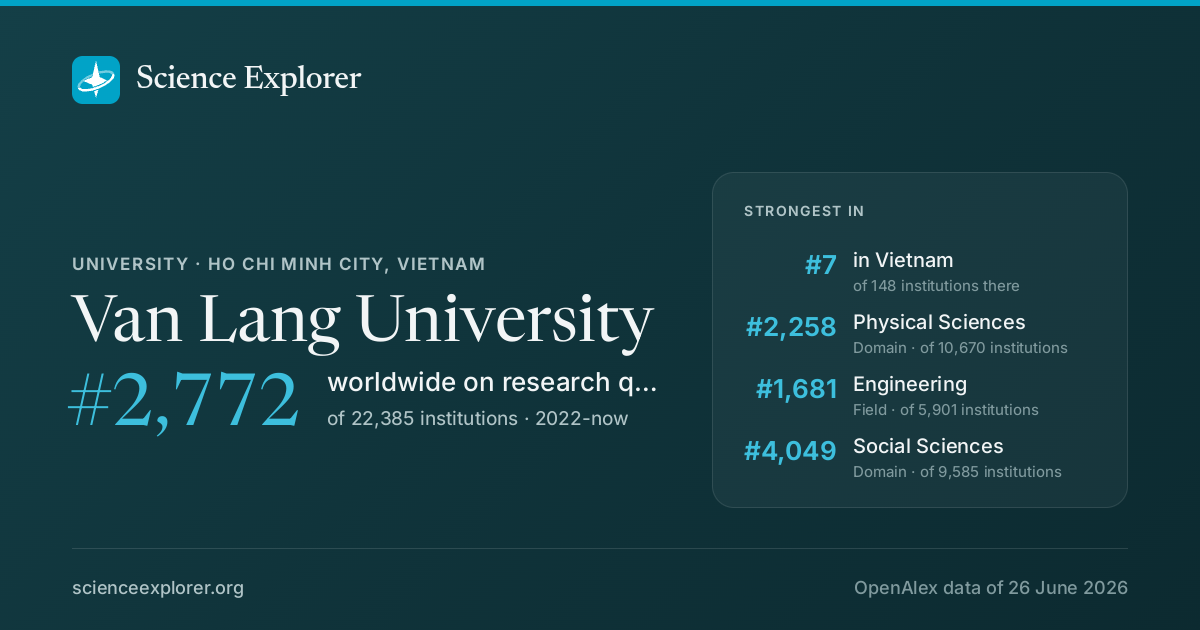
In research, Van Lang University stands highest in Physical Sciences (#2,258 of 10,670 worldwide), Engineering (#1,681 of 5,901 worldwide) and Social Sciences (#4,049 of 9,585 worldwide), 2022-now. Relative to its size it is most specialised in Language and Linguistics and Management Science and Operations Research (Language and Linguistics is 5.0× its share of world research).
- World rank, 2022-now
- #2,772 of 22,385 · #3,590 all time
- Rank in Vietnam
- #7 of 148
- Research works
- 1.8k ▲ 163% vs 2018-21
- Citations
- 13k 7.5 per fractional work
- Top-10% rate
- 14.8% all institutions 10.0%
- vs its own fields
- 1.30× 1.00× is exactly expected
- Open access
- 55% world 40%
- International
- 27% world 18%
What is Van Lang University known for in research?
The fields where it stands highest, 2022-now, ranked among every institution above the floor in each field.
| Field | World rank | Where that sits | Top-10% rate | Works | All time |
|---|---|---|---|---|---|
| Physical SciencesDomain | #2,258 of 10,670 | 15.6% | 609 | #2504 | |
| EngineeringField | #1,681 of 5,901 | 17.9% | 211 | #2974 | |
| Social SciencesDomain | #4,049 of 9,585 | 15.9% | 276 | #3593 | |
| Environmental ScienceField | #1,624 of 3,334 | 17.5% | 78 | #2346 | |
| Materials ScienceField | #1,153 of 2,276 | 7.5% | 85 | - | |
| Computer ScienceField | #2,325 of 4,417 | 16.9% | 90 | #2876 | |
| Social SciencesField | #4,600 of 5,988 | 15.3% | 97 | #3932 |
Each strip is that field's whole ranked pool, with the notch where Van Lang University sits in it, in the colour of the band that rank falls in. The track under the rate is the rate itself: it carries no average mark, because the average differs by field (from about 6% in Dentistry to 21% in Economics).
Which of those standings moved
The same fields on both windows: where it stood over the whole record, and where it stands in 2022-now. The distance is the story, and it is the one thing the two rank columns above cannot show.
- Physical Sciences#2,504 #2,258
- Engineering#2,974 #1,681
- Social Sciences#3,593 #4,049
- Environmental Science#2,346 #1,624
- Computer Science#2,876 #2,325
- Social Sciences#3,932 #4,600
A dot further right is a better standing. Fields it was not ranked in over the whole record are left out.
Which fields of science does Van Lang University work in?
In 2022-now, 62% of research at Van Lang University is in Physical Sciences, 27% in Social Sciences. Its largest fields are Engineering (21%), Social Sciences (10%), Computer Science (9%). It does 1.6× the world's share of Physical Sciences.
Each ring splits the one inside it: the four domains of science, their fields, their subfields. Size is fractional works in 2022-now. Every slice is a page; the interactive view zooms down to single topics and colours each by how much more of it this institution does than the world.
Its 4 domains and 26 fields, with their numbers
- Physical Sciences70461.6%
- Engineering24221.1%
- Computer Science1039.0%
- Environmental Science998.6%
- Materials Science978.5%
- Physics and Astronomy464.1%
- Mathematics433.7%
- Chemistry282.4%
- Energy221.9%
- Earth and Planetary Sciences171.5%
- Chemical Engineering70.6%
- Social Sciences31027.1%
- Social Sciences1109.6%
- Business, Management and Accounting564.9%
- Economics, Econometrics and Finance403.5%
- Arts and Humanities393.4%
- Psychology373.2%
- Decision Sciences302.6%
- Life Sciences665.8%
- Health Sciences635.5%
- Medicine403.5%
- Dentistry131.1%
- Health Professions90.8%
- Nursing10.1%
- Veterinary00.0%
What does Van Lang University specialise in?
Where its research is concentrated relative to its size: Language and Linguistics takes 5.0× the share of its output that it takes of world research.
- Language and LinguisticsSubfield · 24.9 works5.0×
- Management Science and Operations ResearchSubfield · 20.6 works3.6×
Location quotient, a volume reading rather than an impact one. It surfaces small, lopsided specialities.
Field profile
Location quotient across every field it publishes in: outside the ring is more than an institution of this size would be expected to publish, inside it is less.
Rings at 0.5×, 1× and 2×. Widest outward: Mathematics, 3.2×. Every wedge is a field page.
All 26 fields, with their numbers
- Mathematics3.18×43 works
- Decision Sciences2.71×30 works
- Materials Science2.44×98 works
- Dentistry2.27×13 works
- Energy2.10×22 works
- Physics and Astronomy1.82×46 works
- Chemical Engineering1.74×7 works
- Environmental Science1.74×99 works
- Economics, Econometrics and Finance1.62×40 works
- Chemistry1.54×28 works
- Business, Management and Accounting1.51×56 works
- Engineering1.41×242 works
- Arts and Humanities1.17×39 works
- Computer Science1.16×103 works
- Psychology1.05×37 works
- Earth and Planetary Sciences0.95×17 works
- Pharmacology, Toxicology and Pharmaceutics0.88×4 works
- Social Sciences0.76×110 works
- Agricultural and Biological Sciences0.63×34 works
- Biochemistry, Genetics and Molecular Biology0.36×22 works
- Immunology and Microbiology0.32×4 works
- Health Professions0.30×9 works
- Medicine0.18×40 works
- Nursing0.16×1 works
- Neuroscience0.14×3 works
- Veterinary0.09×0 works
- Mathematics 3.2×
- Decision Sciences 2.7×
- Materials Science 2.4×
- Dentistry 2.3×
- Energy 2.1×
- Physics and Astronomy 1.8×
- Chemical Engineering 1.7×
- Environmental Science 1.7×
- Economics, Econometrics and Finance 1.6×
- Chemistry 1.5×
- Business, Management and Accounting 1.5×
- Engineering 1.4×
- Arts and Humanities 1.2×
- Computer Science 1.2×
- Psychology 1.1×
- Earth and Planetary Sciences 0.9×
- Pharmacology, Toxicology and Pharmaceutics 0.9×
- Social Sciences 0.8×
- Agricultural and Biological Sciences 0.6×
- Biochemistry, Genetics and Molecular Biology 0.4×
- Immunology and Microbiology 0.3×
- Health Professions 0.3×
- Medicine 0.2×
- Nursing 0.2×
- Neuroscience 0.1×
- Veterinary 0.1×
Who are the top researchers at Van Lang University?
Ranked on the quality score, Hung Vo Thanh, Nguyen Thuy Lan Chi and Anh Ngoc Thi Do lead among researchers whose main affiliation is Van Lang University.
- 1
Hung Vo Thanh
 Vietnam · #9,563 worldwide
4k citations · 149 works
- 2
Nguyen Thuy Lan Chi
Vietnam · #131,554 worldwide
5k citations · 111 works
- 3
Anh Ngoc Thi Do
Vietnam · #199,641 worldwide
732 citations · 47 works
- 4
Pham Vu Phi Ho
Vietnam · #460,011 worldwide
700 citations · 71 works
- 5
Hieu Minh Vu
Vietnam · #612,762 worldwide
2.1k citations · 89 works
- 6
Duy-Khuong Ly
Vietnam · #924,186 worldwide
465 citations · 38 works
- 7
Hai Thanh Pham
Vietnam · #1,068,449 worldwide
759 citations · 39 works
- 8
Son H. Nguyen
Vietnam · #1,117,400 worldwide
311 citations · 19 works
- 9
Hoang Viet
Vietnam · #1,201,893 worldwide
346 citations · 52 works
- 10
Jeyaprakash Dharmaraja
Vietnam · #1,212,944 worldwide
1.3k citations · 33 works
Which keywords describe research at Van Lang University?
By fractional works in 2022-now, weighted toward what it does more of than the world: Language Teaching, Second Language Acquisition, Corrective Feedback, L2 Motivation, Higher Education, Machine Learning, Two-Dimensional Materials and Deep Learning.
- Collaborative Learning
- Fractional Calculus
- Buckling Behavior
- Finite Element Method
- Energy Consumption
- Fuzzy Mathematics
- GIS-based Evaluation
- Nonlinear Equations
- Student Engagement
- Two-Dimensional Materials
- Graphene
- E-Learning
- Corrective Feedback
- Second Language Acquisition
- Educational Technology
- Economic Growth
- Biomedical Applications
- Renewable Energy
- Sustainability
- Deep Learning
- Machine Learning
- Environmental Impact
- Language Teaching
- Nanomaterials
- Online Learning
- Higher Education
- Energy Efficiency
- Supply Chain Management
- L2 Motivation
- Nanocomposites
- Risk Assessment
- Urbanization
- Corpus Linguistics
- Semiconductor
- Electronic Structure
- Set Pair Analysis
- CO2 Emissions
- Luminescent Materials
- Solid-State Lighting
- Solar Cell Efficiency
Size is fractional works in 2022-now in the topics tagged with each word; colour is the word's share of this institution's work against its share of the world's. The 40 words are chosen for being large and distinctive. Each links to the topic it comes from most.
All 40 words, with their numbers
- Machine Learning48▲ 1.26×60 topics
- Deep Learning46▲ 1.17×62 topics
- Environmental Impact32▲ 1.67×37 topics
- Sustainability32▲ 1.16×47 topics
- Language Teaching32▲ 11×3 topics
- Renewable Energy30▲ 1.79×29 topics
- Nanomaterials28▲ 2.4×18 topics
- Biomedical Applications25▲ 1.85×28 topics
- Online Learning25▲ 2.6×11 topics
- Economic Growth24▲ 2.6×15 topics
- Higher Education24▲ 4.0×10 topics
- Educational Technology24▲ 1.79×19 topics
- Energy Efficiency22▲ 2.1×21 topics
- Second Language Acquisition22▲ 21×2 topics
- Supply Chain Management21▲ 2.0×17 topics
- Corrective Feedback20▲ 24×1 topic
- L2 Motivation20▲ 24×1 topic
- E-Learning20▲ 1.78×12 topics
- Nanocomposites19▲ 2.1×20 topics
- Graphene18▲ 2.4×8 topics
- Risk Assessment18▲ 2.4×12 topics
- Two-Dimensional Materials18▲ 7.0×4 topics
- Urbanization16▲ 3.5×9 topics
- Student Engagement15▲ 3.3×10 topics
- Corpus Linguistics15▲ 6.1×5 topics
- Nonlinear Equations14▲ 9.7×5 topics
- Semiconductor14▲ 3.8×7 topics
- GIS-based Evaluation13▲ 35×2 topics
- Electronic Structure13▲ 6.3×8 topics
- Fuzzy Mathematics13▲ 53×1 topic
- Set Pair Analysis13▲ 53×1 topic
- Energy Consumption12▲ 4.6×5 topics
- CO2 Emissions12▲ 5.7×4 topics
- Finite Element Method10▲ 9.1×4 topics
- Luminescent Materials10▲ 13×3 topics
- Buckling Behavior10▲ 12×2 topics
- Solid-State Lighting10▲ 11×2 topics
- Fractional Calculus10▲ 15×2 topics
- Solar Cell Efficiency9▲ 8.2×2 topics
- Collaborative Learning9▲ 11×2 topics
Which research topics does Van Lang University publish most on?
By volume in 2022-now: EFL/ESL Teaching and Learning, Research studies in Vietnam, Energy, Environment, Economic Growth and Multi-Criteria Decision Making.
Area is fractional works; colour is the subfield each topic belongs to.
- 1 EFL/ESL Teaching and Learning Language and Linguistics 20 works
- 2 Research studies in Vietnam Ecology 13 works
- 3 Energy, Environment, Economic Growth Economics and Econometrics 9 works
- 4 Multi-Criteria Decision Making Management Science and Operations Research 8 works
- 5 Second Language Acquisition and Learning Developmental and Educational Psychology 8 works
- 6 Luminescence Properties of Advanced Materials Materials Chemistry 7 works
- 7 Fractional Differential Equations Solutions Modeling and Simulation 7 works
- 8 Vietnamese History and Culture Studies Sociology and Political Science 7 works
- 9 Advanced Photocatalysis Techniques Renewable Energy, Sustainability and the Environment 7 works
- 10 2D Materials and Applications Materials Chemistry 7 works
How open and international is its research?
Against the world's own shares: the tick on each track. Both are shares of its output, so they sit on one scale and can be read against each other as well as against the world.
World: 40% of research is openly available.
World: 18% is written across borders.
How has Van Lang University's research output changed?
Output in 2022-2025 was 163% higher than in 2018-2021.
The same series as a ribbon: one cell per year, darker for more. The line above answers how much; this answers when.
Its share of all research
Growing output can still be a shrinking share: all of science grows. This is Van Lang University as a percentage of every work published that year, 0.0045% in 2024.
Fractional works of Van Lang University over all fractional works that year. How the balance of science has shifted.
How much of it reaches the world top 10%
Year by year, against all institutions in the same year.
Of each year's output, the share that reached the world's 10% most cited for its field and year. Peak 17.3% in 2022.
Other research institutions in Ho Chi Minh City
- Vietnam National University Ho Chi Minh City
- Ton Duc Thang University
- University of Economics Ho Chi Minh City
- Ho Chi Minh City University of Science
- Industrial University of Ho Chi Minh City
- Ho Chi Minh City University of Technology and Engineering
- University of Medicine and Pharmacy at Ho Chi Minh City
- Trường ĐH Nguyễn Tất Thành
Share Van Lang University's ranking
Badges for a website1Each links back here and updates with every snapshot

Research measures only: rankings here say nothing about teaching, admissions or student experience. Comparable institutions and collaboration partners have tabs of their own, above.
Discussion
Ask a question or share a note about Van Lang University. Posts are plain text and can be reported.