Witten/Herdecke University
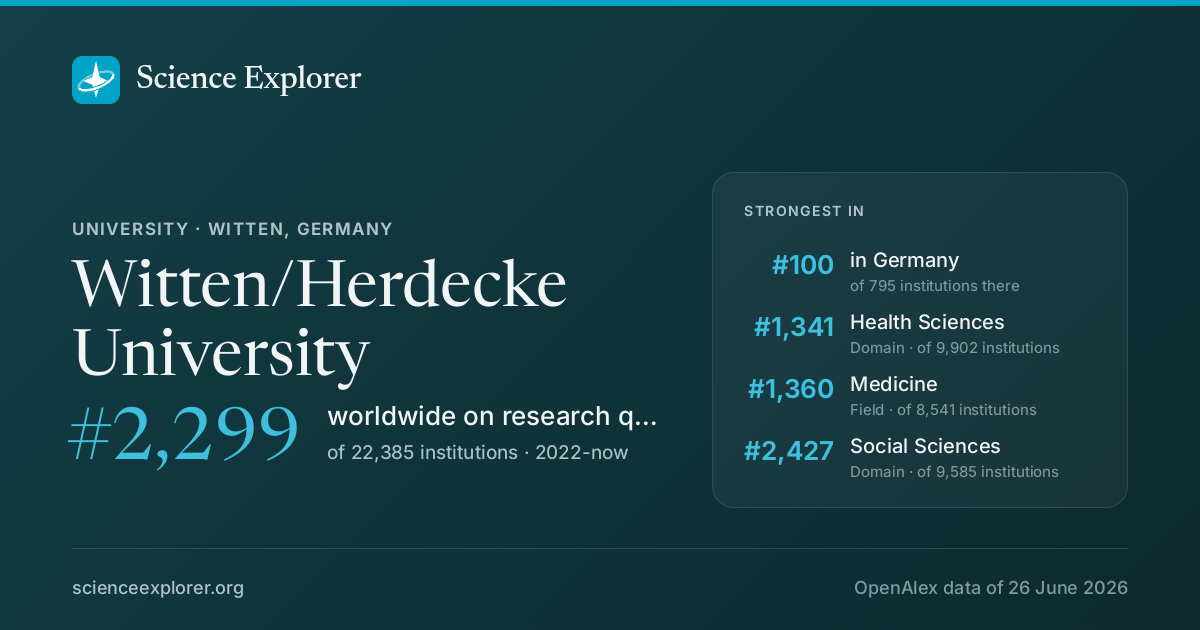
In research, Witten/Herdecke University stands highest in Health Sciences (#1,341 of 9,902 worldwide), Medicine (#1,360 of 8,541 worldwide) and Social Sciences (#2,427 of 9,585 worldwide), 2022-now. Relative to its size it is most specialised in Rehabilitation, Complementary and alternative medicine and Critical Care and Intensive Care Medicine (Rehabilitation is 24.4× its share of world research).
- World rank, 2022-now
- #2,299 of 22,385 · #2,553 all time
- Rank in Germany
- #100 of 795
- Research works
- 9.3k ▲ 12% vs 2018-21
- Citations
- 142k 15.3 per fractional work
- Top-10% rate
- 10.0% all institutions 10.0%
- vs its own fields
- 1.17× 1.00× is exactly expected
- Open access
- 33% world 40%
- International
- 15% world 18%
What is Witten/Herdecke University known for in research?
The fields where it stands highest, 2022-now, ranked among every institution above the floor in each field.
| Field | World rank | Where that sits | Top-10% rate | Works | All time |
|---|---|---|---|---|---|
| Health SciencesDomain | #1,341 of 9,902 | 10.4% | 1,050 | #1221 | |
| MedicineField | #1,360 of 8,541 | 10.2% | 804 | #1200 | |
| Social SciencesDomain | #2,427 of 9,585 | 13.0% | 562 | #2925 | |
| Health ProfessionsField | #496 of 1,895 | 11.3% | 211 | #815 | |
| SurgerySubfield | #619 of 1,532 | 12.1% | 129 | #862 | |
| Social SciencesField | #2,816 of 5,988 | 12.9% | 183 | #3398 | |
| PsychologyField | #1,019 of 2,121 | 9.9% | 168 | #1488 | |
| General Health ProfessionsSubfield | #462 of 944 | 10.9% | 155 | #754 | |
| Business, Management and AccountingField | #1,514 of 2,581 | 17.5% | 107 | #1539 | |
| Life SciencesDomain | #3,808 of 6,403 | 11.0% | 165 | #3960 |
Each strip is that field's whole ranked pool, with the notch where Witten/Herdecke University sits in it, in the colour of the band that rank falls in. The track under the rate is the rate itself: it carries no average mark, because the average differs by field (from about 6% in Dentistry to 21% in Economics).
Which of those standings moved
The same fields on both windows: where it stood over the whole record, and where it stands in 2022-now. The distance is the story, and it is the one thing the two rank columns above cannot show.
- Health Sciences#1,221 #1,341
- Medicine#1,200 #1,360
- Social Sciences#2,925 #2,427
- Health Professions#815 #496
- Surgery#862 #619
- Social Sciences#3,398 #2,816
- Psychology#1,488 #1,019
- General Health Professions#754 #462
- Business, Management and Accounting#1,539 #1,514
- Life Sciences#3,960 #3,808
A dot further right is a better standing. Fields it was not ranked in over the whole record are left out.
Which fields of science does Witten/Herdecke University work in?
In 2022-now, 63% of research at Witten/Herdecke University is in Health Sciences, 23% in Social Sciences. Its largest fields are Medicine (51%), Health Professions (10%), Social Sciences (8%). It does 2.7× the world's share of Health Sciences.
Each ring splits the one inside it: the four domains of science, their fields, their subfields. Size is fractional works in 2022-now. Every slice is a page; the interactive view zooms down to single topics and colours each by how much more of it this institution does than the world.
Its 4 domains and 25 fields, with their numbers
- Health Sciences1,70862.5%
- Medicine1,38650.7%
- Health Professions27510.0%
- Dentistry301.1%
- Nursing160.6%
- Veterinary20.1%
- Social Sciences64023.4%
- Social Sciences2127.7%
- Psychology1987.2%
- Business, Management and Accounting1154.2%
- Arts and Humanities552.0%
- Economics, Econometrics and Finance431.6%
- Decision Sciences170.6%
- Life Sciences2689.8%
- Physical Sciences1164.2%
- Environmental Science341.2%
- Computer Science321.2%
- Engineering311.1%
- Mathematics80.3%
- Materials Science40.1%
- Chemistry30.1%
- Physics and Astronomy20.1%
- Energy10.0%
- Earth and Planetary Sciences00.0%
What does Witten/Herdecke University specialise in?
Where its research is concentrated relative to its size: Rehabilitation takes 24.4× the share of its output that it takes of world research.
- RehabilitationSubfield · 136.5 works24×
- Complementary and alternative medicineSubfield · 96.6 works12×
- Critical Care and Intensive Care MedicineSubfield · 25.1 works6.2×
- PhysiologySubfield · 133.0 works5.6×
- Physical Therapy, Sports Therapy and RehabilitationSubfield · 27.4 works5.5×
Location quotient, a volume reading rather than an impact one. It surfaces small, lopsided specialities.
Field profile
Location quotient across every field it publishes in: outside the ring is more than an institution of this size would be expected to publish, inside it is less.
Rings at 0.5×, 1× and 2×. Widest outward: Health Professions, 3.8×. Every wedge is a field page.
All 25 fields, with their numbers
- Health Professions3.81×274 works
- Medicine2.64×1,386 works
- Psychology2.38×198 works
- Dentistry2.29×30 works
- Neuroscience1.33×59 works
- Business, Management and Accounting1.30×115 works
- Nursing1.18×16 works
- Biochemistry, Genetics and Molecular Biology1.13×165 works
- Immunology and Microbiology0.84×23 works
- Economics, Econometrics and Finance0.74×43 works
- Arts and Humanities0.70×55 works
- Decision Sciences0.66×17 works
- Social Sciences0.61×212 works
- Pharmacology, Toxicology and Pharmaceutics0.53×5 works
- Veterinary0.53×2 works
- Environmental Science0.25×34 works
- Mathematics0.24×8 works
- Computer Science0.15×32 works
- Agricultural and Biological Sciences0.12×16 works
- Engineering0.08×31 works
- Chemistry0.06×3 works
- Energy0.04×1 works
- Materials Science0.04×4 works
- Physics and Astronomy0.04×2 works
- Earth and Planetary Sciences0.01×0 works
- Health Professions 3.8×
- Medicine 2.6×
- Psychology 2.4×
- Dentistry 2.3×
- Neuroscience 1.3×
- Business, Management and Accounting 1.3×
- Nursing 1.2×
- Biochemistry, Genetics and Molecular Biology 1.1×
- Immunology and Microbiology 0.8×
- Economics, Econometrics and Finance 0.7×
- Arts and Humanities 0.7×
- Decision Sciences 0.7×
- Social Sciences 0.6×
- Pharmacology, Toxicology and Pharmaceutics 0.5×
- Veterinary 0.5×
- Environmental Science 0.2×
- Mathematics 0.2×
- Computer Science 0.1×
- Agricultural and Biological Sciences 0.1×
- Engineering 0.1×
- Chemistry 0.1×
- Energy 0.0×
- Materials Science 0.0×
- Physics and Astronomy 0.0×
- Earth and Planetary Sciences 0.0×
Who are the top researchers at Witten/Herdecke University?
Ranked on the quality score, Kevin M. Rostasy, Marc Maegele and Tobias Esch lead among researchers whose main affiliation is Witten/Herdecke University.
- 1
Kevin M. Rostasy
 Germany · #92,280 worldwide
23k citations · 396 works
- 2
Marc Maegele
Germany · #93,896 worldwide
25k citations · 471 works
- 3
Tobias Esch
Germany · #160,712 worldwide
19k citations · 405 works
- 4
Nadine Schäfer
Germany · #188,307 worldwide
6.6k citations · 101 works
- 5
Thomas Clauß
Germany · #283,225 worldwide
7.2k citations · 142 works
- 6
Jan Philipp Röer
Germany · #335,658 worldwide
3.5k citations · 186 works
- 7
Marcel Hülsbeck
Germany · #337,086 worldwide
1.1k citations · 83 works
- 8
Thomas Reinehr
Germany · #344,435 worldwide
23k citations · 486 works
- 9
Anna Füting
Germany · #395,856 worldwide
2.3k citations · 57 works
- 10
Nils‐Christian Bormann
Germany · #439,352 worldwide
2k citations · 62 works
Which keywords describe research at Witten/Herdecke University?
By fractional works in 2022-now, weighted toward what it does more of than the world: Public Health, Reactive Oxygen Species, Muscle Damage, Immune Function, Chronic Diseases, Exercise-Induced Oxidative Stress, Muscle-Derived Interleukin-6 and Physical Activity.
- Elderly Care
- Primary Care
- Germany
- Data Collection
- Athletes
- Sudden Death
- Epidemiological Study
- Atrial Fibrillation
- Genetic Mutations
- Intervention Strategies
- Health Benefits
- Cardiorespiratory Fitness
- High-Intensity Interval Training
- Exercise
- Physical Activity
- Exercise-Induced Oxidative Stress
- Immune Function
- Quality of Life
- Cardiovascular Disease
- Public Health
- Epidemiology
- Mental Health
- Reactive Oxygen Species
- Muscle Damage
- Chronic Diseases
- Muscle-Derived Interleukin-6
- Inflammation
- Heart Failure
- Vascular Function
- Exercise Capacity
- Physical Fitness
- Sedentary Behavior
- Healthcare Utilization
- Social Capital
- Cardiac Remodeling
- Arrhythmogenic Right Ventricular Cardiomyopathy
- Well-being
- Socioeconomic Status
- Health Surveys
- Rehabilitation
Size is fractional works in 2022-now in the topics tagged with each word; colour is the word's share of this institution's work against its share of the world's. The 40 words are chosen for being large and distinctive. Each links to the topic it comes from most.
All 40 words, with their numbers
- Epidemiology199▲ 1.83×122 topics
- Public Health184▲ 4.6×51 topics
- Mental Health141▲ 3.6×35 topics
- Cardiovascular Disease139▲ 4.5×38 topics
- Reactive Oxygen Species130▲ 11×13 topics
- Quality of Life126▲ 3.2×52 topics
- Muscle Damage125▲ 105×2 topics
- Immune Function124▲ 60×3 topics
- Chronic Diseases123▲ 18×8 topics
- Exercise-Induced Oxidative Stress122▲ 152×1 topic
- Muscle-Derived Interleukin-6122▲ 152×1 topic
- Physical Activity110▲ 8.3×12 topics
- Inflammation102▲ 1.75×81 topics
- Exercise93▲ 28×3 topics
- Heart Failure92▲ 7.6×14 topics
- High-Intensity Interval Training79▲ 27×2 topics
- Vascular Function78▲ 28×3 topics
- Cardiorespiratory Fitness76▲ 63×1 topic
- Exercise Capacity76▲ 63×1 topic
- Health Benefits75▲ 8.3×8 topics
- Physical Fitness72▲ 18×3 topics
- Intervention Strategies71▲ 58×1 topic
- Sedentary Behavior71▲ 58×1 topic
- Genetic Mutations65▲ 5.5×22 topics
- Healthcare Utilization60▲ 27×3 topics
- Atrial Fibrillation57▲ 21×2 topics
- Social Capital55▲ 3.9×13 topics
- Epidemiological Study51▲ 27×4 topics
- Cardiac Remodeling50▲ 40×2 topics
- Sudden Death50▲ 43×2 topics
- Arrhythmogenic Right Ventricular Cardiomyopathy50▲ 68×1 topic
- Athletes50▲ 68×1 topic
- Well-being50▲ 4.7×10 topics
- Data Collection49▲ 64×3 topics
- Socioeconomic Status49▲ 35×2 topics
- Germany48▲ 94×1 topic
- Health Surveys48▲ 94×1 topic
- Primary Care48▲ 4.7×14 topics
- Rehabilitation48▲ 4.4×12 topics
- Elderly Care39▲ 9.2×6 topics
Which research topics does Witten/Herdecke University publish most on?
By volume in 2022-now: Exercise and Physiological Responses, Cardiovascular and exercise physiology, Physical Activity and Health and Cardiovascular Effects of Exercise.
Area is fractional works; colour is the subfield each topic belongs to.
- 1 Exercise and Physiological Responses Rehabilitation 122 works
- 2 Cardiovascular and exercise physiology Complementary and alternative medicine 76 works
- 3 Physical Activity and Health Physiology 71 works
- 4 Cardiovascular Effects of Exercise Cardiology and Cardiovascular Medicine 50 works
- 5 Health and Medical Studies General Health Professions 48 works
- 6 Family Business Performance and Succession Organizational Behavior and Human Resource Management 27 works
- 7 Genetics and Physical Performance Genetics 21 works
- 8 Social and Demographic Issues in Germany General Health Professions 17 works
- 9 Palliative Care and End-of-Life Issues Public Health, Environmental and Occupational Health 17 works
- 10 Muscle metabolism and nutrition Cell Biology 17 works
How open and international is its research?
Against the world's own shares: the tick on each track. Both are shares of its output, so they sit on one scale and can be read against each other as well as against the world.
World: 40% of research is openly available.
World: 18% is written across borders.
How has Witten/Herdecke University's research output changed?
Output in 2022-2025 was 12% higher than in 2018-2021.
The same series as a ribbon: one cell per year, darker for more. The line above answers how much; this answers when.
Its share of all research
Growing output can still be a shrinking share: all of science grows. This is Witten/Herdecke University as a percentage of every work published that year, 0.0089% in 2024.
Fractional works of Witten/Herdecke University over all fractional works that year. How the balance of science has shifted.
How much of it reaches the world top 10%
Year by year, against all institutions in the same year.
Of each year's output, the share that reached the world's 10% most cited for its field and year. Peak 14.7% in 2013.
Other research institutions in Witten
- Marien Hospital Witten
- Schmolz Bickenbach (Germany)
- Bitop (Germany)
- Dr. Ausbüttel (Germany)
- DermaTronnier
Share Witten/Herdecke University's ranking
Badges for a website1Each links back here and updates with every snapshot

Research measures only: rankings here say nothing about teaching, admissions or student experience. Comparable institutions and collaboration partners have tabs of their own, above.
Discussion
Ask a question or share a note about Witten/Herdecke University. Posts are plain text and can be reported.