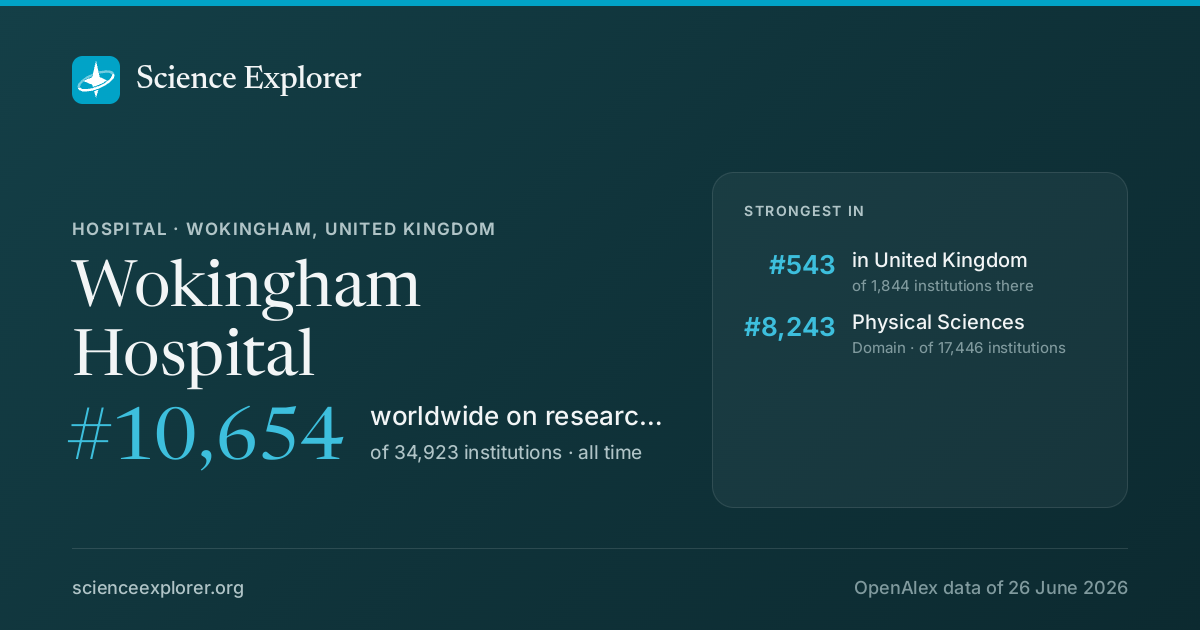
World rank, all time #10,654
of 34,923
Rank in United Kingdom #543
of 1,844 Research works 532
▲ 36% vs 2018-21
Citations 7.5k 14.2 per fractional work
Top-10% rate 8.6%
all institutions 10.0%
vs its own fields 0.98×
1.00× is exactly expected
Open access 10%
world 40%
International 12%
world 18%
What is Wokingham Hospital known for in research?
The fields where it stands highest, over all time, ranked among every institution above the floor in each field.
Field World rank Where that sits Top-10% rate Works Domain #8,243 of 17,446 7.6% 291
Which fields of science does Wokingham Hospital work in?
In all years, 55% of research at Wokingham Hospital is in Physical Sciences , 16% in Health Sciences . Its largest fields are Engineering (15%), Medicine (13%), Chemistry (8%). It does 1.3× the world's share of Physical Sciences.
Physical Sciences: 291 fractional works · 54.8% of its work Engineering: 82 fractional works · 15.3% of its work Mechanical Engineering: 13 fractional works · 2.5% of its work Electrical and Electronic Engineering: 13 fractional works · 2.4% of its work Mechanics of Materials: 11 fractional works · 2.2% of its work Civil and Structural Engineering: 7 fractional works · 1.4% of its work Computational Mechanics: 7 fractional works · 1.4% of its work Ocean Engineering: 5 fractional works · 0.9% of its work Biomedical Engineering: 5 fractional works · 0.9% of its work Building and Construction: 4 fractional works · 0.8% of its work Industrial and Manufacturing Engineering: 4 fractional works · 0.8% of its work Control and Systems Engineering: 3 fractional works · 0.6% of its work Aerospace Engineering: 2 fractional works · 0.5% of its work Automotive Engineering: 2 fractional works · 0.4% of its work Safety, Risk, Reliability and Quality: 2 fractional works · 0.3% of its work Media Technology: 1 fractional works · 0.2% of its work Chemistry: 44 fractional works · 8.4% of its work Organic Chemistry: 30 fractional works · 5.6% of its work Physical and Theoretical Chemistry: 9 fractional works · 1.6% of its work Spectroscopy: 5 fractional works · 0.9% of its work Smaller subfields together: 1 fractional works · 0.3% of its work Environmental Science: 40 fractional works · 7.5% of its work Water Science and Technology: 9 fractional works · 1.6% of its work Management, Monitoring, Policy and Law: 7 fractional works · 1.3% of its work Global and Planetary Change: 7 fractional works · 1.3% of its work Environmental Chemistry: 5 fractional works · 1.0% of its work Ecology: 5 fractional works · 0.9% of its work Pollution: 4 fractional works · 0.7% of its work Environmental Engineering: 2 fractional works · 0.4% of its work Smaller subfields together: 2 fractional works · 0.4% of its work Computer Science: 39 fractional works · 7.2% of its work Artificial Intelligence: 9 fractional works · 1.7% of its work Computer Networks and Communications: 6 fractional works · 1.1% of its work Hardware and Architecture: 5 fractional works · 1.0% of its work Computer Science Applications: 4 fractional works · 0.8% of its work Information Systems: 4 fractional works · 0.8% of its work Computational Theory and Mathematics: 4 fractional works · 0.8% of its work Computer Vision and Pattern Recognition: 3 fractional works · 0.5% of its work Computer Graphics and Computer-Aided Design: 1 fractional works · 0.2% of its work Signal Processing: 1 fractional works · 0.2% of its work Smaller subfields together: 1 fractional works · 0.2% of its work Materials Science: 37 fractional works · 7.0% of its work Materials Chemistry: 20 fractional works · 3.8% of its work Polymers and Plastics: 6 fractional works · 1.2% of its work Biomaterials: 5 fractional works · 0.9% of its work Surfaces, Coatings and Films: 3 fractional works · 0.6% of its work Electronic, Optical and Magnetic Materials: 1 fractional works · 0.3% of its work General Materials Science: 1 fractional works · 0.2% of its work Smaller subfields together: 0 fractional works · 0.1% of its work Physics and Astronomy: 16 fractional works · 3.0% of its work Atomic and Molecular Physics, and Optics: 5 fractional works · 1.0% of its work Statistical and Nonlinear Physics: 5 fractional works · 0.9% of its work Astronomy and Astrophysics: 4 fractional works · 0.7% of its work Smaller subfields together: 2 fractional works · 0.4% of its work Earth and Planetary Sciences: 12 fractional works · 2.3% of its work Atmospheric Science: 5 fractional works · 1.0% of its work Earth-Surface Processes: 1 fractional works · 0.2% of its work Geochemistry and Petrology: 1 fractional works · 0.2% of its work Geology: 1 fractional works · 0.2% of its work Oceanography: 1 fractional works · 0.2% of its work Smaller subfields together: 2 fractional works · 0.4% of its work Chemical Engineering: 11 fractional works · 2.1% of its work Fluid Flow and Transfer Processes: 10 fractional works · 1.9% of its work Smaller subfields together: 1 fractional works · 0.2% of its work Mathematics: 8 fractional works · 1.5% of its work Statistics and Probability: 4 fractional works · 0.7% of its work Theoretical Computer Science: 2 fractional works · 0.3% of its work Mathematical Physics: 1 fractional works · 0.3% of its work Smaller subfields together: 1 fractional works · 0.2% of its work Energy: 2 fractional works · 0.5% of its work Renewable Energy, Sustainability and the Environment: 2 fractional works · 0.5% of its work Health Sciences: 84 fractional works · 15.8% of its work Medicine: 67 fractional works · 12.5% of its work Public Health, Environmental and Occupational Health: 8 fractional works · 1.5% of its work Surgery: 7 fractional works · 1.3% of its work Physiology: 4 fractional works · 0.8% of its work Epidemiology: 4 fractional works · 0.7% of its work Dermatology: 4 fractional works · 0.7% of its work Pediatrics, Perinatology and Child Health: 4 fractional works · 0.7% of its work Psychiatry and Mental health: 3 fractional works · 0.6% of its work Pharmacology: 3 fractional works · 0.6% of its work Pulmonary and Respiratory Medicine: 3 fractional works · 0.6% of its work Rheumatology: 3 fractional works · 0.6% of its work Endocrinology, Diabetes and Metabolism: 2 fractional works · 0.4% of its work Infectious Diseases: 2 fractional works · 0.4% of its work Reproductive Medicine: 2 fractional works · 0.4% of its work Neurology: 2 fractional works · 0.4% of its work Rehabilitation: 2 fractional works · 0.3% of its work Oncology: 2 fractional works · 0.3% of its work Pathology and Forensic Medicine: 2 fractional works · 0.3% of its work Ophthalmology: 1 fractional works · 0.2% of its work Smaller subfields together: 7 fractional works · 1.4% of its work Health Professions: 14 fractional works · 2.6% of its work General Health Professions: 5 fractional works · 1.0% of its work Pharmacy: 3 fractional works · 0.5% of its work Occupational Therapy: 2 fractional works · 0.4% of its work Smaller subfields together: 4 fractional works · 0.7% of its work Dentistry: 1 fractional works · 0.3% of its work Nursing: 1 fractional works · 0.2% of its work Veterinary: 1 fractional works · 0.1% of its work Social Sciences: 84 fractional works · 15.7% of its work Social Sciences: 27 fractional works · 5.1% of its work Sociology and Political Science: 5 fractional works · 1.0% of its work Political Science and International Relations: 5 fractional works · 1.0% of its work Education: 5 fractional works · 0.9% of its work Anthropology: 4 fractional works · 0.7% of its work Transportation: 2 fractional works · 0.4% of its work Safety Research: 2 fractional works · 0.3% of its work Geography, Planning and Development: 1 fractional works · 0.3% of its work Smaller subfields together: 3 fractional works · 0.7% of its work Psychology: 22 fractional works · 4.2% of its work Clinical Psychology: 11 fractional works · 2.1% of its work Developmental and Educational Psychology: 4 fractional works · 0.8% of its work Social Psychology: 4 fractional works · 0.8% of its work Experimental and Cognitive Psychology: 1 fractional works · 0.3% of its work Smaller subfields together: 1 fractional works · 0.3% of its work Arts and Humanities: 18 fractional works · 3.4% of its work Archeology: 7 fractional works · 1.3% of its work Philosophy: 2 fractional works · 0.4% of its work History and Philosophy of Science: 2 fractional works · 0.3% of its work Literature and Literary Theory: 2 fractional works · 0.3% of its work Museology: 1 fractional works · 0.3% of its work Music: 1 fractional works · 0.3% of its work History: 1 fractional works · 0.2% of its work Smaller subfields together: 2 fractional works · 0.4% of its work Economics, Econometrics and Finance: 9 fractional works · 1.7% of its work Economics and Econometrics: 8 fractional works · 1.6% of its work Smaller subfields together: 1 fractional works · 0.2% of its work Business, Management and Accounting: 4 fractional works · 0.7% of its work Marketing: 2 fractional works · 0.3% of its work Smaller subfields together: 2 fractional works · 0.4% of its work Decision Sciences: 4 fractional works · 0.7% of its work Statistics, Probability and Uncertainty: 3 fractional works · 0.5% of its work Smaller subfields together: 1 fractional works · 0.1% of its work Life Sciences: 73 fractional works · 13.7% of its work Biochemistry, Genetics and Molecular Biology: 26 fractional works · 4.8% of its work Molecular Biology: 14 fractional works · 2.6% of its work Genetics: 4 fractional works · 0.8% of its work Cell Biology: 2 fractional works · 0.3% of its work Physiology: 2 fractional works · 0.3% of its work Endocrinology: 1 fractional works · 0.3% of its work Cancer Research: 1 fractional works · 0.2% of its work Molecular Medicine: 1 fractional works · 0.2% of its work Smaller subfields together: 1 fractional works · 0.2% of its work Agricultural and Biological Sciences: 23 fractional works · 4.2% of its work Food Science: 10 fractional works · 1.8% of its work Plant Science: 8 fractional works · 1.5% of its work Animal Science and Zoology: 2 fractional works · 0.4% of its work Insect Science: 1 fractional works · 0.2% of its work Smaller subfields together: 1 fractional works · 0.3% of its work Neuroscience: 11 fractional works · 2.0% of its work Cellular and Molecular Neuroscience: 6 fractional works · 1.2% of its work Cognitive Neuroscience: 3 fractional works · 0.5% of its work Neurology: 1 fractional works · 0.3% of its work Smaller subfields together: 0 fractional works · 0.1% of its work Immunology and Microbiology: 9 fractional works · 1.7% of its work Parasitology: 6 fractional works · 1.0% of its work Immunology: 3 fractional works · 0.6% of its work Smaller subfields together: 1 fractional works · 0.1% of its work Pharmacology, Toxicology and Pharmaceutics: 5 fractional works · 1.0% of its work Pharmaceutical Science: 3 fractional works · 0.5% of its work Pharmacology: 2 fractional works · 0.4% of its work Smaller subfields together: 0 fractional works · 0.1% of its work Physical Sciences Engineering Chemistry Environment… Computer Science Materials Science Physics a… Earth and… Chemical… Mathemati… Health Sciences Medicine Health Pr… Social Sciences Social Sc… Psychology Arts and… Economics Life Sciences Biochemis… Agricultu… Neuroscie… Immunolog… ALL ITS WORK Wokingham Hospital 532 fractional works, all years 14% 55% 16% 16%
Each ring splits the one inside it: the four domains of science, their fields, their subfields. Size is fractional works in all years. Every slice is a page; the interactive view zooms down to single topics and colours each by how much more of it this institution does than the world.
Its 4 domains and 26 fields, with their numbers 82 15.3% 44 8.4% 40 7.5% 39 7.2% 37 7.0% 16 3.0% 12 2.3% 11 2.1% 8 1.5% 2 0.5% 67 12.5% 14 2.6% 1 0.3% 1 0.2% 1 0.1% 27 5.1% 22 4.2% 18 3.4% 9 1.7% 4 0.7% 4 0.7% 26 4.8% 23 4.2% 11 2.0% 9 1.7% 5 1.0% All of science, and how each field's share has moved since 1950: the Science domain explorer
Field profile
Location quotient across every field it publishes in: outside the ring is more than an institution of this size would be expected to publish, inside it is less.
Agricultural and Biological Sciences: 0.93× its world share, 1 works Agricultural and Bio… Biochemistry, Genetics and Molecular Biology: 1.47× its world share, 2 works Biochemistry, Geneti… Immunology and Microbiology: 6.21× its world share, 1 works Immunology and Micro… Neuroscience: 3.19× its world share, 1 works Neuroscience Pharmacology, Toxicology and Pharmaceutics: 3.67× its world share, 0 works Pharmacology, Toxico… Chemistry: 0.27× its world share, 0 works Chemistry Computer Science: 0.69× its world share, 1 works Computer Science Earth and Planetary Sciences: 0.73× its world share, 0 works Earth and Planetary … Engineering: 1.06× its world share, 3 works Engineering Environmental Science: 0.61× its world share, 1 works Environmental Science Mathematics: 4.40× its world share, 1 works Mathematics Health Professions: 0.87× its world share, 0 works Health Professions Medicine: 1.49× its world share, 6 works Medicine Economics, Econometrics and Finance: 2.46× its world share, 1 works Economics, Econometr… Psychology: 0.90× its world share, 0 works Psychology Social Sciences: 0.40× its world share, 1 works Social Sciences 1× world share
Rings at 0.5×, 1× and 2×. Widest outward: Immunology and Microbiology , 6.2×. Every wedge is a field page.
All 16 fields, with their numbers Immunology and Microbiology 6.21× 1 works Mathematics 4.40× 1 works Pharmacology, Toxicology and Pharmaceutics 3.67× 0 works Neuroscience 3.19× 1 works Economics, Econometrics and Finance 2.46× 1 works Medicine 1.49× 6 works Biochemistry, Genetics and Molecular Biology 1.47× 2 works Engineering 1.06× 3 works Agricultural and Biological Sciences 0.93× 1 works Psychology 0.90× 0 works Health Professions 0.87× 0 works Earth and Planetary Sciences 0.73× 0 works Computer Science 0.69× 1 works Environmental Science 0.61× 1 works Social Sciences 0.40× 1 works Chemistry 0.27× 0 works
Who are the top researchers at Wokingham Hospital?
Ranked on the quality score, Tharwat F. Tadros , Judith C. Miller and Tharward F. Tadros lead among researchers whose main affiliation is Wokingham Hospital.
1
Tharwat F. Tadros
United Kingdom · #1,073,124 worldwide7.9k citations · 616 works
2
Judith C. Miller
United Kingdom · #1,649,757 worldwide584 citations · 37 works
3
Tharward F. Tadros
United Kingdom · #1,740,427 worldwide938 citations · 16 works
4
M.A. Plint
United Kingdom · #2,328,577 worldwide393 citations · 79 works
5
Fiona M. Greer
United Kingdom · #2,504,853 worldwide1.3k citations · 24 works
6
H. Prosser Chanter
United Kingdom · #2,657,123 worldwide5 citations · 82 works
7
P. H. Ditchfield
United Kingdom · #2,912,075 worldwide12 citations · 34 works
8
C. W. Penny
United Kingdom · #3,096,703 worldwide15 citations · 36 works
9
Colin Walls
United Kingdom · #3,124,460 worldwide67 citations · 60 works
10
Bart Levecke
United Kingdom · #4,232,449 worldwide570 citations · 34 works
All ranked researchers at Wokingham Hospital
What are the most cited papers from Wokingham Hospital?
The most cited paper from Wokingham Hospital is "Formation and stability of nano-emulsions" (Tharwat F. Tadros, P. Izquierdo, Jordi Esquena et al., 2003), with 1,990 citations. Next come "Safety and efficacy of MVA85A, a new tuberculosis vaccine, in infants previously vaccinated with BCG: a randomised, placebo-controlled phase 2b trial" (1,060) and "Application of rheology for assessment and prediction of the long-term physical stability of emulsions" (529).
Most cited papers
# Paper Released Citations 1
Formation and stability of nano-emulsions
Tharwat F. Tadros, P. Izquierdo, Jordi Esquena et al. · Advances in Colloid and Interface Science
17 Dec 2003
1,990 2
Safety and efficacy of MVA85A, a new tuberculosis vaccine, in infants previously vaccinated with BCG: a randomised, placebo-controlled phase 2b trial
Michele D. Tameris, Mark Hatherill, Bernard Landry et al. · The Lancet
Open access 4 Feb 2013
1,060 3
Application of rheology for assessment and prediction of the long-term physical stability of emulsions
Tharwat F. Tadros · Advances in Colloid and Interface Science
13 Apr 2004
529 4
Concerted peptide trimming by human ERAP1 and ERAP2 aminopeptidase complexes in the endoplasmic reticulum
Loredana Saveanu, Oliver Carroll, Viv Lindo et al. · Nature Immunology
22 May 2005
490 5
Special Issue Papers: Forecasting and control of passenger bookings
Ken Littlewood · Journal of Revenue and Pricing Management
Apr 2005
426
All 59 most cited papers, with filters and sorting
Which keywords describe research at Wokingham Hospital?
By fractional works in all years, weighted toward what it does more of than the world: Self-Assembly, Surfactants, Nanoparticles, Viscoelasticity, Micelles, Colloidal Particles, Rheology and Adsorption.
Size is fractional works in all years in the topics tagged with each word; colour is the word's share of this institution's work against its share of the world's. The 40 words are chosen for being large and distinctive. Each links to the topic it comes from most.
All 40 words, with their numbers Self-Assembly 35 ▲ 17× 7 topics Nanoparticles 31 ▲ 4.5× 19 topics Surfactants 26 ▲ 41× 4 topics Viscoelasticity 23 ▲ 37× 2 topics Epidemiology 22 ◆ 1.02× 53 topics Micelles 19 ▲ 45× 2 topics Colloidal Particles 19 ▲ 58× 3 topics Rheology 16 ▲ 14× 7 topics Adsorption 16 ▲ 13× 2 topics Emulsions 16 ▲ 54× 2 topics Climate Change 15 ◆ 1.08× 27 topics Ionic Liquids 15 ▲ 8.7× 4 topics Polymerization 13 ▲ 14× 3 topics Interfaces 13 ▲ 43× 2 topics Microemulsions 13 ▲ 59× 1 topic Wormlike micelles 13 ▲ 59× 1 topic Janus Particles 13 ▲ 110× 1 topic Pickering Emulsions 13 ▲ 110× 1 topic Biomedical Applications 12 ▲ 2.1× 12 topics Polymers 11 ▲ 24× 3 topics Molecular Modeling 10 ▲ 30× 2 topics Complex Fluids 10 ▲ 57× 1 topic Thixotropy 10 ▲ 57× 1 topic Vibration Analysis 7 ▲ 4.5× 5 topics Polymer 7 ▲ 15× 3 topics Click Chemistry 7 ▲ 17× 2 topics Block Copolymers 6 ▲ 24× 1 topic Living Radical Polymerization 6 ▲ 31× 1 topic Surface Roughness 6 ▲ 8.6× 3 topics Molecular Phylogeny 6 ▲ 5.5× 5 topics Biomimetic 6 ▲ 18× 2 topics Hydrocolloids 6 ▲ 17× 2 topics Electrostatics 5 ▲ 45× 1 topic Polyelectrolytes 5 ▲ 45× 1 topic Proteins 5 ▲ 7.9× 3 topics Friction 5 ▲ 13× 2 topics Climate Change Impacts 5 ▲ 6.5× 4 topics Nanotubes 5 ▲ 7.9× 2 topics Wastewater 5 ▲ 9.8× 2 topics Adhesion 4 ▲ 24× 1 topic
How open and international is its research?
Against the world's own shares: the tick on each track. Both are shares of its output, so they
sit on one scale and can be read against each other as well as against the world.
10% 90%
10.5% 89.5%
World: 40% of research is openly available.
12% 88%
12.2% 87.8%
World: 18% is written across borders.
How has Wokingham Hospital's research output changed?
Output in 2022-2025 was 36% higher than in 2018-2021.
still counting 1990 2000 2010 2020
The same series as a ribbon: one cell per year, darker for more. The line above answers how much ; this answers when .
Its share of all research
still counting 0.0020% 0.0040% 0.0060% Wokingham Hospital 0.000078% in 2025 1980 1990 2000 2010 2020 Fractional works of Wokingham Hospital over all fractional works that year. How the balance of science has shifted .
Share Wokingham Hospital's ranking
A card with Wokingham Hospital's standing and the fields it leads in, for a post or a slide. A link to this page previews as the same card.
Badges for a website 1 Each links back here and updates with every snapshot
 United Kingdom · #1,073,124 worldwide
7.9k citations · 616 works