Science Explorer Back to mapMap
Discussion
Nonprofit · Vigo · Spain

ANFACO-CECOPESCA

World rank, all time
#28,136
of 34,923
Rank in Spain
#554
of 646
Research works
203
▼ 3% vs 2018-21
Citations
5.1k
25.2 per fractional work
Top-10% rate
19.5%
all institutions 10.0%
vs its own fields
0.93×
1.00× is exactly expected
Open access
33%
world 40%
International
11%
world 18%

Which fields of science does ANFACO-CECOPESCA work in?

In all years, 39% of research at ANFACO-CECOPESCA is in Life Sciences, 25% in Physical Sciences. Its largest fields are Biochemistry, Genetics and Molecular Biology (22%), Environmental Science (17%), Medicine (14%). It does 2.4× the world's share of Life Sciences.

Life Sciences: 79 fractional works · 38.7% of its workBiochemistry, Genetics and Molecular Biology: 44 fractional works · 21.9% of its workMolecular Biology: 30 fractional works · 14.9% of its workGenetics: 6 fractional works · 2.7% of its workBiotechnology: 4 fractional works · 1.7% of its workEndocrinology: 3 fractional works · 1.6% of its workCancer Research: 1 fractional works · 0.3% of its workBiochemistry: 0 fractional works · 0.2% of its workCell Biology: 0 fractional works · 0.2% of its workSmaller subfields together: 0 fractional works · 0.2% of its workAgricultural and Biological Sciences: 26 fractional works · 12.9% of its workFood Science: 9 fractional works · 4.5% of its workAnimal Science and Zoology: 8 fractional works · 3.8% of its workAquatic Science: 4 fractional works · 1.8% of its workPlant Science: 3 fractional works · 1.3% of its workEcology, Evolution, Behavior and Systematics: 2 fractional works · 1.1% of its workInsect Science: 1 fractional works · 0.3% of its workSmaller subfields together: 0 fractional works · 0.2% of its workImmunology and Microbiology: 5 fractional works · 2.7% of its workImmunology: 4 fractional works · 2.1% of its workMicrobiology: 1 fractional works · 0.3% of its workSmaller subfields together: 1 fractional works · 0.3% of its workNeuroscience: 1 fractional works · 0.7% of its workCellular and Molecular Neuroscience: 0 fractional works · 0.2% of its workEndocrine and Autonomic Systems: 0 fractional works · 0.2% of its workSmaller subfields together: 0 fractional works · 0.2% of its workPharmacology, Toxicology and Pharmaceutics: 1 fractional works · 0.6% of its workToxicology: 1 fractional works · 0.3% of its workPharmacology: 0 fractional works · 0.2% of its workSmaller subfields together: 0 fractional works · 0.0% of its workPhysical Sciences: 51 fractional works · 25.2% of its workEnvironmental Science: 34 fractional works · 16.9% of its workEnvironmental Chemistry: 11 fractional works · 5.3% of its workHealth, Toxicology and Mutagenesis: 9 fractional works · 4.3% of its workEcology: 8 fractional works · 3.8% of its workNature and Landscape Conservation: 3 fractional works · 1.7% of its workGlobal and Planetary Change: 2 fractional works · 0.8% of its workPollution: 1 fractional works · 0.5% of its workSmaller subfields together: 1 fractional works · 0.4% of its workEngineering: 7 fractional works · 3.5% of its workBiomedical Engineering: 3 fractional works · 1.6% of its workOcean Engineering: 2 fractional works · 1.1% of its workMechanical Engineering: 0 fractional works · 0.2% of its workMechanics of Materials: 0 fractional works · 0.2% of its workSmaller subfields together: 1 fractional works · 0.3% of its workEnergy: 3 fractional works · 1.4% of its workRenewable Energy, Sustainability and the Environment: 3 fractional works · 1.3% of its workChemistry: 3 fractional works · 1.3% of its workOrganic Chemistry: 1 fractional works · 0.6% of its workSpectroscopy: 1 fractional works · 0.5% of its workSmaller subfields together: 0 fractional works · 0.2% of its workEarth and Planetary Sciences: 1 fractional works · 0.7% of its workOceanography: 1 fractional works · 0.4% of its workPaleontology: 1 fractional works · 0.3% of its workMaterials Science: 1 fractional works · 0.7% of its workBiomaterials: 1 fractional works · 0.4% of its workSurfaces, Coatings and Films: 0 fractional works · 0.2% of its workComputer Science: 1 fractional works · 0.5% of its workMathematics: 0 fractional works · 0.2% of its workChemical Engineering: 0 fractional works · 0.1% of its workHealth Sciences: 48 fractional works · 23.8% of its workMedicine: 29 fractional works · 14.1% of its workPublic Health, Environmental and Occupational Health: 7 fractional works · 3.2% of its workOncology: 2 fractional works · 1.1% of its workEpidemiology: 2 fractional works · 1.1% of its workPharmacology: 2 fractional works · 1.0% of its workEndocrinology, Diabetes and Metabolism: 2 fractional works · 1.0% of its workPhysiology: 2 fractional works · 1.0% of its workImmunology and Allergy: 2 fractional works · 0.9% of its workDermatology: 2 fractional works · 0.8% of its workSurgery: 2 fractional works · 0.8% of its workPulmonary and Respiratory Medicine: 1 fractional works · 0.6% of its workCardiology and Cardiovascular Medicine: 1 fractional works · 0.4% of its workPathology and Forensic Medicine: 1 fractional works · 0.4% of its workInfectious Diseases: 1 fractional works · 0.4% of its workFamily Practice: 1 fractional works · 0.3% of its workEmergency Medicine: 0 fractional works · 0.2% of its workRadiology, Nuclear Medicine and Imaging: 0 fractional works · 0.2% of its workGeriatrics and Gerontology: 0 fractional works · 0.2% of its workSmaller subfields together: 1 fractional works · 0.5% of its workHealth Professions: 18 fractional works · 8.8% of its workGeneral Health Professions: 16 fractional works · 7.7% of its workEmergency Medical Services: 1 fractional works · 0.4% of its workPharmacy: 1 fractional works · 0.4% of its workHealth Information Management: 1 fractional works · 0.3% of its workSmaller subfields together: 0 fractional works · 0.1% of its workVeterinary: 1 fractional works · 0.5% of its workSmall Animals: 1 fractional works · 0.5% of its workNursing: 1 fractional works · 0.4% of its workNutrition and Dietetics: 1 fractional works · 0.3% of its workSmaller subfields together: 0 fractional works · 0.1% of its workSocial Sciences: 25 fractional works · 12.2% of its workEconomics, Econometrics and Finance: 7 fractional works · 3.3% of its workEconomics and Econometrics: 7 fractional works · 3.3% of its workSocial Sciences: 7 fractional works · 3.2% of its workGeneral Social Sciences: 2 fractional works · 0.9% of its workSociology and Political Science: 2 fractional works · 0.7% of its workHealth: 1 fractional works · 0.5% of its workEducation: 1 fractional works · 0.5% of its workDemography: 1 fractional works · 0.3% of its workSafety Research: 0 fractional works · 0.2% of its workSmaller subfields together: 0 fractional works · 0.1% of its workBusiness, Management and Accounting: 6 fractional works · 3.1% of its workOrganizational Behavior and Human Resource Management: 6 fractional works · 3.0% of its workSmaller subfields together: 0 fractional works · 0.1% of its workArts and Humanities: 3 fractional works · 1.6% of its workHistory and Philosophy of Science: 1 fractional works · 0.3% of its workLiterature and Literary Theory: 1 fractional works · 0.3% of its workArcheology: 1 fractional works · 0.3% of its workHistory: 0 fractional works · 0.2% of its workPhilosophy: 0 fractional works · 0.2% of its workSmaller subfields together: 0 fractional works · 0.2% of its workDecision Sciences: 1 fractional works · 0.6% of its workStatistics, Probability and Uncertainty: 1 fractional works · 0.6% of its workPsychology: 1 fractional works · 0.4% of its workExperimental and Cognitive Psychology: 0 fractional works · 0.2% of its workSmaller subfields together: 0 fractional works · 0.2% of its workALL ITS WORKANFACO-CECOPESCA203fractional works, all years
Life Sciences39%Physical Sciences25%Health Sciences24%Social Sciences12%

Each ring splits the one inside it: the four domains of science, their fields, their subfields. Size is fractional works in all years. Every slice is a page; the interactive view zooms down to single topics and colours each by how much more of it this institution does than the world.

Its 4 domains and 24 fields, with their numbers
    1. Biochemistry, Genetics and Molecular Biology4421.9%
    2. Agricultural and Biological Sciences2612.9%
    3. Immunology and Microbiology52.7%
    4. Neuroscience10.7%
    5. Pharmacology, Toxicology and Pharmaceutics10.6%
    1. Environmental Science3416.9%
    2. Engineering73.5%
    3. Energy31.4%
    4. Chemistry31.3%
    5. Earth and Planetary Sciences10.7%
    6. Materials Science10.7%
    7. Computer Science10.5%
    8. Mathematics00.2%
    9. Chemical Engineering00.1%
    1. Medicine2914.1%
    2. Health Professions188.8%
    3. Veterinary10.5%
    4. Nursing10.4%
    1. Economics, Econometrics and Finance73.3%
    2. Social Sciences73.2%
    3. Business, Management and Accounting63.1%
    4. Arts and Humanities31.6%
    5. Decision Sciences10.6%
    6. Psychology10.4%
All of science, and how each field's share has moved since 1950: the Science domain explorer

Field profile

Location quotient across every field it publishes in: outside the ring is more than an institution of this size would be expected to publish, inside it is less.

Agricultural and Biological Sciences: 5.64× its world share, 3 worksAgricultural and Bio…Biochemistry, Genetics and Molecular Biology: 2.61× its world share, 2 worksBiochemistry, Geneti…Immunology and Microbiology: 3.06× its world share, 0 worksImmunology and Micro…Neuroscience: 0.57× its world share, 0 worksNeuroscienceEarth and Planetary Sciences: 0.59× its world share, 0 worksEarth and Planetary …Energy: 9.37× its world share, 1 worksEnergyEngineering: 0.22× its world share, 0 worksEngineeringEnvironmental Science: 2.93× its world share, 2 worksEnvironmental ScienceMaterials Science: 0.96× its world share, 0 worksMaterials ScienceHealth Professions: 0.35× its world share, 0 worksHealth ProfessionsMedicine: 0.89× its world share, 2 worksMedicineNursing: 3.43× its world share, 0 worksNursingBusiness, Management and Accounting: 1.48× its world share, 1 worksBusiness, Management…1×world share
more than its size predictsabout as predictedless

Rings at 0.5×, 1× and 2×. Widest outward: Energy, 9.4×. Every wedge is a field page.

All 13 fields, with their numbers
  1. Energy9.37×1 works
  2. Agricultural and Biological Sciences5.64×3 works
  3. Nursing3.43×0 works
  4. Immunology and Microbiology3.06×0 works
  5. Environmental Science2.93×2 works
  6. Biochemistry, Genetics and Molecular Biology2.61×2 works
  7. Business, Management and Accounting1.48×1 works
  8. Materials Science0.96×0 works
  9. Medicine0.89×2 works
  10. Earth and Planetary Sciences0.59×0 works
  11. Neuroscience0.57×0 works
  12. Health Professions0.35×0 works
  13. Engineering0.22×0 works

Who are the top researchers at ANFACO-CECOPESCA?

Ranked on the quality score, Mercedes Alonso, Miroslava Atanassova and María-José Chapela lead among researchers whose main affiliation is ANFACO-CECOPESCA.

  1. 1 Mercedes Alonso Spain · #1,471,693 worldwide 416 citations · 17 works
  2. 2 Miroslava Atanassova Spain · #2,044,839 worldwide 1.2k citations · 39 works
  3. 3 María-José Chapela Spain · #2,252,625 worldwide 1k citations · 27 works
  4. 4 Paula Fajardo Spain · #2,472,015 worldwide 943 citations · 35 works
  5. 5 Ana G. Cabado Spain · #3,011,111 worldwide 1.5k citations · 55 works
  6. 6 Mercedes Pérez-Fernández Spain · #3,483,156 worldwide 200 citations · 22 works
  7. 7 Francisco J. Santaclara Spain · #3,694,301 worldwide 1k citations · 28 works
  8. 8 Ana Garcia Cabado Spain · #3,750,581 worldwide 1.4k citations · 40 works
  9. 9 Emmanuelle Asselin Spain · #3,849,631 worldwide 28 citations · 18 works
  10. 10 Martiña Ferreira Spain · #3,971,302 worldwide 615 citations · 26 works
All ranked researchers at ANFACO-CECOPESCA

What are the most cited papers from ANFACO-CECOPESCA?

The most cited paper from ANFACO-CECOPESCA is "Is clinical prevention better than cure?" (Juan Gérvas, Barbara H. Starfield, Iona Heath, 2008), with 393 citations. Next come "Evaluation of a chitosan-based edible film as carrier of natamycin to improve the storability of Saloio cheese" (270) and "Gene-associated markers provide tools for tackling illegal fishing and false eco-certification" (269).

Most cited papers
#PaperReleasedCitations
1 Is clinical prevention better than cure? Juan Gérvas, Barbara H. Starfield, Iona Heath · The Lancet Dec 2008 393
2 Evaluation of a chitosan-based edible film as carrier of natamycin to improve the storability of Saloio cheese Paula Fajardo, Joana T. Martins, Clara Fuciños et al. · Journal of Food Engineering 15 Jul 2010 270
3 Gene-associated markers provide tools for tackling illegal fishing and false eco-certification Einar Eg Nielsen et al. · Nature Communications Open access 22 May 2012 269
4 Tetrodotoxin, an Extremely Potent Marine Neurotoxin: Distribution, Toxicity, Origin and Therapeutical Uses Jorge Lago, Laura Rodríguez, Lucía Blanco et al. · Marine Drugs Open access 19 Oct 2015 245
5 The concept of prevention: a good idea gone astray?: Table 1 Barbara H. Starfield, James F. Hyde, Juan Gérvas et al. · Journal of Epidemiology & Community Health Open access 16 Jun 2008 238
All 62 most cited papers, with filters and sorting

Which keywords describe research at ANFACO-CECOPESCA?

By fractional works in all years, weighted toward what it does more of than the world: Public Health, DNA Barcoding, Traceability, Food Authentication, Fraud Detection, Primary Care, Epidemiology and Harmful Algal Blooms.

▲ more of its work than of the world's◆ about the world's share▼ less than the world's

Size is fractional works in all years in the topics tagged with each word; colour is the word's share of this institution's work against its share of the world's. The 40 words are chosen for being large and distinctive. Each links to the topic it comes from most.

All 40 words, with their numbers
  1. Public Health22▲ 8.0×15 topics
  2. Epidemiology20▲ 2.4×22 topics
  3. DNA Barcoding18▲ 56×2 topics
  4. Traceability17▲ 182×2 topics
  5. Food Authentication16▲ 86×1 topic
  6. Fraud Detection16▲ 103×1 topic
  7. Primary Care15▲ 17×9 topics
  8. Harmful Algal Blooms10▲ 50×3 topics
  9. Healthcare Quality10▲ 43×5 topics
  10. Dinoflagellates9▲ 403×1 topic
  11. Marine Toxins9▲ 403×1 topic
  12. Quality Improvement8▲ 19×5 topics
  13. Consumer Perception8▲ 24×2 topics
  14. Antioxidants7▲ 8.5×2 topics
  15. Foodborne Illness7▲ 78×2 topics
  16. Lipid Oxidation7▲ 36×2 topics
  17. Pathogenicity7▲ 41×2 topics
  18. Bioaccumulation7▲ 30×3 topics
  19. Population Dynamics7▲ 12×3 topics
  20. Modified Atmosphere Packaging7▲ 37×2 topics
  21. Communication7▲ 12×3 topics
  22. Meat Quality7▲ 37×1 topic
  23. Protein Oxidation7▲ 51×1 topic
  24. Aquaculture7▲ 13×5 topics
  25. Social Network Analysis6▲ 23×2 topics
  26. Referral6▲ 144×1 topic
  27. Specialist6▲ 144×1 topic
  28. Antimicrobial Resistance6▲ 11×2 topics
  29. Food Safety5▲ 9.7×6 topics
  30. Probiotics5▲ 11×3 topics
  31. Chronic Disease Management5▲ 18×3 topics
  32. Genome Sequencing5▲ 15×2 topics
  33. Infection5▲ 9.3×4 topics
  34. Campylobacter5▲ 89×1 topic
  35. Pesticides5▲ 25×2 topics
  36. Salmonella5▲ 89×1 topic
  37. Gut Microbiota5▲ 7.0×4 topics
  38. Continuity of Care5▲ 38×1 topic
  39. Fisheries5▲ 54×2 topics
  40. Patient-Centered Medical Home5▲ 47×1 topic

Which research topics does ANFACO-CECOPESCA publish most on?

By volume in 2022-now: Natural Products and Biological Research, Algal biology and biofuel production, Protein Hydrolysis and Bioactive Peptides and Aquaculture Nutrition and Growth.

  1. 1 Natural Products and Biological Research Surgery 1 works
  2. 2 Algal biology and biofuel production Renewable Energy, Sustainability and the Environment 1 works
  3. 3 Protein Hydrolysis and Bioactive Peptides Molecular Biology 1 works
  4. 4 Aquaculture Nutrition and Growth Aquatic Science 1 works
  5. 5 Cephalopods and Marine Biology Ecology, Evolution, Behavior and Systematics 0 works
  6. 6 Agriculture Sustainability and Environmental Impact Ecology 0 works
  7. 7 Healthcare Systems and Technology Organizational Behavior and Human Resource Management 0 works
  8. 8 Clinical Reasoning and Diagnostic Skills Family Practice 0 works
  9. 9 Innovations in Medical Education Public Health, Environmental and Occupational Health 0 works
  10. 10 Meat and Animal Product Quality Animal Science and Zoology 0 works

How open and international is its research?

Against the world's own shares: the tick on each track. Both are shares of its output, so they sit on one scale and can be read against each other as well as against the world.

openly available32.6%not open67.4%

World: 40% of research is openly available.

with international co-authors11.4%domestic only88.6%

World: 18% is written across borders.

How has ANFACO-CECOPESCA's research output changed?

Output in 2022-2025 was 3% lower than in 2018-2021.

still counting1990200020102020
grewheldshrank

The same series as a ribbon: one cell per year, darker for more. The line above answers how much; this answers when.

Its share of all research

Growing output can still be a shrinking share: all of science grows. This is ANFACO-CECOPESCA as a percentage of every work published that year, 0.000064% in 2024.

still counting0.00025%0.00050%0.00075%ANFACO-CECOPESCA0.000074% in 20251990200020102020

Fractional works of ANFACO-CECOPESCA over all fractional works that year. How the balance of science has shifted.

Other research institutions in Vigo

All research institutions in Vigo

Share ANFACO-CECOPESCA's ranking
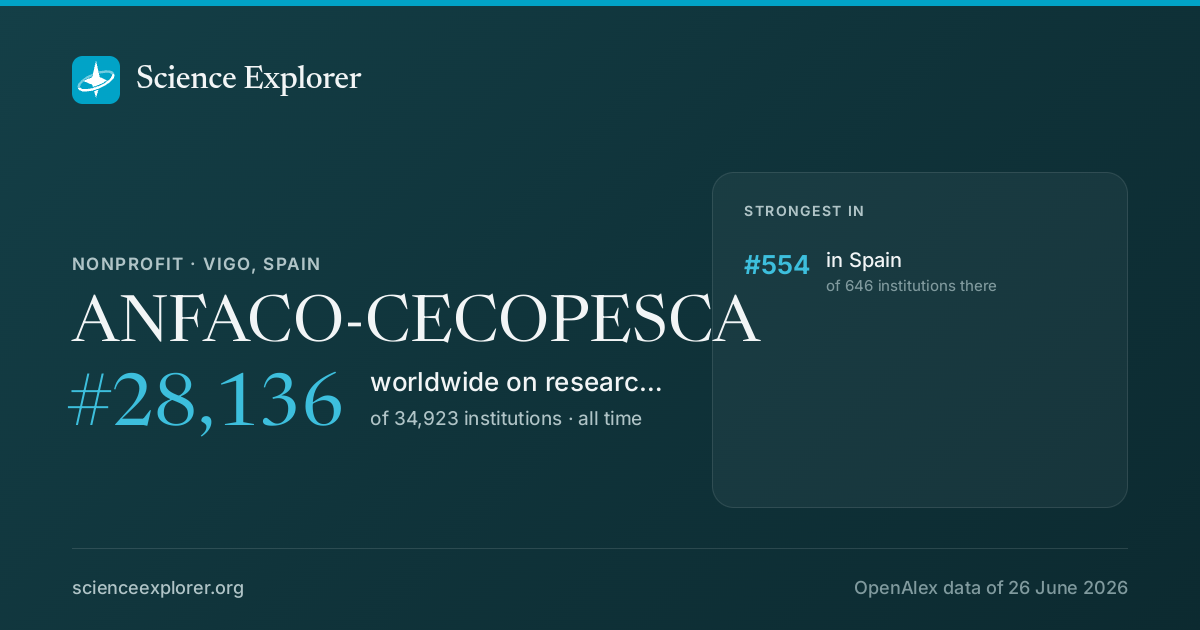
ANFACO-CECOPESCA on Science Explorer

A card with ANFACO-CECOPESCA's standing and the fields it leads in, for a post or a slide. A link to this page previews as the same card.

Download the card

1200 × 630 PNG, sized for social posts, drawn from the latest snapshot.

Badges for a website1Each links back here and updates with every snapshot

Research measures only: rankings here say nothing about teaching, admissions or student experience. Comparable institutions and collaboration partners have tabs of their own, above.

Discussion

Ask a question or share a note about ANFACO-CECOPESCA. Posts are plain text and can be reported.