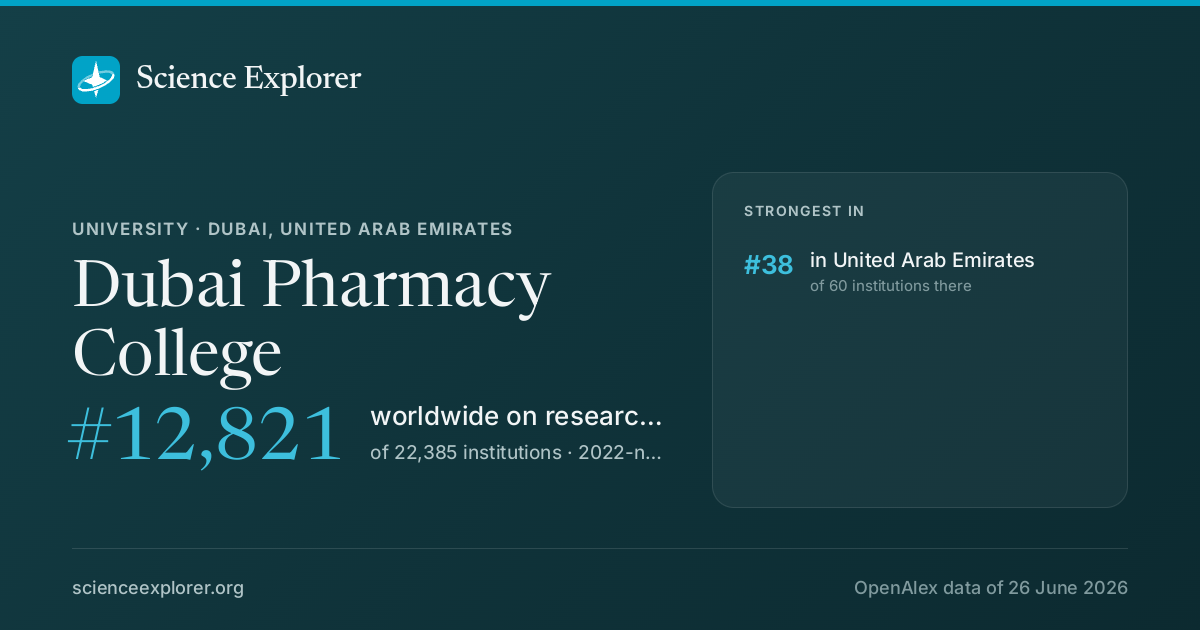
World rank, 2022-now #12,821
of 22,385 · #18,493 all time
Rank in United Arab Emirates #38
of 60 Research works 310
▲ 147% vs 2018-21
Citations 3k 9.5 per fractional work
Top-10% rate 8.8%
all institutions 10.0%
vs its own fields 0.97×
1.00× is exactly expected
Open access 60%
world 40%
International 40%
world 18%
Which fields of science does Dubai Pharmacy College work in?
In 2022-now, 37% of research at Dubai Pharmacy College is in Health Sciences , 25% in Physical Sciences . Its largest fields are Medicine (32%), Biochemistry, Genetics and Molecular Biology (10%), Pharmacology, Toxicology and Pharmaceutics (9%). It does 1.8× the world's share of Life Sciences .
Health Sciences: 63 fractional works · 36.5% of its work Medicine: 55 fractional works · 32.0% of its work Public Health, Environmental and Occupational Health: 5 fractional works · 2.8% of its work Oncology: 4 fractional works · 2.4% of its work Endocrinology, Diabetes and Metabolism: 4 fractional works · 2.1% of its work Geriatrics and Gerontology: 3 fractional works · 1.8% of its work Pulmonary and Respiratory Medicine: 3 fractional works · 1.8% of its work Pediatrics, Perinatology and Child Health: 3 fractional works · 1.7% of its work Physiology: 3 fractional works · 1.6% of its work Epidemiology: 3 fractional works · 1.5% of its work Infectious Diseases: 3 fractional works · 1.5% of its work Pharmacology: 2 fractional works · 1.4% of its work Complementary and alternative medicine: 2 fractional works · 1.4% of its work Cardiology and Cardiovascular Medicine: 2 fractional works · 1.2% of its work Radiology, Nuclear Medicine and Imaging: 2 fractional works · 1.1% of its work Surgery: 2 fractional works · 1.1% of its work Gastroenterology: 2 fractional works · 0.9% of its work Genetics: 2 fractional works · 0.9% of its work Hematology: 1 fractional works · 0.8% of its work Rheumatology: 1 fractional works · 0.7% of its work Obstetrics and Gynecology: 1 fractional works · 0.7% of its work Neurology: 1 fractional works · 0.6% of its work Psychiatry and Mental health: 1 fractional works · 0.6% of its work Pathology and Forensic Medicine: 1 fractional works · 0.5% of its work Health Informatics: 1 fractional works · 0.5% of its work Dermatology: 1 fractional works · 0.5% of its work Emergency Medicine: 1 fractional works · 0.4% of its work Family Practice: 1 fractional works · 0.3% of its work Reproductive Medicine: 0 fractional works · 0.2% of its work Smaller subfields together: 2 fractional works · 1.0% of its work Health Professions: 4 fractional works · 2.6% of its work General Health Professions: 3 fractional works · 1.8% of its work Emergency Medical Services: 1 fractional works · 0.4% of its work Smaller subfields together: 1 fractional works · 0.3% of its work Nursing: 2 fractional works · 1.3% of its work Nutrition and Dietetics: 2 fractional works · 1.1% of its work Smaller subfields together: 0 fractional works · 0.3% of its work Dentistry: 1 fractional works · 0.6% of its work Oral Surgery: 1 fractional works · 0.4% of its work Smaller subfields together: 0 fractional works · 0.2% of its work Physical Sciences: 43 fractional works · 25.2% of its work Engineering: 15 fractional works · 8.8% of its work Biomedical Engineering: 5 fractional works · 2.8% of its work Ocean Engineering: 3 fractional works · 1.8% of its work Electrical and Electronic Engineering: 1 fractional works · 0.8% of its work Mechanical Engineering: 1 fractional works · 0.7% of its work Civil and Structural Engineering: 1 fractional works · 0.6% of its work Aerospace Engineering: 1 fractional works · 0.6% of its work Mechanics of Materials: 1 fractional works · 0.5% of its work Computational Mechanics: 1 fractional works · 0.5% of its work Smaller subfields together: 1 fractional works · 0.4% of its work Chemistry: 7 fractional works · 4.0% of its work Organic Chemistry: 3 fractional works · 1.8% of its work Analytical Chemistry: 2 fractional works · 1.3% of its work Spectroscopy: 2 fractional works · 1.0% of its work Materials Science: 7 fractional works · 3.9% of its work Biomaterials: 3 fractional works · 1.8% of its work Polymers and Plastics: 2 fractional works · 1.0% of its work Materials Chemistry: 2 fractional works · 1.0% of its work Smaller subfields together: 0 fractional works · 0.1% of its work Computer Science: 6 fractional works · 3.7% of its work Artificial Intelligence: 2 fractional works · 1.3% of its work Computational Theory and Mathematics: 2 fractional works · 1.1% of its work Information Systems: 2 fractional works · 1.0% of its work Human-Computer Interaction: 0 fractional works · 0.3% of its work Smaller subfields together: 0 fractional works · 0.0% of its work Environmental Science: 3 fractional works · 1.9% of its work Management, Monitoring, Policy and Law: 1 fractional works · 0.4% of its work Pollution: 1 fractional works · 0.3% of its work Ecology: 0 fractional works · 0.3% of its work Environmental Engineering: 0 fractional works · 0.3% of its work Smaller subfields together: 1 fractional works · 0.6% of its work Earth and Planetary Sciences: 2 fractional works · 1.2% of its work Geophysics: 1 fractional works · 0.8% of its work Smaller subfields together: 1 fractional works · 0.3% of its work Physics and Astronomy: 1 fractional works · 0.8% of its work Atomic and Molecular Physics, and Optics: 1 fractional works · 0.7% of its work Smaller subfields together: 0 fractional works · 0.1% of its work Mathematics: 1 fractional works · 0.4% of its work Statistics and Probability: 1 fractional works · 0.4% of its work Smaller subfields together: 0 fractional works · 0.0% of its work Energy: 1 fractional works · 0.4% of its work Renewable Energy, Sustainability and the Environment: 0 fractional works · 0.2% of its work Smaller subfields together: 0 fractional works · 0.2% of its work Chemical Engineering: 0 fractional works · 0.1% of its work Life Sciences: 43 fractional works · 24.8% of its work Biochemistry, Genetics and Molecular Biology: 17 fractional works · 10.0% of its work Molecular Biology: 10 fractional works · 6.1% of its work Genetics: 3 fractional works · 1.9% of its work Aging: 1 fractional works · 0.6% of its work Cancer Research: 1 fractional works · 0.4% of its work Cell Biology: 0 fractional works · 0.2% of its work Endocrinology: 0 fractional works · 0.2% of its work Biotechnology: 0 fractional works · 0.2% of its work Smaller subfields together: 1 fractional works · 0.3% of its work Pharmacology, Toxicology and Pharmaceutics: 16 fractional works · 9.2% of its work Pharmaceutical Science: 11 fractional works · 6.5% of its work Pharmacology: 3 fractional works · 1.9% of its work Toxicology: 1 fractional works · 0.5% of its work Drug Discovery: 1 fractional works · 0.3% of its work Agricultural and Biological Sciences: 5 fractional works · 2.8% of its work Food Science: 2 fractional works · 1.3% of its work Plant Science: 2 fractional works · 0.9% of its work Insect Science: 1 fractional works · 0.4% of its work Smaller subfields together: 0 fractional works · 0.3% of its work Immunology and Microbiology: 3 fractional works · 1.5% of its work Immunology: 1 fractional works · 0.7% of its work Applied Microbiology and Biotechnology: 1 fractional works · 0.6% of its work Smaller subfields together: 0 fractional works · 0.2% of its work Neuroscience: 2 fractional works · 1.3% of its work Cognitive Neuroscience: 2 fractional works · 1.0% of its work Smaller subfields together: 0 fractional works · 0.3% of its work Social Sciences: 23 fractional works · 13.5% of its work Social Sciences: 6 fractional works · 3.8% of its work Sociology and Political Science: 2 fractional works · 1.3% of its work Education: 2 fractional works · 1.0% of its work Political Science and International Relations: 1 fractional works · 0.4% of its work Health: 1 fractional works · 0.3% of its work Smaller subfields together: 1 fractional works · 0.7% of its work Economics, Econometrics and Finance: 6 fractional works · 3.5% of its work Economics and Econometrics: 4 fractional works · 2.3% of its work Finance: 2 fractional works · 1.0% of its work General Economics, Econometrics and Finance: 0 fractional works · 0.2% of its work Business, Management and Accounting: 4 fractional works · 2.1% of its work Accounting: 1 fractional works · 0.5% of its work Management Information Systems: 1 fractional works · 0.4% of its work Strategy and Management: 1 fractional works · 0.4% of its work Management of Technology and Innovation: 0 fractional works · 0.3% of its work Smaller subfields together: 1 fractional works · 0.5% of its work Psychology: 3 fractional works · 2.0% of its work Clinical Psychology: 1 fractional works · 0.9% of its work Developmental and Educational Psychology: 1 fractional works · 0.4% of its work Social Psychology: 1 fractional works · 0.3% of its work Applied Psychology: 0 fractional works · 0.3% of its work Smaller subfields together: 0 fractional works · 0.1% of its work Decision Sciences: 2 fractional works · 1.4% of its work Management Science and Operations Research: 2 fractional works · 1.2% of its work Smaller subfields together: 0 fractional works · 0.1% of its work Arts and Humanities: 1 fractional works · 0.7% of its work Health Sciences Medicine Health Pr… Physical Sciences Engineering Chemistry Materials… Computer… Environme… Life Sciences Biochemistry Pharmacology Agricultu… Immunolog… Social Sciences Social Sc… Economics Business Psychology ALL ITS WORK Dubai Pharmacy College 172 fractional works, 2022-now 25% 25% 37% 14%
Each ring splits the one inside it: the four domains of science, their fields, their subfields. Size is fractional works in 2022-now. Every slice is a page; the interactive view zooms down to single topics and colours each by how much more of it this institution does than the world.
Its 4 domains and 25 fields, with their numbers 55 32.0% 4 2.6% 2 1.3% 1 0.6% 15 8.8% 7 4.0% 7 3.9% 6 3.7% 3 1.9% 2 1.2% 1 0.8% 1 0.4% 1 0.4% 0 0.1% 17 10.0% 16 9.2% 5 2.8% 3 1.5% 2 1.3% 6 3.8% 6 3.5% 4 2.1% 3 2.0% 2 1.4% 1 0.7% All of science, and how each field's share has moved since 1950: the Science domain explorer
Field profile
Location quotient across every field it publishes in: outside the ring is more than an institution of this size would be expected to publish, inside it is less.
Agricultural and Biological Sciences: 0.59× its world share, 5 works Agricultural and Bio… Biochemistry, Genetics and Molecular Biology: 1.87× its world share, 17 works Biochemistry, Geneti… Immunology and Microbiology: 1.46× its world share, 2 works Immunology and Micro… Neuroscience: 0.79× its world share, 2 works Neuroscience Pharmacology, Toxicology and Pharmaceutics: 26.12× its world share, 16 works Pharmacology, Toxico… Chemical Engineering: 0.28× its world share, 0 works Chemical Engineering Chemistry: 2.55× its world share, 7 works Chemistry Computer Science: 0.48× its world share, 6 works Computer Science Earth and Planetary Sciences: 0.73× its world share, 2 works Earth and Planetary … Energy: 0.44× its world share, 1 works Energy Engineering: 0.59× its world share, 15 works Engineering Environmental Science: 0.38× its world share, 3 works Environmental Science Materials Science: 1.11× its world share, 7 works Materials Science Mathematics: 0.38× its world share, 1 works Mathematics Physics and Astronomy: 0.36× its world share, 1 works Physics and Astronomy Dentistry: 1.32× its world share, 1 works Dentistry Health Professions: 0.98× its world share, 4 works Health Professions Medicine: 1.66× its world share, 55 works Medicine Nursing: 2.71× its world share, 2 works Nursing Arts and Humanities: 0.23× its world share, 1 works Arts and Humanities Business, Management and Accounting: 0.66× its world share, 4 works Business, Management… Decision Sciences: 1.43× its world share, 2 works Decision Sciences Economics, Econometrics and Finance: 1.66× its world share, 6 works Economics, Econometr… Psychology: 0.66× its world share, 4 works Psychology Social Sciences: 0.30× its world share, 6 works Social Sciences 1× world share
Rings at 0.5×, 1× and 2×. Widest outward: Pharmacology, Toxicology and Pharmaceutics , 26.1×. Every wedge is a field page.
All 25 fields, with their numbers Pharmacology, Toxicology and Pharmaceutics 26.12× 16 works Nursing 2.71× 2 works Chemistry 2.55× 7 works Biochemistry, Genetics and Molecular Biology 1.87× 17 works Medicine 1.66× 55 works Economics, Econometrics and Finance 1.66× 6 works Immunology and Microbiology 1.46× 2 works Decision Sciences 1.43× 2 works Dentistry 1.32× 1 works Materials Science 1.11× 7 works Health Professions 0.98× 4 works Neuroscience 0.79× 2 works Earth and Planetary Sciences 0.73× 2 works Business, Management and Accounting 0.66× 4 works Psychology 0.66× 4 works Agricultural and Biological Sciences 0.59× 5 works Engineering 0.59× 15 works Computer Science 0.48× 6 works Energy 0.44× 1 works Environmental Science 0.38× 3 works Mathematics 0.38× 1 works Physics and Astronomy 0.36× 1 works Social Sciences 0.30× 6 works Chemical Engineering 0.28× 0 works Arts and Humanities 0.23× 1 works
Who are the top researchers at Dubai Pharmacy College?
Ranked on the quality score, Aliasgar Shahiwala , Ammar Ali Saleh Jaber and Roland Falder lead among researchers whose main affiliation is Dubai Pharmacy College.
1
Aliasgar Shahiwala
United Arab Emirates · #1,512,909 worldwide4.6k citations · 103 works
2
Ammar Ali Saleh Jaber
United Arab Emirates · #1,910,832 worldwide1.7k citations · 82 works
3
Roland Falder
United Arab Emirates · #2,567,053 worldwide31 citations · 72 works
4
Semira Abdi Beshir
United Arab Emirates · #3,386,767 worldwide369 citations · 53 works
5
Mirza Rafi Baig
United Arab Emirates · #3,471,733 worldwide1.4k citations · 126 works
6
Fazilatun Nessa
United Arab Emirates · #4,084,083 worldwide459 citations · 26 works
7
Naglaa Gamil Shehab
United Arab Emirates · #4,678,778 worldwide528 citations · 40 works
8
Bazigha K. Abdul Rasool
United Arab Emirates · #5,371,735 worldwide746 citations · 44 works
9
Gazala Afreen Khan
United Arab Emirates · #5,701,416 worldwide57 citations · 27 works
10
Heyam Saad Ali
United Arab Emirates · #6,356,309 worldwide786 citations · 78 works
All ranked researchers at Dubai Pharmacy College
What are the most cited papers from Dubai Pharmacy College?
The most cited paper from Dubai Pharmacy College is "Adverse effects of biologics: a network meta-analysis and Cochrane overview" (Jasvinder A. Singh et al., 2011), with 829 citations. Next come "Drug safety in India" (367) and "A qualitative insight into the perceptions and COVID-19 vaccine hesitancy among Pakistani pharmacists" (346).
Most cited papers
# Paper Released Citations 1
Adverse effects of biologics: a network meta-analysis and Cochrane overview
Jasvinder A. Singh et al. · Cochrane Database of Systematic Reviews
Open access 4 Feb 2011
829 2
Drug safety in India
Mirza Rafiullah Baig, Yaser Mohammed Al‐Worafi, Wafa Mohammed Alseragi et al. · Elsevier eBooks
Book chapter 2020
367 3
A qualitative insight into the perceptions and COVID-19 vaccine hesitancy among Pakistani pharmacists
Muhammad Osama Yaseen, Muhammad Osama Yaseen, Arifa Saif et al. · Human Vaccines & Immunotherapeutics
Open access 31 Jan 2022
346 4
Patients’ beliefs toward generic medication in Yemen
Ammar Ali Saleh Jaber, Yaser Mohammed Al‐Worafi, Abdullah Ahmed Dhabali · Journal of Generic Medicines The Business Journal for the Generic Medicines Sector
19 Aug 2021
338 5
Knowledge, Beliefs and Factors Affecting the Use of Generic Medicines among Patients in Ibb, Yemen: A Mixed-method Study
Yaser Mohammed Al‐Worafi, Wafa Mohammed Alseragi, Khaled Mohamed Alakhali et al. · Journal of Pharmacy Practice and Community Medicine
Open access 10 Jan 2021
303
All 59 most cited papers, with filters and sorting
Which keywords describe research at Dubai Pharmacy College?
By fractional works in 2022-now, weighted toward what it does more of than the world: Nanoparticles, Drug Delivery, Pharmacokinetics, Antioxidant, Biomedical Applications, Medicinal Chemistry , Polymeric Materials and Cyclodextrins.
Size is fractional works in 2022-now in the topics tagged with each word; colour is the word's share of this institution's work against its share of the world's. The 40 words are chosen for being large and distinctive. Each links to the topic it comes from most.
All 40 words, with their numbers Nanoparticles 13 ▲ 6.1× 18 topics Epidemiology 9 ▲ 1.31× 44 topics Drug Delivery 8 ▲ 8.0× 10 topics Inflammation 7 ▲ 1.98× 38 topics Biomedical Applications 6 ▲ 3.2× 16 topics Oxidative Stress 6 ▲ 2.2× 24 topics Antioxidant 6 ▲ 4.7× 19 topics Cancer 6 ▲ 2.4× 28 topics Pharmacokinetics 5 ▲ 12× 7 topics Pandemic 5 ▲ 2.7× 8 topics Medicinal Chemistry 4 ▲ 9.0× 7 topics Cyclodextrins 4 ▲ 111× 1 topic Polymeric Materials 4 ▲ 33× 2 topics Protein 4 ▲ 19× 2 topics Solid Dispersions 4 ▲ 111× 1 topic Cancer Therapy 4 ▲ 4.0× 10 topics Chitosan 4 ▲ 28× 2 topics Nasal 4 ▲ 40× 2 topics Mucosal 4 ▲ 67× 1 topic Polymeric 4 ▲ 67× 1 topic Clinical Trials 4 ▲ 3.2× 12 topics Herbal Medicine 4 ▲ 7.5× 7 topics Elderly 4 ▲ 8.3× 2 topics Antioxidant Activity 3 ▲ 3.1× 14 topics Vaccine 3 ▲ 4.7× 8 topics Adverse Drug Reactions 3 ▲ 33× 3 topics Inappropriate Medication Use 3 ▲ 42× 1 topic Polypharmacy 3 ▲ 42× 1 topic Microneedles 3 ▲ 53× 1 topic Solid Lipid Nanoparticles 3 ▲ 53× 1 topic Coronavirus 3 ▲ 7.7× 3 topics Method Validation 3 ▲ 27× 3 topics Anti-inflammatory 2 ▲ 5.1× 11 topics Medication Adherence 2 ▲ 25× 2 topics Drug Development 2 ▲ 16× 2 topics Tumor Targeting 2 ▲ 7.2× 3 topics Gene Therapy 2 ▲ 6.8× 5 topics Molecular Docking 2 ▲ 10× 2 topics Green Analytical Chemistry 2 ▲ 22× 1 topic Pharmaceutical Analysis 2 ▲ 69× 1 topic
How open and international is its research?
Against the world's own shares: the tick on each track. Both are shares of its output, so they
sit on one scale and can be read against each other as well as against the world.
60% 40%
59.8% 40.2%
World: 40% of research is openly available.
40% 60%
40.5% 59.5%
World: 18% is written across borders.
How has Dubai Pharmacy College's research output changed?
Output in 2022-2025 was 147% higher than in 2018-2021.
still counting 1990 2000 2010 2020
The same series as a ribbon: one cell per year, darker for more. The line above answers how much ; this answers when .
Its share of all research
still counting 0.00050% 0.0010% Dubai Pharmacy College 0.00091% in 2025 1980 1990 2000 2010 2020 Fractional works of Dubai Pharmacy College over all fractional works that year. How the balance of science has shifted .
Share Dubai Pharmacy College's ranking
A card with Dubai Pharmacy College's standing and the fields it leads in, for a post or a slide. A link to this page previews as the same card.
Badges for a website 1 Each links back here and updates with every snapshot
 United Arab Emirates · #1,512,909 worldwide
4.6k citations · 103 works