Science Explorer Back to mapMap
Discussion
University · Izmir · Türkiye

Ege University

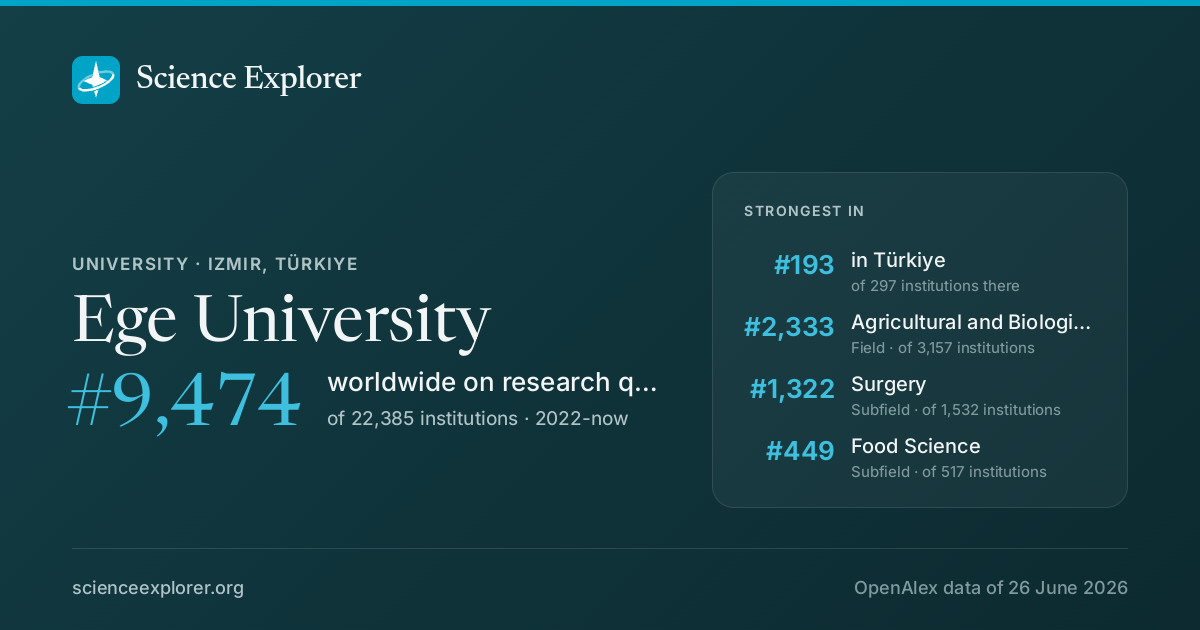
In research, Ege University stands highest in Agricultural and Biological Sciences (#2,333 of 3,157 worldwide), Surgery (#1,322 of 1,532 worldwide) and Food Science (#449 of 517 worldwide), 2022-now. Relative to its size it is most specialised in Museology, Forestry and Orthodontics (Museology is 8.4× its share of world research).

World rank, 2022-now
#9,474
of 22,385 · #12,537 all time
Rank in Türkiye
#193
of 297
Research works
30k
▲ 12% vs 2018-21
Citations
429k
14.4 per fractional work
Top-10% rate
5.7%
all institutions 10.0%
vs its own fields
0.56×
1.00× is exactly expected
Open access
49%
world 40%
International
11%
world 18%

What is Ege University known for in research?

The fields where it stands highest, 2022-now, ranked among every institution above the floor in each field.

FieldWorld rankWhere that sitsTop-10% rateWorksAll time
Agricultural and Biological SciencesField #2,333 of 3,157 5.7%695 #3284
SurgerySubfield #1,322 of 1,532 4.8%248 #2687
Food ScienceSubfield #449 of 517 5.5%145 #1011
DentistryField #352 of 405 8.8%111 #594
NursingField #240 of 273 5.8%91 #749
Arts and HumanitiesField #1,670 of 1,896 8.5%397 #2923
Plant ScienceSubfield #1,186 of 1,317 4.7%233 #2065
Social SciencesDomain #8,642 of 9,585 7.1%1,454 #11789
MathematicsField #960 of 1,051 7.0%96 #1872
EngineeringField #5,420 of 5,901 6.2%633 #5757

Each strip is that field's whole ranked pool, with the notch where Ege University sits in it, in the colour of the band that rank falls in. The track under the rate is the rate itself: it carries no average mark, because the average differs by field (from about 6% in Dentistry to 21% in Economics).

Which of those standings moved

The same fields on both windows: where it stood over the whole record, and where it stands in 2022-now. The distance is the story, and it is the one thing the two rank columns above cannot show.

  1. Agricultural and Biological Sciences#3,284 #2,333
  2. Surgery#2,687 #1,322
  3. Food Science#1,011 #449
  4. Dentistry#594 #352
  5. Nursing#749 #240
  6. Arts and Humanities#2,923 #1,670
  7. Plant Science#2,065 #1,186
  8. Social Sciences#11,789 #8,642
  9. Mathematics#1,872 #960
  10. Engineering#5,757 #5,420
all time2022-now, better2022-now, worse

A dot further right is a better standing. Fields it was not ranked in over the whole record are left out.

Which fields of science does Ege University work in?

In 2022-now, 32% of research at Ege University is in Health Sciences, 27% in Physical Sciences. Its largest fields are Medicine (27%), Agricultural and Biological Sciences (10%), Engineering (9%). It does 1.6× the world's share of Life Sciences.

Health Sciences: 2,555 fractional works · 32.5% of its workMedicine: 2,092 fractional works · 26.6% of its workSurgery: 282 fractional works · 3.6% of its workPulmonary and Respiratory Medicine: 162 fractional works · 2.1% of its workEpidemiology: 131 fractional works · 1.7% of its workOncology: 125 fractional works · 1.6% of its workPublic Health, Environmental and Occupational Health: 111 fractional works · 1.4% of its workRadiology, Nuclear Medicine and Imaging: 111 fractional works · 1.4% of its workPhysiology: 98 fractional works · 1.2% of its workCardiology and Cardiovascular Medicine: 75 fractional works · 1.0% of its workInfectious Diseases: 66 fractional works · 0.8% of its workEndocrinology, Diabetes and Metabolism: 63 fractional works · 0.8% of its workPediatrics, Perinatology and Child Health: 61 fractional works · 0.8% of its workPsychiatry and Mental health: 59 fractional works · 0.7% of its workPathology and Forensic Medicine: 57 fractional works · 0.7% of its workRheumatology: 56 fractional works · 0.7% of its workNeurology: 55 fractional works · 0.7% of its workOphthalmology: 55 fractional works · 0.7% of its workPharmacology: 54 fractional works · 0.7% of its workHematology: 45 fractional works · 0.6% of its workGenetics: 39 fractional works · 0.5% of its workBiochemistry: 31 fractional works · 0.4% of its workComplementary and alternative medicine: 31 fractional works · 0.4% of its workEmergency Medicine: 30 fractional works · 0.4% of its workOrthopedics and Sports Medicine: 29 fractional works · 0.4% of its workDermatology: 29 fractional works · 0.4% of its workObstetrics and Gynecology: 26 fractional works · 0.3% of its workRehabilitation: 25 fractional works · 0.3% of its workCritical Care and Intensive Care Medicine: 22 fractional works · 0.3% of its workUrology: 21 fractional works · 0.3% of its workReproductive Medicine: 21 fractional works · 0.3% of its workNephrology: 19 fractional works · 0.2% of its workGastroenterology: 16 fractional works · 0.2% of its workSmaller subfields together: 84 fractional works · 1.1% of its workHealth Professions: 224 fractional works · 2.8% of its workGeneral Health Professions: 87 fractional works · 1.1% of its workEmergency Medical Services: 34 fractional works · 0.4% of its workSpeech and Hearing: 30 fractional works · 0.4% of its workRadiological and Ultrasound Technology: 22 fractional works · 0.3% of its workSmaller subfields together: 50 fractional works · 0.6% of its workDentistry: 133 fractional works · 1.7% of its workOral Surgery: 52 fractional works · 0.7% of its workOrthodontics: 44 fractional works · 0.6% of its workPeriodontics: 26 fractional works · 0.3% of its workSmaller subfields together: 12 fractional works · 0.2% of its workNursing: 98 fractional works · 1.2% of its workNutrition and Dietetics: 80 fractional works · 1.0% of its workSmaller subfields together: 18 fractional works · 0.2% of its workVeterinary: 7 fractional works · 0.1% of its workPhysical Sciences: 2,097 fractional works · 26.7% of its workEngineering: 703 fractional works · 8.9% of its workBiomedical Engineering: 181 fractional works · 2.3% of its workElectrical and Electronic Engineering: 108 fractional works · 1.4% of its workMechanical Engineering: 92 fractional works · 1.2% of its workCivil and Structural Engineering: 74 fractional works · 0.9% of its workBuilding and Construction: 53 fractional works · 0.7% of its workMechanics of Materials: 35 fractional works · 0.4% of its workControl and Systems Engineering: 35 fractional works · 0.4% of its workAutomotive Engineering: 29 fractional works · 0.4% of its workAerospace Engineering: 25 fractional works · 0.3% of its workIndustrial and Manufacturing Engineering: 22 fractional works · 0.3% of its workOcean Engineering: 21 fractional works · 0.3% of its workSmaller subfields together: 28 fractional works · 0.4% of its workEnvironmental Science: 362 fractional works · 4.6% of its workGlobal and Planetary Change: 75 fractional works · 1.0% of its workWater Science and Technology: 54 fractional works · 0.7% of its workEcology: 51 fractional works · 0.7% of its workIndustrial and Manufacturing Engineering: 36 fractional works · 0.5% of its workHealth, Toxicology and Mutagenesis: 31 fractional works · 0.4% of its workPollution: 28 fractional works · 0.4% of its workManagement, Monitoring, Policy and Law: 26 fractional works · 0.3% of its workEnvironmental Engineering: 25 fractional works · 0.3% of its workNature and Landscape Conservation: 17 fractional works · 0.2% of its workEnvironmental Chemistry: 16 fractional works · 0.2% of its workSmaller subfields together: 3 fractional works · 0.0% of its workMaterials Science: 283 fractional works · 3.6% of its workMaterials Chemistry: 98 fractional works · 1.2% of its workBiomaterials: 84 fractional works · 1.1% of its workPolymers and Plastics: 74 fractional works · 0.9% of its workSmaller subfields together: 27 fractional works · 0.3% of its workComputer Science: 250 fractional works · 3.2% of its workArtificial Intelligence: 81 fractional works · 1.0% of its workInformation Systems: 42 fractional works · 0.5% of its workComputer Networks and Communications: 35 fractional works · 0.4% of its workComputational Theory and Mathematics: 28 fractional works · 0.4% of its workComputer Vision and Pattern Recognition: 23 fractional works · 0.3% of its workSmaller subfields together: 41 fractional works · 0.5% of its workChemistry: 122 fractional works · 1.5% of its workOrganic Chemistry: 53 fractional works · 0.7% of its workAnalytical Chemistry: 23 fractional works · 0.3% of its workInorganic Chemistry: 17 fractional works · 0.2% of its workSmaller subfields together: 29 fractional works · 0.4% of its workPhysics and Astronomy: 112 fractional works · 1.4% of its workAstronomy and Astrophysics: 60 fractional works · 0.8% of its workSmaller subfields together: 52 fractional works · 0.7% of its workMathematics: 105 fractional works · 1.3% of its workApplied Mathematics: 30 fractional works · 0.4% of its workGeometry and Topology: 20 fractional works · 0.3% of its workStatistics and Probability: 16 fractional works · 0.2% of its workSmaller subfields together: 39 fractional works · 0.5% of its workEnergy: 86 fractional works · 1.1% of its workRenewable Energy, Sustainability and the Environment: 77 fractional works · 1.0% of its workSmaller subfields together: 9 fractional works · 0.1% of its workEarth and Planetary Sciences: 56 fractional works · 0.7% of its workOceanography: 22 fractional works · 0.3% of its workSmaller subfields together: 34 fractional works · 0.4% of its workChemical Engineering: 19 fractional works · 0.2% of its workLife Sciences: 1,612 fractional works · 20.5% of its workAgricultural and Biological Sciences: 770 fractional works · 9.8% of its workPlant Science: 262 fractional works · 3.3% of its workFood Science: 159 fractional works · 2.0% of its workAquatic Science: 68 fractional works · 0.9% of its workAnimal Science and Zoology: 60 fractional works · 0.8% of its workForestry: 52 fractional works · 0.7% of its workEcology, Evolution, Behavior and Systematics: 50 fractional works · 0.6% of its workInsect Science: 46 fractional works · 0.6% of its workAgronomy and Crop Science: 31 fractional works · 0.4% of its workSoil Science: 29 fractional works · 0.4% of its workSmaller subfields together: 13 fractional works · 0.2% of its workBiochemistry, Genetics and Molecular Biology: 591 fractional works · 7.5% of its workMolecular Biology: 325 fractional works · 4.1% of its workGenetics: 93 fractional works · 1.2% of its workCancer Research: 41 fractional works · 0.5% of its workCell Biology: 34 fractional works · 0.4% of its workBiotechnology: 31 fractional works · 0.4% of its workClinical Biochemistry: 16 fractional works · 0.2% of its workSmaller subfields together: 51 fractional works · 0.7% of its workNeuroscience: 111 fractional works · 1.4% of its workCognitive Neuroscience: 47 fractional works · 0.6% of its workCellular and Molecular Neuroscience: 20 fractional works · 0.3% of its workNeurology: 17 fractional works · 0.2% of its workSmaller subfields together: 26 fractional works · 0.3% of its workImmunology and Microbiology: 96 fractional works · 1.2% of its workImmunology: 59 fractional works · 0.7% of its workParasitology: 19 fractional works · 0.2% of its workSmaller subfields together: 19 fractional works · 0.2% of its workPharmacology, Toxicology and Pharmaceutics: 45 fractional works · 0.6% of its workPharmaceutical Science: 19 fractional works · 0.2% of its workSmaller subfields together: 25 fractional works · 0.3% of its workSocial Sciences: 1,602 fractional works · 20.4% of its workSocial Sciences: 627 fractional works · 8.0% of its workSociology and Political Science: 199 fractional works · 2.5% of its workEducation: 145 fractional works · 1.8% of its workPolitical Science and International Relations: 74 fractional works · 0.9% of its workGender Studies: 37 fractional works · 0.5% of its workCultural Studies: 28 fractional works · 0.4% of its workHealth: 24 fractional works · 0.3% of its workCommunication: 24 fractional works · 0.3% of its workAnthropology: 19 fractional works · 0.2% of its workUrban Studies: 17 fractional works · 0.2% of its workDemography: 16 fractional works · 0.2% of its workSmaller subfields together: 44 fractional works · 0.6% of its workArts and Humanities: 430 fractional works · 5.5% of its workLiterature and Literary Theory: 102 fractional works · 1.3% of its workMuseology: 81 fractional works · 1.0% of its workLanguage and Linguistics: 68 fractional works · 0.9% of its workPhilosophy: 51 fractional works · 0.6% of its workArcheology: 50 fractional works · 0.6% of its workHistory: 33 fractional works · 0.4% of its workSmaller subfields together: 46 fractional works · 0.6% of its workPsychology: 293 fractional works · 3.7% of its workClinical Psychology: 122 fractional works · 1.5% of its workSocial Psychology: 91 fractional works · 1.2% of its workExperimental and Cognitive Psychology: 33 fractional works · 0.4% of its workDevelopmental and Educational Psychology: 31 fractional works · 0.4% of its workSmaller subfields together: 15 fractional works · 0.2% of its workEconomics, Econometrics and Finance: 108 fractional works · 1.4% of its workEconomics and Econometrics: 92 fractional works · 1.2% of its workSmaller subfields together: 17 fractional works · 0.2% of its workBusiness, Management and Accounting: 101 fractional works · 1.3% of its workStrategy and Management: 31 fractional works · 0.4% of its workMarketing: 29 fractional works · 0.4% of its workSmaller subfields together: 42 fractional works · 0.5% of its workDecision Sciences: 43 fractional works · 0.5% of its workManagement Science and Operations Research: 27 fractional works · 0.3% of its workSmaller subfields together: 16 fractional works · 0.2% of its workALL ITS WORKEge University7,867fractional works, 2022-now
Life Sciences20%Physical Sciences27%Health Sciences32%Social Sciences20%

Each ring splits the one inside it: the four domains of science, their fields, their subfields. Size is fractional works in 2022-now. Every slice is a page; the interactive view zooms down to single topics and colours each by how much more of it this institution does than the world.

Its 4 domains and 26 fields, with their numbers
  1. Health Sciences2,55532.5%
    1. Medicine2,09226.6%
    2. Health Professions2242.8%
    3. Dentistry1331.7%
    4. Nursing981.2%
    5. Veterinary70.1%
    1. Engineering7038.9%
    2. Environmental Science3624.6%
    3. Materials Science2833.6%
    4. Computer Science2503.2%
    5. Chemistry1221.5%
    6. Physics and Astronomy1121.4%
    7. Mathematics1051.3%
    8. Energy861.1%
    9. Earth and Planetary Sciences560.7%
    10. Chemical Engineering190.2%
  2. Life Sciences1,61220.5%
    1. Agricultural and Biological Sciences7709.8%
    2. Biochemistry, Genetics and Molecular Biology5917.5%
    3. Neuroscience1111.4%
    4. Immunology and Microbiology961.2%
    5. Pharmacology, Toxicology and Pharmaceutics450.6%
  3. Social Sciences1,60220.4%
    1. Social Sciences6278.0%
    2. Arts and Humanities4305.5%
    3. Psychology2933.7%
    4. Economics, Econometrics and Finance1081.4%
    5. Business, Management and Accounting1011.3%
    6. Decision Sciences430.5%
All of science, and how each field's share has moved since 1950: the Science domain explorer

What does Ege University specialise in?

Where its research is concentrated relative to its size: Museology takes 8.4× the share of its output that it takes of world research.

  1. MuseologySubfield · 80.5 works8.4×
  2. ForestrySubfield · 52.3 works6.4×
  3. OrthodonticsSubfield · 44.0 works5.0×
  4. Aquatic ScienceSubfield · 67.5 works4.7×
← less than its size predicts1×more →

Location quotient, a volume reading rather than an impact one. It surfaces small, lopsided specialities.

Field profile

Location quotient across every field it publishes in: outside the ring is more than an institution of this size would be expected to publish, inside it is less.

Agricultural and Biological Sciences: 2.06× its world share, 770 worksAgricultural and Bio…Biochemistry, Genetics and Molecular Biology: 1.41× its world share, 591 worksBiochemistry, Geneti…Immunology and Microbiology: 1.21× its world share, 96 worksImmunology and Micro…Neuroscience: 0.87× its world share, 111 worksNeurosciencePharmacology, Toxicology and Pharmaceutics: 1.61× its world share, 45 worksPharmacology, Toxico…Chemical Engineering: 0.67× its world share, 19 worksChemical EngineeringChemistry: 0.99× its world share, 122 worksChemistryComputer Science: 0.41× its world share, 250 worksComputer ScienceEarth and Planetary Sciences: 0.46× its world share, 56 worksEarth and Planetary …Energy: 1.18× its world share, 86 worksEnergyEngineering: 0.60× its world share, 703 worksEngineeringEnvironmental Science: 0.93× its world share, 362 worksEnvironmental ScienceMaterials Science: 1.03× its world share, 283 worksMaterials ScienceMathematics: 1.14× its world share, 105 worksMathematicsPhysics and Astronomy: 0.64× its world share, 112 worksPhysics and AstronomyDentistry: 3.50× its world share, 133 worksDentistryHealth Professions: 1.08× its world share, 224 worksHealth ProfessionsMedicine: 1.38× its world share, 2,092 worksMedicineNursing: 2.55× its world share, 98 worksNursingVeterinary: 0.67× its world share, 7 worksVeterinaryArts and Humanities: 1.89× its world share, 430 worksArts and HumanitiesBusiness, Management and Accounting: 0.40× its world share, 102 worksBusiness, Management…Decision Sciences: 0.56× its world share, 43 worksDecision SciencesEconomics, Econometrics and Finance: 0.64× its world share, 108 worksEconomics, Econometr…Psychology: 1.22× its world share, 292 worksPsychologySocial Sciences: 0.63× its world share, 627 worksSocial Sciences1×world share
more than its size predictsabout as predictedless

Rings at 0.5×, 1× and 2×. Widest outward: Dentistry, 3.5×. Every wedge is a field page.

All 26 fields, with their numbers
  1. Dentistry3.50×133 works
  2. Nursing2.55×98 works
  3. Agricultural and Biological Sciences2.06×770 works
  4. Arts and Humanities1.89×430 works
  5. Pharmacology, Toxicology and Pharmaceutics1.61×45 works
  6. Biochemistry, Genetics and Molecular Biology1.41×591 works
  7. Medicine1.38×2,092 works
  8. Psychology1.22×292 works
  9. Immunology and Microbiology1.21×96 works
  10. Energy1.18×86 works
  11. Mathematics1.14×105 works
  12. Health Professions1.08×224 works
  13. Materials Science1.03×283 works
  14. Chemistry0.99×122 works
  15. Environmental Science0.93×362 works
  16. Neuroscience0.87×111 works
  17. Chemical Engineering0.67×19 works
  18. Veterinary0.67×7 works
  19. Physics and Astronomy0.64×112 works
  20. Economics, Econometrics and Finance0.64×108 works
  21. Social Sciences0.63×627 works
  22. Engineering0.60×703 works
  23. Decision Sciences0.56×43 works
  24. Earth and Planetary Sciences0.46×56 works
  25. Computer Science0.41×250 works
  26. Business, Management and Accounting0.40×102 works

Who are the top researchers at Ege University?

Ranked on the quality score, Jale Yanık, Arif Hepbaşlı and Nesrin Moğulkoç lead among researchers whose main affiliation is Ege University.

  1. 1 Jale Yanık Türkiye · #113,526 worldwide 8.1k citations · 116 works
  2. 2 Arif Hepbaşlı Türkiye · #123,261 worldwide 21k citations · 459 works
  3. 3 Nesrin Moğulkoç Türkiye · #250,685 worldwide 3.1k citations · 155 works
  4. 4 Gözde Duman Türkiye · #510,468 worldwide 2.7k citations · 49 works
  5. 5 Abdurrahman Nazif Çatık Türkiye · #820,219 worldwide 1.4k citations · 104 works
  6. 6 Müşerref Arda Türkiye · #829,599 worldwide 2.7k citations · 58 works
  7. 7 Meral Kayıkçıoğlu Türkiye · #837,657 worldwide 19k citations · 289 works
  8. 8 İsmail Türkan Türkiye · #899,574 worldwide 10k citations · 125 works
  9. 9 Engin Karatepe Türkiye · #923,410 worldwide 3.6k citations · 57 works
  10. 10 İpek Kazançoğlu Türkiye · #972,292 worldwide 3k citations · 76 works
All ranked researchers at Ege University

What are the most cited papers from Ege University?

The most cited paper from Ege University is "Guidelines for the use and interpretation of assays for monitoring autophagy (3rd edition)" (Daniel J. Klionsky et al., 2016), with 6,023 citations. Next come "A standardised static in vitro digestion method suitable for food – an international consensus" (5,749) and "INFOGEST static in vitro simulation of gastrointestinal food digestion" (5,074).

Most cited papers
#PaperReleasedCitations
1 Guidelines for the use and interpretation of assays for monitoring autophagy (3rd edition) Daniel J. Klionsky et al. · Autophagy Open access2,467 authors 2 Jan 2016 6,023
2 A standardised static in vitro digestion method suitable for food – an international consensus Mans Minekus et al. · Food & Function Open access 2014 5,749
3 INFOGEST static in vitro simulation of gastrointestinal food digestion André Brodkorb et al. · Nature Protocols Open access 18 Mar 2019 5,074
4 The development of Assessment of SpondyloArthritis international Society classification criteria for axial spondyloarthritis (part II): validation and final selection Martín Rudwaleit et al. · Annals of the Rheumatic Diseases Open access 18 Mar 2009 3,707
5 Temsirolimus, Interferon Alfa, or Both for Advanced Renal-Cell Carcinoma Gary R. Hudes, Michael Anthony Carducci, Piotr Tomczak et al. · New England Journal of Medicine 30 May 2007 3,671
All 59 most cited papers, with filters and sorting

Which keywords describe research at Ege University?

By fractional works in 2022-now, weighted toward what it does more of than the world: Epidemiology, Cultural Heritage, Climate Change, Inflammation, Ethnography, Biomedical Applications, Storytelling and Mythology.

▲ more of its work than of the world's◆ about the world's share▼ less than the world's

Size is fractional works in 2022-now in the topics tagged with each word; colour is the word's share of this institution's work against its share of the world's. The 40 words are chosen for being large and distinctive. Each links to the topic it comes from most.

All 40 words, with their numbers
  1. Epidemiology403▲ 1.29×131 topics
  2. Climate Change252▲ 1.18×90 topics
  3. Inflammation226▲ 1.35×83 topics
  4. Sustainability198◆ 1.03×77 topics
  5. Cultural Heritage182▲ 4.3×22 topics
  6. Environmental Impact173▲ 1.29×51 topics
  7. Biomedical Applications171▲ 1.84×35 topics
  8. Quality of Life169▲ 1.49×54 topics
  9. Oxidative Stress156▲ 1.21×61 topics
  10. Mental Health151▲ 1.34×39 topics
  11. Cancer149▲ 1.41×59 topics
  12. Nanoparticles145▲ 1.46×39 topics
  13. Treatment132▲ 1.37×51 topics
  14. Antioxidant Activity125▲ 2.6×31 topics
  15. Antioxidant115▲ 2.1×50 topics
  16. Antioxidants108▲ 3.1×16 topics
  17. Tissue Engineering106▲ 2.2×13 topics
  18. Clinical Trials105▲ 2.0×19 topics
  19. Health Benefits97▲ 3.7×16 topics
  20. Ethnography90▲ 6.7×6 topics
  21. Phenolic Compounds81▲ 5.6×9 topics
  22. Storytelling76▲ 20×3 topics
  23. Mythology76▲ 19×3 topics
  24. Folklore76▲ 19×2 topics
  25. Morphology75▲ 5.3×8 topics
  26. Rituals74▲ 12×2 topics
  27. Traditional Beliefs73▲ 30×1 topic
  28. Turkish Culture73▲ 30×1 topic
  29. Biogeography68▲ 3.1×15 topics
  30. Polyphenols61▲ 4.4×6 topics
  31. Sufism59▲ 16×2 topics
  32. Vegetation54▲ 6.6×4 topics
  33. Livestock50▲ 13×3 topics
  34. Lipid Oxidation49▲ 6.2×2 topics
  35. Cooperatives49▲ 8.4×3 topics
  36. Grazing49▲ 27×2 topics
  37. Modified Atmosphere Packaging49▲ 7.2×2 topics
  38. Divan Poetry49▲ 24×1 topic
  39. Turkish Literature49▲ 24×1 topic
  40. Rangelands48▲ 71×1 topic

Which research topics does Ege University publish most on?

By volume in 2022-now: Cultural and Sociopolitical Studies, Turkish Literature and Culture, Agricultural and Rural Development Research and Linguistics and Cultural Studies.

  1. 1 Cultural and Sociopolitical Studies Museology 73 works
  2. 2 Turkish Literature and Culture Literature and Literary Theory 49 works
  3. 3 Agricultural and Rural Development Research Forestry 48 works
  4. 4 Linguistics and Cultural Studies Language and Linguistics 40 works
  5. 5 Advanced biosensing and bioanalysis techniques Molecular Biology 35 works
  6. 6 Textile materials and evaluations Polymers and Plastics 35 works
  7. 7 Meat and Animal Product Quality Animal Science and Zoology 34 works
  8. 8 Education Practices and Challenges Philosophy 34 works
  9. 9 Algal biology and biofuel production Renewable Energy, Sustainability and the Environment 31 works
  10. 10 Fish Biology and Ecology Studies Aquatic Science 30 works

How open and international is its research?

Against the world's own shares: the tick on each track. Both are shares of its output, so they sit on one scale and can be read against each other as well as against the world.

openly available49.0%not open51.0%

World: 40% of research is openly available.

with international co-authors11.3%domestic only88.7%

World: 18% is written across borders.

How has Ege University's research output changed?

Output in 2022-2025 was 12% higher than in 2018-2021.

still counting1990200020102020
grewheldshrank

The same series as a ribbon: one cell per year, darker for more. The line above answers how much; this answers when.

Its share of all research

Growing output can still be a shrinking share: all of science grows. This is Ege University as a percentage of every work published that year, 0.032% in 2024.

still counting0.020%0.040%Ege University0.029% in 202519801990200020102020

Fractional works of Ege University over all fractional works that year. How the balance of science has shifted.

How much of it reaches the world top 10%

Year by year, against all institutions in the same year.

still counting5%10%15%all institutions10.0% in 2025Ege University6.3% in 2025200020102020

Of each year's output, the share that reached the world's 10% most cited for its field and year. Peak 9.2% in 2006.

Other research institutions in Izmir

All research institutions in Izmir

Share Ege University's ranking

Ege University on Science Explorer

A card with Ege University's standing and the fields it leads in, for a post or a slide. A link to this page previews as the same card.

Download the card

1200 × 630 PNG, sized for social posts, drawn from the latest snapshot.

Badges for a website1Each links back here and updates with every snapshot

Research measures only: rankings here say nothing about teaching, admissions or student experience. Comparable institutions and collaboration partners have tabs of their own, above.

Discussion

Ask a question or share a note about Ege University. Posts are plain text and can be reported.