Emmes (United States)
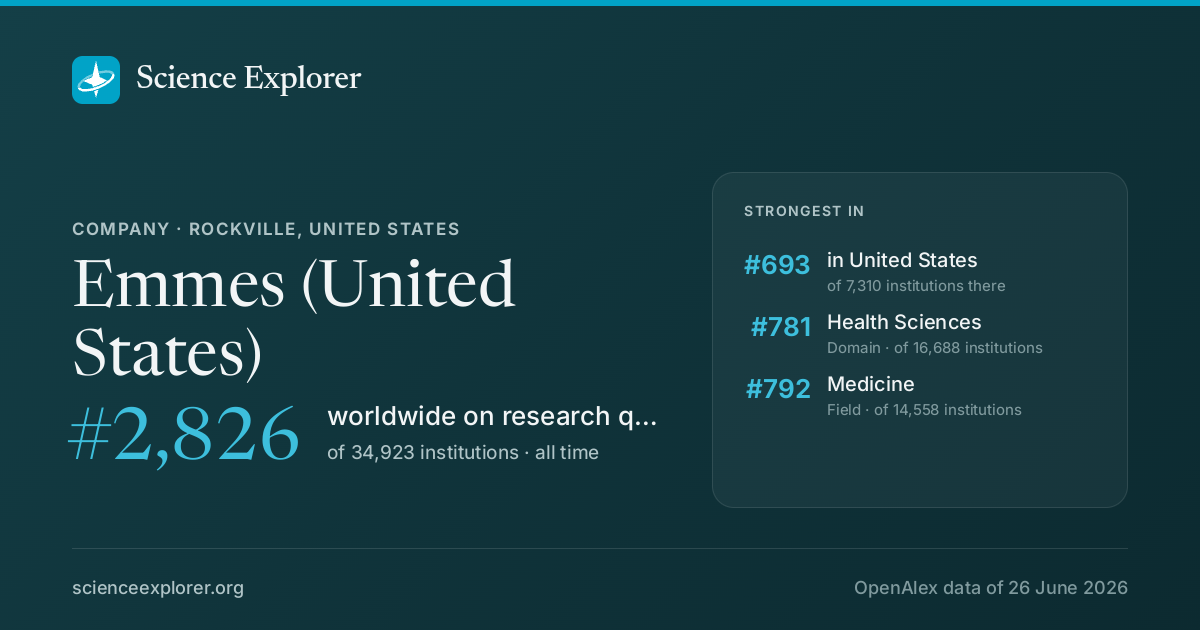
In research, Emmes (United States) stands highest in Health Sciences (#781 of 16,688 worldwide) and Medicine (#792 of 14,558 worldwide), over all time.
- World rank, all time
- #2,826 of 34,923
- Rank in United States
- #693 of 7,310
- Research works
- 501 ▼ 46% vs 2018-21
- Citations
- 28k 56.5 per fractional work
- Top-10% rate
- 18.6% all institutions 10.0%
- vs its own fields
- 1.29× 1.00× is exactly expected
- Open access
- 48% world 40%
- International
- 19% world 18%
What is Emmes (United States) known for in research?
The fields where it stands highest, over all time, ranked among every institution above the floor in each field.
| Field | World rank | Where that sits | Top-10% rate | Works |
|---|---|---|---|---|
| Health SciencesDomain | #781 of 16,688 | 23.5% | 352 | |
| MedicineField | #792 of 14,558 | 23.9% | 331 |
Each strip is that field's whole ranked pool, with the notch where Emmes (United States) sits in it, in the colour of the band that rank falls in. The track under the rate is the rate itself: it carries no average mark, because the average differs by field (from about 6% in Dentistry to 21% in Economics).
Which fields of science does Emmes (United States) work in?
In 2022-now, 73% of research at Emmes (United States) is in Health Sciences, 21% in Life Sciences. Its largest fields are Medicine (69%), Biochemistry, Genetics and Molecular Biology (12%), Immunology and Microbiology (6%). It does 2.7× the world's share of Health Sciences.
Each ring splits the one inside it: the four domains of science, their fields, their subfields. Size is fractional works in 2022-now. Every slice is a page; the interactive view zooms down to single topics and colours each by how much more of it this institution does than the world.
Its 4 domains and 18 fields, with their numbers
- Health Sciences4072.5%
- Medicine3869.2%
- Health Professions22.8%
- Nursing00.3%
- Dentistry00.1%
- Veterinary00.1%
- Life Sciences1120.5%
- Social Sciences34.7%
- Social Sciences11.6%
- Psychology11.5%
- Economics, Econometrics and Finance11.3%
- Decision Sciences00.3%
- Physical Sciences12.3%
- Mathematics11.1%
- Computer Science11.0%
- Environmental Science00.1%
- Materials Science00.1%
Field profile
Location quotient across every field it publishes in: outside the ring is more than an institution of this size would be expected to publish, inside it is less.
Rings at 0.5×, 1× and 2×. Widest outward: Immunology and Microbiology, 6.1×. Every wedge is a field page.
All 18 fields, with their numbers
- Immunology and Microbiology6.10×3 works
- Medicine3.60×38 works
- Biochemistry, Genetics and Molecular Biology2.21×6 works
- Pharmacology, Toxicology and Pharmaceutics1.73×0 works
- Health Professions1.04×2 works
- Mathematics0.94×1 works
- Veterinary0.90×0 works
- Neuroscience0.86×1 works
- Nursing0.64×0 works
- Economics, Econometrics and Finance0.58×1 works
- Psychology0.50×1 works
- Decision Sciences0.34×0 works
- Dentistry0.25×0 works
- Computer Science0.13×0 works
- Social Sciences0.13×1 works
- Agricultural and Biological Sciences0.12×0 works
- Environmental Science0.02×0 works
- Materials Science0.02×0 works
- Immunology and Microbiology 6.1×
- Medicine 3.6×
- Biochemistry, Genetics and Molecular Biology 2.2×
- Pharmacology, Toxicology and Pharmaceutics 1.7×
- Health Professions 1.0×
- Mathematics 0.9×
- Veterinary 0.9×
- Neuroscience 0.9×
- Nursing 0.6×
- Economics, Econometrics and Finance 0.6×
- Psychology 0.5×
- Decision Sciences 0.3×
- Dentistry 0.2×
- Computer Science 0.1×
- Social Sciences 0.1×
- Agricultural and Biological Sciences 0.1×
- Environmental Science 0.0×
- Materials Science 0.0×
Who are the top researchers at Emmes (United States)?
Ranked on the quality score, Traci E. Clemons, Donald M. Stablein and Adam M. Mendizabal lead among researchers whose main affiliation is Emmes (United States).
- 1
Traci E. Clemons
 United States · #66,093 worldwide
13k citations · 251 works
- 2
Donald M. Stablein
United States · #77,961 worldwide
19k citations · 177 works
- 3
Adam M. Mendizabal
United States · #97,119 worldwide
11k citations · 140 works
- 4
Mat Makowski
United States · #129,076 worldwide
18k citations · 45 works
- 5
Karen L Martz
United States · #165,993 worldwide
10k citations · 128 works
- 6
Martin Ho
United States · #196,972 worldwide
4.2k citations · 102 works
- 7
Anne S. Lindblad
United States · #208,331 worldwide
9.2k citations · 110 works
- 8
Robert Lindblad
United States · #208,830 worldwide
8.7k citations · 114 works
- 9
Alice K. Henning
United States · #213,140 worldwide
9.4k citations · 78 works
- 10
Mark Wolff
United States · #245,608 worldwide
7.6k citations · 80 works
Which keywords describe research at Emmes (United States)?
By fractional works in 2022-now, weighted toward what it does more of than the world: Epidemiology, Substance Use Disorders, Psychiatric Disorders, Pathogenesis, Vaccine Development, Chronic Pain Management, Opioid Prescribing and Global Burden of Disease.
- Viral Infections
- Medication Adherence
- Influenza
- Antigen Presentation
- Virus
- Genomics
- drug use
- Immunosuppressive Drugs
- Vascular Endothelial Growth Factor
- Immunity
- Antimicrobial Resistance
- Immune Response
- Clinical Trials
- Macular Degeneration
- Global Burden of Disease
- Pandemic
- Chronic Pain Management
- Psychiatric Disorders
- Oxidative Stress
- Substance Use Disorders
- Epidemiology
- Inflammation
- Pathogenesis
- Vaccine Development
- Opioid Prescribing
- Alcohol Dependence
- Motivational Interviewing
- Vaccine
- Diabetic Retinopathy
- SARS-CoV-2
- HIV
- Retinal Pigment Epithelium
- ACE2 Receptor
- Substance Abuse
- harm reduction
- Graft Survival
- Antibodies
- Disease Burden
- Vaccines
- Respiratory
Size is fractional works in 2022-now in the topics tagged with each word; colour is the word's share of this institution's work against its share of the world's. The 40 words are chosen for being large and distinctive. Each links to the topic it comes from most.
All 40 words, with their numbers
- Epidemiology11▲ 5.0×56 topics
- Substance Use Disorders5▲ 111×2 topics
- Inflammation3▲ 2.9×19 topics
- Oxidative Stress3▲ 3.2×10 topics
- Pathogenesis3▲ 9.3×12 topics
- Psychiatric Disorders3▲ 35×2 topics
- Vaccine Development2▲ 18×6 topics
- Chronic Pain Management2▲ 132×1 topic
- Opioid Prescribing2▲ 132×1 topic
- Pandemic2▲ 4.3×4 topics
- Alcohol Dependence2▲ 95×1 topic
- Global Burden of Disease2▲ 16×2 topics
- Motivational Interviewing2▲ 95×1 topic
- Macular Degeneration2▲ 29×3 topics
- Vaccine2▲ 9.4×10 topics
- Clinical Trials2▲ 4.9×9 topics
- Diabetic Retinopathy2▲ 31×2 topics
- Immune Response2▲ 5.5×12 topics
- SARS-CoV-22▲ 10×5 topics
- Antimicrobial Resistance2▲ 13×4 topics
- HIV2▲ 33×4 topics
- Immunity2▲ 6.8×5 topics
- Retinal Pigment Epithelium1▲ 48×1 topic
- Vascular Endothelial Growth Factor1▲ 30×1 topic
- ACE2 Receptor1▲ 10×3 topics
- Immunosuppressive Drugs1▲ 39×2 topics
- Substance Abuse1▲ 36×2 topics
- drug use1▲ 81×1 topic
- harm reduction1▲ 81×1 topic
- Genomics1▲ 7.4×3 topics
- Graft Survival1▲ 25×2 topics
- Virus1▲ 24×2 topics
- Antibodies1▲ 36×2 topics
- Antigen Presentation1▲ 22×2 topics
- Disease Burden1▲ 28×2 topics
- Influenza1▲ 50×2 topics
- Vaccines1▲ 35×2 topics
- Medication Adherence1▲ 35×2 topics
- Respiratory1▲ 19×2 topics
- Viral Infections1▲ 33×2 topics
Which research topics does Emmes (United States) publish most on?
By volume in 2022-now: Opioid Use Disorder Treatment, Substance Abuse Treatment and Outcomes, Retinal Diseases and Treatments and HIV, Drug Use, Sexual Risk.
Area is fractional works; colour is the subfield each topic belongs to.
- 1 Opioid Use Disorder Treatment Public Health, Environmental and Occupational Health 2 works
- 2 Substance Abuse Treatment and Outcomes Epidemiology 2 works
- 3 Retinal Diseases and Treatments Ophthalmology 1 works
- 4 HIV, Drug Use, Sexual Risk Epidemiology 1 works
- 5 Influenza Virus Research Studies Epidemiology 1 works
- 6 Respiratory viral infections research Epidemiology 1 works
- 7 vaccines and immunoinformatics approaches Molecular Biology 1 works
- 8 Renal Transplantation Outcomes and Treatments Transplantation 1 works
- 9 Ethics in Clinical Research Public Health, Environmental and Occupational Health 1 works
- 10 Genetic Syndromes and Imprinting Genetics 1 works
How open and international is its research?
Against the world's own shares: the tick on each track. Both are shares of its output, so they sit on one scale and can be read against each other as well as against the world.
World: 40% of research is openly available.
World: 18% is written across borders.
How has Emmes (United States)'s research output changed?
Output in 2022-2025 was 46% lower than in 2018-2021.
The same series as a ribbon: one cell per year, darker for more. The line above answers how much; this answers when.
Its share of all research
Growing output can still be a shrinking share: all of science grows. This is Emmes (United States) as a percentage of every work published that year, 0.00020% in 2024.
Fractional works of Emmes (United States) over all fractional works that year. How the balance of science has shifted.
How much of it reaches the world top 10%
Year by year, against all institutions in the same year.
Of each year's output, the share that reached the world's 10% most cited for its field and year. Peak 29.0% in 2012.
Other research institutions in Rockville
- United States Nuclear Regulatory Commission
- Signal Processing (United States)
- Orthopaedic Center
- Biomedical Research Institute
- Westat (United States)
- Research Applications (United States)
- Kai Research (United States)
- Micro Focus (United States)

Share Emmes (United States)'s ranking



Research measures only: rankings here say nothing about teaching, admissions or student experience. Comparable institutions and collaboration partners have tabs of their own, above.
Discussion
Ask a question or share a note about Emmes (United States). Posts are plain text and can be reported.