Science Explorer Back to mapMap
Discussion
Company · London · United Kingdom

Future Science Group (United Kingdom)

World rank, 2022-now
#20,175
of 22,385 · #31,807 all time
Rank in United Kingdom
#745
of 862
Research works
375
▼ 29% vs 2018-21
Citations
1.9k
5.1 per fractional work
Top-10% rate
5.5%
all institutions 10.0%
vs its own fields
0.88×
1.00× is exactly expected
Open access
52%
world 40%
International
12%
world 18%

Which fields of science does Future Science Group (United Kingdom) work in?

In 2022-now, 32% of research at Future Science Group (United Kingdom) is in Life Sciences, 27% in Health Sciences. Its largest fields are Medicine (26%), Biochemistry, Genetics and Molecular Biology (21%), Engineering (12%). It does 2.2× the world's share of Life Sciences.

Life Sciences: 32 fractional works · 32.4% of its workBiochemistry, Genetics and Molecular Biology: 21 fractional works · 21.3% of its workMolecular Biology: 15 fractional works · 14.9% of its workCancer Research: 2 fractional works · 1.9% of its workBiophysics: 2 fractional works · 1.8% of its workGenetics: 1 fractional works · 0.8% of its workPhysiology: 0 fractional works · 0.5% of its workCell Biology: 0 fractional works · 0.4% of its workEndocrinology: 0 fractional works · 0.4% of its workClinical Biochemistry: 0 fractional works · 0.3% of its workStructural Biology: 0 fractional works · 0.3% of its workImmunology and Microbiology: 6 fractional works · 5.5% of its workImmunology: 5 fractional works · 4.5% of its workParasitology: 1 fractional works · 0.7% of its workVirology: 0 fractional works · 0.3% of its workAgricultural and Biological Sciences: 3 fractional works · 3.4% of its workPlant Science: 2 fractional works · 1.8% of its workAgronomy and Crop Science: 0 fractional works · 0.4% of its workAnimal Science and Zoology: 0 fractional works · 0.3% of its workFood Science: 0 fractional works · 0.2% of its workSmaller subfields together: 1 fractional works · 0.6% of its workPharmacology, Toxicology and Pharmaceutics: 2 fractional works · 1.7% of its workPharmacology: 1 fractional works · 1.2% of its workPharmaceutical Science: 1 fractional works · 0.6% of its workNeuroscience: 0 fractional works · 0.3% of its workCognitive Neuroscience: 0 fractional works · 0.3% of its workHealth Sciences: 27 fractional works · 27.0% of its workMedicine: 26 fractional works · 25.8% of its workInfectious Diseases: 4 fractional works · 4.1% of its workPulmonary and Respiratory Medicine: 3 fractional works · 2.7% of its workOncology: 3 fractional works · 2.6% of its workSurgery: 3 fractional works · 2.5% of its workCardiology and Cardiovascular Medicine: 2 fractional works · 2.0% of its workRadiology, Nuclear Medicine and Imaging: 2 fractional works · 2.0% of its workPharmacology: 2 fractional works · 1.7% of its workPediatrics, Perinatology and Child Health: 1 fractional works · 1.3% of its workEpidemiology: 1 fractional works · 1.3% of its workPhysiology: 1 fractional works · 0.8% of its workNeurology: 1 fractional works · 0.7% of its workPsychiatry and Mental health: 1 fractional works · 0.7% of its workGenetics: 1 fractional works · 0.7% of its workHealth Informatics: 1 fractional works · 0.5% of its workPublic Health, Environmental and Occupational Health: 1 fractional works · 0.5% of its workReproductive Medicine: 0 fractional works · 0.5% of its workAnesthesiology and Pain Medicine: 0 fractional works · 0.3% of its workHematology: 0 fractional works · 0.3% of its workSmaller subfields together: 1 fractional works · 0.6% of its workHealth Professions: 1 fractional works · 1.0% of its workGeneral Health Professions: 1 fractional works · 0.5% of its workHealth Information Management: 0 fractional works · 0.3% of its workSmaller subfields together: 0 fractional works · 0.1% of its workDentistry: 0 fractional works · 0.2% of its workPhysical Sciences: 26 fractional works · 25.9% of its workEngineering: 12 fractional works · 11.9% of its workBiomedical Engineering: 4 fractional works · 4.3% of its workMedia Technology: 2 fractional works · 2.0% of its workElectrical and Electronic Engineering: 1 fractional works · 1.0% of its workAerospace Engineering: 1 fractional works · 1.0% of its workOcean Engineering: 1 fractional works · 0.8% of its workSafety, Risk, Reliability and Quality: 1 fractional works · 0.7% of its workBuilding and Construction: 1 fractional works · 0.5% of its workControl and Systems Engineering: 0 fractional works · 0.5% of its workMechanical Engineering: 0 fractional works · 0.4% of its workCivil and Structural Engineering: 0 fractional works · 0.3% of its workIndustrial and Manufacturing Engineering: 0 fractional works · 0.3% of its workSmaller subfields together: 0 fractional works · 0.1% of its workEnvironmental Science: 6 fractional works · 6.2% of its workEcology: 2 fractional works · 1.5% of its workEnvironmental Engineering: 1 fractional works · 1.5% of its workGlobal and Planetary Change: 1 fractional works · 1.4% of its workPollution: 1 fractional works · 0.8% of its workEnvironmental Chemistry: 0 fractional works · 0.3% of its workWater Science and Technology: 0 fractional works · 0.2% of its workHealth, Toxicology and Mutagenesis: 0 fractional works · 0.2% of its workManagement, Monitoring, Policy and Law: 0 fractional works · 0.2% of its workSmaller subfields together: 0 fractional works · 0.1% of its workComputer Science: 3 fractional works · 3.1% of its workInformation Systems: 1 fractional works · 0.9% of its workComputational Theory and Mathematics: 1 fractional works · 0.8% of its workArtificial Intelligence: 1 fractional works · 0.8% of its workComputer Networks and Communications: 0 fractional works · 0.3% of its workSmaller subfields together: 0 fractional works · 0.2% of its workChemistry: 2 fractional works · 1.6% of its workOrganic Chemistry: 1 fractional works · 0.7% of its workSpectroscopy: 1 fractional works · 0.7% of its workSmaller subfields together: 0 fractional works · 0.2% of its workMaterials Science: 1 fractional works · 0.9% of its workMaterials Chemistry: 1 fractional works · 0.6% of its workBiomaterials: 0 fractional works · 0.3% of its workEarth and Planetary Sciences: 1 fractional works · 0.8% of its workGeology: 1 fractional works · 0.7% of its workSmaller subfields together: 0 fractional works · 0.2% of its workPhysics and Astronomy: 1 fractional works · 0.5% of its workAtomic and Molecular Physics, and Optics: 0 fractional works · 0.4% of its workSmaller subfields together: 0 fractional works · 0.1% of its workEnergy: 0 fractional works · 0.4% of its workEnergy Engineering and Power Technology: 0 fractional works · 0.3% of its workSmaller subfields together: 0 fractional works · 0.1% of its workMathematics: 0 fractional works · 0.4% of its workStatistics and Probability: 0 fractional works · 0.4% of its workSocial Sciences: 15 fractional works · 14.7% of its workSocial Sciences: 8 fractional works · 8.4% of its workSociology and Political Science: 3 fractional works · 2.7% of its workGeography, Planning and Development: 2 fractional works · 1.7% of its workPolitical Science and International Relations: 1 fractional works · 1.0% of its workSafety Research: 1 fractional works · 0.8% of its workPublic Administration: 1 fractional works · 0.5% of its workDevelopment: 0 fractional works · 0.5% of its workCultural Studies: 0 fractional works · 0.3% of its workHealth: 0 fractional works · 0.3% of its workEducation: 0 fractional works · 0.3% of its workLibrary and Information Sciences: 0 fractional works · 0.2% of its workEconomics, Econometrics and Finance: 3 fractional works · 2.6% of its workEconomics and Econometrics: 2 fractional works · 2.1% of its workGeneral Economics, Econometrics and Finance: 0 fractional works · 0.3% of its workSmaller subfields together: 0 fractional works · 0.2% of its workBusiness, Management and Accounting: 2 fractional works · 1.6% of its workStrategy and Management: 1 fractional works · 1.0% of its workManagement Information Systems: 0 fractional works · 0.3% of its workSmaller subfields together: 0 fractional works · 0.2% of its workDecision Sciences: 1 fractional works · 1.3% of its workInformation Systems and Management: 1 fractional works · 0.6% of its workManagement Science and Operations Research: 1 fractional works · 0.6% of its workArts and Humanities: 1 fractional works · 0.6% of its workArcheology: 0 fractional works · 0.3% of its workSmaller subfields together: 0 fractional works · 0.3% of its workPsychology: 0 fractional works · 0.3% of its workALL ITS WORKFuture ScienceGroup (United…100fractional works, 2022-now
Life Sciences32%Physical Sciences26%Health Sciences27%Social Sciences15%

Each ring splits the one inside it: the four domains of science, their fields, their subfields. Size is fractional works in 2022-now. Every slice is a page; the interactive view zooms down to single topics and colours each by how much more of it this institution does than the world.

Its 4 domains and 23 fields, with their numbers
    1. Biochemistry, Genetics and Molecular Biology2121.3%
    2. Immunology and Microbiology65.5%
    3. Agricultural and Biological Sciences33.4%
    4. Pharmacology, Toxicology and Pharmaceutics21.7%
    5. Neuroscience00.3%
    1. Medicine2625.8%
    2. Health Professions11.0%
    3. Dentistry00.2%
    1. Engineering1211.9%
    2. Environmental Science66.2%
    3. Computer Science33.1%
    4. Chemistry21.6%
    5. Materials Science10.9%
    6. Earth and Planetary Sciences10.8%
    7. Physics and Astronomy10.5%
    8. Energy00.4%
    9. Mathematics00.4%
    1. Social Sciences88.4%
    2. Economics, Econometrics and Finance32.6%
    3. Business, Management and Accounting21.6%
    4. Decision Sciences11.3%
    5. Arts and Humanities10.6%
    6. Psychology00.3%
All of science, and how each field's share has moved since 1950: the Science domain explorer

Field profile

Location quotient across every field it publishes in: outside the ring is more than an institution of this size would be expected to publish, inside it is less.

Agricultural and Biological Sciences: 0.72× its world share, 3 worksAgricultural and Bio…Biochemistry, Genetics and Molecular Biology: 4.00× its world share, 21 worksBiochemistry, Geneti…Immunology and Microbiology: 5.51× its world share, 6 worksImmunology and Micro…Neuroscience: 0.21× its world share, 0 worksNeurosciencePharmacology, Toxicology and Pharmaceutics: 4.95× its world share, 2 worksPharmacology, Toxico…Chemistry: 0.99× its world share, 2 worksChemistryComputer Science: 0.40× its world share, 3 worksComputer ScienceEarth and Planetary Sciences: 0.53× its world share, 1 worksEarth and Planetary …Energy: 0.48× its world share, 0 worksEnergyEngineering: 0.79× its world share, 12 worksEngineeringEnvironmental Science: 1.26× its world share, 6 worksEnvironmental ScienceMaterials Science: 0.26× its world share, 1 worksMaterials ScienceMathematics: 0.35× its world share, 0 worksMathematicsPhysics and Astronomy: 0.24× its world share, 0 worksPhysics and AstronomyDentistry: 0.41× its world share, 0 worksDentistryHealth Professions: 0.38× its world share, 1 worksHealth ProfessionsMedicine: 1.34× its world share, 26 worksMedicineArts and Humanities: 0.23× its world share, 1 worksArts and HumanitiesBusiness, Management and Accounting: 0.49× its world share, 2 worksBusiness, Management…Decision Sciences: 1.30× its world share, 1 worksDecision SciencesEconomics, Econometrics and Finance: 1.21× its world share, 3 worksEconomics, Econometr…Psychology: 0.09× its world share, 0 worksPsychologySocial Sciences: 0.66× its world share, 8 worksSocial Sciences1×world share
more than its size predictsabout as predictedless

Rings at 0.5×, 1× and 2×. Widest outward: Immunology and Microbiology, 5.5×. Every wedge is a field page.

All 23 fields, with their numbers
  1. Immunology and Microbiology5.51×6 works
  2. Pharmacology, Toxicology and Pharmaceutics4.95×2 works
  3. Biochemistry, Genetics and Molecular Biology4.00×21 works
  4. Medicine1.34×26 works
  5. Decision Sciences1.30×1 works
  6. Environmental Science1.26×6 works
  7. Economics, Econometrics and Finance1.21×3 works
  8. Chemistry0.99×2 works
  9. Engineering0.79×12 works
  10. Agricultural and Biological Sciences0.72×3 works
  11. Social Sciences0.66×8 works
  12. Earth and Planetary Sciences0.53×1 works
  13. Business, Management and Accounting0.49×2 works
  14. Energy0.48×0 works
  15. Dentistry0.41×0 works
  16. Computer Science0.40×3 works
  17. Health Professions0.38×1 works
  18. Mathematics0.35×0 works
  19. Materials Science0.26×1 works
  20. Physics and Astronomy0.24×0 works
  21. Arts and Humanities0.23×1 works
  22. Neuroscience0.21×0 works
  23. Psychology0.09×0 works

Who are the top researchers at Future Science Group (United Kingdom)?

Ranked on the quality score, Laura Dormer, Joanne Walker and Rachel Jenkins lead among researchers whose main affiliation is Future Science Group (United Kingdom).

  1. 1 Laura Dormer United Kingdom · #1,765,939 worldwide 597 citations · 51 works
  2. 2 Joanne Walker United Kingdom · #2,157,880 worldwide 269 citations · 18 works
  3. 3 Rachel Jenkins United Kingdom · #4,739,340 worldwide 57 citations · 17 works
  4. 4 Alexandra Sklan United Kingdom · #4,837,896 worldwide 74 citations · 32 works
  5. 5 Gino D’Oca United Kingdom · #5,243,695 worldwide 22 citations · 18 works
  6. 6 Sonia Mannan United Kingdom · #5,602,325 worldwide 72 citations · 15 works
  7. 7 Rosalind Hill United Kingdom · #5,606,247 worldwide 14 citations · 17 works
  8. 8 Elisa Manzotti United Kingdom · #5,627,515 worldwide 257 citations · 30 works
  9. 9 Sankeetha Nadarajah United Kingdom · #5,934,065 worldwide 24 citations · 19 works
  10. 10 Joseph Martin United Kingdom · #6,112,297 worldwide 61 citations · 20 works
All ranked researchers at Future Science Group (United Kingdom)

What are the most cited papers from Future Science Group (United Kingdom)?

The most cited paper from Future Science Group (United Kingdom) is "Macroevolutionary convergence connects morphological form to ecological function in birds" (Alex L. Pigot, Catherine Sheard, Eliot T. Miller et al., 2020), with 567 citations. Next come "Good Publication Practice (GPP) Guidelines for Company-Sponsored Biomedical Research: 2022 Update" (270) and "Peak Serum: Implications of Serum Supply for Cell Therapy Manufacturing" (145).

Most cited papers
#PaperReleasedCitations
1 Macroevolutionary convergence connects morphological form to ecological function in birds Alex L. Pigot, Catherine Sheard, Eliot T. Miller et al. · Nature Ecology & Evolution Open access 13 Jan 2020 567
2 Good Publication Practice (GPP) Guidelines for Company-Sponsored Biomedical Research: 2022 Update Lisa M DeTora, Dikran Toroser, Angela Sykes et al. · Annals of Internal Medicine 29 Aug 2022 270
3 Peak Serum: Implications of Serum Supply for Cell Therapy Manufacturing David A. Brindley, Natasha L. Davie, Emily J Culme-Seymour et al. · Regenerative Medicine 15 Dec 2011 145
4 Enhanced Weathering Using Basalt Rock Powder: Carbon Sequestration, Co-benefits and Risks in a Mesocosm Study With Solanum tuberosum Arthur Vienne, Sílvia Poblador, Miguel Portillo‐Estrada et al. · Frontiers in Climate Open access 17 May 2022 127
5 Student engagement with sustainability: understanding the value–action gap Gareth Chaplin, Paul Wyton · International Journal of Sustainability in Higher Education 26 Aug 2014 125
All 60 most cited papers, with filters and sorting

Which keywords describe research at Future Science Group (United Kingdom)?

By fractional works in 2022-now, weighted toward what it does more of than the world: Clinical Outcomes, Biosimilars, Immunogenicity, Gene Expression, SARS-CoV-2, Vaccine, Clinical Trials and Biosensors.

▲ more of its work than of the world's◆ about the world's share▼ less than the world's

Size is fractional works in 2022-now in the topics tagged with each word; colour is the word's share of this institution's work against its share of the world's. The 40 words are chosen for being large and distinctive. Each links to the topic it comes from most.

All 40 words, with their numbers
  1. Epidemiology6▲ 1.48×18 topics
  2. Machine Learning5▲ 1.63×10 topics
  3. Deep Learning4▲ 1.23×10 topics
  4. Clinical Outcomes4▲ 19×4 topics
  5. Gene Expression4▲ 6.4×8 topics
  6. Biosimilars4▲ 192×1 topic
  7. Immunogenicity4▲ 89×1 topic
  8. Artificial Intelligence3▲ 2.3×5 topics
  9. Big Data3▲ 3.5×4 topics
  10. Clinical Trials3▲ 4.8×7 topics
  11. SARS-CoV-23▲ 10×3 topics
  12. Remote Sensing3▲ 2.5×7 topics
  13. Vaccine3▲ 7.5×4 topics
  14. Biosensors3▲ 5.9×3 topics
  15. Biomarkers3▲ 3.8×8 topics
  16. Chemotherapy2▲ 3.3×5 topics
  17. RNA-Seq2▲ 18×2 topics
  18. Precision Medicine2▲ 4.2×6 topics
  19. Coronavirus2▲ 10×2 topics
  20. Data Analysis2▲ 7.7×2 topics
  21. Governance2▲ 6.1×3 topics
  22. Immunity2▲ 5.0×2 topics
  23. Image Processing2▲ 4.3×3 topics
  24. Microfluidic Devices2▲ 16×2 topics
  25. Pharmacokinetics2▲ 7.0×2 topics
  26. Cost-effectiveness Analysis2▲ 22×1 topic
  27. Genomics2▲ 5.7×3 topics
  28. Geospatial Crowdsourcing2▲ 86×1 topic
  29. Health Utility Measures2▲ 22×1 topic
  30. Security and Privacy2▲ 8.8×3 topics
  31. Smart Cities2▲ 6.3×2 topics
  32. Volunteered Geographic Information2▲ 86×1 topic
  33. antibody2▲ 17×1 topic
  34. spike protein2▲ 17×1 topic
  35. Cellular Imaging2▲ 16×2 topics
  36. Targeted Therapy2▲ 7.1×3 topics
  37. Bioimage Analysis2▲ 39×1 topic
  38. High-Content Screening2▲ 39×1 topic
  39. Loop-Mediated Isothermal Amplification1▲ 25×1 topic
  40. Paper-Based Microfluidics1▲ 25×1 topic

Which research topics does Future Science Group (United Kingdom) publish most on?

By volume in 2022-now: Biosimilars and Bioanalytical Methods, Geographic Information Systems Studies, SARS-CoV-2 and COVID-19 Research and Health Systems, Economic Evaluations, Quality of Life.

  1. 1 Biosimilars and Bioanalytical Methods Immunology 4 works
  2. 2 Geographic Information Systems Studies Geography, Planning and Development 2 works
  3. 3 SARS-CoV-2 and COVID-19 Research Infectious Diseases 2 works
  4. 4 Health Systems, Economic Evaluations, Quality of Life Economics and Econometrics 2 works
  5. 5 Cell Image Analysis Techniques Biophysics 2 works
  6. 6 Biosensors and Analytical Detection Biomedical Engineering 1 works
  7. 7 Molecular Biology Techniques and Applications Molecular Biology 1 works
  8. 8 Smart Cities and Technologies Media Technology 1 works
  9. 9 Single-cell and spatial transcriptomics Molecular Biology 1 works
  10. 10 Epigenetics and DNA Methylation Molecular Biology 1 works

How open and international is its research?

Against the world's own shares: the tick on each track. Both are shares of its output, so they sit on one scale and can be read against each other as well as against the world.

openly available52.2%not open47.8%

World: 40% of research is openly available.

with international co-authors12.3%domestic only87.7%

World: 18% is written across borders.

How has Future Science Group (United Kingdom)'s research output changed?

Output in 2022-2025 was 29% lower than in 2018-2021.

still counting1990200020102020
grewheldshrank

The same series as a ribbon: one cell per year, darker for more. The line above answers how much; this answers when.

Its share of all research

Growing output can still be a shrinking share: all of science grows. This is Future Science Group (United Kingdom) as a percentage of every work published that year, 0.00024% in 2024.

still counting0.00050%0.0010%0.0015%Future Science Group (United Kingdom)0.00021% in 20251990200020102020

Fractional works of Future Science Group (United Kingdom) over all fractional works that year. How the balance of science has shifted.

How much of it reaches the world top 10%

Year by year, against all institutions in the same year.

5%10%all institutions10.0% in 2023Future Science Group (United Kingdom)2.5% in 20232020

Of each year's output, the share that reached the world's 10% most cited for its field and year. Peak 3.7% in 2022.

Other research institutions in London

All research institutions in London

Share Future Science Group (United Kingdom)'s ranking
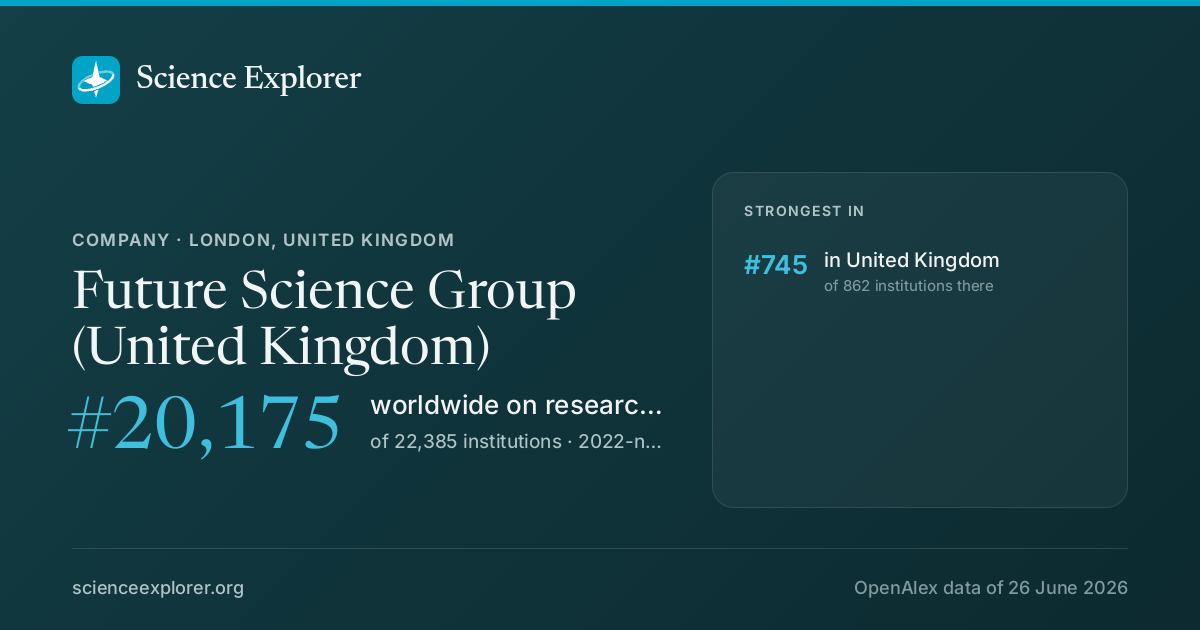
Future Science Group (United Kingdom) on Science Explorer

A card with Future Science Group (United Kingdom)'s standing and the fields it leads in, for a post or a slide. A link to this page previews as the same card.

Download the card

1200 × 630 PNG, sized for social posts, drawn from the latest snapshot.

Badges for a website1Each links back here and updates with every snapshot

Research measures only: rankings here say nothing about teaching, admissions or student experience. Comparable institutions and collaboration partners have tabs of their own, above.

Discussion

Ask a question or share a note about Future Science Group (United Kingdom). Keep it to the research: no personal attacks, advertising or links. Any reader can report a post, which collapses it for everyone until it is opened.