Science Explorer Back to mapMap
University · Seosan City · South Korea

Hanseo University

In research, Hanseo University stands highest in Physical Sciences (#5,700 of 10,670 worldwide) and Social Sciences (#8,630 of 9,585 worldwide), 2022-now.

World rank, 2022-now
#8,494
of 22,385 · #16,053 all time
Rank in South Korea
#144
of 343
Research works
1.8k
▼ 11% vs 2018-21
Citations
19k
10.5 per fractional work
Top-10% rate
5.9%
all institutions 10.0%
vs its own fields
0.84×
1.00× is exactly expected
Open access
56%
world 40%
International
17%
world 18%

What is Hanseo University known for in research?

The fields where it stands highest, 2022-now, ranked among every institution above the floor in each field.

FieldWorld rankWhere that sitsTop-10% rateWorksAll time
Physical SciencesDomain #5,700 of 10,670 6.0%156 #13342
Social SciencesDomain #8,630 of 9,585 6.4%73 #13504

Each strip is that field's whole ranked pool, with the notch where Hanseo University sits in it, in the colour of the band that rank falls in. The track under the rate is the rate itself: it carries no average mark, because the average differs by field (from about 6% in Dentistry to 21% in Economics).

Which fields of science does Hanseo University work in?

In 2022-now, 52% of research at Hanseo University is in Physical Sciences, 25% in Social Sciences. Its largest fields are Engineering (20%), Medicine (12%), Social Sciences (10%). It does 1.3× the world's share of Physical Sciences.

Physical Sciences: 174 fractional works · 52.3% of its workEngineering: 65 fractional works · 19.6% of its workElectrical and Electronic Engineering: 17 fractional works · 5.2% of its workBiomedical Engineering: 11 fractional works · 3.4% of its workAerospace Engineering: 11 fractional works · 3.2% of its workControl and Systems Engineering: 6 fractional works · 1.7% of its workAutomotive Engineering: 5 fractional works · 1.4% of its workMechanical Engineering: 4 fractional works · 1.1% of its workCivil and Structural Engineering: 3 fractional works · 1.0% of its workBuilding and Construction: 2 fractional works · 0.7% of its workOcean Engineering: 2 fractional works · 0.5% of its workComputational Mechanics: 2 fractional works · 0.5% of its workIndustrial and Manufacturing Engineering: 1 fractional works · 0.3% of its workSafety, Risk, Reliability and Quality: 1 fractional works · 0.3% of its workSmaller subfields together: 1 fractional works · 0.2% of its workComputer Science: 31 fractional works · 9.2% of its workInformation Systems: 12 fractional works · 3.6% of its workComputer Graphics and Computer-Aided Design: 6 fractional works · 1.8% of its workArtificial Intelligence: 5 fractional works · 1.5% of its workComputer Vision and Pattern Recognition: 4 fractional works · 1.3% of its workComputer Networks and Communications: 2 fractional works · 0.5% of its workSmaller subfields together: 2 fractional works · 0.5% of its workMaterials Science: 29 fractional works · 8.6% of its workMaterials Chemistry: 21 fractional works · 6.3% of its workElectronic, Optical and Magnetic Materials: 3 fractional works · 1.0% of its workPolymers and Plastics: 2 fractional works · 0.7% of its workBiomaterials: 1 fractional works · 0.4% of its workSmaller subfields together: 1 fractional works · 0.2% of its workEnvironmental Science: 20 fractional works · 5.8% of its workGlobal and Planetary Change: 4 fractional works · 1.3% of its workEnvironmental Engineering: 3 fractional works · 0.9% of its workWater Science and Technology: 3 fractional works · 0.8% of its workHealth, Toxicology and Mutagenesis: 3 fractional works · 0.8% of its workManagement, Monitoring, Policy and Law: 3 fractional works · 0.8% of its workIndustrial and Manufacturing Engineering: 1 fractional works · 0.4% of its workPollution: 1 fractional works · 0.3% of its workEcology: 1 fractional works · 0.3% of its workSmaller subfields together: 0 fractional works · 0.1% of its workEnergy: 12 fractional works · 3.7% of its workRenewable Energy, Sustainability and the Environment: 12 fractional works · 3.7% of its workChemistry: 6 fractional works · 1.8% of its workOrganic Chemistry: 3 fractional works · 0.8% of its workInorganic Chemistry: 1 fractional works · 0.4% of its workSpectroscopy: 1 fractional works · 0.2% of its workSmaller subfields together: 1 fractional works · 0.4% of its workPhysics and Astronomy: 4 fractional works · 1.1% of its workAtomic and Molecular Physics, and Optics: 2 fractional works · 0.7% of its workSmaller subfields together: 1 fractional works · 0.4% of its workMathematics: 3 fractional works · 1.0% of its workGeometry and Topology: 3 fractional works · 0.8% of its workSmaller subfields together: 1 fractional works · 0.2% of its workEarth and Planetary Sciences: 3 fractional works · 0.8% of its workAtmospheric Science: 1 fractional works · 0.4% of its workGeology: 1 fractional works · 0.3% of its workSmaller subfields together: 0 fractional works · 0.1% of its workChemical Engineering: 2 fractional works · 0.7% of its workBioengineering: 1 fractional works · 0.3% of its workCatalysis: 1 fractional works · 0.3% of its workSmaller subfields together: 0 fractional works · 0.1% of its workSocial Sciences: 83 fractional works · 24.8% of its workSocial Sciences: 34 fractional works · 10.1% of its workSociology and Political Science: 13 fractional works · 4.0% of its workCultural Studies: 6 fractional works · 1.7% of its workEducation: 6 fractional works · 1.7% of its workSafety Research: 3 fractional works · 0.8% of its workGeneral Social Sciences: 2 fractional works · 0.5% of its workTransportation: 2 fractional works · 0.5% of its workHealth: 1 fractional works · 0.3% of its workDemography: 1 fractional works · 0.2% of its workSmaller subfields together: 2 fractional works · 0.5% of its workPsychology: 23 fractional works · 7.0% of its workSocial Psychology: 11 fractional works · 3.2% of its workClinical Psychology: 7 fractional works · 2.1% of its workApplied Psychology: 3 fractional works · 0.8% of its workExperimental and Cognitive Psychology: 2 fractional works · 0.5% of its workDevelopmental and Educational Psychology: 1 fractional works · 0.3% of its workSmaller subfields together: 0 fractional works · 0.1% of its workBusiness, Management and Accounting: 10 fractional works · 3.0% of its workMarketing: 6 fractional works · 1.7% of its workBusiness and International Management: 2 fractional works · 0.5% of its workManagement of Technology and Innovation: 1 fractional works · 0.3% of its workOrganizational Behavior and Human Resource Management: 1 fractional works · 0.3% of its workStrategy and Management: 1 fractional works · 0.2% of its workSmaller subfields together: 1 fractional works · 0.2% of its workArts and Humanities: 7 fractional works · 2.0% of its workVisual Arts and Performing Arts: 3 fractional works · 0.8% of its workArcheology: 1 fractional works · 0.4% of its workConservation: 1 fractional works · 0.3% of its workSmaller subfields together: 2 fractional works · 0.5% of its workEconomics, Econometrics and Finance: 6 fractional works · 1.7% of its workEconomics and Econometrics: 3 fractional works · 0.9% of its workGeneral Economics, Econometrics and Finance: 2 fractional works · 0.7% of its workSmaller subfields together: 0 fractional works · 0.0% of its workDecision Sciences: 3 fractional works · 1.0% of its workInformation Systems and Management: 1 fractional works · 0.4% of its workStatistics, Probability and Uncertainty: 1 fractional works · 0.4% of its workManagement Science and Operations Research: 1 fractional works · 0.3% of its workHealth Sciences: 57 fractional works · 17.2% of its workMedicine: 40 fractional works · 11.9% of its workPublic Health, Environmental and Occupational Health: 5 fractional works · 1.5% of its workPhysiology: 4 fractional works · 1.3% of its workSurgery: 4 fractional works · 1.1% of its workRehabilitation: 3 fractional works · 0.8% of its workRadiology, Nuclear Medicine and Imaging: 2 fractional works · 0.5% of its workEndocrinology, Diabetes and Metabolism: 2 fractional works · 0.5% of its workPediatrics, Perinatology and Child Health: 2 fractional works · 0.5% of its workPulmonary and Respiratory Medicine: 2 fractional works · 0.5% of its workCardiology and Cardiovascular Medicine: 1 fractional works · 0.4% of its workEpidemiology: 1 fractional works · 0.4% of its workOncology: 1 fractional works · 0.4% of its workPharmacology: 1 fractional works · 0.4% of its workComplementary and alternative medicine: 1 fractional works · 0.3% of its workNephrology: 1 fractional works · 0.3% of its workDermatology: 1 fractional works · 0.3% of its workPathology and Forensic Medicine: 1 fractional works · 0.3% of its workInfectious Diseases: 1 fractional works · 0.3% of its workOrthopedics and Sports Medicine: 1 fractional works · 0.3% of its workPsychiatry and Mental health: 1 fractional works · 0.3% of its workRheumatology: 1 fractional works · 0.3% of its workTransplantation: 1 fractional works · 0.2% of its workHealth Informatics: 1 fractional works · 0.2% of its workSmaller subfields together: 2 fractional works · 0.6% of its workHealth Professions: 10 fractional works · 2.9% of its workGeneral Health Professions: 6 fractional works · 1.8% of its workRadiological and Ultrasound Technology: 1 fractional works · 0.2% of its workSmaller subfields together: 3 fractional works · 0.8% of its workNursing: 5 fractional works · 1.6% of its workLeadership and Management: 4 fractional works · 1.3% of its workNutrition and Dietetics: 1 fractional works · 0.2% of its workSmaller subfields together: 0 fractional works · 0.0% of its workDentistry: 3 fractional works · 0.9% of its workPeriodontics: 2 fractional works · 0.5% of its workSmaller subfields together: 1 fractional works · 0.4% of its workLife Sciences: 19 fractional works · 5.7% of its workBiochemistry, Genetics and Molecular Biology: 9 fractional works · 2.7% of its workMolecular Biology: 5 fractional works · 1.6% of its workGenetics: 1 fractional works · 0.4% of its workCell Biology: 1 fractional works · 0.3% of its workSmaller subfields together: 1 fractional works · 0.4% of its workAgricultural and Biological Sciences: 5 fractional works · 1.6% of its workPlant Science: 2 fractional works · 0.6% of its workFood Science: 1 fractional works · 0.4% of its workAquatic Science: 1 fractional works · 0.3% of its workSmaller subfields together: 1 fractional works · 0.4% of its workNeuroscience: 2 fractional works · 0.7% of its workCognitive Neuroscience: 1 fractional works · 0.2% of its workSmaller subfields together: 1 fractional works · 0.4% of its workImmunology and Microbiology: 1 fractional works · 0.4% of its workImmunology: 1 fractional works · 0.4% of its workSmaller subfields together: 0 fractional works · 0.1% of its workPharmacology, Toxicology and Pharmaceutics: 1 fractional works · 0.3% of its workALL ITS WORKHanseo University334fractional works, 2022-now
Life Sciences6%Physical Sciences52%Health Sciences17%Social Sciences25%

Each ring splits the one inside it: the four domains of science, their fields, their subfields. Size is fractional works in 2022-now. Every slice is a page; the interactive view zooms down to single topics and colours each by how much more of it this institution does than the world.

Its 4 domains and 25 fields, with their numbers
    1. Engineering6519.6%
    2. Computer Science319.2%
    3. Materials Science298.6%
    4. Environmental Science205.8%
    5. Energy123.7%
    6. Chemistry61.8%
    7. Physics and Astronomy41.1%
    8. Mathematics31.0%
    9. Earth and Planetary Sciences30.8%
    10. Chemical Engineering20.7%
    1. Social Sciences3410.1%
    2. Psychology237.0%
    3. Business, Management and Accounting103.0%
    4. Arts and Humanities72.0%
    5. Economics, Econometrics and Finance61.7%
    6. Decision Sciences31.0%
    1. Medicine4011.9%
    2. Health Professions102.9%
    3. Nursing51.6%
    4. Dentistry30.9%
    1. Biochemistry, Genetics and Molecular Biology92.7%
    2. Agricultural and Biological Sciences51.6%
    3. Neuroscience20.7%
    4. Immunology and Microbiology10.4%
    5. Pharmacology, Toxicology and Pharmaceutics10.3%
All of science, and how each field's share has moved since 1950: the Science domain explorer

Field profile

Location quotient across every field it publishes in: outside the ring is more than an institution of this size would be expected to publish, inside it is less.

Agricultural and Biological Sciences: 0.35× its world share, 6 worksAgricultural and Bio…Biochemistry, Genetics and Molecular Biology: 0.50× its world share, 9 worksBiochemistry, Geneti…Immunology and Microbiology: 0.43× its world share, 1 worksImmunology and Micro…Neuroscience: 0.40× its world share, 2 worksNeurosciencePharmacology, Toxicology and Pharmaceutics: 0.72× its world share, 1 worksPharmacology, Toxico…Chemical Engineering: 2.04× its world share, 2 worksChemical EngineeringChemistry: 1.16× its world share, 6 worksChemistryComputer Science: 1.18× its world share, 31 worksComputer ScienceEarth and Planetary Sciences: 0.54× its world share, 3 worksEarth and Planetary …Energy: 3.98× its world share, 12 worksEnergyEngineering: 1.30× its world share, 65 worksEngineeringEnvironmental Science: 1.18× its world share, 20 worksEnvironmental ScienceMaterials Science: 2.45× its world share, 29 worksMaterials ScienceMathematics: 0.83× its world share, 3 worksMathematicsPhysics and Astronomy: 0.50× its world share, 4 worksPhysics and AstronomyDentistry: 1.87× its world share, 3 worksDentistryHealth Professions: 1.08× its world share, 10 worksHealth ProfessionsMedicine: 0.62× its world share, 40 worksMedicineNursing: 3.25× its world share, 5 worksNursingArts and Humanities: 0.68× its world share, 7 worksArts and HumanitiesBusiness, Management and Accounting: 0.95× its world share, 10 worksBusiness, Management…Decision Sciences: 1.08× its world share, 4 worksDecision SciencesEconomics, Econometrics and Finance: 0.78× its world share, 6 worksEconomics, Econometr…Psychology: 2.29× its world share, 23 worksPsychologySocial Sciences: 0.80× its world share, 34 worksSocial Sciences1×world share
more than its size predictsabout as predictedless

Rings at 0.5×, 1× and 2×. Widest outward: Energy, 4.0×. Every wedge is a field page.

All 25 fields, with their numbers
  1. Energy3.98×12 works
  2. Nursing3.25×5 works
  3. Materials Science2.45×29 works
  4. Psychology2.29×23 works
  5. Chemical Engineering2.04×2 works
  6. Dentistry1.87×3 works
  7. Engineering1.30×65 works
  8. Computer Science1.18×31 works
  9. Environmental Science1.18×20 works
  10. Chemistry1.16×6 works
  11. Health Professions1.08×10 works
  12. Decision Sciences1.08×4 works
  13. Business, Management and Accounting0.95×10 works
  14. Mathematics0.83×3 works
  15. Social Sciences0.80×34 works
  16. Economics, Econometrics and Finance0.78×6 works
  17. Pharmacology, Toxicology and Pharmaceutics0.72×1 works
  18. Arts and Humanities0.68×7 works
  19. Medicine0.62×40 works
  20. Earth and Planetary Sciences0.54×3 works
  21. Biochemistry, Genetics and Molecular Biology0.50×9 works
  22. Physics and Astronomy0.50×4 works
  23. Immunology and Microbiology0.43×1 works
  24. Neuroscience0.40×2 works
  25. Agricultural and Biological Sciences0.35×6 works

Who are the top researchers at Hanseo University?

Ranked on the quality score, Jong Han Lee, Lei Zhu and Eunsung Oh lead among researchers whose main affiliation is Hanseo University.

  1. 1 Jong Han Lee South Korea · #1,026,168 worldwide 1.7k citations · 36 works
  2. 2 Lei Zhu South Korea · #1,786,259 worldwide 8.9k citations · 383 works
  3. 3 Eunsung Oh South Korea · #1,879,296 worldwide 2.4k citations · 63 works
  4. 4 Jayabalan Jayaprakash South Korea · #2,060,193 worldwide 590 citations · 15 works
  5. 5 Seon‐Heui Cha South Korea · #2,398,391 worldwide 2.9k citations · 110 works
  6. 6 Seung-Min Kang South Korea · #3,431,093 worldwide 940 citations · 53 works
  7. 7 Sung Hyun Son South Korea · #3,495,860 worldwide 464 citations · 24 works
  8. 8 Gang-Woo Lee South Korea · #3,761,730 worldwide 355 citations · 29 works
  9. 9 Jong-Sook Bae South Korea · #4,011,595 worldwide 244 citations · 25 works
  10. 10 Sunhee Park South Korea · #4,255,050 worldwide 744 citations · 44 works
All ranked researchers at Hanseo University

What are the most cited papers from Hanseo University?

The most cited paper from Hanseo University is "Dynamic Base Station Switching-On/Off Strategies for Green Cellular Networks" (Eunsung Oh, Kyuho Son, Bhaskar Krishnamachari, 2013), with 422 citations. Next come "Complications Encountered in the Treatment of Benign Thyroid Nodules with US-guided Radiofrequency Ablation: A Multicenter Study" (383) and "Relationship between smartphone addiction and physical activity in Chinese international students in Korea" (332).

Most cited papers
#PaperReleasedCitations
1 Dynamic Base Station Switching-On/Off Strategies for Green Cellular Networks Eunsung Oh, Kyuho Son, Bhaskar Krishnamachari · IEEE Transactions on Wireless Communications May 2013 422
2 Complications Encountered in the Treatment of Benign Thyroid Nodules with US-guided Radiofrequency Ablation: A Multicenter Study Jung Hwan Baek, Jeong Hyun Lee, Jin Yong Sung et al. · Radiology 14 Oct 2011 383
3 Relationship between smartphone addiction and physical activity in Chinese international students in Korea Sung‐Eun Kim, Jinwoo Kim, Yong‐Seok Jee · Journal of Behavioral Addictions Open access Sep 2015 332
4 Treadmill exercise prevents aging-induced failure of memory through an increase in neurogenesis and suppression of apoptosis in rat hippocampus Sung‐Eun Kim, Il‐Gyu Ko, Bo-Kyun Kim et al. · Experimental Gerontology 15 Feb 2010 256
5 Enhanced photocatalytic degradation of Acid Blue dye using CdS/TiO2 nanocomposite Nida Qutub, Preeti Singh, Suhail Sabir et al. · Scientific Reports Open access 6 Apr 2022 248
All 60 most cited papers, with filters and sorting

Which keywords describe research at Hanseo University?

By fractional works in 2022-now, weighted toward what it does more of than the world: Virtual Reality, Self-Efficacy, Nanomaterials, Social Support, Graphene, Adolescent Development, Water Splitting and Artificial Intelligence.

▲ more of its work than of the world's◆ about the world's share▼ less than the world's

Size is fractional works in 2022-now in the topics tagged with each word; colour is the word's share of this institution's work against its share of the world's. The 40 words are chosen for being large and distinctive. Each links to the topic it comes from most.

All 40 words, with their numbers
  1. Virtual Reality22▲ 14×8 topics
  2. Nanomaterials21▲ 6.0×13 topics
  3. Self-Efficacy20▲ 23×7 topics
  4. Social Support18▲ 9.8×9 topics
  5. Graphene16▲ 7.3×9 topics
  6. Artificial Intelligence15▲ 3.2×15 topics
  7. Educational Technology13▲ 3.2×12 topics
  8. Depression12▲ 4.3×9 topics
  9. Adolescent Development12▲ 30×4 topics
  10. Quality of Life11▲ 2.4×20 topics
  11. Energy Storage11▲ 5.1×5 topics
  12. Water Splitting10▲ 8.4×4 topics
  13. E-Learning10▲ 3.1×6 topics
  14. Psychological Factors10▲ 14×4 topics
  15. Visible Light10▲ 13×2 topics
  16. Two-Dimensional Materials9▲ 12×4 topics
  17. CO2 Reduction9▲ 12×2 topics
  18. Online Education9▲ 14×3 topics
  19. Lifestyle9▲ 86×3 topics
  20. Nanocrystals8▲ 9.9×5 topics
  21. Teacher Professional Development8▲ 16×3 topics
  22. Lifelong Learning8▲ 12×3 topics
  23. Acculturation Stress8▲ 221×1 topic
  24. Distance Education8▲ 13×3 topics
  25. Fashion8▲ 64×2 topics
  26. Multicultural Adolescents8▲ 221×1 topic
  27. Semiconductor8▲ 7.4×4 topics
  28. Learning Satisfaction8▲ 79×1 topic
  29. Smart Learning8▲ 79×1 topic
  30. Hydrogen Production8▲ 8.4×1 topic
  31. Photocatalyst8▲ 13×1 topic
  32. Text Mining8▲ 17×4 topics
  33. Electrocatalysis7▲ 7.0×4 topics
  34. Nanostructures7▲ 4.9×6 topics
  35. Human-Computer Interaction6▲ 11×4 topics
  36. Multimedia Technology6▲ 30×2 topics
  37. Digital Media Technology6▲ 46×1 topic
  38. Visual Communication Design6▲ 46×1 topic
  39. Nursing6▲ 9.1×4 topics
  40. Semantic Network Analysis5▲ 75×2 topics

Which research topics does Hanseo University publish most on?

By volume in 2022-now: Psychosocial Factors Impacting Youth, Education and Learning Interventions, Advanced Photocatalysis Techniques and Digital Media and Visual Art.

  1. 1 Psychosocial Factors Impacting Youth Sociology and Political Science 8 works
  2. 2 Education and Learning Interventions Information Systems 8 works
  3. 3 Advanced Photocatalysis Techniques Renewable Energy, Sustainability and the Environment 8 works
  4. 4 Digital Media and Visual Art Computer Graphics and Computer-Aided Design 6 works
  5. 5 MXene and MAX Phase Materials Materials Chemistry 5 works
  6. 6 Health and Wellbeing Research General Health Professions 4 works
  7. 7 Healthcare Education and Workforce Issues Leadership and Management 4 works
  8. 8 Consumer Perception and Purchasing Behavior Marketing 4 works
  9. 9 Diverse Topics in Contemporary Research Cultural Studies 4 works
  10. 10 Diverse Approaches in Healthcare and Education Studies Public Health, Environmental and Occupational Health 3 works

How open and international is its research?

Against the world's own shares: the tick on each track. Both are shares of its output, so they sit on one scale and can be read against each other as well as against the world.

openly available56.1%not open43.9%

World: 40% of research is openly available.

with international co-authors16.8%domestic only83.2%

World: 18% is written across borders.

How has Hanseo University's research output changed?

Output in 2022-2025 was 11% lower than in 2018-2021.

still counting200020102020
grewheldshrank

The same series as a ribbon: one cell per year, darker for more. The line above answers how much; this answers when.

Its share of all research

Growing output can still be a shrinking share: all of science grows. This is Hanseo University as a percentage of every work published that year, 0.0014% in 2024.

still counting0.0020%0.0040%0.0060%Hanseo University0.0011% in 2025200020102020

Fractional works of Hanseo University over all fractional works that year. How the balance of science has shifted.

How much of it reaches the world top 10%

Year by year, against all institutions in the same year.

still counting5%10%15%all institutions10.0% in 2025Hanseo University5.9% in 202520102020

Of each year's output, the share that reached the world's 10% most cited for its field and year. Peak 7.5% in 2009.

Other research institutions in Seosan City

All research institutions in Seosan City

Share Hanseo University's ranking
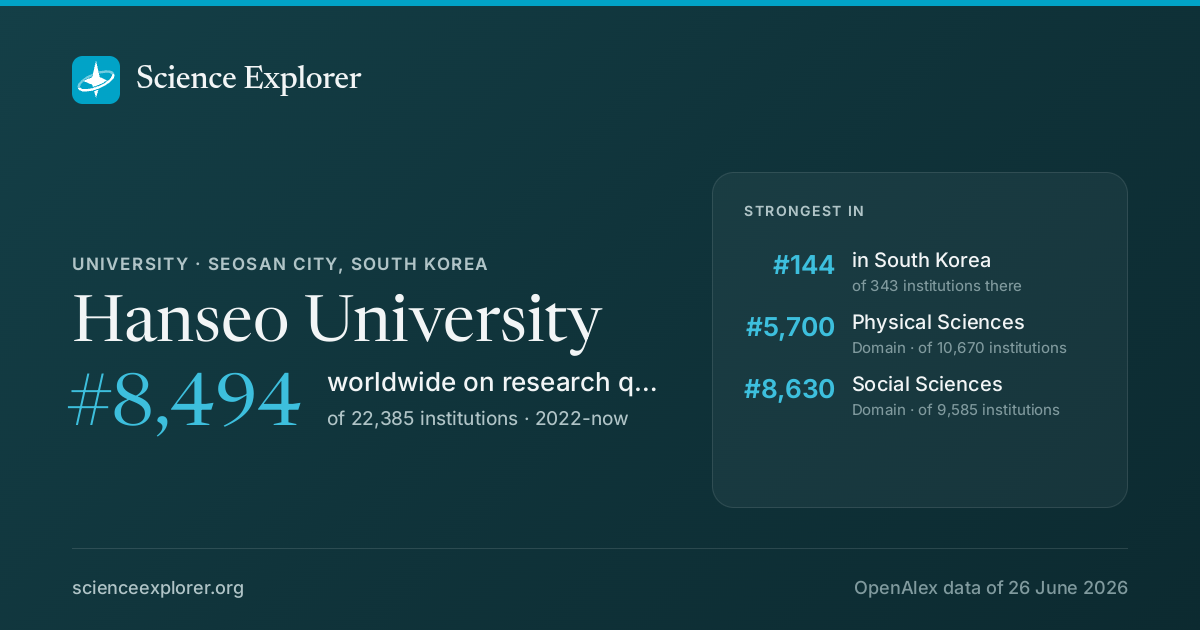
Hanseo University on Science Explorer

A card with Hanseo University's standing and the fields it leads in, for a post or a slide. A link to this page previews as the same card.

Download the card

1200 × 630 PNG, sized for social posts, drawn from the latest snapshot.

Badges for a website1Each links back here and updates with every snapshot

Research measures only: rankings here say nothing about teaching, admissions or student experience. Comparable institutions and collaboration partners have tabs of their own, above.

Discussion

Ask a question or share a note about Hanseo University. Keep it to the research: no personal attacks, advertising or links. Any reader can report a post, which collapses it for everyone until it is opened.