Science Explorer Back to mapMap
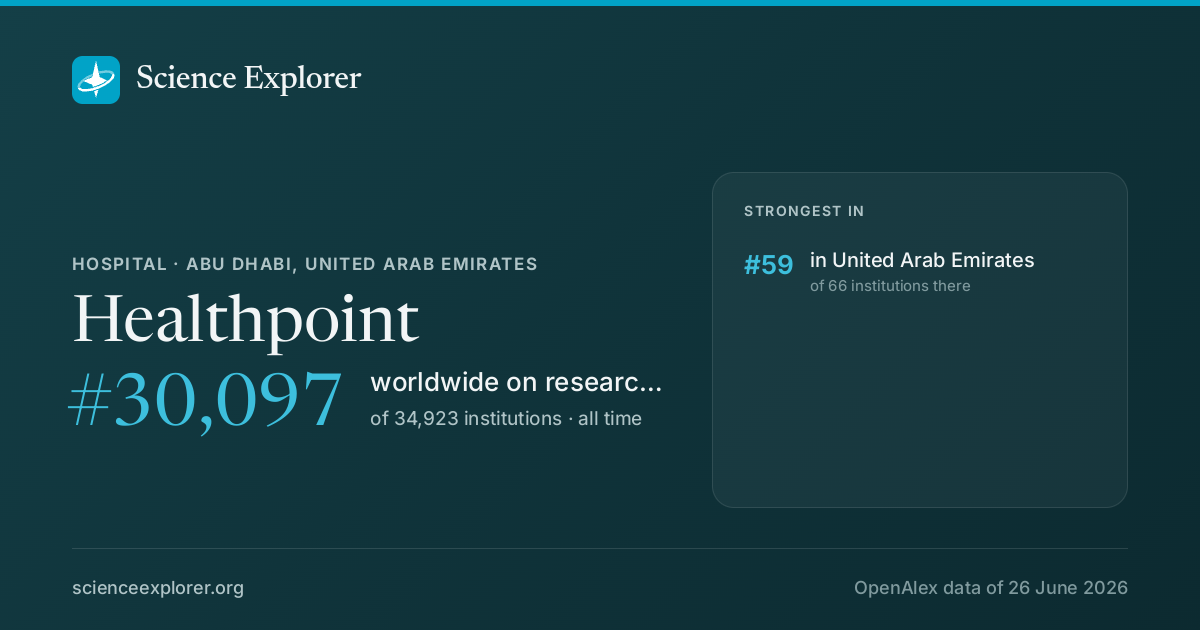
Hospital / health system · Abu Dhabi · United Arab Emirates

Healthpoint

World rank, all time
#30,097
of 34,923
Rank in United Arab Emirates
#59
of 66
Research works
169
◆ 2% vs 2018-21
Citations
1.8k
10.6 per fractional work
Top-10% rate
7.2%
all institutions 10.0%
vs its own fields
0.88×
1.00× is exactly expected
Open access
38%
world 40%
International
49%
world 18%

Which fields of science does Healthpoint work in?

In 2022-now, 66% of research at Healthpoint is in Health Sciences, 16% in Social Sciences. Its largest fields are Medicine (53%), Health Professions (8%), Computer Science (7%). It does 2.5× the world's share of Health Sciences.

Health Sciences: 33 fractional works · 65.6% of its workMedicine: 27 fractional works · 53.1% of its workSurgery: 5 fractional works · 10.6% of its workCardiology and Cardiovascular Medicine: 2 fractional works · 4.3% of its workPublic Health, Environmental and Occupational Health: 2 fractional works · 3.7% of its workGeriatrics and Gerontology: 2 fractional works · 3.3% of its workOrthopedics and Sports Medicine: 2 fractional works · 3.1% of its workEpidemiology: 2 fractional works · 3.0% of its workPulmonary and Respiratory Medicine: 1 fractional works · 2.5% of its workRheumatology: 1 fractional works · 2.1% of its workRadiology, Nuclear Medicine and Imaging: 1 fractional works · 1.7% of its workDermatology: 1 fractional works · 1.6% of its workRehabilitation: 1 fractional works · 1.4% of its workEmergency Medicine: 1 fractional works · 1.3% of its workEndocrinology, Diabetes and Metabolism: 1 fractional works · 1.2% of its workPsychiatry and Mental health: 1 fractional works · 1.2% of its workPediatrics, Perinatology and Child Health: 1 fractional works · 1.1% of its workPhysiology: 0 fractional works · 1.0% of its workPathology and Forensic Medicine: 0 fractional works · 1.0% of its workInfectious Diseases: 0 fractional works · 1.0% of its workHepatology: 0 fractional works · 0.9% of its workOncology: 0 fractional works · 0.9% of its workNeurology: 0 fractional works · 0.7% of its workHematology: 0 fractional works · 0.7% of its workFamily Practice: 0 fractional works · 0.7% of its workOtorhinolaryngology: 0 fractional works · 0.6% of its workGenetics: 0 fractional works · 0.5% of its workGastroenterology: 0 fractional works · 0.5% of its workPharmacology: 0 fractional works · 0.5% of its workObstetrics and Gynecology: 0 fractional works · 0.4% of its workAnesthesiology and Pain Medicine: 0 fractional works · 0.4% of its workUrology: 0 fractional works · 0.3% of its workHealth Informatics: 0 fractional works · 0.3% of its workReproductive Medicine: 0 fractional works · 0.3% of its workCritical Care and Intensive Care Medicine: 0 fractional works · 0.2% of its workSmaller subfields together: 0 fractional works · 0.3% of its workHealth Professions: 4 fractional works · 8.1% of its workGeneral Health Professions: 3 fractional works · 6.1% of its workHealth Information Management: 1 fractional works · 1.2% of its workOccupational Therapy: 0 fractional works · 0.5% of its workEmergency Medical Services: 0 fractional works · 0.3% of its workSmaller subfields together: 0 fractional works · 0.1% of its workDentistry: 2 fractional works · 3.8% of its workOral Surgery: 1 fractional works · 1.7% of its workOrthodontics: 1 fractional works · 1.7% of its workPeriodontics: 0 fractional works · 0.3% of its workVeterinary: 0 fractional works · 0.4% of its workSmall Animals: 0 fractional works · 0.4% of its workNursing: 0 fractional works · 0.2% of its workSocial Sciences: 8 fractional works · 15.6% of its workSocial Sciences: 2 fractional works · 4.9% of its workLaw: 1 fractional works · 1.3% of its workEducation: 0 fractional works · 0.8% of its workDemography: 0 fractional works · 0.7% of its workDevelopment: 0 fractional works · 0.7% of its workSociology and Political Science: 0 fractional works · 0.7% of its workHealth: 0 fractional works · 0.3% of its workSmaller subfields together: 0 fractional works · 0.4% of its workEconomics, Econometrics and Finance: 2 fractional works · 3.5% of its workEconomics and Econometrics: 1 fractional works · 2.5% of its workFinance: 0 fractional works · 1.0% of its workPsychology: 2 fractional works · 3.1% of its workClinical Psychology: 1 fractional works · 1.6% of its workExperimental and Cognitive Psychology: 0 fractional works · 1.0% of its workSmaller subfields together: 0 fractional works · 0.5% of its workArts and Humanities: 1 fractional works · 1.8% of its workPhilosophy: 1 fractional works · 1.7% of its workSmaller subfields together: 0 fractional works · 0.2% of its workBusiness, Management and Accounting: 1 fractional works · 1.2% of its workStrategy and Management: 0 fractional works · 1.0% of its workManagement of Technology and Innovation: 0 fractional works · 0.2% of its workDecision Sciences: 1 fractional works · 1.1% of its workManagement Science and Operations Research: 0 fractional works · 0.7% of its workStatistics, Probability and Uncertainty: 0 fractional works · 0.4% of its workSmaller subfields together: 0 fractional works · 0.0% of its workPhysical Sciences: 6 fractional works · 12.5% of its workComputer Science: 3 fractional works · 6.9% of its workArtificial Intelligence: 2 fractional works · 4.0% of its workComputer Vision and Pattern Recognition: 1 fractional works · 2.1% of its workSignal Processing: 0 fractional works · 0.2% of its workInformation Systems: 0 fractional works · 0.2% of its workSmaller subfields together: 0 fractional works · 0.4% of its workEngineering: 1 fractional works · 2.7% of its workBiomedical Engineering: 1 fractional works · 1.8% of its workComputational Mechanics: 0 fractional works · 0.3% of its workBuilding and Construction: 0 fractional works · 0.2% of its workControl and Systems Engineering: 0 fractional works · 0.2% of its workSafety, Risk, Reliability and Quality: 0 fractional works · 0.2% of its workMathematics: 1 fractional works · 1.3% of its workStatistics and Probability: 1 fractional works · 1.1% of its workModeling and Simulation: 0 fractional works · 0.2% of its workEnvironmental Science: 1 fractional works · 1.2% of its workEnvironmental Chemistry: 0 fractional works · 0.5% of its workWater Science and Technology: 0 fractional works · 0.5% of its workSmaller subfields together: 0 fractional works · 0.2% of its workPhysics and Astronomy: 0 fractional works · 0.2% of its workRadiation: 0 fractional works · 0.2% of its workChemistry: 0 fractional works · 0.1% of its workLife Sciences: 3 fractional works · 6.3% of its workBiochemistry, Genetics and Molecular Biology: 2 fractional works · 3.8% of its workGenetics: 1 fractional works · 1.9% of its workMolecular Biology: 1 fractional works · 1.2% of its workPhysiology: 0 fractional works · 0.3% of its workSmaller subfields together: 0 fractional works · 0.4% of its workImmunology and Microbiology: 1 fractional works · 1.6% of its workImmunology: 1 fractional works · 1.1% of its workParasitology: 0 fractional works · 0.2% of its workVirology: 0 fractional works · 0.2% of its workSmaller subfields together: 0 fractional works · 0.0% of its workNeuroscience: 0 fractional works · 0.6% of its workNeurology: 0 fractional works · 0.5% of its workSmaller subfields together: 0 fractional works · 0.1% of its workAgricultural and Biological Sciences: 0 fractional works · 0.3% of its workAnimal Science and Zoology: 0 fractional works · 0.2% of its workSmaller subfields together: 0 fractional works · 0.1% of its workALL ITS WORKHealthpoint50fractional works, 2022-now
Life Sciences6%Physical Sciences12%Health Sciences66%Social Sciences16%

Each ring splits the one inside it: the four domains of science, their fields, their subfields. Size is fractional works in 2022-now. Every slice is a page; the interactive view zooms down to single topics and colours each by how much more of it this institution does than the world.

Its 4 domains and 21 fields, with their numbers
    1. Medicine2753.1%
    2. Health Professions48.1%
    3. Dentistry23.8%
    4. Veterinary00.4%
    5. Nursing00.2%
    1. Social Sciences24.9%
    2. Economics, Econometrics and Finance23.5%
    3. Psychology23.1%
    4. Arts and Humanities11.8%
    5. Business, Management and Accounting11.2%
    6. Decision Sciences11.1%
    1. Computer Science36.9%
    2. Engineering12.7%
    3. Mathematics11.3%
    4. Environmental Science11.2%
    5. Physics and Astronomy00.2%
    6. Chemistry00.1%
    1. Biochemistry, Genetics and Molecular Biology23.8%
    2. Immunology and Microbiology11.6%
    3. Neuroscience00.6%
    4. Agricultural and Biological Sciences00.3%
All of science, and how each field's share has moved since 1950: the Science domain explorer

Field profile

Location quotient across every field it publishes in: outside the ring is more than an institution of this size would be expected to publish, inside it is less.

Agricultural and Biological Sciences: 0.06× its world share, 0 worksAgricultural and Bio…Biochemistry, Genetics and Molecular Biology: 0.71× its world share, 2 worksBiochemistry, Geneti…Immunology and Microbiology: 1.60× its world share, 1 worksImmunology and Micro…Neuroscience: 0.38× its world share, 0 worksNeuroscienceChemistry: 0.05× its world share, 0 worksChemistryComputer Science: 0.89× its world share, 4 worksComputer ScienceEngineering: 0.18× its world share, 1 worksEngineeringEnvironmental Science: 0.24× its world share, 1 worksEnvironmental ScienceMathematics: 1.13× its world share, 1 worksMathematicsPhysics and Astronomy: 0.10× its world share, 0 worksPhysics and AstronomyDentistry: 7.77× its world share, 2 worksDentistryHealth Professions: 3.09× its world share, 4 worksHealth ProfessionsMedicine: 2.76× its world share, 27 worksMedicineNursing: 0.36× its world share, 0 worksNursingVeterinary: 2.85× its world share, 0 worksVeterinaryArts and Humanities: 0.63× its world share, 1 worksArts and HumanitiesBusiness, Management and Accounting: 0.38× its world share, 1 worksBusiness, Management…Decision Sciences: 1.15× its world share, 1 worksDecision SciencesEconomics, Econometrics and Finance: 1.64× its world share, 2 worksEconomics, Econometr…Psychology: 1.01× its world share, 2 worksPsychologySocial Sciences: 0.38× its world share, 2 worksSocial Sciences1×world share
more than its size predictsabout as predictedless

Rings at 0.5×, 1× and 2×. Widest outward: Dentistry, 7.8×. Every wedge is a field page.

All 21 fields, with their numbers
  1. Dentistry7.77×2 works
  2. Health Professions3.09×4 works
  3. Veterinary2.85×0 works
  4. Medicine2.76×27 works
  5. Economics, Econometrics and Finance1.64×2 works
  6. Immunology and Microbiology1.60×1 works
  7. Decision Sciences1.15×1 works
  8. Mathematics1.13×1 works
  9. Psychology1.01×2 works
  10. Computer Science0.89×4 works
  11. Biochemistry, Genetics and Molecular Biology0.71×2 works
  12. Arts and Humanities0.63×1 works
  13. Neuroscience0.38×0 works
  14. Business, Management and Accounting0.38×1 works
  15. Social Sciences0.38×2 works
  16. Nursing0.36×0 works
  17. Environmental Science0.24×1 works
  18. Engineering0.18×1 works
  19. Physics and Astronomy0.10×0 works
  20. Agricultural and Biological Sciences0.06×0 works
  21. Chemistry0.05×0 works

Who are the top researchers at Healthpoint?

Ranked on the quality score, William Murrell, Chris Butcher and Dennis L. Carson lead among researchers whose main affiliation is Healthpoint.

  1. 1 William Murrell United Arab Emirates · #1,536,002 worldwide 1.2k citations · 87 works
  2. 2 Chris Butcher United Arab Emirates · #3,768,050 worldwide 223 citations · 31 works
  3. 3 Dennis L. Carson United Arab Emirates · #4,407,422 worldwide 344 citations · 15 works
All ranked researchers at Healthpoint

What are the most cited papers from Healthpoint?

The most cited paper from Healthpoint is "Acute and Impaired Wound Healing" (Tatiana N. Demidova‐Rice, Michael R. Hamblin, Ira M. Herman, 2012), with 723 citations. Next come "The effect of tofacitinib on pneumococcal and influenza vaccine responses in rheumatoid arthritis" (196) and "The Edge Effect" (106).

Most cited papers
#PaperReleasedCitations
1 Acute and Impaired Wound Healing Tatiana N. Demidova‐Rice, Michael R. Hamblin, Ira M. Herman · Advances in Skin & Wound Care Open access 19 Jun 2012 723
2 The effect of tofacitinib on pneumococcal and influenza vaccine responses in rheumatoid arthritis Kevin L. Winthrop, Joel C. Silverfield, Arthur Racewicz et al. · Annals of the Rheumatic Diseases Open access 21 Mar 2015 196
3 The Edge Effect Kevin Y. Woo, Elizabeth A. Ayello, R. Gary Sibbald · Advances in Skin & Wound Care Feb 2007 106
4 Debridement Carly Kirshen, Kevin Y. Woo, Elizabeth A. Ayello et al. · Advances in Skin & Wound Care Nov 2006 89
5 Zinc pyrithione in alcohol-based products for skin antisepsis: Persistence of antimicrobial effects Eugene Guthery, Lawton Anthony Seal, Edward Lowell Anderson · American Journal of Infection Control Open access Feb 2005 81
All 60 most cited papers, with filters and sorting

Which keywords describe research at Healthpoint?

By fractional works in 2022-now, weighted toward what it does more of than the world: Quality of Life, Epidemiology, Elderly, Inappropriate Medication Use, Polypharmacy, Inflammation, Healthcare and Social Justice.

▲ more of its work than of the world's◆ about the world's share▼ less than the world's

Size is fractional works in 2022-now in the topics tagged with each word; colour is the word's share of this institution's work against its share of the world's. The 28 words are chosen for being large and distinctive. Each links to the topic it comes from most.

All 28 words, with their numbers
  1. Epidemiology5▲ 2.6×36 topics
  2. Quality of Life4▲ 5.2×17 topics
  3. Inflammation2▲ 2.4×19 topics
  4. Elderly2▲ 18×2 topics
  5. Deep Learning2◆ 1.14×7 topics
  6. Healthcare2▲ 3.5×7 topics
  7. Treatment2▲ 2.6×17 topics
  8. Diagnosis2▲ 3.2×13 topics
  9. Inappropriate Medication Use2▲ 72×1 topic
  10. Polypharmacy2▲ 72×1 topic
  11. Social Justice2▲ 5.2×3 topics
  12. Cardiovascular Disease1▲ 2.5×12 topics
  13. Risk Factors1▲ 2.6×9 topics
  14. Community Empowerment1▲ 3.7×2 topics
  15. Mental Health1▲ 1.82×6 topics
  16. Health Promotion1▲ 7.4×3 topics
  17. Management1▲ 3.1×9 topics
  18. Surgical Management1▲ 5.7×6 topics
  19. Aging1▲ 4.0×5 topics
  20. Complications1▲ 4.2×8 topics
  21. Neural Networks1▲ 1.35×3 topics
  22. Obesity1▲ 2.8×8 topics
  23. Prevention1▲ 5.0×6 topics
  24. Collaborative Partnerships1▲ 99×1 topic
  25. Community Capacity Building1▲ 99×1 topic
  26. Ethics1▲ 3.9×4 topics
  27. Pathogenesis1▲ 4.0×7 topics
  28. Public Health Policy1▲ 7.7×2 topics

Which research topics does Healthpoint publish most on?

By volume in 2022-now: Pharmaceutical Practices and Patient Outcomes, Community Health and Development, Hermeneutics and Narrative Identity and Sports injuries and prevention.

  1. 1 Pharmaceutical Practices and Patient Outcomes Geriatrics and Gerontology 2 works
  2. 2 Community Health and Development General Health Professions 1 works
  3. 3 Hermeneutics and Narrative Identity Philosophy 1 works
  4. 4 Sports injuries and prevention Orthopedics and Sports Medicine 1 works
  5. 5 Aging, Elder Care, and Social Issues General Health Professions 1 works
  6. 6 Health, Medicine and Society General Health Professions 1 works
  7. 7 Orthodontics and Dentofacial Orthopedics Orthodontics 1 works
  8. 8 Economic and Environmental Valuation Economics and Econometrics 1 works
  9. 9 Capital Investment and Risk Analysis Finance 0 works
  10. 10 Speech Recognition and Synthesis Artificial Intelligence 0 works

How open and international is its research?

Against the world's own shares: the tick on each track. Both are shares of its output, so they sit on one scale and can be read against each other as well as against the world.

openly available38.0%not open62.0%

World: 40% of research is openly available.

with international co-authors49.3%domestic only50.7%

World: 18% is written across borders.

How has Healthpoint's research output changed?

Output in 2022-2025 was 2% lower than in 2018-2021.

still counting1990200020102020
grewheldshrank

The same series as a ribbon: one cell per year, darker for more. The line above answers how much; this answers when.

Its share of all research

Growing output can still be a shrinking share: all of science grows. This is Healthpoint as a percentage of every work published that year, 0.00013% in 2024.

still counting0.00020%0.00040%Healthpoint0.00028% in 20251990200020102020

Fractional works of Healthpoint over all fractional works that year. How the balance of science has shifted.

Other research institutions in Abu Dhabi

All research institutions in Abu Dhabi

Share Healthpoint's ranking

Healthpoint on Science Explorer

A card with Healthpoint's standing and the fields it leads in, for a post or a slide. A link to this page previews as the same card.

Download the card

1200 × 630 PNG, sized for social posts, drawn from the latest snapshot.

Badges for a website1Each links back here and updates with every snapshot

Research measures only: rankings here say nothing about teaching, admissions or student experience. Comparable institutions and collaboration partners have tabs of their own, above.

Discussion

Ask a question or share a note about Healthpoint. Posts are plain text and can be reported.