Science Explorer Back to mapMap
Discussion
Institution · Accra · Ghana

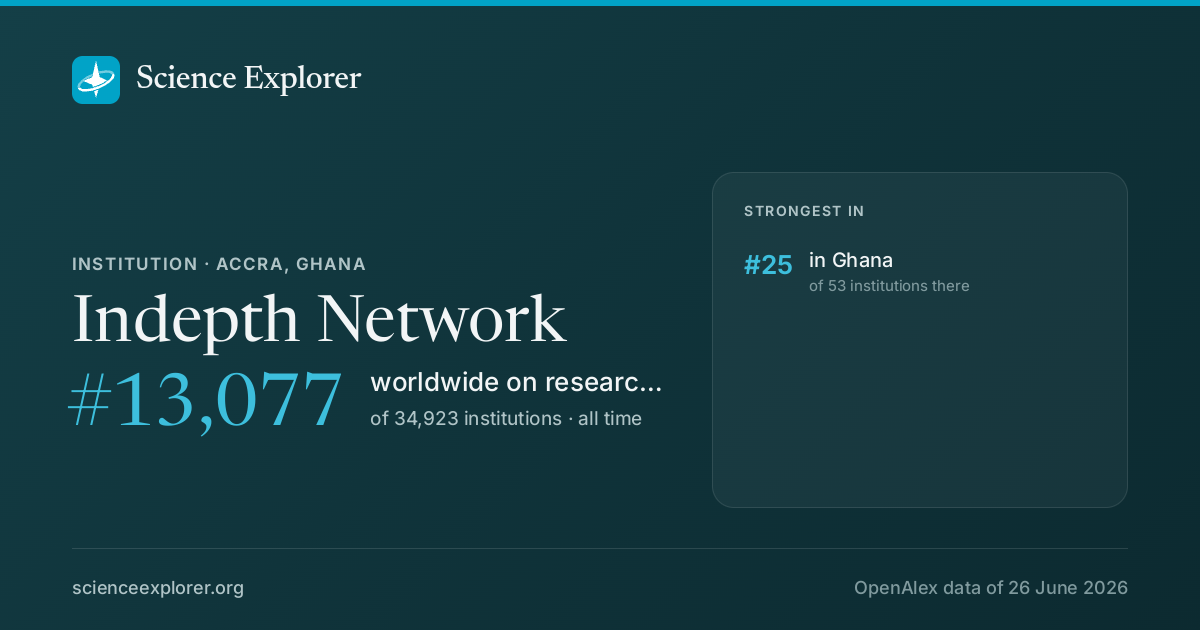
Indepth Network

World rank, all time
#13,077
of 34,923
Rank in Ghana
#25
of 53
Research works
226
▲ 18% vs 2018-21
Citations
5.4k
24.0 per fractional work
Top-10% rate
4.9%
all institutions 10.0%
vs its own fields
1.16×
1.00× is exactly expected
Open access
90%
world 40%
International
29%
world 18%

Which fields of science does Indepth Network work in?

In 2022-now, 47% of research at Indepth Network is in Physical Sciences, 33% in Social Sciences. Its largest fields are Physics and Astronomy (17%), Social Sciences (12%), Medicine (10%). It does 1.3× the world's share of Social Sciences.

Physical Sciences: 47 fractional works · 46.6% of its workPhysics and Astronomy: 17 fractional works · 16.9% of its workAstronomy and Astrophysics: 7 fractional works · 6.9% of its workAtomic and Molecular Physics, and Optics: 5 fractional works · 4.6% of its workStatistical and Nonlinear Physics: 4 fractional works · 4.0% of its workInstrumentation: 1 fractional works · 0.7% of its workNuclear and High Energy Physics: 1 fractional works · 0.7% of its workComputer Science: 9 fractional works · 9.4% of its workArtificial Intelligence: 4 fractional works · 4.1% of its workComputational Theory and Mathematics: 2 fractional works · 2.3% of its workInformation Systems: 2 fractional works · 2.3% of its workComputer Networks and Communications: 0 fractional works · 0.4% of its workSignal Processing: 0 fractional works · 0.2% of its workEngineering: 8 fractional works · 8.3% of its workComputational Mechanics: 2 fractional works · 2.0% of its workOcean Engineering: 2 fractional works · 1.7% of its workAerospace Engineering: 1 fractional works · 1.3% of its workCivil and Structural Engineering: 1 fractional works · 0.8% of its workBiomedical Engineering: 1 fractional works · 0.7% of its workControl and Systems Engineering: 1 fractional works · 0.7% of its workMechanical Engineering: 0 fractional works · 0.4% of its workAutomotive Engineering: 0 fractional works · 0.3% of its workElectrical and Electronic Engineering: 0 fractional works · 0.3% of its workSmaller subfields together: 0 fractional works · 0.1% of its workMathematics: 6 fractional works · 6.0% of its workGeometry and Topology: 2 fractional works · 2.0% of its workApplied Mathematics: 1 fractional works · 1.3% of its workAlgebra and Number Theory: 1 fractional works · 0.7% of its workMathematical Physics: 1 fractional works · 0.7% of its workModeling and Simulation: 1 fractional works · 0.7% of its workTheoretical Computer Science: 1 fractional works · 0.7% of its workEarth and Planetary Sciences: 3 fractional works · 2.6% of its workAtmospheric Science: 1 fractional works · 1.3% of its workGeochemistry and Petrology: 1 fractional works · 1.0% of its workGeophysics: 0 fractional works · 0.3% of its workMaterials Science: 2 fractional works · 2.0% of its workMaterials Chemistry: 1 fractional works · 1.3% of its workGeneral Materials Science: 1 fractional works · 0.7% of its workEnvironmental Science: 2 fractional works · 1.5% of its workGlobal and Planetary Change: 1 fractional works · 0.7% of its workEnvironmental Chemistry: 0 fractional works · 0.3% of its workManagement, Monitoring, Policy and Law: 0 fractional works · 0.3% of its workSmaller subfields together: 0 fractional works · 0.2% of its workSocial Sciences: 33 fractional works · 32.5% of its workSocial Sciences: 12 fractional works · 11.6% of its workSociology and Political Science: 4 fractional works · 3.6% of its workEducation: 2 fractional works · 2.1% of its workHealth: 1 fractional works · 1.1% of its workDemography: 1 fractional works · 0.9% of its workPolitical Science and International Relations: 1 fractional works · 0.9% of its workLaw: 1 fractional works · 0.8% of its workUrban Studies: 1 fractional works · 0.7% of its workTransportation: 1 fractional works · 0.7% of its workGeneral Social Sciences: 0 fractional works · 0.3% of its workGender Studies: 0 fractional works · 0.2% of its workSafety Research: 0 fractional works · 0.2% of its workEconomics, Econometrics and Finance: 5 fractional works · 5.4% of its workEconomics and Econometrics: 4 fractional works · 3.6% of its workFinance: 2 fractional works · 1.8% of its workBusiness, Management and Accounting: 5 fractional works · 5.4% of its workMarketing: 3 fractional works · 2.6% of its workManagement of Technology and Innovation: 1 fractional works · 1.3% of its workManagement Information Systems: 1 fractional works · 0.7% of its workTourism, Leisure and Hospitality Management: 0 fractional works · 0.3% of its workOrganizational Behavior and Human Resource Management: 0 fractional works · 0.2% of its workSmaller subfields together: 0 fractional works · 0.2% of its workArts and Humanities: 4 fractional works · 4.3% of its workArcheology: 1 fractional works · 1.3% of its workReligious studies: 1 fractional works · 1.3% of its workPhilosophy: 1 fractional works · 0.7% of its workHistory and Philosophy of Science: 1 fractional works · 0.7% of its workLanguage and Linguistics: 0 fractional works · 0.3% of its workDecision Sciences: 4 fractional works · 3.9% of its workManagement Science and Operations Research: 1 fractional works · 1.3% of its workStatistics, Probability and Uncertainty: 1 fractional works · 1.3% of its workInformation Systems and Management: 1 fractional works · 1.2% of its workPsychology: 2 fractional works · 2.0% of its workClinical Psychology: 1 fractional works · 0.9% of its workSocial Psychology: 0 fractional works · 0.4% of its workDevelopmental and Educational Psychology: 0 fractional works · 0.3% of its workExperimental and Cognitive Psychology: 0 fractional works · 0.3% of its workHealth Sciences: 12 fractional works · 12.1% of its workMedicine: 10 fractional works · 10.4% of its workPublic Health, Environmental and Occupational Health: 1 fractional works · 1.1% of its workSurgery: 1 fractional works · 1.0% of its workPulmonary and Respiratory Medicine: 1 fractional works · 1.0% of its workPsychiatry and Mental health: 1 fractional works · 1.0% of its workPediatrics, Perinatology and Child Health: 1 fractional works · 0.7% of its workPhysiology: 1 fractional works · 0.7% of its workInfectious Diseases: 1 fractional works · 0.7% of its workEpidemiology: 1 fractional works · 0.7% of its workDermatology: 1 fractional works · 0.7% of its workHepatology: 0 fractional works · 0.4% of its workRheumatology: 0 fractional works · 0.4% of its workEmergency Medicine: 0 fractional works · 0.3% of its workOncology: 0 fractional works · 0.2% of its workUrology: 0 fractional works · 0.2% of its workSmaller subfields together: 1 fractional works · 1.3% of its workHealth Professions: 2 fractional works · 1.6% of its workGeneral Health Professions: 1 fractional works · 1.2% of its workHealth Information Management: 0 fractional works · 0.2% of its workSmaller subfields together: 0 fractional works · 0.2% of its workNursing: 0 fractional works · 0.1% of its workLife Sciences: 9 fractional works · 8.7% of its workBiochemistry, Genetics and Molecular Biology: 4 fractional works · 4.2% of its workMolecular Biology: 2 fractional works · 1.8% of its workGenetics: 2 fractional works · 1.7% of its workBiochemistry: 0 fractional works · 0.5% of its workSmaller subfields together: 0 fractional works · 0.2% of its workAgricultural and Biological Sciences: 2 fractional works · 2.1% of its workAnimal Science and Zoology: 1 fractional works · 0.7% of its workFood Science: 1 fractional works · 0.7% of its workGeneral Agricultural and Biological Sciences: 0 fractional works · 0.4% of its workPlant Science: 0 fractional works · 0.4% of its workSmaller subfields together: 0 fractional works · 0.0% of its workNeuroscience: 2 fractional works · 2.0% of its workCognitive Neuroscience: 2 fractional works · 1.7% of its workSmaller subfields together: 0 fractional works · 0.3% of its workImmunology and Microbiology: 0 fractional works · 0.2% of its workPharmacology, Toxicology and Pharmaceutics: 0 fractional works · 0.2% of its workPharmacology: 0 fractional works · 0.2% of its workALL ITS WORKIndepth Network101fractional works, 2022-now
Life Sciences9%Physical Sciences47%Health Sciences12%Social Sciences33%

Each ring splits the one inside it: the four domains of science, their fields, their subfields. Size is fractional works in 2022-now. Every slice is a page; the interactive view zooms down to single topics and colours each by how much more of it this institution does than the world.

Its 4 domains and 21 fields, with their numbers
    1. Physics and Astronomy1716.9%
    2. Computer Science99.4%
    3. Engineering88.3%
    4. Mathematics66.0%
    5. Earth and Planetary Sciences32.6%
    6. Materials Science22.0%
    7. Environmental Science21.5%
    1. Social Sciences1211.6%
    2. Economics, Econometrics and Finance55.4%
    3. Business, Management and Accounting55.4%
    4. Arts and Humanities44.3%
    5. Decision Sciences43.9%
    6. Psychology22.0%
    1. Medicine1010.4%
    2. Health Professions21.6%
    3. Nursing00.1%
    1. Biochemistry, Genetics and Molecular Biology44.2%
    2. Agricultural and Biological Sciences22.1%
    3. Neuroscience22.0%
    4. Immunology and Microbiology00.2%
    5. Pharmacology, Toxicology and Pharmaceutics00.2%
All of science, and how each field's share has moved since 1950: the Science domain explorer

Field profile

Location quotient across every field it publishes in: outside the ring is more than an institution of this size would be expected to publish, inside it is less.

Agricultural and Biological Sciences: 0.44× its world share, 2 worksAgricultural and Bio…Biochemistry, Genetics and Molecular Biology: 0.79× its world share, 4 worksBiochemistry, Geneti…Immunology and Microbiology: 0.22× its world share, 0 worksImmunology and Micro…Neuroscience: 1.24× its world share, 2 worksNeurosciencePharmacology, Toxicology and Pharmaceutics: 0.59× its world share, 0 worksPharmacology, Toxico…Computer Science: 1.21× its world share, 9 worksComputer ScienceEarth and Planetary Sciences: 1.69× its world share, 3 worksEarth and Planetary …Engineering: 0.55× its world share, 8 worksEngineeringEnvironmental Science: 0.30× its world share, 2 worksEnvironmental ScienceMaterials Science: 0.57× its world share, 2 worksMaterials ScienceMathematics: 5.06× its world share, 6 worksMathematicsPhysics and Astronomy: 7.59× its world share, 17 worksPhysics and AstronomyHealth Professions: 0.62× its world share, 2 worksHealth ProfessionsMedicine: 0.54× its world share, 10 worksMedicineNursing: 0.22× its world share, 0 worksNursingArts and Humanities: 1.49× its world share, 4 worksArts and HumanitiesBusiness, Management and Accounting: 1.67× its world share, 5 worksBusiness, Management…Decision Sciences: 4.00× its world share, 4 worksDecision SciencesEconomics, Econometrics and Finance: 2.51× its world share, 5 worksEconomics, Econometr…Psychology: 0.66× its world share, 2 worksPsychologySocial Sciences: 0.92× its world share, 12 worksSocial Sciences1×world share
more than its size predictsabout as predictedless

Rings at 0.5×, 1× and 2×. Widest outward: Physics and Astronomy, 7.6×. Every wedge is a field page.

All 21 fields, with their numbers
  1. Physics and Astronomy7.59×17 works
  2. Mathematics5.06×6 works
  3. Decision Sciences4.00×4 works
  4. Economics, Econometrics and Finance2.51×5 works
  5. Earth and Planetary Sciences1.69×3 works
  6. Business, Management and Accounting1.67×5 works
  7. Arts and Humanities1.49×4 works
  8. Neuroscience1.24×2 works
  9. Computer Science1.21×9 works
  10. Social Sciences0.92×12 works
  11. Biochemistry, Genetics and Molecular Biology0.79×4 works
  12. Psychology0.66×2 works
  13. Health Professions0.62×2 works
  14. Pharmacology, Toxicology and Pharmaceutics0.59×0 works
  15. Materials Science0.57×2 works
  16. Engineering0.55×8 works
  17. Medicine0.54×10 works
  18. Agricultural and Biological Sciences0.44×2 works
  19. Environmental Science0.30×2 works
  20. Immunology and Microbiology0.22×0 works
  21. Nursing0.22×0 works

Who are the top researchers at Indepth Network?

Ranked on the quality score, Antonio Dominguez-Digat, Pallavi Lele and Cheikh Mbacké lead among researchers whose main affiliation is Indepth Network.

  1. 1 Antonio Dominguez-Digat Ghana · #301,339 worldwide 62 citations · 18 works
  2. 2 Pallavi Lele Ghana · #1,603,224 worldwide 530 citations · 21 works
  3. 3 Cheikh Mbacké Ghana · #1,622,114 worldwide 492 citations · 21 works
  4. 4 Vadym Partasyuk Ghana · #2,269,344 worldwide 618 citations · 46 works
  5. 5 Zhongning Yi Ghana · #2,297,863 worldwide 0 citations · 64 works
  6. 6 Spark Tsai Ghana · #2,301,272 worldwide 0 citations · 43 works
  7. 7 Chengbin Song Ghana · #2,370,595 worldwide 0 citations · 37 works
  8. 8 Qingming Li Ghana · #2,411,272 worldwide 0 citations · 34 works
  9. 9 chang sik Kim Ghana · #2,729,754 worldwide 0 citations · 18 works
  10. 10 Chengbin Song Ghana · #2,790,882 worldwide 0 citations · 16 works
All ranked researchers at Indepth Network

What are the most cited papers from Indepth Network?

The most cited paper from Indepth Network is "The global distribution and burden of dengue" (Samir Bhatt, Peter W. Gething, Oliver J. Brady et al., 2013), with 10,418 citations. Next come "Sickle Cell Disease in Africa" (718) and "The African Genome Variation Project shapes medical genetics in Africa" (701).

Most cited papers
#PaperReleasedCitations
1 The global distribution and burden of dengue Samir Bhatt, Peter W. Gething, Oliver J. Brady et al. · Nature Open access Apr 2013 10,418
2 Sickle Cell Disease in Africa Scott D. Grosse, Isaac Odame, Hani Khalil Atrash et al. · American Journal of Preventive Medicine Open access 17 Nov 2011 718
3 The African Genome Variation Project shapes medical genetics in Africa Deepti Gurdasani et al. · Nature Open access 2 Dec 2014 701
4 A systematic review of barriers to data sharing in public health Willem Gijsbert van Panhuis, Proma Paul, Claudia Emerson et al. · BMC Public Health ReviewOpen access 5 Nov 2014 608
5 Sleep Problems: An Emerging Global Epidemic? Findings From the INDEPTH WHO-SAGE Study Among More Than 40,000 Older Adults From 8 Countries Across Africa and Asia Saverio Stranges, William W. Tigbe, Francesc Xavier Gómez-Olivé et al. · SLEEP Open access 31 Jul 2012 597
All 60 most cited papers, with filters and sorting

Which keywords describe research at Indepth Network?

By fractional works in 2022-now, weighted toward what it does more of than the world: Quantum Gravity, Entanglement, Market Competition, Bell Inequality, Decoherence, Relativity, Consumer Behavior and E-commerce.

▲ more of its work than of the world's◆ about the world's share▼ less than the world's

Size is fractional works in 2022-now in the topics tagged with each word; colour is the word's share of this institution's work against its share of the world's. The 40 words are chosen for being large and distinctive. Each links to the topic it comes from most.

All 40 words, with their numbers
  1. Quantum Gravity4▲ 51×3 topics
  2. Machine Learning4▲ 1.24×9 topics
  3. Education4▲ 2.1×6 topics
  4. Entanglement4▲ 24×2 topics
  5. Healthcare4▲ 3.1×6 topics
  6. Sustainability4▲ 1.42×6 topics
  7. Bell Inequality3▲ 91×1 topic
  8. Consumer Behavior3▲ 5.3×3 topics
  9. Decoherence3▲ 91×1 topic
  10. Market Competition3▲ 74×2 topics
  11. Relativity3▲ 117×2 topics
  12. E-commerce3▲ 5.5×2 topics
  13. Dark Energy3▲ 41×2 topics
  14. Historical Astronomy3▲ 153×2 topics
  15. Marketing Strategies3▲ 29×1 topic
  16. Retail Economics3▲ 110×1 topic
  17. Asset Pricing2▲ 27×2 topics
  18. Security2▲ 3.5×4 topics
  19. Complex Adaptive Systems2▲ 68×2 topics
  20. Cosmic Microwave Background2▲ 36×1 topic
  21. Cosmological Parameters2▲ 36×1 topic
  22. Dark Matter2▲ 17×3 topics
  23. General Covariance2▲ 157×1 topic
  24. Modeling2▲ 8.2×2 topics
  25. Nonlinear Dynamics2▲ 8.9×2 topics
  26. Philosophy2▲ 4.5×2 topics
  27. Unified Field Theories2▲ 157×1 topic
  28. Decision Making2▲ 5.7×2 topics
  29. Embodied Cognition2▲ 110×1 topic
  30. Employment2▲ 49×1 topic
  31. Firm Survival2▲ 79×1 topic
  32. Lorentz Violation2▲ 97×1 topic
  33. Market Efficiency2▲ 24×1 topic
  34. Noncommutative Field Theory2▲ 97×1 topic
  35. Nucleic Acids2▲ 55×2 topics
  36. Predictive Brain Theory2▲ 110×1 topic
  37. Social Inequality2▲ 6.4×4 topics
  38. Stock Returns2▲ 38×1 topic
  39. Urban Planning2▲ 17×2 topics
  40. Cosmology1▲ 20×2 topics

Which research topics does Indepth Network publish most on?

By volume in 2022-now: Quantum Mechanics and Applications, Consumer Market Behavior and Pricing, Relativity and Gravitational Theory and Cosmology and Gravitation Theories.

  1. 1 Quantum Mechanics and Applications Atomic and Molecular Physics, and Optics 3 works
  2. 2 Consumer Market Behavior and Pricing Marketing 3 works
  3. 3 Relativity and Gravitational Theory Astronomy and Astrophysics 2 works
  4. 4 Cosmology and Gravitation Theories Astronomy and Astrophysics 2 works
  5. 5 Firm Innovation and Growth Economics and Econometrics 2 works
  6. 6 Noncommutative and Quantum Gravity Theories Statistical and Nonlinear Physics 2 works
  7. 7 Financial Markets and Investment Strategies Finance 2 works
  8. 8 Embodied and Extended Cognition Cognitive Neuroscience 2 works
  9. 9 Biblical Studies and Interpretation Religious studies 1 works
  10. 10 Complex Systems and Decision Making Management Science and Operations Research 1 works

How open and international is its research?

Against the world's own shares: the tick on each track. Both are shares of its output, so they sit on one scale and can be read against each other as well as against the world.

openly available90.0%not open10.0%

World: 40% of research is openly available.

with international co-authors29.3%domestic only70.7%

World: 18% is written across borders.

How has Indepth Network's research output changed?

Output in 2022-2025 was 18% higher than in 2018-2021.

still counting1990200020102020
grewheldshrank

The same series as a ribbon: one cell per year, darker for more. The line above answers how much; this answers when.

Its share of all research

Growing output can still be a shrinking share: all of science grows. This is Indepth Network as a percentage of every work published that year, 0.00014% in 2024.

still counting0.00020%0.00040%0.00060%Indepth Network0.00051% in 202519801990200020102020

Fractional works of Indepth Network over all fractional works that year. How the balance of science has shifted.

Other research institutions in Accra

All research institutions in Accra

Share Indepth Network's ranking

Indepth Network on Science Explorer

A card with Indepth Network's standing and the fields it leads in, for a post or a slide. A link to this page previews as the same card.

Download the card

1200 × 630 PNG, sized for social posts, drawn from the latest snapshot.

Badges for a website1Each links back here and updates with every snapshot

Research measures only: rankings here say nothing about teaching, admissions or student experience. Comparable institutions and collaboration partners have tabs of their own, above.

Discussion

Ask a question or share a note about Indepth Network. Posts are plain text and can be reported.