Science Explorer Back to mapMap
Discussion
Company · Gothenburg · Sweden

Integrative Research Laboratories

World rank, all time
#29,710
of 34,923
Rank in Sweden
#219
of 259
Research works
124
▲ 21% vs 2018-21
Citations
4.6k
37.5 per fractional work
Top-10% rate
9.6%
all institutions 10.0%
vs its own fields
1.12×
1.00× is exactly expected
Open access
24%
world 40%
International
13%
world 18%

Which fields of science does Integrative Research Laboratories work in?

In all years, 50% of research at Integrative Research Laboratories is in Health Sciences, 31% in Life Sciences. Its largest fields are Medicine (48%), Biochemistry, Genetics and Molecular Biology (13%), Chemistry (9%). It does 2.0× the world's share of Health Sciences.

Health Sciences: 62 fractional works · 49.9% of its workMedicine: 59 fractional works · 47.9% of its workPhysiology: 10 fractional works · 8.0% of its workPulmonary and Respiratory Medicine: 7 fractional works · 6.0% of its workPharmacology: 6 fractional works · 4.5% of its workCardiology and Cardiovascular Medicine: 5 fractional works · 4.3% of its workImmunology and Allergy: 5 fractional works · 4.0% of its workSurgery: 4 fractional works · 3.3% of its workEndocrinology, Diabetes and Metabolism: 3 fractional works · 2.6% of its workPediatrics, Perinatology and Child Health: 3 fractional works · 2.2% of its workNeurology: 2 fractional works · 1.8% of its workGastroenterology: 2 fractional works · 1.8% of its workOncology: 2 fractional works · 1.6% of its workPsychiatry and Mental health: 2 fractional works · 1.3% of its workRadiology, Nuclear Medicine and Imaging: 1 fractional works · 0.9% of its workPublic Health, Environmental and Occupational Health: 1 fractional works · 0.9% of its workEpidemiology: 1 fractional works · 0.8% of its workRheumatology: 1 fractional works · 0.7% of its workAnesthesiology and Pain Medicine: 1 fractional works · 0.7% of its workComplementary and alternative medicine: 1 fractional works · 0.7% of its workPathology and Forensic Medicine: 1 fractional works · 0.4% of its workNephrology: 0 fractional works · 0.4% of its workGenetics: 0 fractional works · 0.4% of its workDermatology: 0 fractional works · 0.3% of its workSmaller subfields together: 1 fractional works · 0.6% of its workVeterinary: 1 fractional works · 1.2% of its workSmall Animals: 1 fractional works · 1.1% of its workSmaller subfields together: 0 fractional works · 0.1% of its workHealth Professions: 0 fractional works · 0.4% of its workGeneral Health Professions: 0 fractional works · 0.3% of its workSmaller subfields together: 0 fractional works · 0.1% of its workDentistry: 0 fractional works · 0.3% of its workOral Surgery: 0 fractional works · 0.3% of its workNursing: 0 fractional works · 0.2% of its workLife Sciences: 38 fractional works · 30.7% of its workBiochemistry, Genetics and Molecular Biology: 16 fractional works · 12.6% of its workMolecular Biology: 13 fractional works · 10.5% of its workGenetics: 1 fractional works · 0.7% of its workBiochemistry: 1 fractional works · 0.6% of its workCancer Research: 1 fractional works · 0.5% of its workCell Biology: 0 fractional works · 0.3% of its workAgricultural and Biological Sciences: 9 fractional works · 7.3% of its workAnimal Science and Zoology: 9 fractional works · 6.9% of its workFood Science: 0 fractional works · 0.3% of its workSmaller subfields together: 0 fractional works · 0.1% of its workNeuroscience: 6 fractional works · 4.7% of its workCellular and Molecular Neuroscience: 4 fractional works · 3.0% of its workCognitive Neuroscience: 1 fractional works · 0.4% of its workBehavioral Neuroscience: 0 fractional works · 0.4% of its workBiological Psychiatry: 0 fractional works · 0.3% of its workEndocrine and Autonomic Systems: 0 fractional works · 0.3% of its workSmaller subfields together: 0 fractional works · 0.2% of its workPharmacology, Toxicology and Pharmaceutics: 5 fractional works · 4.2% of its workPharmacology: 4 fractional works · 2.8% of its workPharmaceutical Science: 2 fractional works · 1.2% of its workSmaller subfields together: 0 fractional works · 0.1% of its workImmunology and Microbiology: 2 fractional works · 2.0% of its workImmunology: 2 fractional works · 2.0% of its workPhysical Sciences: 22 fractional works · 17.7% of its workChemistry: 12 fractional works · 9.3% of its workAnalytical Chemistry: 7 fractional works · 5.4% of its workOrganic Chemistry: 4 fractional works · 2.9% of its workSpectroscopy: 1 fractional works · 0.8% of its workSmaller subfields together: 0 fractional works · 0.1% of its workComputer Science: 4 fractional works · 2.9% of its workComputer Science Applications: 2 fractional works · 1.6% of its workArtificial Intelligence: 0 fractional works · 0.4% of its workComputational Theory and Mathematics: 0 fractional works · 0.3% of its workHuman-Computer Interaction: 0 fractional works · 0.3% of its workSmaller subfields together: 0 fractional works · 0.3% of its workEngineering: 3 fractional works · 2.5% of its workElectrical and Electronic Engineering: 1 fractional works · 1.0% of its workBiomedical Engineering: 1 fractional works · 0.8% of its workMechanical Engineering: 0 fractional works · 0.3% of its workSafety, Risk, Reliability and Quality: 0 fractional works · 0.3% of its workSmaller subfields together: 0 fractional works · 0.1% of its workMaterials Science: 2 fractional works · 1.9% of its workMaterials Chemistry: 1 fractional works · 0.9% of its workPolymers and Plastics: 1 fractional works · 0.5% of its workCeramics and Composites: 0 fractional works · 0.3% of its workSmaller subfields together: 0 fractional works · 0.2% of its workPhysics and Astronomy: 0 fractional works · 0.4% of its workAtomic and Molecular Physics, and Optics: 0 fractional works · 0.3% of its workSmaller subfields together: 0 fractional works · 0.1% of its workChemical Engineering: 0 fractional works · 0.4% of its workBioengineering: 0 fractional works · 0.3% of its workSmaller subfields together: 0 fractional works · 0.1% of its workEnvironmental Science: 0 fractional works · 0.2% of its workHealth, Toxicology and Mutagenesis: 0 fractional works · 0.2% of its workMathematics: 0 fractional works · 0.1% of its workSocial Sciences: 2 fractional works · 1.6% of its workPsychology: 1 fractional works · 0.6% of its workSocial Psychology: 0 fractional works · 0.3% of its workExperimental and Cognitive Psychology: 0 fractional works · 0.3% of its workDecision Sciences: 0 fractional works · 0.4% of its workInformation Systems and Management: 0 fractional works · 0.4% of its workEconomics, Econometrics and Finance: 0 fractional works · 0.4% of its workEconomics and Econometrics: 0 fractional works · 0.4% of its workSocial Sciences: 0 fractional works · 0.3% of its workSociology and Political Science: 0 fractional works · 0.3% of its workALL ITS WORKIntegrativeResearch…124fractional works, all years
Life Sciences31%Physical Sciences18%Health Sciences50%Social Sciences2%

Each ring splits the one inside it: the four domains of science, their fields, their subfields. Size is fractional works in all years. Every slice is a page; the interactive view zooms down to single topics and colours each by how much more of it this institution does than the world.

Its 4 domains and 22 fields, with their numbers
    1. Medicine5947.9%
    2. Veterinary11.2%
    3. Health Professions00.4%
    4. Dentistry00.3%
    5. Nursing00.2%
    1. Biochemistry, Genetics and Molecular Biology1612.6%
    2. Agricultural and Biological Sciences97.3%
    3. Neuroscience64.7%
    4. Pharmacology, Toxicology and Pharmaceutics54.2%
    5. Immunology and Microbiology22.0%
    1. Chemistry129.3%
    2. Computer Science42.9%
    3. Engineering32.5%
    4. Materials Science21.9%
    5. Physics and Astronomy00.4%
    6. Chemical Engineering00.4%
    7. Environmental Science00.2%
    8. Mathematics00.1%
    1. Psychology10.6%
    2. Decision Sciences00.4%
    3. Economics, Econometrics and Finance00.4%
    4. Social Sciences00.3%
All of science, and how each field's share has moved since 1950: the Science domain explorer

Field profile

Location quotient across every field it publishes in: outside the ring is more than an institution of this size would be expected to publish, inside it is less.

Biochemistry, Genetics and Molecular Biology: 2.15× its world share, 1 worksBiochemistry, Geneti…Immunology and Microbiology: 7.69× its world share, 1 worksImmunology and Micro…Neuroscience: 5.76× its world share, 1 worksNeurosciencePharmacology, Toxicology and Pharmaceutics: 10.98× its world share, 0 worksPharmacology, Toxico…Chemistry: 0.62× its world share, 0 worksChemistryComputer Science: 0.41× its world share, 0 worksComputer ScienceEngineering: 1.68× its world share, 2 worksEngineeringEnvironmental Science: 0.11× its world share, 0 worksEnvironmental ScienceMaterials Science: 3.74× its world share, 1 worksMaterials SciencePhysics and Astronomy: 0.87× its world share, 0 worksPhysics and AstronomyMedicine: 1.12× its world share, 2 worksMedicineNursing: 1.58× its world share, 0 worksNursingPsychology: 0.16× its world share, 0 worksPsychology1×world share
more than its size predictsabout as predictedless

Rings at 0.5×, 1× and 2×. Widest outward: Pharmacology, Toxicology and Pharmaceutics, 11.0×. Every wedge is a field page.

All 13 fields, with their numbers
  1. Pharmacology, Toxicology and Pharmaceutics10.98×0 works
  2. Immunology and Microbiology7.69×1 works
  3. Neuroscience5.76×1 works
  4. Materials Science3.74×1 works
  5. Biochemistry, Genetics and Molecular Biology2.15×1 works
  6. Engineering1.68×2 works
  7. Nursing1.58×0 works
  8. Medicine1.12×2 works
  9. Physics and Astronomy0.87×0 works
  10. Chemistry0.62×0 works
  11. Computer Science0.41×0 works
  12. Psychology0.16×0 works
  13. Environmental Science0.11×0 works

Who are the top researchers at Integrative Research Laboratories?

Ranked on the quality score, P O Lagerström, Per Andersson and A.‐B. Jeppsson lead among researchers whose main affiliation is Integrative Research Laboratories.

  1. 1 P O Lagerström Sweden · #1,202,689 worldwide 495 citations · 17 works
  2. 2 Per Andersson Sweden · #3,078,930 worldwide 766 citations · 21 works
  3. 3 A.‐B. Jeppsson Sweden · #3,411,158 worldwide 467 citations · 16 works
  4. 4 Ulf Junggren Sweden · #3,885,756 worldwide 1.5k citations · 89 works
All ranked researchers at Integrative Research Laboratories

What are the most cited papers from Integrative Research Laboratories?

The most cited paper from Integrative Research Laboratories is "Substituted benzimidazoles inhibit gastric acid secretion by blocking (H+ + K+) ATPase" (ERIK FELLENIUS, Thomas Berglindh, George M. Sachs et al., 1981), with 627 citations. Next come "Texicological studies on omeprazole" (356) and "Clinical Pharmacokinetics of β-Adrenoreceptor Blocking Drugs" (295).

Most cited papers
#PaperReleasedCitations
1 Substituted benzimidazoles inhibit gastric acid secretion by blocking (H+ + K+) ATPase ERIK FELLENIUS, Thomas Berglindh, George M. Sachs et al. · Nature Mar 1981 627
2 Texicological studies on omeprazole Lars G. Ekman, Emma Hansson, Niilo Havu et al. · Scandinavian Journal of Gastroenterology 1985 356
3 Clinical Pharmacokinetics of β-Adrenoreceptor Blocking Drugs Gillis Johnsson, Carl Gunnar Regårdh · Clinical Pharmacokinetics 1976 295
4 Differentiation of cardiac chronotropic and inotropic effects of ?-adrenoceptor agonists Enar I. Carlsson, C. Dahl�f, Anders Hedberg et al. · Naunyn-Schmiedeberg s Archives of Pharmacology 1977 259
5 Inhibition of gastric acid secretion by omeprazole in the dog and rat Håkan Larsson, Enar I. Carlsson, Ulf Junggren et al. · Gastroenterology Oct 1983 253
All 61 most cited papers, with filters and sorting

Which keywords describe research at Integrative Research Laboratories?

By fractional works in all years, weighted toward what it does more of than the world: Inflammation, Clenbuterol, Ractopamine, Epidemiology, Asthma, Cell Signaling, Genetics and Drug Discovery.

▲ more of its work than of the world's◆ about the world's share▼ less than the world's

Size is fractional works in all years in the topics tagged with each word; colour is the word's share of this institution's work against its share of the world's. The 40 words are chosen for being large and distinctive. Each links to the topic it comes from most.

All 40 words, with their numbers
  1. Inflammation15▲ 5.2×23 topics
  2. Epidemiology14▲ 2.8×10 topics
  3. Clenbuterol9▲ 320×1 topic
  4. Ractopamine9▲ 320×1 topic
  5. Asthma8▲ 52×2 topics
  6. Cell Signaling8▲ 20×4 topics
  7. Genetics8▲ 8.4×7 topics
  8. Drug Discovery8▲ 16×5 topics
  9. Treatment8▲ 4.8×6 topics
  10. Method Validation7▲ 74×2 topics
  11. Crystal Structure7▲ 22×3 topics
  12. Green Analytical Chemistry7▲ 59×1 topic
  13. Pharmaceutical Analysis7▲ 177×1 topic
  14. Pharmacology7▲ 17×2 topics
  15. G-Protein-Coupled Receptors7▲ 67×1 topic
  16. Signal Transduction7▲ 22×1 topic
  17. Allergic Diseases6▲ 67×1 topic
  18. Eosinophils6▲ 67×1 topic
  19. Pharmacokinetics5▲ 15×5 topics
  20. Diagnosis5▲ 3.7×5 topics
  21. Cardiovascular Disease4▲ 3.0×9 topics
  22. Chronic Cough4▲ 103×1 topic
  23. Cough Reflex Sensitivity4▲ 103×1 topic
  24. Clinical Trials4▲ 4.9×4 topics
  25. Management4▲ 3.8×2 topics
  26. Prevalence4▲ 7.5×3 topics
  27. Heart Failure4▲ 6.5×8 topics
  28. Continuous Infusion3▲ 52×2 topics
  29. Adverse Drug Reactions3▲ 37×3 topics
  30. Anaphylaxis3▲ 85×1 topic
  31. Antibiotic Pharmacokinetics3▲ 53×1 topic
  32. Critically Ill Patients3▲ 53×1 topic
  33. Food Allergy3▲ 85×1 topic
  34. Calcium Signaling3▲ 17×3 topics
  35. Medicinal Chemistry3▲ 5.5×5 topics
  36. Genetic Variation2▲ 6.5×2 topics
  37. Chronic Pain2▲ 8.5×3 topics
  38. Cytochrome P4502▲ 27×2 topics
  39. Anesthesia2▲ 15×2 topics
  40. Medication Adherence2▲ 30×2 topics

Which research topics does Integrative Research Laboratories publish most on?

By volume in 2022-now: MicroRNA in disease regulation, Neutrophil, Myeloperoxidase and Oxidative Mechanisms, Glass properties and applications and Energy Load and Power Forecasting.

  1. 1 MicroRNA in disease regulation Cancer Research 0 works
  2. 2 Neutrophil, Myeloperoxidase and Oxidative Mechanisms Immunology 0 works
  3. 3 Glass properties and applications Ceramics and Composites 0 works
  4. 4 Energy Load and Power Forecasting Electrical and Electronic Engineering 0 works
  5. 5 Inhalation and Respiratory Drug Delivery Pulmonary and Respiratory Medicine 0 works
  6. 6 Smart Grid and Power Systems Electrical and Electronic Engineering 0 works
  7. 7 Intravenous Infusion Technology and Safety Biomedical Engineering 0 works
  8. 8 Power System Reliability and Maintenance Safety, Risk, Reliability and Quality 0 works
  9. 9 Advanced Chemical Sensor Technologies Biomedical Engineering 0 works
  10. 10 Computational Drug Discovery Methods Computational Theory and Mathematics 0 works

How open and international is its research?

Against the world's own shares: the tick on each track. Both are shares of its output, so they sit on one scale and can be read against each other as well as against the world.

openly available24.0%not open76.0%

World: 40% of research is openly available.

with international co-authors13.2%domestic only86.8%

World: 18% is written across borders.

How has Integrative Research Laboratories's research output changed?

Output in 2022-2025 was 21% higher than in 2018-2021.

still counting1990200020102020
grewheldshrank

The same series as a ribbon: one cell per year, darker for more. The line above answers how much; this answers when.

Its share of all research

Growing output can still be a shrinking share: all of science grows. This is Integrative Research Laboratories as a percentage of every work published that year, 0.000058% in 2024.

still counting0.0010%0.0020%0.0030%Integrative Research Laboratories0.000061% in 202519801990200020102020

Fractional works of Integrative Research Laboratories over all fractional works that year. How the balance of science has shifted.

Other research institutions in Gothenburg

All research institutions in Gothenburg

Share Integrative Research Laboratories's ranking
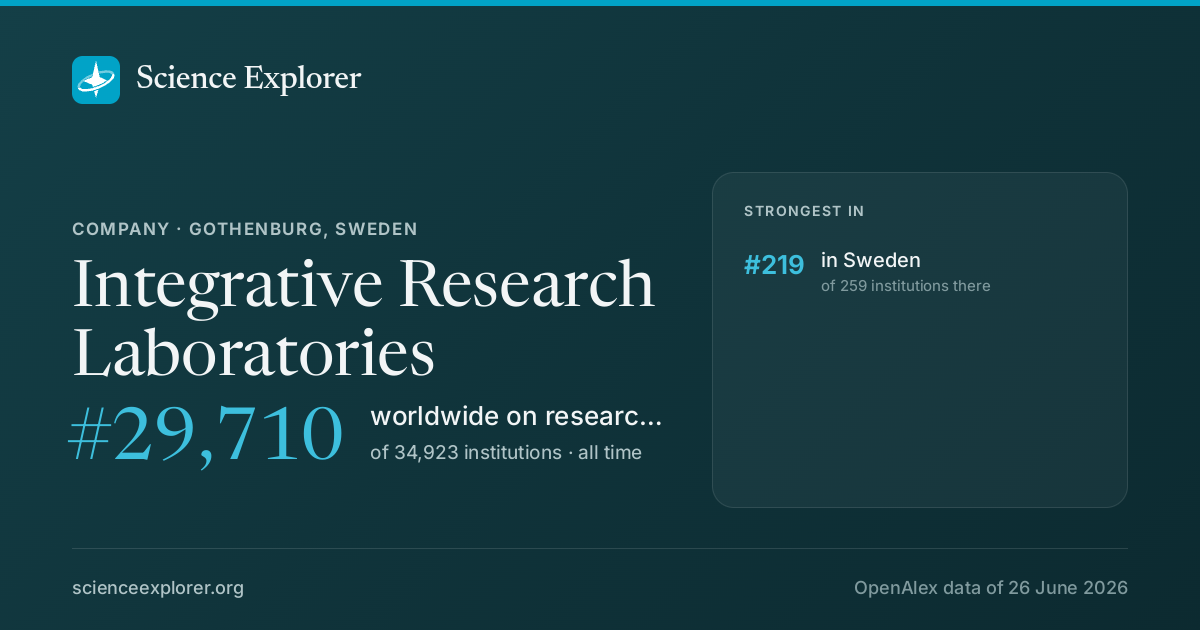
Integrative Research Laboratories on Science Explorer

A card with Integrative Research Laboratories's standing and the fields it leads in, for a post or a slide. A link to this page previews as the same card.

Download the card

1200 × 630 PNG, sized for social posts, drawn from the latest snapshot.

Badges for a website1Each links back here and updates with every snapshot

Research measures only: rankings here say nothing about teaching, admissions or student experience. Comparable institutions and collaboration partners have tabs of their own, above.

Discussion

Ask a question or share a note about Integrative Research Laboratories. Posts are plain text and can be reported.