World rank, all time #14,046
of 34,923
Rank in Sweden #114
of 259 Research works 422
▲ 44% vs 2018-21
Citations 10k 24.8 per fractional work
Top-10% rate 9.2%
all institutions 10.0%
vs its own fields 0.90×
1.00× is exactly expected
Open access 28%
world 40%
International 27%
world 18%
What is Lund Science (Sweden) known for in research?
The fields where it stands highest, over all time, ranked among every institution above the floor in each field.
Which fields of science does Lund Science (Sweden) work in?
In 2022-now, 47% of research at Lund Science (Sweden) is in Physical Sciences , 20% in Health Sciences . Its largest fields are Medicine (19%), Environmental Science (13%), Computer Science (10%).
Physical Sciences: 22 fractional works · 47.0% of its work Environmental Science: 6 fractional works · 13.0% of its work Global and Planetary Change: 2 fractional works · 5.0% of its work Ecology: 1 fractional works · 2.7% of its work Environmental Chemistry: 1 fractional works · 1.2% of its work Environmental Engineering: 1 fractional works · 1.2% of its work Management, Monitoring, Policy and Law: 0 fractional works · 1.0% of its work Nature and Landscape Conservation: 0 fractional works · 0.8% of its work Water Science and Technology: 0 fractional works · 0.7% of its work Health, Toxicology and Mutagenesis: 0 fractional works · 0.4% of its work Computer Science: 5 fractional works · 9.8% of its work Artificial Intelligence: 2 fractional works · 4.5% of its work Computer Vision and Pattern Recognition: 1 fractional works · 1.7% of its work Computer Networks and Communications: 1 fractional works · 1.3% of its work Information Systems: 1 fractional works · 1.2% of its work Software: 0 fractional works · 0.5% of its work Computational Theory and Mathematics: 0 fractional works · 0.4% of its work Signal Processing: 0 fractional works · 0.4% of its work Engineering: 4 fractional works · 9.0% of its work Biomedical Engineering: 1 fractional works · 1.6% of its work Electrical and Electronic Engineering: 1 fractional works · 1.4% of its work Computational Mechanics: 1 fractional works · 1.4% of its work Mechanics of Materials: 1 fractional works · 1.2% of its work Aerospace Engineering: 0 fractional works · 0.9% of its work Mechanical Engineering: 0 fractional works · 0.7% of its work Building and Construction: 0 fractional works · 0.6% of its work Industrial and Manufacturing Engineering: 0 fractional works · 0.5% of its work Civil and Structural Engineering: 0 fractional works · 0.4% of its work Smaller subfields together: 0 fractional works · 0.3% of its work Physics and Astronomy: 3 fractional works · 6.5% of its work Atomic and Molecular Physics, and Optics: 1 fractional works · 2.5% of its work Nuclear and High Energy Physics: 1 fractional works · 1.7% of its work Statistical and Nonlinear Physics: 0 fractional works · 0.9% of its work Astronomy and Astrophysics: 0 fractional works · 0.7% of its work Condensed Matter Physics: 0 fractional works · 0.5% of its work Smaller subfields together: 0 fractional works · 0.2% of its work Earth and Planetary Sciences: 2 fractional works · 3.5% of its work Atmospheric Science: 1 fractional works · 2.6% of its work Oceanography: 0 fractional works · 0.4% of its work Earth-Surface Processes: 0 fractional works · 0.3% of its work Geophysics: 0 fractional works · 0.2% of its work Smaller subfields together: 0 fractional works · 0.1% of its work Mathematics: 2 fractional works · 3.3% of its work Modeling and Simulation: 1 fractional works · 1.1% of its work Applied Mathematics: 0 fractional works · 0.9% of its work Geometry and Topology: 0 fractional works · 0.7% of its work Mathematical Physics: 0 fractional works · 0.4% of its work Statistics and Probability: 0 fractional works · 0.2% of its work Smaller subfields together: 0 fractional works · 0.0% of its work Materials Science: 1 fractional works · 1.2% of its work Biomaterials: 0 fractional works · 0.9% of its work Materials Chemistry: 0 fractional works · 0.2% of its work Chemical Engineering: 0 fractional works · 0.6% of its work Bioengineering: 0 fractional works · 0.4% of its work Fluid Flow and Transfer Processes: 0 fractional works · 0.2% of its work Chemistry: 0 fractional works · 0.1% of its work Health Sciences: 10 fractional works · 20.3% of its work Medicine: 9 fractional works · 19.0% of its work Surgery: 2 fractional works · 4.0% of its work Oncology: 1 fractional works · 2.9% of its work Hematology: 1 fractional works · 1.4% of its work Public Health, Environmental and Occupational Health: 1 fractional works · 1.3% of its work Radiology, Nuclear Medicine and Imaging: 1 fractional works · 1.3% of its work Pathology and Forensic Medicine: 1 fractional works · 1.3% of its work Pediatrics, Perinatology and Child Health: 0 fractional works · 1.0% of its work Cardiology and Cardiovascular Medicine: 0 fractional works · 0.7% of its work Dermatology: 0 fractional works · 0.6% of its work Neurology: 0 fractional works · 0.5% of its work Physiology: 0 fractional works · 0.5% of its work Reproductive Medicine: 0 fractional works · 0.5% of its work Epidemiology: 0 fractional works · 0.4% of its work Psychiatry and Mental health: 0 fractional works · 0.4% of its work Genetics: 0 fractional works · 0.4% of its work Pulmonary and Respiratory Medicine: 0 fractional works · 0.3% of its work Rheumatology: 0 fractional works · 0.3% of its work Anesthesiology and Pain Medicine: 0 fractional works · 0.2% of its work Critical Care and Intensive Care Medicine: 0 fractional works · 0.2% of its work Rehabilitation: 0 fractional works · 0.2% of its work Smaller subfields together: 0 fractional works · 0.6% of its work Health Professions: 0 fractional works · 0.7% of its work Radiological and Ultrasound Technology: 0 fractional works · 0.4% of its work Occupational Therapy: 0 fractional works · 0.2% of its work Smaller subfields together: 0 fractional works · 0.1% of its work Nursing: 0 fractional works · 0.6% of its work Nutrition and Dietetics: 0 fractional works · 0.6% of its work Social Sciences: 8 fractional works · 17.0% of its work Social Sciences: 4 fractional works · 8.0% of its work Political Science and International Relations: 1 fractional works · 3.0% of its work Sociology and Political Science: 1 fractional works · 2.7% of its work Transportation: 0 fractional works · 1.0% of its work Anthropology: 0 fractional works · 0.7% of its work Health: 0 fractional works · 0.3% of its work Law: 0 fractional works · 0.2% of its work Smaller subfields together: 0 fractional works · 0.1% of its work Business, Management and Accounting: 1 fractional works · 2.9% of its work Accounting: 0 fractional works · 0.9% of its work Management of Technology and Innovation: 0 fractional works · 0.7% of its work Marketing: 0 fractional works · 0.5% of its work Strategy and Management: 0 fractional works · 0.5% of its work Management Information Systems: 0 fractional works · 0.4% of its work Smaller subfields together: 0 fractional works · 0.0% of its work Economics, Econometrics and Finance: 1 fractional works · 2.8% of its work Economics and Econometrics: 1 fractional works · 2.2% of its work Finance: 0 fractional works · 0.5% of its work Psychology: 1 fractional works · 1.7% of its work Social Psychology: 0 fractional works · 1.0% of its work Clinical Psychology: 0 fractional works · 0.5% of its work Developmental and Educational Psychology: 0 fractional works · 0.2% of its work Arts and Humanities: 1 fractional works · 1.2% of its work Classics: 0 fractional works · 0.4% of its work Language and Linguistics: 0 fractional works · 0.4% of its work Archeology: 0 fractional works · 0.2% of its work History: 0 fractional works · 0.2% of its work Decision Sciences: 0 fractional works · 0.5% of its work Management Science and Operations Research: 0 fractional works · 0.5% of its work Life Sciences: 7 fractional works · 15.6% of its work Biochemistry, Genetics and Molecular Biology: 3 fractional works · 7.0% of its work Molecular Biology: 2 fractional works · 4.4% of its work Cancer Research: 1 fractional works · 1.3% of its work Genetics: 0 fractional works · 0.5% of its work Cell Biology: 0 fractional works · 0.5% of its work Biochemistry: 0 fractional works · 0.4% of its work Agricultural and Biological Sciences: 2 fractional works · 4.5% of its work Plant Science: 1 fractional works · 1.8% of its work Food Science: 0 fractional works · 0.8% of its work Soil Science: 0 fractional works · 0.8% of its work Ecology, Evolution, Behavior and Systematics: 0 fractional works · 0.6% of its work Agronomy and Crop Science: 0 fractional works · 0.4% of its work Smaller subfields together: 0 fractional works · 0.0% of its work Neuroscience: 1 fractional works · 2.4% of its work Cognitive Neuroscience: 0 fractional works · 0.8% of its work Biological Psychiatry: 0 fractional works · 0.6% of its work Developmental Neuroscience: 0 fractional works · 0.5% of its work Neurology: 0 fractional works · 0.5% of its work Smaller subfields together: 0 fractional works · 0.1% of its work Immunology and Microbiology: 1 fractional works · 1.2% of its work Immunology: 0 fractional works · 1.0% of its work Microbiology: 0 fractional works · 0.2% of its work Pharmacology, Toxicology and Pharmaceutics: 0 fractional works · 0.5% of its work Pharmacology: 0 fractional works · 0.4% of its work Smaller subfields together: 0 fractional works · 0.2% of its work Physical Sciences Environmental Science Computer Science Engineering Physics a… Earth and… Mathemati… Health Sciences Medicine Social Sciences Social Sciences Business Economics Psychology Life Sciences Biochemist… Agricultu… Neuroscie… ALL ITS WORK Lund Science (Sweden) 48 fractional works, 2022-now Life Sciences16% Physical Sciences47% Health Sciences20% Social Sciences17%
Each ring splits the one inside it: the four domains of science, their fields, their subfields. Size is fractional works in 2022-now. Every slice is a page; the interactive view zooms down to single topics and colours each by how much more of it this institution does than the world.
Its 4 domains and 23 fields, with their numbers Environmental Science6 13.0% Computer Science5 9.8% Engineering4 9.0% Physics and Astronomy3 6.5% Earth and Planetary Sciences2 3.5% Mathematics2 3.3% Materials Science1 1.2% Chemical Engineering0 0.6% Chemistry0 0.1% Medicine9 19.0% Health Professions0 0.7% Nursing0 0.6% Social Sciences4 8.0% Business, Management and Accounting1 2.9% Economics, Econometrics and Finance1 2.8% Psychology1 1.7% Arts and Humanities1 1.2% Decision Sciences0 0.5% Biochemistry, Genetics and Molecular Biology3 7.0% Agricultural and Biological Sciences2 4.5% Neuroscience1 2.4% Immunology and Microbiology1 1.2% Pharmacology, Toxicology and Pharmaceutics0 0.5%
All of science, and how each field's share has moved since 1950: the Science domain explorer
Field profile
Location quotient across every field it publishes in: outside the ring is more than an institution of this size would be expected to publish, inside it is less.
Agricultural and Biological Sciences: 0.94× its world share, 2 works Agricultural and Bio… Biochemistry, Genetics and Molecular Biology: 1.31× its world share, 3 works Biochemistry, Geneti… Immunology and Microbiology: 1.18× its world share, 1 works Immunology and Micro… Neuroscience: 1.51× its world share, 1 works Neuroscience Pharmacology, Toxicology and Pharmaceutics: 1.49× its world share, 0 works Pharmacology, Toxico… Chemical Engineering: 1.66× its world share, 0 works Chemical Engineering Chemistry: 0.07× its world share, 0 works Chemistry Computer Science: 1.26× its world share, 5 works Computer Science Earth and Planetary Sciences: 2.24× its world share, 2 works Earth and Planetary … Engineering: 0.60× its world share, 4 works Engineering Environmental Science: 2.62× its world share, 6 works Environmental Science Materials Science: 0.33× its world share, 0 works Materials Science Mathematics: 2.79× its world share, 2 works Mathematics Physics and Astronomy: 2.94× its world share, 3 works Physics and Astronomy Health Professions: 0.28× its world share, 0 works Health Professions Medicine: 0.99× its world share, 9 works Medicine Nursing: 1.19× its world share, 0 works Nursing Arts and Humanities: 0.40× its world share, 1 works Arts and Humanities Business, Management and Accounting: 0.90× its world share, 1 works Business, Management… Decision Sciences: 0.54× its world share, 0 works Decision Sciences Economics, Econometrics and Finance: 1.29× its world share, 1 works Economics, Econometr… Psychology: 0.55× its world share, 1 works Psychology Social Sciences: 0.63× its world share, 4 works Social Sciences 1× world share more than its size predicts about as predicted less
Rings at 0.5×, 1× and 2×. Widest outward: Physics and Astronomy , 2.9×. Every wedge is a field page.
All 23 fields, with their numbers Physics and Astronomy 2.94× 3 works Mathematics 2.79× 2 works Environmental Science 2.62× 6 works Earth and Planetary Sciences 2.24× 2 works Chemical Engineering 1.66× 0 works Neuroscience 1.51× 1 works Pharmacology, Toxicology and Pharmaceutics 1.49× 0 works Biochemistry, Genetics and Molecular Biology 1.31× 3 works Economics, Econometrics and Finance 1.29× 1 works Computer Science 1.26× 5 works Nursing 1.19× 0 works Immunology and Microbiology 1.18× 1 works Medicine 0.99× 9 works Agricultural and Biological Sciences 0.94× 2 works Business, Management and Accounting 0.90× 1 works Social Sciences 0.63× 4 works Engineering 0.60× 4 works Psychology 0.55× 1 works Decision Sciences 0.54× 0 works Arts and Humanities 0.40× 1 works Materials Science 0.33× 0 works Health Professions 0.28× 0 works Chemistry 0.07× 0 works
Who are the top researchers at Lund Science (Sweden)?
Ranked on the quality score, S.E. Larsson , Claes Bankvall and Jaime Arriagada lead among researchers whose main affiliation is Lund Science (Sweden).
1
S.E. Larsson
Sweden · #347,755 worldwide
2.4k citations · 37 works
2
Claes Bankvall
Sweden · #2,358,756 worldwide
295 citations · 21 works
3
Jaime Arriagada
Sweden · #3,050,385 worldwide
290 citations · 20 works
4
S. D. Wicksell
Sweden · #3,075,218 worldwide
89 citations · 15 works
5
Pierre Naert
Sweden · #3,384,414 worldwide
42 citations · 23 works
6
Tord Torisson
Sweden · #4,120,140 worldwide
417 citations · 27 works
7
Arash Saidi
Sweden · #4,450,422 worldwide
169 citations · 22 works
8
Torbjörn O. Lindquist
Sweden · #4,535,660 worldwide
137 citations · 15 works
9
Rongguang Jia
Sweden · #4,542,153 worldwide
258 citations · 24 works
10
Ingvar Persson
Sweden · #5,184,224 worldwide
30 citations · 30 works
All ranked researchers at Lund Science (Sweden)
What are the most cited papers from Lund Science (Sweden)?
The most cited paper from Lund Science (Sweden) is "A new model for control of systems with friction" (Carlos Canudas de Wit, Henrik Olsson, Karl Johan Åström et al., 1995), with 3,686 citations. Next come "The theoretical basis of a method to determine the fracture energyG F of concrete" (696) and "Stem cells in human neurodegenerative disorders — time for clinical translation?" (619).
All 60 most cited papers, with filters and sorting
Which keywords describe research at Lund Science (Sweden)?
By fractional works in 2022-now, weighted toward what it does more of than the world: Climate Change, Social-Ecological Systems, Global Warming, Remote Sensing, Risk Perception, Modeling, Atherosclerosis and Angiogenesis.
▲ more of its work than of the world's ◆ about the world's share ▼ less than the world's
Size is fractional works in 2022-now in the topics tagged with each word; colour is the word's share of this institution's work against its share of the world's. The 15 words are chosen for being large and distinctive. Each links to the topic it comes from most.
All 15 words, with their numbers Climate Change 5 ▲ 3.6× 32 topics Remote Sensing 2 ▲ 3.2× 15 topics Social-Ecological Systems 2 ▲ 28× 3 topics Machine Learning 2 ◆ 1.06× 11 topics Global Warming 1 ▲ 6.9× 7 topics Deep Learning 1 ▼ 0.79× 11 topics Angiogenesis 1 ▲ 7.3× 6 topics Atherosclerosis 1 ▲ 8.4× 3 topics Inflammation 1 ▲ 1.22× 13 topics Modeling 1 ▲ 11× 2 topics Risk Perception 1 ▲ 9.7× 4 topics Multi-Criteria Analysis 1 ▲ 42× 2 topics Decision Support 1 ▲ 71× 1 topic Fuzzy Cognitive Maps 1 ▲ 150× 1 topic Public Perception 1 ▲ 16× 2 topics
How open and international is its research?
Against the world's own shares: the tick on each track. Both are shares of its output, so they
sit on one scale and can be read against each other as well as against the world.
28% 72%
openly available28.4% not open71.6%
World: 40% of research is openly available.
27% 73%
with international co-authors26.8% domestic only73.2%
World: 18% is written across borders.
How has Lund Science (Sweden)'s research output changed?
Output in 2022-2025 was 44% higher than in 2018-2021.
still counting 1990 2000 2010 2020
grew held shrank
The same series as a ribbon: one cell per year, darker for more. The line above answers how much ; this answers when .
Its share of all research
still counting 0.0010% 0.0020% Lund Science (Sweden) 0.00028% in 2025 1980 1990 2000 2010 2020 Fractional works of Lund Science (Sweden) over all fractional works that year. How the balance of science has shifted .
Share Lund Science (Sweden)'s ranking
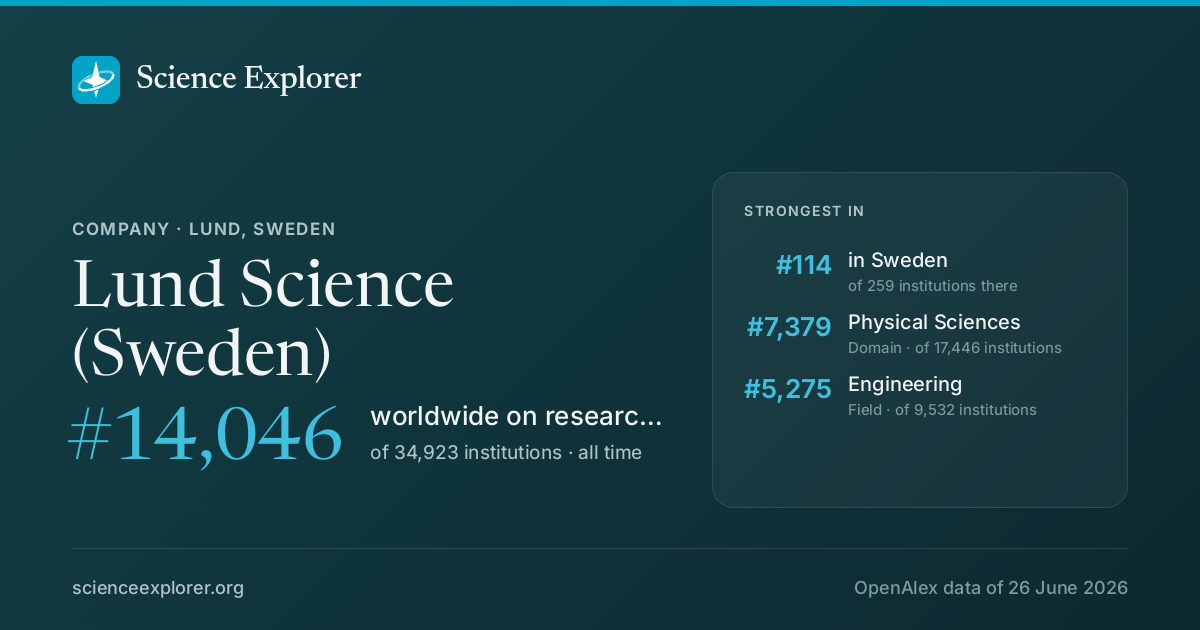
A card with Lund Science (Sweden)'s standing and the fields it leads in, for a post or a slide. A link to this page previews as the same card.
Badges for a website 1 Each links back here and updates with every snapshot