Science Explorer Back to mapMap
Discussion
Archive · Lund · Sweden

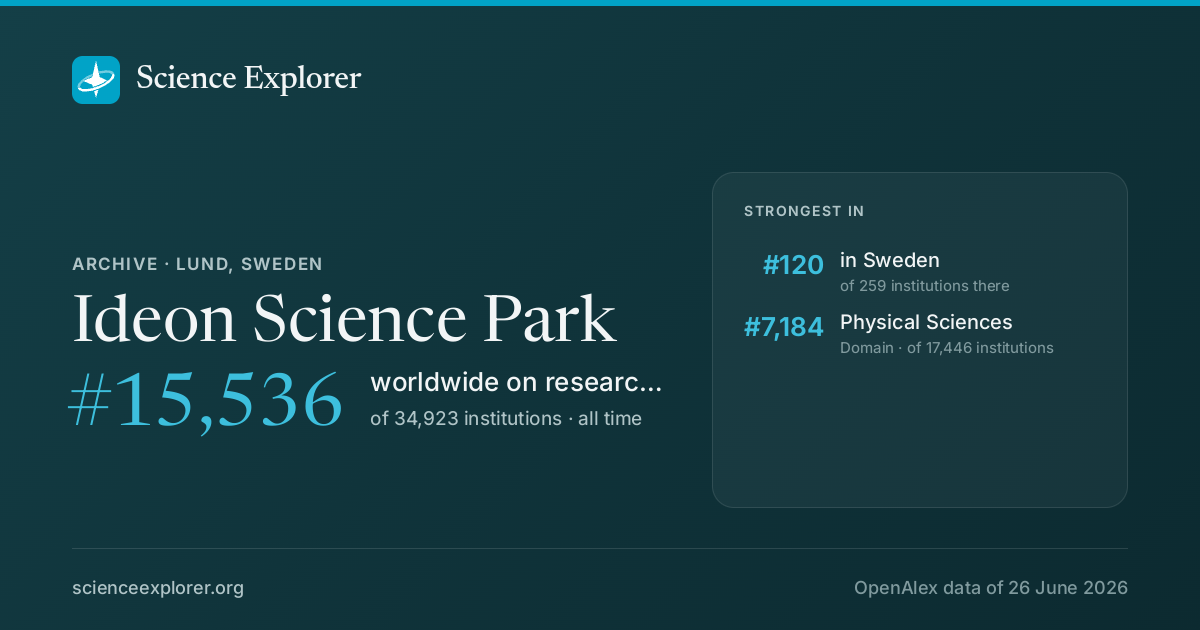
Ideon Science Park

In research, Ideon Science Park stands highest in Physical Sciences (#7,184 of 17,446 worldwide), over all time.

World rank, all time
#15,536
of 34,923
Rank in Sweden
#120
of 259
Research works
308
▲ 29% vs 2018-21
Citations
12k
38.8 per fractional work
Top-10% rate
13.7%
all institutions 10.0%
vs its own fields
1.09×
1.00× is exactly expected
Open access
36%
world 40%
International
30%
world 18%

What is Ideon Science Park known for in research?

The fields where it stands highest, over all time, ranked among every institution above the floor in each field.

FieldWorld rankWhere that sitsTop-10% rateWorks
Physical SciencesDomain #7,184 of 17,446 17.8%163

Each strip is that field's whole ranked pool, with the notch where Ideon Science Park sits in it, in the colour of the band that rank falls in. The track under the rate is the rate itself: it carries no average mark, because the average differs by field (from about 6% in Dentistry to 21% in Economics).

Which fields of science does Ideon Science Park work in?

In 2022-now, 41% of research at Ideon Science Park is in Physical Sciences, 32% in Life Sciences. Its largest fields are Medicine (22%), Environmental Science (18%), Biochemistry, Genetics and Molecular Biology (15%). It does 1.8× the world's share of Life Sciences.

Physical Sciences: 13 fractional works · 40.6% of its workEnvironmental Science: 6 fractional works · 18.5% of its workEcology: 1 fractional works · 3.1% of its workWater Science and Technology: 1 fractional works · 2.7% of its workIndustrial and Manufacturing Engineering: 1 fractional works · 2.4% of its workGlobal and Planetary Change: 1 fractional works · 2.2% of its workPollution: 1 fractional works · 2.1% of its workHealth, Toxicology and Mutagenesis: 1 fractional works · 2.1% of its workEnvironmental Engineering: 1 fractional works · 2.1% of its workNature and Landscape Conservation: 0 fractional works · 1.0% of its workEnvironmental Chemistry: 0 fractional works · 0.7% of its workEngineering: 2 fractional works · 6.4% of its workBiomedical Engineering: 1 fractional works · 2.0% of its workCivil and Structural Engineering: 0 fractional works · 1.5% of its workElectrical and Electronic Engineering: 0 fractional works · 1.4% of its workMechanical Engineering: 0 fractional works · 0.3% of its workMedia Technology: 0 fractional works · 0.3% of its workOcean Engineering: 0 fractional works · 0.3% of its workBuilding and Construction: 0 fractional works · 0.3% of its workMechanics of Materials: 0 fractional works · 0.2% of its workSmaller subfields together: 0 fractional works · 0.1% of its workPhysics and Astronomy: 2 fractional works · 5.4% of its workAtomic and Molecular Physics, and Optics: 1 fractional works · 2.2% of its workCondensed Matter Physics: 0 fractional works · 1.5% of its workNuclear and High Energy Physics: 0 fractional works · 1.2% of its workStatistical and Nonlinear Physics: 0 fractional works · 0.3% of its workSmaller subfields together: 0 fractional works · 0.1% of its workChemistry: 1 fractional works · 2.6% of its workPhysical and Theoretical Chemistry: 0 fractional works · 0.9% of its workOrganic Chemistry: 0 fractional works · 0.6% of its workAnalytical Chemistry: 0 fractional works · 0.5% of its workSpectroscopy: 0 fractional works · 0.4% of its workElectrochemistry: 0 fractional works · 0.2% of its workMaterials Science: 1 fractional works · 2.4% of its workMaterials Chemistry: 0 fractional works · 1.1% of its workBiomaterials: 0 fractional works · 0.6% of its workElectronic, Optical and Magnetic Materials: 0 fractional works · 0.3% of its workSurfaces, Coatings and Films: 0 fractional works · 0.3% of its workSmaller subfields together: 0 fractional works · 0.0% of its workComputer Science: 1 fractional works · 2.3% of its workComputational Theory and Mathematics: 0 fractional works · 1.2% of its workComputer Vision and Pattern Recognition: 0 fractional works · 0.5% of its workInformation Systems: 0 fractional works · 0.2% of its workSmaller subfields together: 0 fractional works · 0.3% of its workEarth and Planetary Sciences: 1 fractional works · 2.1% of its workAtmospheric Science: 1 fractional works · 2.1% of its workEnergy: 0 fractional works · 0.8% of its workRenewable Energy, Sustainability and the Environment: 0 fractional works · 0.8% of its workChemical Engineering: 0 fractional works · 0.2% of its workCatalysis: 0 fractional works · 0.2% of its workLife Sciences: 10 fractional works · 32.0% of its workBiochemistry, Genetics and Molecular Biology: 5 fractional works · 14.6% of its workMolecular Biology: 3 fractional works · 10.8% of its workCancer Research: 0 fractional works · 0.8% of its workPhysiology: 0 fractional works · 0.7% of its workCell Biology: 0 fractional works · 0.6% of its workMolecular Medicine: 0 fractional works · 0.5% of its workBiotechnology: 0 fractional works · 0.3% of its workEndocrinology: 0 fractional works · 0.3% of its workGenetics: 0 fractional works · 0.3% of its workClinical Biochemistry: 0 fractional works · 0.2% of its workAgricultural and Biological Sciences: 4 fractional works · 11.3% of its workPlant Science: 1 fractional works · 3.3% of its workFood Science: 1 fractional works · 3.3% of its workEcology, Evolution, Behavior and Systematics: 1 fractional works · 2.3% of its workAnimal Science and Zoology: 0 fractional works · 1.3% of its workAgronomy and Crop Science: 0 fractional works · 0.4% of its workSoil Science: 0 fractional works · 0.3% of its workForestry: 0 fractional works · 0.2% of its workGeneral Agricultural and Biological Sciences: 0 fractional works · 0.2% of its workPharmacology, Toxicology and Pharmaceutics: 1 fractional works · 2.4% of its workToxicology: 0 fractional works · 1.5% of its workPharmaceutical Science: 0 fractional works · 0.9% of its workImmunology and Microbiology: 1 fractional works · 2.4% of its workImmunology: 1 fractional works · 2.1% of its workMicrobiology: 0 fractional works · 0.2% of its workSmaller subfields together: 0 fractional works · 0.0% of its workNeuroscience: 0 fractional works · 1.3% of its workSensory Systems: 0 fractional works · 1.0% of its workCellular and Molecular Neuroscience: 0 fractional works · 0.2% of its workSmaller subfields together: 0 fractional works · 0.0% of its workHealth Sciences: 8 fractional works · 24.8% of its workMedicine: 7 fractional works · 22.3% of its workEndocrinology, Diabetes and Metabolism: 2 fractional works · 5.3% of its workPublic Health, Environmental and Occupational Health: 1 fractional works · 2.7% of its workEpidemiology: 1 fractional works · 2.4% of its workInfectious Diseases: 1 fractional works · 1.6% of its workOncology: 0 fractional works · 1.6% of its workRheumatology: 0 fractional works · 1.5% of its workGenetics: 0 fractional works · 1.1% of its workRehabilitation: 0 fractional works · 0.7% of its workReproductive Medicine: 0 fractional works · 0.7% of its workRadiology, Nuclear Medicine and Imaging: 0 fractional works · 0.6% of its workObstetrics and Gynecology: 0 fractional works · 0.5% of its workPhysiology: 0 fractional works · 0.5% of its workPediatrics, Perinatology and Child Health: 0 fractional works · 0.5% of its workNeurology: 0 fractional works · 0.5% of its workAnesthesiology and Pain Medicine: 0 fractional works · 0.4% of its workDermatology: 0 fractional works · 0.3% of its workUrology: 0 fractional works · 0.3% of its workEmergency Medicine: 0 fractional works · 0.2% of its workPharmacology: 0 fractional works · 0.2% of its workPsychiatry and Mental health: 0 fractional works · 0.2% of its workPulmonary and Respiratory Medicine: 0 fractional works · 0.2% of its workSmaller subfields together: 0 fractional works · 0.2% of its workNursing: 1 fractional works · 1.6% of its workNutrition and Dietetics: 1 fractional works · 1.6% of its workHealth Professions: 0 fractional works · 0.9% of its workSpeech and Hearing: 0 fractional works · 0.3% of its workGeneral Health Professions: 0 fractional works · 0.2% of its workHealth Information Management: 0 fractional works · 0.2% of its workSmaller subfields together: 0 fractional works · 0.0% of its workSocial Sciences: 1 fractional works · 2.7% of its workBusiness, Management and Accounting: 0 fractional works · 0.9% of its workMarketing: 0 fractional works · 0.5% of its workManagement Information Systems: 0 fractional works · 0.2% of its workStrategy and Management: 0 fractional works · 0.2% of its workSocial Sciences: 0 fractional works · 0.6% of its workHealth: 0 fractional works · 0.3% of its workSmaller subfields together: 0 fractional works · 0.3% of its workPsychology: 0 fractional works · 0.6% of its workClinical Psychology: 0 fractional works · 0.2% of its workSocial Psychology: 0 fractional works · 0.2% of its workSmaller subfields together: 0 fractional works · 0.1% of its workArts and Humanities: 0 fractional works · 0.5% of its workHistory and Philosophy of Science: 0 fractional works · 0.5% of its workEconomics, Econometrics and Finance: 0 fractional works · 0.1% of its workALL ITS WORKIdeon SciencePark32fractional works, 2022-now
Life Sciences32%Physical Sciences41%Health Sciences25%Social Sciences3%

Each ring splits the one inside it: the four domains of science, their fields, their subfields. Size is fractional works in 2022-now. Every slice is a page; the interactive view zooms down to single topics and colours each by how much more of it this institution does than the world.

Its 4 domains and 22 fields, with their numbers
    1. Environmental Science618.5%
    2. Engineering26.4%
    3. Physics and Astronomy25.4%
    4. Chemistry12.6%
    5. Materials Science12.4%
    6. Computer Science12.3%
    7. Earth and Planetary Sciences12.1%
    8. Energy00.8%
    9. Chemical Engineering00.2%
    1. Biochemistry, Genetics and Molecular Biology514.6%
    2. Agricultural and Biological Sciences411.3%
    3. Pharmacology, Toxicology and Pharmaceutics12.4%
    4. Immunology and Microbiology12.4%
    5. Neuroscience01.3%
    1. Medicine722.3%
    2. Nursing11.6%
    3. Health Professions00.9%
    1. Business, Management and Accounting00.9%
    2. Social Sciences00.6%
    3. Psychology00.6%
    4. Arts and Humanities00.5%
    5. Economics, Econometrics and Finance00.1%
All of science, and how each field's share has moved since 1950: the Science domain explorer

Field profile

Location quotient across every field it publishes in: outside the ring is more than an institution of this size would be expected to publish, inside it is less.

Agricultural and Biological Sciences: 2.39× its world share, 4 worksAgricultural and Bio…Biochemistry, Genetics and Molecular Biology: 2.74× its world share, 5 worksBiochemistry, Geneti…Immunology and Microbiology: 2.33× its world share, 1 worksImmunology and Micro…Neuroscience: 0.80× its world share, 0 worksNeurosciencePharmacology, Toxicology and Pharmaceutics: 6.80× its world share, 1 worksPharmacology, Toxico…Chemical Engineering: 0.59× its world share, 0 worksChemical EngineeringChemistry: 1.65× its world share, 1 worksChemistryComputer Science: 0.29× its world share, 1 worksComputer ScienceEarth and Planetary Sciences: 1.32× its world share, 1 worksEarth and Planetary …Energy: 0.88× its world share, 0 worksEnergyEngineering: 0.43× its world share, 2 worksEngineeringEnvironmental Science: 3.72× its world share, 6 worksEnvironmental ScienceMaterials Science: 0.68× its world share, 1 worksMaterials SciencePhysics and Astronomy: 2.42× its world share, 2 worksPhysics and AstronomyHealth Professions: 0.33× its world share, 0 worksHealth ProfessionsMedicine: 1.16× its world share, 7 worksMedicineNursing: 3.34× its world share, 0 worksNursingArts and Humanities: 0.18× its world share, 0 worksArts and HumanitiesBusiness, Management and Accounting: 0.29× its world share, 0 worksBusiness, Management…Economics, Econometrics and Finance: 0.04× its world share, 0 worksEconomics, Econometr…Psychology: 0.18× its world share, 0 worksPsychologySocial Sciences: 0.05× its world share, 0 worksSocial Sciences1×world share
more than its size predictsabout as predictedless

Rings at 0.5×, 1× and 2×. Widest outward: Pharmacology, Toxicology and Pharmaceutics, 6.8×. Every wedge is a field page.

All 22 fields, with their numbers
  1. Pharmacology, Toxicology and Pharmaceutics6.80×1 works
  2. Environmental Science3.72×6 works
  3. Nursing3.34×0 works
  4. Biochemistry, Genetics and Molecular Biology2.74×5 works
  5. Physics and Astronomy2.42×2 works
  6. Agricultural and Biological Sciences2.39×4 works
  7. Immunology and Microbiology2.33×1 works
  8. Chemistry1.65×1 works
  9. Earth and Planetary Sciences1.32×1 works
  10. Medicine1.16×7 works
  11. Energy0.88×0 works
  12. Neuroscience0.80×0 works
  13. Materials Science0.68×1 works
  14. Chemical Engineering0.59×0 works
  15. Engineering0.43×2 works
  16. Health Professions0.33×0 works
  17. Computer Science0.29×1 works
  18. Business, Management and Accounting0.29×0 works
  19. Arts and Humanities0.18×0 works
  20. Psychology0.18×0 works
  21. Social Sciences0.05×0 works
  22. Economics, Econometrics and Finance0.04×0 works

What are the most cited papers from Ideon Science Park?

The most cited paper from Ideon Science Park is "InP Nanowire Array Solar Cells Achieving 13.8% Efficiency by Exceeding the Ray Optics Limit" (Jesper Wallentin, Nicklas Anttu, Damir Asoli et al., 2013), with 1,187 citations. Next come "Artificial intelligence in supply chain management: A systematic literature review" (989) and "Alteration of Intestinal Microflora Is Associated With Reduction in Abdominal Bloating and Pain in Patients With Irritable Bowel Syndrome" (535).

Most cited papers
#PaperReleasedCitations
1 InP Nanowire Array Solar Cells Achieving 13.8% Efficiency by Exceeding the Ray Optics Limit Jesper Wallentin, Nicklas Anttu, Damir Asoli et al. · Science 18 Jan 2013 1,187
2 Artificial intelligence in supply chain management: A systematic literature review Reza Toorajipour, Vahid Sohrabpour, Ali Nazarpour et al. · Journal of Business Research ReviewOpen access 24 Sep 2020 989
3 Alteration of Intestinal Microflora Is Associated With Reduction in Abdominal Bloating and Pain in Patients With Irritable Bowel Syndrome Sören Nobaek, Marie-Louise Johansson, Göran Molin et al. · The American Journal of Gastroenterology May 2000 535
4 Ecological control of the gastrointestinal tract. The role of probiotic flora Stig Bengmark · Gut Open access 1998 511
5 Physical system modeling with Modelica Sven Erik Mattsson, Hilding Elmqvist, Martin Otter · Control Engineering Practice Apr 1998 421
All 60 most cited papers, with filters and sorting

Which keywords describe research at Ideon Science Park?

By fractional works in 2022-now, weighted toward what it does more of than the world: Climate Change, Growth Hormone, Invasive Species, BET Bromodomains, PROTACs, Cushing's Syndrome, Pituitary Adenomas and Wastewater Treatment.

▲ more of its work than of the world's◆ about the world's share▼ less than the world's

Size is fractional works in 2022-now in the topics tagged with each word; colour is the word's share of this institution's work against its share of the world's. The 12 words are chosen for being large and distinctive. Each links to the topic it comes from most.

All 12 words, with their numbers
  1. Climate Change3▲ 3.2×13 topics
  2. Growth Hormone1▲ 89×2 topics
  3. BET Bromodomains1▲ 128×1 topic
  4. Invasive Species1▲ 9.7×4 topics
  5. PROTACs1▲ 128×1 topic
  6. Epidemiology1◆ 0.91×7 topics
  7. Machine Learning1◆ 1.12×6 topics
  8. Biodiversity1▲ 4.3×4 topics
  9. Cushing's Syndrome1▲ 104×1 topic
  10. Inflammation1▲ 1.46×8 topics
  11. Pituitary Adenomas1▲ 104×1 topic
  12. Wastewater Treatment1▲ 13×3 topics

Which research topics does Ideon Science Park publish most on?

By volume in 2022-now: Protein Degradation and Inhibitors, Pituitary Gland Disorders and Treatments, Opioid Use Disorder Treatment and Wastewater Treatment and Nitrogen Removal.

  1. 1 Protein Degradation and Inhibitors Molecular Biology 1 works
  2. 2 Pituitary Gland Disorders and Treatments Endocrinology, Diabetes and Metabolism 1 works
  3. 3 Opioid Use Disorder Treatment Public Health, Environmental and Occupational Health 1 works
  4. 4 Wastewater Treatment and Nitrogen Removal Pollution 0 works
  5. 5 Water Treatment and Disinfection Health, Toxicology and Mutagenesis 0 works
  6. 6 Forensic Toxicology and Drug Analysis Toxicology 0 works
  7. 7 Proteins in Food Systems Food Science 0 works
  8. 8 Constructed Wetlands for Wastewater Treatment Industrial and Manufacturing Engineering 0 works
  9. 9 Meat and Animal Product Quality Animal Science and Zoology 0 works
  10. 10 Computational Drug Discovery Methods Computational Theory and Mathematics 0 works

How open and international is its research?

Against the world's own shares: the tick on each track. Both are shares of its output, so they sit on one scale and can be read against each other as well as against the world.

openly available36.5%not open63.5%

World: 40% of research is openly available.

with international co-authors30.0%domestic only70.0%

World: 18% is written across borders.

How has Ideon Science Park's research output changed?

Output in 2022-2025 was 29% higher than in 2018-2021.

still counting1990200020102020
grewheldshrank

The same series as a ribbon: one cell per year, darker for more. The line above answers how much; this answers when.

Its share of all research

Growing output can still be a shrinking share: all of science grows. This is Ideon Science Park as a percentage of every work published that year, 0.00016% in 2024.

still counting0.00050%0.0010%0.0015%Ideon Science Park0.00014% in 202519801990200020102020

Fractional works of Ideon Science Park over all fractional works that year. How the balance of science has shifted.

Other research institutions in Lund

All research institutions in Lund

Share Ideon Science Park's ranking

Ideon Science Park on Science Explorer

A card with Ideon Science Park's standing and the fields it leads in, for a post or a slide. A link to this page previews as the same card.

Download the card

1200 × 630 PNG, sized for social posts, drawn from the latest snapshot.

Badges for a website1Each links back here and updates with every snapshot

Research measures only: rankings here say nothing about teaching, admissions or student experience. Comparable institutions and collaboration partners have tabs of their own, above.

Discussion

Ask a question or share a note about Ideon Science Park. Posts are plain text and can be reported.