Lyell McEwin Hospital
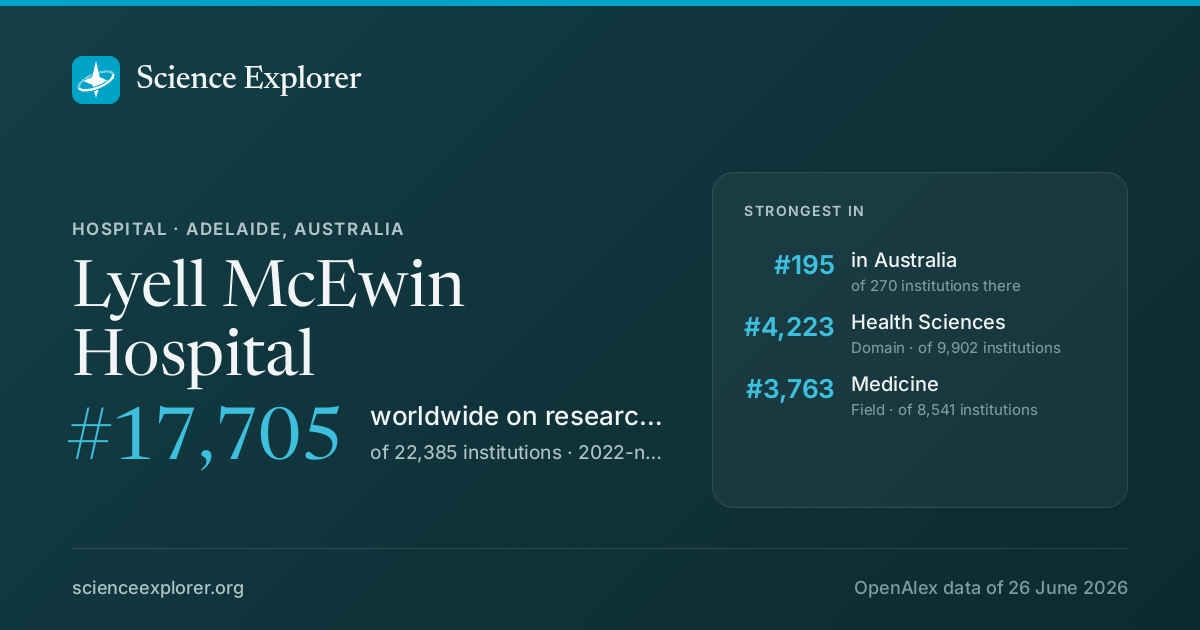
In research, Lyell McEwin Hospital stands highest in Health Sciences (#4,223 of 9,902 worldwide) and Medicine (#3,763 of 8,541 worldwide), 2022-now. Relative to its size it is most specialised in Cardiology and Cardiovascular Medicine and Surgery (Cardiology and Cardiovascular Medicine is 13.8× its share of world research).
- World rank, 2022-now
- #17,705 of 22,385 · #16,323 all time
- Rank in Australia
- #195 of 270
- Research works
- 504 ▲ 22% vs 2018-21
- Citations
- 9.5k 18.7 per fractional work
- Top-10% rate
- 8.2% all institutions 10.0%
- vs its own fields
- 0.94× 1.00× is exactly expected
- Open access
- 48% world 40%
- International
- 22% world 18%
What is Lyell McEwin Hospital known for in research?
The fields where it stands highest, 2022-now, ranked among every institution above the floor in each field.
| Field | World rank | Where that sits | Top-10% rate | Works | All time |
|---|---|---|---|---|---|
| Health SciencesDomain | #4,223 of 9,902 | 7.2% | 125 | #4112 | |
| MedicineField | #3,763 of 8,541 | 7.1% | 118 | #3662 |
Each strip is that field's whole ranked pool, with the notch where Lyell McEwin Hospital sits in it, in the colour of the band that rank falls in. The track under the rate is the rate itself: it carries no average mark, because the average differs by field (from about 6% in Dentistry to 21% in Economics).
Which fields of science does Lyell McEwin Hospital work in?
In 2022-now, 89% of research at Lyell McEwin Hospital is in Health Sciences, 5% in Life Sciences. Its largest fields are Medicine (84%), Health Professions (4%), Biochemistry, Genetics and Molecular Biology (3%). It does 3.6× the world's share of Health Sciences.
Each ring splits the one inside it: the four domains of science, their fields, their subfields. Size is fractional works in 2022-now. Every slice is a page; the interactive view zooms down to single topics and colours each by how much more of it this institution does than the world.
Its 4 domains and 22 fields, with their numbers
- Health Sciences13588.7%
- Medicine12883.7%
- Health Professions64.0%
- Nursing10.6%
- Veterinary00.3%
- Dentistry00.1%
- Life Sciences74.9%
- Physical Sciences53.2%
- Computer Science31.9%
- Engineering10.5%
- Environmental Science10.5%
- Earth and Planetary Sciences00.3%
- Mathematics00.1%
- Materials Science00.1%
- Social Sciences53.1%
What does Lyell McEwin Hospital specialise in?
Where its research is concentrated relative to its size: Cardiology and Cardiovascular Medicine takes 13.8× the share of its output that it takes of world research.
- Cardiology and Cardiovascular MedicineSubfield · 22.1 works14×
- SurgerySubfield · 25.3 works7.1×
Location quotient, a volume reading rather than an impact one. It surfaces small, lopsided specialities.
Field profile
Location quotient across every field it publishes in: outside the ring is more than an institution of this size would be expected to publish, inside it is less.
Rings at 0.5×, 1× and 2×. Widest outward: Medicine, 4.3×. Every wedge is a field page.
All 22 fields, with their numbers
- Medicine4.35×128 works
- Veterinary2.41×0 works
- Health Professions1.53×6 works
- Nursing1.18×1 works
- Immunology and Microbiology1.04×2 works
- Pharmacology, Toxicology and Pharmaceutics0.70×0 works
- Biochemistry, Genetics and Molecular Biology0.54×4 works
- Neuroscience0.39×1 works
- Computer Science0.24×3 works
- Dentistry0.23×0 works
- Psychology0.22×1 works
- Earth and Planetary Sciences0.18×0 works
- Economics, Econometrics and Finance0.18×1 works
- Social Sciences0.13×2 works
- Decision Sciences0.12×0 works
- Environmental Science0.09×1 works
- Mathematics0.07×0 works
- Business, Management and Accounting0.05×0 works
- Engineering0.03×1 works
- Arts and Humanities0.03×0 works
- Agricultural and Biological Sciences0.02×0 works
- Materials Science0.02×0 works
- Medicine 4.3×
- Veterinary 2.4×
- Health Professions 1.5×
- Nursing 1.2×
- Immunology and Microbiology 1.0×
- Pharmacology, Toxicology and Pharmaceutics 0.7×
- Biochemistry, Genetics and Molecular Biology 0.5×
- Neuroscience 0.4×
- Computer Science 0.2×
- Dentistry 0.2×
- Psychology 0.2×
- Earth and Planetary Sciences 0.2×
- Economics, Econometrics and Finance 0.2×
- Social Sciences 0.1×
- Decision Sciences 0.1×
- Environmental Science 0.1×
- Mathematics 0.1×
- Business, Management and Accounting 0.1×
- Engineering 0.0×
- Arts and Humanities 0.0×
- Agricultural and Biological Sciences 0.0×
- Materials Science 0.0×
Who are the top researchers at Lyell McEwin Hospital?
Ranked on the quality score, Rajvinder Singh, Bernd Froessler and Elizabeth Mary Ann Murphy lead among researchers whose main affiliation is Lyell McEwin Hospital.
- 1
Rajvinder Singh
 Australia · #237,622 worldwide
8.6k citations · 286 works
- 2
Bernd Froessler
Australia · #568,823 worldwide
1.4k citations · 48 works
- 3
Elizabeth Mary Ann Murphy
Australia · #1,001,352 worldwide
1.9k citations · 72 works
- 4
Mohamed Asif Chinnaratha
Australia · #1,669,577 worldwide
520 citations · 45 works
- 5
Rohit Joshi
Australia · #1,732,828 worldwide
1.6k citations · 111 works
- 6
Anthony Zimmermann
Australia · #2,116,804 worldwide
285 citations · 26 works
- 7
Rebecca E Thomas
Australia · #2,192,003 worldwide
622 citations · 24 works
- 8
Julie Tucker
Australia · #2,575,290 worldwide
70 citations · 17 works
- 9
Anupam Parange
Australia · #2,798,769 worldwide
233 citations · 19 works
- 10
Jacqui Adams
Australia · #3,237,810 worldwide
849 citations · 30 works
Which keywords describe research at Lyell McEwin Hospital?
By fractional works in 2022-now, weighted toward what it does more of than the world: Epidemiology, Guidelines, Risk Factors, Complications, Catheter Ablation, Diagnosis, Clinical Practice Guidelines and Mortality.
- Type 2 Diabetes
- Myocardial Infarction
- Inflammatory Bowel Disease
- Preoperative Chemoradiotherapy
- Survival Analysis
- Clinical Guidelines
- Revision Surgery
- Risk Stratification
- Sudden Cardiac Death
- Children
- Endoscopic Resection
- Anticoagulant Therapy
- Chemotherapy
- Maternal Mortality
- Echocardiography
- Management
- Clinical Practice Guidelines
- Treatment
- Complications
- Guidelines
- Epidemiology
- Risk Factors
- Diagnosis
- Catheter Ablation
- Mortality
- Metabolic Syndrome
- Arrhythmias
- Surgery
- Heart Failure
- Atrial Fibrillation
- Surgical Management
- Stroke Prevention
- Neoadjuvant Therapy
- Thromboembolism
- Total Hip Replacement
- Endothelial Dysfunction
- Hyperglycemia
- Radiofrequency Ablation
- Molecular Characterization
- Preeclampsia
Size is fractional works in 2022-now in the topics tagged with each word; colour is the word's share of this institution's work against its share of the world's. The 40 words are chosen for being large and distinctive. Each links to the topic it comes from most.
All 40 words, with their numbers
- Epidemiology19▲ 3.2×59 topics
- Guidelines10▲ 14×12 topics
- Risk Factors10▲ 6.0×18 topics
- Complications9▲ 12×13 topics
- Diagnosis7▲ 5.1×25 topics
- Treatment7▲ 3.9×25 topics
- Catheter Ablation6▲ 34×2 topics
- Clinical Practice Guidelines6▲ 7.2×10 topics
- Mortality6▲ 6.8×10 topics
- Management6▲ 4.7×18 topics
- Metabolic Syndrome5▲ 4.3×11 topics
- Echocardiography5▲ 12×6 topics
- Arrhythmias5▲ 34×2 topics
- Maternal Mortality5▲ 14×5 topics
- Surgery5▲ 8.6×7 topics
- Chemotherapy4▲ 3.9×12 topics
- Heart Failure4▲ 6.2×8 topics
- Anticoagulant Therapy4▲ 21×3 topics
- Atrial Fibrillation4▲ 27×2 topics
- Endoscopic Resection4▲ 27×2 topics
- Surgical Management4▲ 6.2×11 topics
- Children4▲ 11×6 topics
- Stroke Prevention4▲ 20×2 topics
- Sudden Cardiac Death4▲ 28×2 topics
- Neoadjuvant Therapy4▲ 9.8×5 topics
- Risk Stratification4▲ 32×1 topic
- Thromboembolism4▲ 32×1 topic
- Revision Surgery4▲ 18×2 topics
- Total Hip Replacement4▲ 18×2 topics
- Clinical Guidelines3▲ 7.7×8 topics
- Endothelial Dysfunction3▲ 9.3×5 topics
- Survival Analysis3▲ 7.9×5 topics
- Hyperglycemia3▲ 19×3 topics
- Preoperative Chemoradiotherapy3▲ 27×2 topics
- Radiofrequency Ablation3▲ 20×2 topics
- Inflammatory Bowel Disease3▲ 17×4 topics
- Molecular Characterization3▲ 12×5 topics
- Myocardial Infarction3▲ 8.4×6 topics
- Preeclampsia3▲ 26×2 topics
- Type 2 Diabetes3▲ 8.7×4 topics
Which research topics does Lyell McEwin Hospital publish most on?
By volume in 2022-now: Atrial Fibrillation Management and Outcomes, Cardiac Arrhythmias and Treatments, Pregnancy and preeclampsia studies and Gestational Diabetes Research and Management.
Area is fractional works; colour is the subfield each topic belongs to.
- 1 Atrial Fibrillation Management and Outcomes Cardiology and Cardiovascular Medicine 4 works
- 2 Cardiac Arrhythmias and Treatments Cardiology and Cardiovascular Medicine 3 works
- 3 Pregnancy and preeclampsia studies Obstetrics and Gynecology 3 works
- 4 Gestational Diabetes Research and Management Obstetrics and Gynecology 2 works
- 5 Esophageal and GI Pathology Surgery 2 works
- 6 Gastric Cancer Management and Outcomes Pulmonary and Respiratory Medicine 2 works
- 7 Cardiac electrophysiology and arrhythmias Cardiology and Cardiovascular Medicine 2 works
- 8 Colorectal Cancer Screening and Detection Oncology 2 works
- 9 Maternal and Perinatal Health Interventions Obstetrics and Gynecology 2 works
- 10 Esophageal Cancer Research and Treatment Surgery 2 works
How open and international is its research?
Against the world's own shares: the tick on each track. Both are shares of its output, so they sit on one scale and can be read against each other as well as against the world.
World: 40% of research is openly available.
World: 18% is written across borders.
How has Lyell McEwin Hospital's research output changed?
Output in 2022-2025 was 22% higher than in 2018-2021.
The same series as a ribbon: one cell per year, darker for more. The line above answers how much; this answers when.
Its share of all research
Growing output can still be a shrinking share: all of science grows. This is Lyell McEwin Hospital as a percentage of every work published that year, 0.00069% in 2024.
Fractional works of Lyell McEwin Hospital over all fractional works that year. How the balance of science has shifted.
How much of it reaches the world top 10%
Year by year, against all institutions in the same year.
Of each year's output, the share that reached the world's 10% most cited for its field and year. Peak 20.2% in 2014.
Other research institutions in Adelaide
- The University of Adelaide
- Flinders University
- University of South Australia
- Royal Adelaide Hospital
- UCL Australia
- South Australia Pathology
- Queen Elizabeth Hospital
- South Australian Health and Medical Research Institute

Share Lyell McEwin Hospital's ranking
Badges for a website1Each links back here and updates with every snapshot

Research measures only: rankings here say nothing about teaching, admissions or student experience. Comparable institutions and collaboration partners have tabs of their own, above.
Discussion
Ask a question or share a note about Lyell McEwin Hospital. Posts are plain text and can be reported.