Science Explorer Back to mapMap
Discussion

Micro Systems Engineering (United States)

World rank, all time
#28,759
of 34,923
Rank in United States
#6,053
of 7,310
Research works
129
▼ 31% vs 2018-21
Citations
1.1k
8.4 per fractional work
Top-10% rate
5.0%
all institutions 10.0%
vs its own fields
0.92×
1.00× is exactly expected
Open access
18%
world 40%
International
10%
world 18%

Which fields of science does Micro Systems Engineering (United States) work in?

In all years, 61% of research at Micro Systems Engineering (United States) is in Physical Sciences, 28% in Health Sciences. Its largest fields are Engineering (37%), Medicine (26%), Computer Science (11%). It does 1.5× the world's share of Physical Sciences.

Physical Sciences: 78 fractional works · 60.7% of its workEngineering: 48 fractional works · 37.4% of its workElectrical and Electronic Engineering: 24 fractional works · 18.4% of its workBiomedical Engineering: 11 fractional works · 8.3% of its workComputational Mechanics: 3 fractional works · 2.0% of its workMechanical Engineering: 2 fractional works · 1.9% of its workAerospace Engineering: 2 fractional works · 1.8% of its workControl and Systems Engineering: 2 fractional works · 1.2% of its workIndustrial and Manufacturing Engineering: 1 fractional works · 1.1% of its workMedia Technology: 1 fractional works · 1.0% of its workCivil and Structural Engineering: 1 fractional works · 0.9% of its workMechanics of Materials: 0 fractional works · 0.3% of its workSafety, Risk, Reliability and Quality: 0 fractional works · 0.3% of its workComputer Science: 15 fractional works · 11.4% of its workComputer Networks and Communications: 4 fractional works · 3.0% of its workComputer Vision and Pattern Recognition: 3 fractional works · 2.3% of its workHardware and Architecture: 3 fractional works · 2.3% of its workInformation Systems: 3 fractional works · 2.0% of its workComputer Graphics and Computer-Aided Design: 1 fractional works · 0.5% of its workArtificial Intelligence: 1 fractional works · 0.5% of its workSignal Processing: 0 fractional works · 0.4% of its workSmaller subfields together: 1 fractional works · 0.4% of its workMaterials Science: 7 fractional works · 5.1% of its workMaterials Chemistry: 3 fractional works · 2.1% of its workSurfaces, Coatings and Films: 2 fractional works · 1.2% of its workGeneral Materials Science: 1 fractional works · 0.8% of its workElectronic, Optical and Magnetic Materials: 1 fractional works · 0.6% of its workSmaller subfields together: 1 fractional works · 0.4% of its workEnvironmental Science: 4 fractional works · 2.9% of its workEnvironmental Engineering: 2 fractional works · 1.3% of its workIndustrial and Manufacturing Engineering: 1 fractional works · 0.6% of its workPollution: 0 fractional works · 0.4% of its workManagement, Monitoring, Policy and Law: 0 fractional works · 0.4% of its workSmaller subfields together: 0 fractional works · 0.3% of its workPhysics and Astronomy: 3 fractional works · 2.5% of its workAtomic and Molecular Physics, and Optics: 2 fractional works · 1.8% of its workStatistical and Nonlinear Physics: 0 fractional works · 0.4% of its workInstrumentation: 0 fractional works · 0.3% of its workSmaller subfields together: 0 fractional works · 0.1% of its workChemistry: 1 fractional works · 0.7% of its workSpectroscopy: 0 fractional works · 0.4% of its workAnalytical Chemistry: 0 fractional works · 0.3% of its workSmaller subfields together: 0 fractional works · 0.1% of its workEarth and Planetary Sciences: 0 fractional works · 0.3% of its workAtmospheric Science: 0 fractional works · 0.2% of its workSmaller subfields together: 0 fractional works · 0.1% of its workChemical Engineering: 0 fractional works · 0.2% of its workBioengineering: 0 fractional works · 0.2% of its workMathematics: 0 fractional works · 0.1% of its workEnergy: 0 fractional works · 0.1% of its workHealth Sciences: 36 fractional works · 28.3% of its workMedicine: 34 fractional works · 26.1% of its workCardiology and Cardiovascular Medicine: 24 fractional works · 18.2% of its workRadiology, Nuclear Medicine and Imaging: 4 fractional works · 2.8% of its workSurgery: 1 fractional works · 1.1% of its workOphthalmology: 1 fractional works · 0.9% of its workEpidemiology: 1 fractional works · 0.8% of its workEmergency Medicine: 1 fractional works · 0.6% of its workNeurology: 1 fractional works · 0.4% of its workNephrology: 0 fractional works · 0.3% of its workComplementary and alternative medicine: 0 fractional works · 0.2% of its workSmaller subfields together: 1 fractional works · 0.8% of its workHealth Professions: 1 fractional works · 1.1% of its workMedical Laboratory Technology: 1 fractional works · 1.0% of its workSmaller subfields together: 0 fractional works · 0.0% of its workDentistry: 1 fractional works · 0.9% of its workOral Surgery: 1 fractional works · 0.9% of its workVeterinary: 0 fractional works · 0.1% of its workLife Sciences: 8 fractional works · 6.3% of its workBiochemistry, Genetics and Molecular Biology: 3 fractional works · 2.4% of its workMolecular Biology: 2 fractional works · 1.3% of its workBiophysics: 1 fractional works · 0.7% of its workBiotechnology: 0 fractional works · 0.3% of its workSmaller subfields together: 0 fractional works · 0.2% of its workNeuroscience: 3 fractional works · 2.3% of its workCognitive Neuroscience: 2 fractional works · 1.2% of its workCellular and Molecular Neuroscience: 1 fractional works · 0.6% of its workNeurology: 0 fractional works · 0.4% of its workSmaller subfields together: 0 fractional works · 0.1% of its workImmunology and Microbiology: 1 fractional works · 1.0% of its workImmunology: 0 fractional works · 0.4% of its workVirology: 0 fractional works · 0.4% of its workSmaller subfields together: 0 fractional works · 0.3% of its workAgricultural and Biological Sciences: 1 fractional works · 0.5% of its workAnimal Science and Zoology: 0 fractional works · 0.3% of its workPlant Science: 0 fractional works · 0.3% of its workPharmacology, Toxicology and Pharmaceutics: 0 fractional works · 0.0% of its workSocial Sciences: 6 fractional works · 4.7% of its workPsychology: 2 fractional works · 1.5% of its workClinical Psychology: 1 fractional works · 0.7% of its workDevelopmental and Educational Psychology: 0 fractional works · 0.3% of its workExperimental and Cognitive Psychology: 0 fractional works · 0.3% of its workSocial Psychology: 0 fractional works · 0.3% of its workDecision Sciences: 2 fractional works · 1.2% of its workInformation Systems and Management: 1 fractional works · 0.8% of its workManagement Science and Operations Research: 0 fractional works · 0.4% of its workBusiness, Management and Accounting: 1 fractional works · 1.0% of its workManagement of Technology and Innovation: 0 fractional works · 0.4% of its workStrategy and Management: 0 fractional works · 0.4% of its workManagement Information Systems: 0 fractional works · 0.3% of its workSocial Sciences: 1 fractional works · 0.7% of its workSociology and Political Science: 0 fractional works · 0.3% of its workEducation: 0 fractional works · 0.3% of its workSmaller subfields together: 0 fractional works · 0.1% of its workEconomics, Econometrics and Finance: 0 fractional works · 0.3% of its workEconomics and Econometrics: 0 fractional works · 0.3% of its workALL ITS WORKMicro SystemsEngineering…129fractional works, all years
Life Sciences6%Physical Sciences61%Health Sciences28%Social Sciences5%

Each ring splits the one inside it: the four domains of science, their fields, their subfields. Size is fractional works in all years. Every slice is a page; the interactive view zooms down to single topics and colours each by how much more of it this institution does than the world.

Its 4 domains and 24 fields, with their numbers
    1. Engineering4837.4%
    2. Computer Science1511.4%
    3. Materials Science75.1%
    4. Environmental Science42.9%
    5. Physics and Astronomy32.5%
    6. Chemistry10.7%
    7. Earth and Planetary Sciences00.3%
    8. Chemical Engineering00.2%
    9. Mathematics00.1%
    10. Energy00.1%
    1. Medicine3426.1%
    2. Health Professions11.1%
    3. Dentistry10.9%
    4. Veterinary00.1%
    1. Biochemistry, Genetics and Molecular Biology32.4%
    2. Neuroscience32.3%
    3. Immunology and Microbiology11.0%
    4. Agricultural and Biological Sciences10.5%
    5. Pharmacology, Toxicology and Pharmaceutics00.0%
    1. Psychology21.5%
    2. Decision Sciences21.2%
    3. Business, Management and Accounting11.0%
    4. Social Sciences10.7%
    5. Economics, Econometrics and Finance00.3%
All of science, and how each field's share has moved since 1950: the Science domain explorer

Field profile

Location quotient across every field it publishes in: outside the ring is more than an institution of this size would be expected to publish, inside it is less.

Biochemistry, Genetics and Molecular Biology: 0.74× its world share, 0 worksBiochemistry, Geneti…Immunology and Microbiology: 8.91× its world share, 1 worksImmunology and Micro…Pharmacology, Toxicology and Pharmaceutics: 1.70× its world share, 0 worksPharmacology, Toxico…Computer Science: 0.41× its world share, 0 worksComputer ScienceEarth and Planetary Sciences: 1.49× its world share, 0 worksEarth and Planetary …Engineering: 0.95× its world share, 1 worksEngineeringEnvironmental Science: 0.90× its world share, 0 worksEnvironmental ScienceMaterials Science: 2.01× its world share, 1 worksMaterials ScienceMathematics: 1.52× its world share, 0 worksMathematicsPhysics and Astronomy: 0.32× its world share, 0 worksPhysics and AstronomyDentistry: 11.09× its world share, 0 worksDentistryMedicine: 2.12× its world share, 4 worksMedicineBusiness, Management and Accounting: 0.56× its world share, 0 worksBusiness, Management…Decision Sciences: 2.78× its world share, 0 worksDecision SciencesSocial Sciences: 0.17× its world share, 0 worksSocial Sciences1×world share
more than its size predictsabout as predictedless

Rings at 0.5×, 1× and 2×. Widest outward: Dentistry, 11.1×. Every wedge is a field page.

All 15 fields, with their numbers
  1. Dentistry11.09×0 works
  2. Immunology and Microbiology8.91×1 works
  3. Decision Sciences2.78×0 works
  4. Medicine2.12×4 works
  5. Materials Science2.01×1 works
  6. Pharmacology, Toxicology and Pharmaceutics1.70×0 works
  7. Mathematics1.52×0 works
  8. Earth and Planetary Sciences1.49×0 works
  9. Engineering0.95×1 works
  10. Environmental Science0.90×0 works
  11. Biochemistry, Genetics and Molecular Biology0.74×0 works
  12. Business, Management and Accounting0.56×0 works
  13. Computer Science0.41×0 works
  14. Physics and Astronomy0.32×0 works
  15. Social Sciences0.17×0 works

Who are the top researchers at Micro Systems Engineering (United States)?

Ranked on the quality score, Dirk Muessig, Volker Lang and Roger F. Caldwell lead among researchers whose main affiliation is Micro Systems Engineering (United States).

  1. 1 Dirk Muessig United States · #2,878,560 worldwide 217 citations · 16 works
  2. 2 Volker Lang United States · #3,824,632 worldwide 838 citations · 123 works
  3. 3 Roger F. Caldwell United States · #4,398,461 worldwide 115 citations · 17 works
  4. 4 J. Fung Chen United States · #4,439,618 worldwide 101 citations · 16 works
  5. 5 Joe Gallacher United States · #4,493,028 worldwide 336 citations · 38 works
  6. 6 Larry J. Stotts United States · #4,853,974 worldwide 209 citations · 33 works
  7. 7 Jie Lian United States · #5,065,355 worldwide 1.2k citations · 123 works
  8. 8 Thomas L. Laidig United States · #5,771,394 worldwide 232 citations · 42 works
  9. 9 Dirk Müssig United States · #5,979,577 worldwide 508 citations · 54 works
All ranked researchers at Micro Systems Engineering (United States)

What are the most cited papers from Micro Systems Engineering (United States)?

The most cited paper from Micro Systems Engineering (United States) is "Characterization of the effect of surface roughness and texture on fluid flow—past, present, and future" (James B. Taylor, Andres L. Carrano, Satish G. Kandlikar, 2006), with 212 citations. Next come "A Population-Based Prospective Cohort Study of Personal Exposure to Magnetic Fields during Pregnancy and the Risk of Miscarriage" (204) and "A Simple Method to Detect Atrial Fibrillation Using RR Intervals" (155).

Most cited papers
#PaperReleasedCitations
1 Characterization of the effect of surface roughness and texture on fluid flow—past, present, and future James B. Taylor, Andres L. Carrano, Satish G. Kandlikar · International Journal of Thermal Sciences 14 Feb 2006 212
2 A Population-Based Prospective Cohort Study of Personal Exposure to Magnetic Fields during Pregnancy and the Risk of Miscarriage De‐Kun Li, Roxana Odouli, Seunghwan Wi et al. · Epidemiology 2002 204
3 A Simple Method to Detect Atrial Fibrillation Using RR Intervals Jie Lian, Lian Y. Wang, Dirk Muessig · The American Journal of Cardiology Open access May 2011 155
4 Flow-through micro-electroporation chip for high efficiency single-cell genetic manipulation Yong Huang, Boris E. Rubinsky · Sensors and Actuators A Physical May 2003 144
5 A Technique to Evaluate MRI-Induced Electric Fields at the Ends of Practical Implanted Lead Feng Shi, Rui Qiang, Wolfgang Kainz et al. · IEEE Transactions on Microwave Theory and Techniques 5 Dec 2014 139
All 62 most cited papers, with filters and sorting

Which keywords describe research at Micro Systems Engineering (United States)?

By fractional works in all years, weighted toward what it does more of than the world: Sudden Cardiac Death, Arrhythmias, Heart Failure, Remote Monitoring, Echocardiography, Cardiac Resynchronization Therapy, Implantable Cardioverter-Defibrillator and Catheter Ablation.

▲ more of its work than of the world's◆ about the world's share▼ less than the world's

Size is fractional works in all years in the topics tagged with each word; colour is the word's share of this institution's work against its share of the world's. The 40 words are chosen for being large and distinctive. Each links to the topic it comes from most.

All 40 words, with their numbers
  1. Sudden Cardiac Death12▲ 82×2 topics
  2. Arrhythmias9▲ 54×2 topics
  3. Heart Failure9▲ 15×6 topics
  4. Remote Monitoring8▲ 57×3 topics
  5. Echocardiography8▲ 23×2 topics
  6. Deep Learning8▲ 2.8×13 topics
  7. Cardiac Resynchronization Therapy7▲ 128×1 topic
  8. Implantable Cardioverter-Defibrillator7▲ 128×1 topic
  9. Catheter Ablation6▲ 40×2 topics
  10. Machine Learning5▲ 1.92×11 topics
  11. Ion Channels5▲ 18×1 topic
  12. Long-QT Syndrome5▲ 54×1 topic
  13. Radiofrequency Ablation4▲ 29×1 topic
  14. Ventricular Tachycardia4▲ 54×1 topic
  15. Guidelines4▲ 6.1×5 topics
  16. Spectroscopy3▲ 7.8×3 topics
  17. Health Monitoring3▲ 17×2 topics
  18. Thermal Behavior3▲ 36×2 topics
  19. Electromigration3▲ 44×2 topics
  20. Thermal Management3▲ 8.1×4 topics
  21. Wearable Sensors3▲ 26×2 topics
  22. Nanofabrication3▲ 25×2 topics
  23. Telemedicine3▲ 21×2 topics
  24. Wavelet Transform3▲ 12×2 topics
  25. Arrhythmia Detection3▲ 71×1 topic
  26. ECG Signal3▲ 71×1 topic
  27. High-Resolution Patterning3▲ 53×2 topics
  28. Integrated Circuits3▲ 9.0×3 topics
  29. Failure Analysis3▲ 15×2 topics
  30. Implantable Antennas3▲ 91×1 topic
  31. MAC Protocols3▲ 26×2 topics
  32. Security and Privacy3▲ 22×2 topics
  33. Wireless Body Area Networks3▲ 91×1 topic
  34. High-Temperature Electronics2▲ 27×2 topics
  35. Anticoagulant Therapy2▲ 16×1 topic
  36. Atrial Fibrillation2▲ 20×1 topic
  37. Parallel Imaging2▲ 26×1 topic
  38. Perfusion Imaging2▲ 19×1 topic
  39. Silicon2▲ 24×2 topics
  40. FPGA2▲ 21×3 topics

Which research topics does Micro Systems Engineering (United States) publish most on?

By volume in 2022-now: Cardiac pacing and defibrillation studies, Endodontics and Root Canal Treatments, Nail Diseases and Treatments and Poxvirus research and outbreaks.

  1. 1 Cardiac pacing and defibrillation studies Cardiology and Cardiovascular Medicine 1 works
  2. 2 Endodontics and Root Canal Treatments Oral Surgery 0 works
  3. 3 Nail Diseases and Treatments Epidemiology 0 works
  4. 4 Poxvirus research and outbreaks Virology 0 works
  5. 5 Ultrasound and Hyperthermia Applications Biomedical Engineering 0 works
  6. 6 Advanced MRI Techniques and Applications Radiology, Nuclear Medicine and Imaging 0 works
  7. 7 Wireless Body Area Networks Biomedical Engineering 0 works
  8. 8 Cardiac Arrhythmias and Treatments Cardiology and Cardiovascular Medicine 0 works
  9. 9 E-Learning and Knowledge Management Computer Science Applications 0 works
  10. 10 Cardiovascular Syncope and Autonomic Disorders Surgery 0 works

How open and international is its research?

Against the world's own shares: the tick on each track. Both are shares of its output, so they sit on one scale and can be read against each other as well as against the world.

openly available17.5%not open82.5%

World: 40% of research is openly available.

with international co-authors10.0%domestic only90.0%

World: 18% is written across borders.

How has Micro Systems Engineering (United States)'s research output changed?

Output in 2022-2025 was 31% lower than in 2018-2021.

still counting1990200020102020
grewheldshrank

The same series as a ribbon: one cell per year, darker for more. The line above answers how much; this answers when.

Its share of all research

Growing output can still be a shrinking share: all of science grows. This is Micro Systems Engineering (United States) as a percentage of every work published that year, 0.000016% in 2024.

still counting0.00025%0.00050%0.00075%Micro Systems Engineering (United States)0.000037% in 202519801990200020102020

Fractional works of Micro Systems Engineering (United States) over all fractional works that year. How the balance of science has shifted.

Other research institutions in Lake Oswego

All research institutions in Lake Oswego

Share Micro Systems Engineering (United States)'s ranking
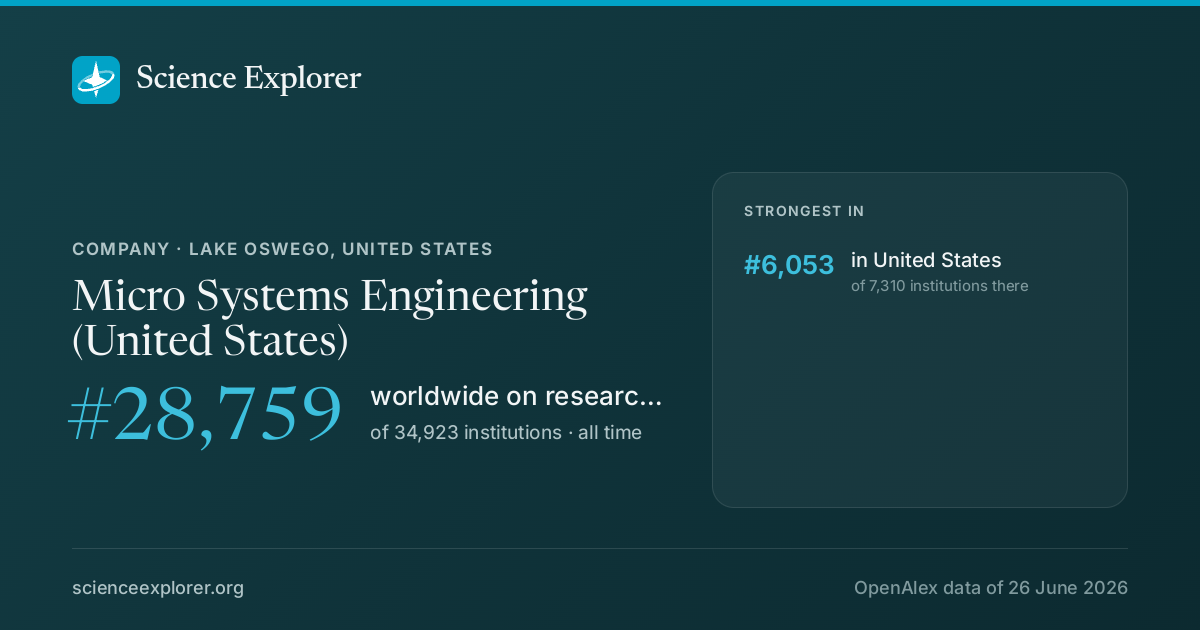
Micro Systems Engineering (United States) on Science Explorer

A card with Micro Systems Engineering (United States)'s standing and the fields it leads in, for a post or a slide. A link to this page previews as the same card.

Download the card

1200 × 630 PNG, sized for social posts, drawn from the latest snapshot.

Badges for a website1Each links back here and updates with every snapshot

Research measures only: rankings here say nothing about teaching, admissions or student experience. Comparable institutions and collaboration partners have tabs of their own, above.

Discussion

Ask a question or share a note about Micro Systems Engineering (United States). Keep it to the research: no personal attacks, advertising or links. Any reader can report a post, which collapses it for everyone until it is opened.
