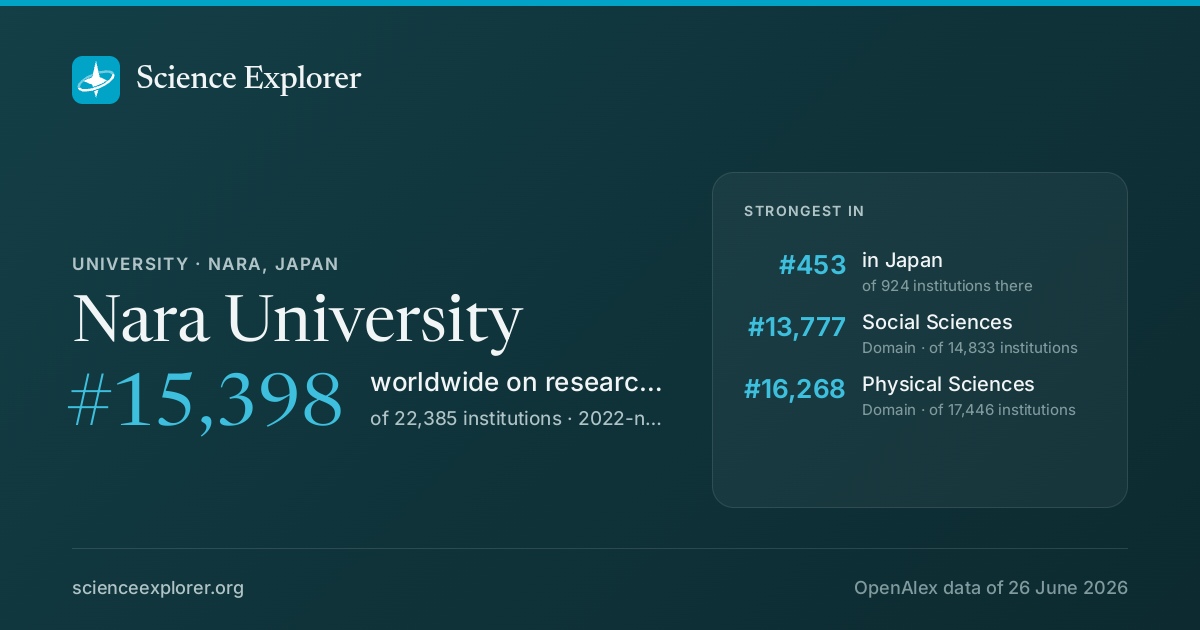
World rank, 2022-now #15,398
of 22,385 · #18,929 all time
Rank in Japan #453
of 924 Research works 445
▲ 71% vs 2018-21
Citations 4.6k 10.3 per fractional work
Top-10% rate 7.8%
all institutions 10.0%
vs its own fields 0.96×
1.00× is exactly expected
Open access 54%
world 40%
International 22%
world 18%
What is Nara University known for in research?
The fields where it stands highest, over all time, ranked among every institution above the floor in each field.
Which fields of science does Nara University work in?
In 2022-now, 38% of research at Nara University is in Social Sciences , 26% in Physical Sciences . Its largest fields are Medicine (18%), Computer Science (13%), Arts and Humanities (11%). It does 1.5× the world's share of Social Sciences.
Social Sciences: 37 fractional works · 38.1% of its work Arts and Humanities: 11 fractional works · 11.3% of its work Philosophy: 4 fractional works · 3.9% of its work Literature and Literary Theory: 3 fractional works · 3.0% of its work Language and Linguistics: 2 fractional works · 2.2% of its work Visual Arts and Performing Arts: 1 fractional works · 0.8% of its work History and Philosophy of Science: 0 fractional works · 0.5% of its work Music: 0 fractional works · 0.3% of its work Archeology: 0 fractional works · 0.3% of its work Smaller subfields together: 0 fractional works · 0.2% of its work Social Sciences: 10 fractional works · 10.8% of its work Sociology and Political Science: 4 fractional works · 4.2% of its work Education: 2 fractional works · 2.6% of its work Linguistics and Language: 1 fractional works · 1.0% of its work Safety Research: 1 fractional works · 0.5% of its work Demography: 0 fractional works · 0.5% of its work Gender Studies: 0 fractional works · 0.5% of its work Political Science and International Relations: 0 fractional works · 0.4% of its work Transportation: 0 fractional works · 0.3% of its work Anthropology: 0 fractional works · 0.2% of its work Cultural Studies: 0 fractional works · 0.2% of its work Smaller subfields together: 0 fractional works · 0.2% of its work Psychology: 7 fractional works · 7.7% of its work Social Psychology: 2 fractional works · 2.4% of its work Clinical Psychology: 2 fractional works · 2.4% of its work Experimental and Cognitive Psychology: 2 fractional works · 1.9% of its work Developmental and Educational Psychology: 1 fractional works · 0.9% of its work Smaller subfields together: 0 fractional works · 0.0% of its work Business, Management and Accounting: 4 fractional works · 3.9% of its work Organizational Behavior and Human Resource Management: 1 fractional works · 1.5% of its work Accounting: 1 fractional works · 0.9% of its work Management Information Systems: 1 fractional works · 0.6% of its work Marketing: 0 fractional works · 0.3% of its work Strategy and Management: 0 fractional works · 0.3% of its work Smaller subfields together: 0 fractional works · 0.3% of its work Economics, Econometrics and Finance: 4 fractional works · 3.7% of its work Economics and Econometrics: 3 fractional works · 2.9% of its work General Economics, Econometrics and Finance: 0 fractional works · 0.4% of its work Finance: 0 fractional works · 0.4% of its work Decision Sciences: 1 fractional works · 0.6% of its work Statistics, Probability and Uncertainty: 0 fractional works · 0.2% of its work Management Science and Operations Research: 0 fractional works · 0.2% of its work Smaller subfields together: 0 fractional works · 0.2% of its work Physical Sciences: 25 fractional works · 26.0% of its work Computer Science: 13 fractional works · 13.1% of its work Artificial Intelligence: 4 fractional works · 3.8% of its work Information Systems: 3 fractional works · 2.8% of its work Computer Vision and Pattern Recognition: 3 fractional works · 2.8% of its work Signal Processing: 1 fractional works · 1.4% of its work Computer Networks and Communications: 1 fractional works · 0.7% of its work Computational Theory and Mathematics: 1 fractional works · 0.6% of its work Computer Science Applications: 0 fractional works · 0.5% of its work Hardware and Architecture: 0 fractional works · 0.3% of its work Smaller subfields together: 0 fractional works · 0.2% of its work Engineering: 6 fractional works · 6.1% of its work Electrical and Electronic Engineering: 1 fractional works · 1.4% of its work Building and Construction: 1 fractional works · 1.1% of its work Biomedical Engineering: 1 fractional works · 0.9% of its work Industrial and Manufacturing Engineering: 1 fractional works · 0.9% of its work Aerospace Engineering: 0 fractional works · 0.5% of its work Mechanical Engineering: 0 fractional works · 0.5% of its work Media Technology: 0 fractional works · 0.5% of its work Smaller subfields together: 0 fractional works · 0.4% of its work Environmental Science: 4 fractional works · 3.8% of its work Ecology: 1 fractional works · 0.9% of its work Health, Toxicology and Mutagenesis: 1 fractional works · 0.7% of its work Pollution: 0 fractional works · 0.5% of its work Management, Monitoring, Policy and Law: 0 fractional works · 0.4% of its work Nature and Landscape Conservation: 0 fractional works · 0.3% of its work Water Science and Technology: 0 fractional works · 0.3% of its work Global and Planetary Change: 0 fractional works · 0.3% of its work Smaller subfields together: 0 fractional works · 0.3% of its work Earth and Planetary Sciences: 1 fractional works · 0.8% of its work Oceanography: 0 fractional works · 0.3% of its work Smaller subfields together: 0 fractional works · 0.5% of its work Materials Science: 1 fractional works · 0.6% of its work Materials Chemistry: 0 fractional works · 0.3% of its work Electronic, Optical and Magnetic Materials: 0 fractional works · 0.2% of its work Smaller subfields together: 0 fractional works · 0.1% of its work Physics and Astronomy: 1 fractional works · 0.6% of its work Astronomy and Astrophysics: 0 fractional works · 0.4% of its work Smaller subfields together: 0 fractional works · 0.2% of its work Mathematics: 0 fractional works · 0.5% of its work Statistics and Probability: 0 fractional works · 0.3% of its work Smaller subfields together: 0 fractional works · 0.2% of its work Energy: 0 fractional works · 0.4% of its work Renewable Energy, Sustainability and the Environment: 0 fractional works · 0.3% of its work Smaller subfields together: 0 fractional works · 0.1% of its work Chemistry: 0 fractional works · 0.2% of its work Chemical Engineering: 0 fractional works · 0.1% of its work Health Sciences: 21 fractional works · 22.0% of its work Medicine: 18 fractional works · 18.4% of its work Psychiatry and Mental health: 2 fractional works · 2.1% of its work Oncology: 2 fractional works · 1.7% of its work Radiology, Nuclear Medicine and Imaging: 2 fractional works · 1.7% of its work Public Health, Environmental and Occupational Health: 1 fractional works · 1.4% of its work Pulmonary and Respiratory Medicine: 1 fractional works · 1.3% of its work Physiology: 1 fractional works · 1.1% of its work Epidemiology: 1 fractional works · 0.9% of its work Surgery: 1 fractional works · 0.9% of its work Reproductive Medicine: 1 fractional works · 0.7% of its work Rheumatology: 1 fractional works · 0.6% of its work Health Informatics: 1 fractional works · 0.5% of its work Pediatrics, Perinatology and Child Health: 0 fractional works · 0.5% of its work Emergency Medicine: 0 fractional works · 0.4% of its work Endocrinology, Diabetes and Metabolism: 0 fractional works · 0.4% of its work Cardiology and Cardiovascular Medicine: 0 fractional works · 0.4% of its work Hematology: 0 fractional works · 0.4% of its work Biochemistry: 0 fractional works · 0.3% of its work Obstetrics and Gynecology: 0 fractional works · 0.3% of its work Nephrology: 0 fractional works · 0.3% of its work Urology: 0 fractional works · 0.3% of its work Hepatology: 0 fractional works · 0.3% of its work Infectious Diseases: 0 fractional works · 0.3% of its work Dermatology: 0 fractional works · 0.3% of its work Pharmacology: 0 fractional works · 0.2% of its work Immunology and Allergy: 0 fractional works · 0.2% of its work Smaller subfields together: 1 fractional works · 0.7% of its work Health Professions: 3 fractional works · 2.8% of its work Health Information Management: 1 fractional works · 1.2% of its work General Health Professions: 1 fractional works · 1.1% of its work Smaller subfields together: 0 fractional works · 0.5% of its work Dentistry: 0 fractional works · 0.5% of its work Periodontics: 0 fractional works · 0.4% of its work Smaller subfields together: 0 fractional works · 0.1% of its work Nursing: 0 fractional works · 0.4% of its work Nutrition and Dietetics: 0 fractional works · 0.3% of its work Smaller subfields together: 0 fractional works · 0.0% of its work Life Sciences: 13 fractional works · 13.9% of its work Agricultural and Biological Sciences: 5 fractional works · 4.9% of its work Plant Science: 2 fractional works · 2.6% of its work Food Science: 1 fractional works · 1.2% of its work General Agricultural and Biological Sciences: 1 fractional works · 0.8% of its work Smaller subfields together: 0 fractional works · 0.4% of its work Biochemistry, Genetics and Molecular Biology: 4 fractional works · 4.0% of its work Molecular Biology: 2 fractional works · 2.6% of its work Genetics: 1 fractional works · 0.8% of its work Cell Biology: 0 fractional works · 0.2% of its work Biotechnology: 0 fractional works · 0.2% of its work Smaller subfields together: 0 fractional works · 0.2% of its work Neuroscience: 2 fractional works · 2.4% of its work Cognitive Neuroscience: 1 fractional works · 1.4% of its work Neurology: 1 fractional works · 0.6% of its work Cellular and Molecular Neuroscience: 0 fractional works · 0.2% of its work Smaller subfields together: 0 fractional works · 0.2% of its work Pharmacology, Toxicology and Pharmaceutics: 1 fractional works · 1.3% of its work Pharmaceutical Science: 0 fractional works · 0.5% of its work Toxicology: 0 fractional works · 0.4% of its work Pharmacology: 0 fractional works · 0.4% of its work Immunology and Microbiology: 1 fractional works · 1.2% of its work Immunology: 1 fractional works · 0.8% of its work Smaller subfields together: 0 fractional works · 0.4% of its work Social Sciences Arts and Humanities Social Sciences Psychology Business Economics Physical Sciences Computer Science Engineeri… Environme… Health Sciences Medicine Health Pr… Life Sciences Agricultu… Biochemis… Neuroscie… ALL ITS WORK Nara University 97 fractional works, 2022-now 14% 26% 22% 38%
Each ring splits the one inside it: the four domains of science, their fields, their subfields. Size is fractional works in 2022-now. Every slice is a page; the interactive view zooms down to single topics and colours each by how much more of it this institution does than the world.
Its 4 domains and 25 fields, with their numbers 11 11.3% 10 10.8% 7 7.7% 4 3.9% 4 3.7% 1 0.6% 13 13.1% 6 6.1% 4 3.8% 1 0.8% 1 0.6% 1 0.6% 0 0.5% 0 0.4% 0 0.2% 0 0.1% 18 18.4% 3 2.8% 0 0.5% 0 0.4% 5 4.9% 4 4.0% 2 2.4% 1 1.3% 1 1.2% All of science, and how each field's share has moved since 1950: the Science domain explorer
Field profile
Location quotient across every field it publishes in: outside the ring is more than an institution of this size would be expected to publish, inside it is less.
Agricultural and Biological Sciences: 1.03× its world share, 5 works Agricultural and Bio… Biochemistry, Genetics and Molecular Biology: 0.75× its world share, 4 works Biochemistry, Geneti… Immunology and Microbiology: 1.20× its world share, 1 works Immunology and Micro… Neuroscience: 1.50× its world share, 2 works Neuroscience Pharmacology, Toxicology and Pharmaceutics: 3.65× its world share, 1 works Pharmacology, Toxico… Chemical Engineering: 0.14× its world share, 0 works Chemical Engineering Chemistry: 0.13× its world share, 0 works Chemistry Computer Science: 1.68× its world share, 13 works Computer Science Earth and Planetary Sciences: 0.48× its world share, 1 works Earth and Planetary … Energy: 0.41× its world share, 0 works Energy Engineering: 0.41× its world share, 6 works Engineering Environmental Science: 0.77× its world share, 4 works Environmental Science Materials Science: 0.17× its world share, 1 works Materials Science Mathematics: 0.44× its world share, 0 works Mathematics Physics and Astronomy: 0.25× its world share, 0 works Physics and Astronomy Dentistry: 0.94× its world share, 0 works Dentistry Health Professions: 1.07× its world share, 3 works Health Professions Medicine: 0.96× its world share, 18 works Medicine Nursing: 0.72× its world share, 0 works Nursing Arts and Humanities: 3.91× its world share, 11 works Arts and Humanities Business, Management and Accounting: 1.22× its world share, 4 works Business, Management… Decision Sciences: 0.64× its world share, 1 works Decision Sciences Economics, Econometrics and Finance: 1.75× its world share, 4 works Economics, Econometr… Psychology: 2.52× its world share, 7 works Psychology Social Sciences: 0.85× its world share, 10 works Social Sciences 1× world share
Rings at 0.5×, 1× and 2×. Widest outward: Arts and Humanities , 3.9×. Every wedge is a field page.
All 25 fields, with their numbers Arts and Humanities 3.91× 11 works Pharmacology, Toxicology and Pharmaceutics 3.65× 1 works Psychology 2.52× 7 works Economics, Econometrics and Finance 1.75× 4 works Computer Science 1.68× 13 works Neuroscience 1.50× 2 works Business, Management and Accounting 1.22× 4 works Immunology and Microbiology 1.20× 1 works Health Professions 1.07× 3 works Agricultural and Biological Sciences 1.03× 5 works Medicine 0.96× 18 works Dentistry 0.94× 0 works Social Sciences 0.85× 10 works Environmental Science 0.77× 4 works Biochemistry, Genetics and Molecular Biology 0.75× 4 works Nursing 0.72× 0 works Decision Sciences 0.64× 1 works Earth and Planetary Sciences 0.48× 1 works Mathematics 0.44× 0 works Energy 0.41× 0 works Engineering 0.41× 6 works Physics and Astronomy 0.25× 0 works Materials Science 0.17× 1 works Chemical Engineering 0.14× 0 works Chemistry 0.13× 0 works
Who are the top researchers at Nara University?
Ranked on the quality score, Toshitake Takata , Tsuyoshi Fujiwara and Harumasa Yoshimura lead among researchers whose main affiliation is Nara University.
1
Toshitake Takata
Japan · #3,106,904 worldwide1.3k citations · 25 works
2
Tsuyoshi Fujiwara
Japan · #4,971,851 worldwide3.1k citations · 174 works
3
Harumasa Yoshimura
Japan · #5,015,794 worldwide8 citations · 22 works
4
恭二 中田
Japan · #5,097,816 worldwide0 citations · 15 works
5
Mohamed Hafsi
Japan · #5,530,573 worldwide21 citations · 22 works
6
Med Hafsi
Japan · #5,640,366 worldwide12 citations · 27 works
7
Masafumi Miki
Japan · #5,914,756 worldwide14 citations · 30 works
8
Hisao Nakkagawa
Japan · #5,980,130 worldwide583 citations · 66 works
9
Keiji Iwasaki
Japan · #6,087,183 worldwide909 citations · 65 works
10
T Usui
Japan · #6,755,156 worldwide56 citations · 64 works
All ranked researchers at Nara University
What are the most cited papers from Nara University?
The most cited paper from Nara University is "The Relationship between Green Tea and Total Caffeine Intake and Risk for Self-Reported Type 2 Diabetes among Japanese Adults" (Hiroyasu Iso, Chigusa Date, Kenji Wakai et al., 2006), with 462 citations. Next come "Beyond Self-Presentation: Evidence for Self-Criticism among Japanese" (269) and "Production rate of hard thermal photons and screening of quark mass singularity" (243).
Most cited papers
# Paper Released Citations 1
The Relationship between Green Tea and Total Caffeine Intake and Risk for Self-Reported Type 2 Diabetes among Japanese Adults
Hiroyasu Iso, Chigusa Date, Kenji Wakai et al. · Annals of Internal Medicine
18 Apr 2006
462 2
Beyond Self-Presentation: Evidence for Self-Criticism among Japanese
Steven J. Heine, Toshitake Takata, Darrin R. Lehman · Personality and Social Psychology Bulletin
2000
269 3
Production rate of hard thermal photons and screening of quark mass singularity
R. Baier, Hisao Nakkagawa, A. Niégawa et al. · The European Physical Journal C
Open access Sep 1992
243 4
Transepithelial Transport of the Bioactive Tripeptide, Val-Pro-Pro, in Human Intestinal Caco-2 Cell Monolayers
Makoto Satake, Masashi Enjoh, Yasunori Nakamura et al. · Bioscience Biotechnology and Biochemistry
Open access 2002
236 5
Waxy protein deficiency and chromosomal location of coding genes in common wheat
Makoto Yamamori, Toshiki Nakamura, Tetsuya Endo et al. · Theoretical and Applied Genetics
Oct 1994
215
All 61 most cited papers, with filters and sorting
Which keywords describe research at Nara University?
By fractional works in 2022-now, weighted toward what it does more of than the world: Deep Learning, Philosophy , Healthcare, Feminism, Literature, Epidemiology , Ethics and Convolutional Neural Networks.
Size is fractional works in 2022-now in the topics tagged with each word; colour is the word's share of this institution's work against its share of the world's. The 40 words are chosen for being large and distinctive. Each links to the topic it comes from most.
All 40 words, with their numbers Deep Learning 8 ▲ 2.3× 16 topics Epidemiology 5 ▲ 1.39× 37 topics Machine Learning 4 ▲ 1.37× 16 topics Healthcare 4 ▲ 3.3× 9 topics Globalization 3 ▲ 1.75× 14 topics Philosophy 3 ▲ 7.5× 8 topics Convolutional Neural Networks 3 ▲ 3.8× 5 topics Literature 3 ▲ 5.2× 6 topics Mental Health 3 ▲ 1.89× 12 topics Big Data 2 ▲ 2.7× 7 topics Ethics 2 ▲ 5.1× 5 topics Feminism 2 ▲ 8.4× 5 topics History 2 ▲ 3.3× 5 topics Culture 2 ▲ 4.1× 4 topics Identity 2 ▲ 2.9× 4 topics Religion 2 ▲ 4.5× 5 topics Resilience 2 ▲ 4.2× 7 topics Medical Imaging 2 ▲ 3.6× 4 topics Security 2 ▲ 2.9× 5 topics Leadership 2 ▲ 3.9× 5 topics Neuroscience 2 ▲ 5.1× 3 topics Organizational Performance 2 ▲ 5.9× 4 topics Social Movements 2 ▲ 5.4× 2 topics Africa 1 ▲ 36× 2 topics Black Studies 1 ▲ 70× 1 topic Civil Rights Movement 1 ▲ 70× 1 topic Speech Perception 1 ▲ 17× 3 topics Backpropagation Learning 1 ▲ 18× 1 topic Derrida 1 ▲ 143× 1 topic Digital Education 1 ▲ 9.3× 2 topics Levinas 1 ▲ 143× 1 topic Low-Power 1 ▲ 33× 2 topics Lusophone 1 ▲ 60× 1 topic Postcolonial 1 ▲ 60× 1 topic Self-Organizing Maps 1 ▲ 18× 1 topic Sentinel Lymph Node Biopsy 1 ▲ 16× 2 topics Sociolinguistics 1 ▲ 7.5× 3 topics Bilingual Education 1 ▲ 10× 3 topics Diaspora 1 ▲ 21× 2 topics Positive Psychology 1 ▲ 15× 2 topics
Which research topics does Nara University publish most on?
By volume in 2022-now: Race, History, and American Society , Neural Networks and Applications , Philosophy, Ethics, and Existentialism and Literature, Culture, and Criticism .
Race, History, and Ameri… 1 Race, History, and American Society: 1 fractional works Neural Networks and Appl… 1 Neural Networks and Applications: 1 fractional works Philosophy, Ethics, and Existentialism: 1 fractional works Literature, Culture, and… 1 Literature, Culture, and Criticism: 1 fractional works Empathy and Medical Educ… 1 Empathy and Medical Education: 1 fractional works Cutaneous Melanoma Detection and Management: 1 fractional works Education, Psychology, and Social Research: 1 fractional works Classical Philosophy and… 1 Classical Philosophy and Thought: 1 fractional works BIM and Construction Integration: 1 fractional works Face recognition and analysis: 1 fractional works
Area is fractional works; colour is the subfield each topic belongs to.
1
Sociology and Political Science 1 works
2
Artificial Intelligence 1 works
3
Philosophy 1 works
4
Literature and Literary Theory 1 works
5
Psychiatry and Mental health 1 works
6
Oncology 1 works
7
Education 1 works
8
Philosophy 1 works
9
Building and Construction 1 works
10
Computer Vision and Pattern Recognition 1 works
How open and international is its research?
Against the world's own shares: the tick on each track. Both are shares of its output, so they
sit on one scale and can be read against each other as well as against the world.
54% 46%
53.5% 46.5%
World: 40% of research is openly available.
22% 78%
22.5% 77.5%
World: 18% is written across borders.
How has Nara University's research output changed?
Output in 2022-2025 was 71% higher than in 2018-2021.
still counting 1990 2000 2010 2020
The same series as a ribbon: one cell per year, darker for more. The line above answers how much ; this answers when .
Its share of all research
still counting 0.0010% 0.0020% 0.0030% Nara University 0.00058% in 2025 1980 1990 2000 2010 2020 Fractional works of Nara University over all fractional works that year. How the balance of science has shifted .
Share Nara University's ranking
A card with Nara University's standing and the fields it leads in, for a post or a slide. A link to this page previews as the same card.
Badges for a website 1 Each links back here and updates with every snapshot
 Japan · #3,106,904 worldwide
1.3k citations · 25 works