Pacific Tower
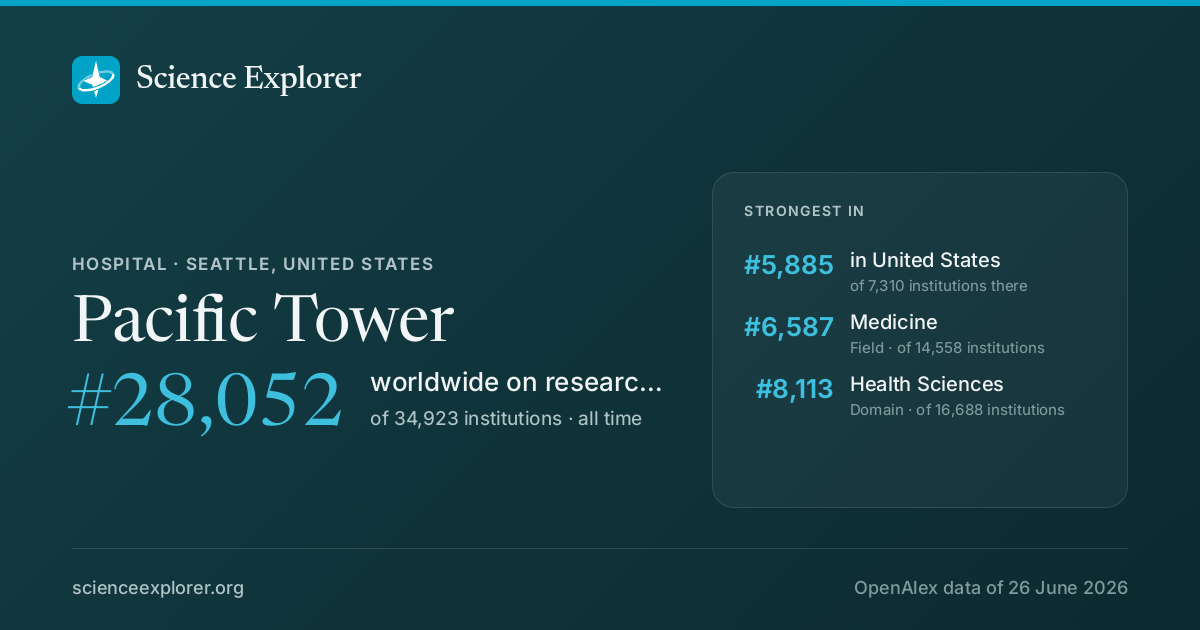
In research, Pacific Tower stands highest in Medicine (#6,587 of 14,558 worldwide) and Health Sciences (#8,113 of 16,688 worldwide), over all time.
- World rank, all time
- #28,052 of 34,923
- Rank in United States
- #5,885 of 7,310
- Research works
- 188 ▼ 30% vs 2018-21
- Citations
- 5.6k 29.9 per fractional work
- Top-10% rate
- 12.3% all institutions 10.0%
- vs its own fields
- 1.03× 1.00× is exactly expected
- Open access
- 19% world 40%
- International
- 22% world 18%
What is Pacific Tower known for in research?
The fields where it stands highest, over all time, ranked among every institution above the floor in each field.
| Field | World rank | Where that sits | Top-10% rate | Works |
|---|---|---|---|---|
| MedicineField | #6,587 of 14,558 | 10.0% | 128 | |
| Health SciencesDomain | #8,113 of 16,688 | 10.1% | 135 |
Each strip is that field's whole ranked pool, with the notch where Pacific Tower sits in it, in the colour of the band that rank falls in. The track under the rate is the rate itself: it carries no average mark, because the average differs by field (from about 6% in Dentistry to 21% in Economics).
Which fields of science does Pacific Tower work in?
In all years, 72% of research at Pacific Tower is in Health Sciences, 14% in Life Sciences. Its largest fields are Medicine (68%), Biochemistry, Genetics and Molecular Biology (9%), Engineering (3%). It does 2.9× the world's share of Health Sciences.
Each ring splits the one inside it: the four domains of science, their fields, their subfields. Size is fractional works in all years. Every slice is a page; the interactive view zooms down to single topics and colours each by how much more of it this institution does than the world.
Its 4 domains and 23 fields, with their numbers
- Health Sciences13571.9%
- Medicine12868.1%
- Health Professions52.5%
- Dentistry10.4%
- Nursing10.4%
- Veterinary10.4%
- Life Sciences2714.5%
- Social Sciences168.5%
- Physical Sciences105.2%
- Engineering63.0%
- Environmental Science20.9%
- Computer Science10.6%
- Physics and Astronomy00.3%
- Materials Science00.2%
- Mathematics00.1%
- Chemistry00.1%
Field profile
Location quotient across every field it publishes in: outside the ring is more than an institution of this size would be expected to publish, inside it is less.
Rings at 0.5×, 1× and 2×. Widest outward: Veterinary, 8.3×. Every wedge is a field page.
All 13 fields, with their numbers
- Veterinary8.28×0 works
- Medicine3.58×7 works
- Health Professions2.49×1 works
- Neuroscience1.30×0 works
- Biochemistry, Genetics and Molecular Biology0.87×0 works
- Immunology and Microbiology0.84×0 works
- Environmental Science0.59×0 works
- Chemistry0.54×0 works
- Engineering0.47×1 works
- Agricultural and Biological Sciences0.44×0 works
- Psychology0.42×0 works
- Business, Management and Accounting0.26×0 works
- Social Sciences0.06×0 works
- Veterinary 8.3×
- Medicine 3.6×
- Health Professions 2.5×
- Neuroscience 1.3×
- Biochemistry, Genetics and Molecular Biology 0.9×
- Immunology and Microbiology 0.8×
- Environmental Science 0.6×
- Chemistry 0.5×
- Engineering 0.5×
- Agricultural and Biological Sciences 0.4×
- Psychology 0.4×
- Business, Management and Accounting 0.3×
- Social Sciences 0.1×
Who are the top researchers at Pacific Tower?
Ranked on the quality score, Barbara L. Drinkwater, Ralph J. Pommert and Yajuan Wang lead among researchers whose main affiliation is Pacific Tower.
- 1
Barbara L. Drinkwater
 United States · #695,206 worldwide
7.3k citations · 119 works
- 2
Ralph J. Pommert
United States · #3,102,672 worldwide
0 citations · 16 works
- 3
Yajuan Wang
United States · #3,390,908 worldwide
443 citations · 69 works
- 4
S. R. Khanolkar
United States · #4,325,947 worldwide
310 citations · 15 works
- 5
Mohammad Amin Nezami
United States · #5,947,498 worldwide
130 citations · 45 works
Which keywords describe research at Pacific Tower?
By fractional works in all years, weighted toward what it does more of than the world: Acupuncture, Pain Relief, Depression, Clinical Trials, Osteoarthritis, Adverse Events, Epidemiology and Fibroblast Response.
- Immunomodulation
- Echocardiography
- Botulinum Toxin
- Ayurveda
- Alternative Medicine
- Pain Management
- Adverse Reactions
- Fractures
- Wnt Signaling
- Immunotherapy
- Neurological Disorders
- Bone Mineral Density
- Risk Factors
- Quality of Life
- Diagnosis
- Treatment
- Fibroblast Response
- Osteoarthritis
- Depression
- Acupuncture
- Epidemiology
- Pain Relief
- Clinical Trials
- Adverse Events
- Neurological Effects
- Inflammation
- Oxidative Stress
- Precision Medicine
- Complications
- Surgical Management
- Genetics
- Parathyroid Hormone
- Clinical Practice Guidelines
- Osteoporotic Fractures
- Herbal Medicine
- Genomic Analysis
- Complementary Medicine
- Traditional Chinese Medicine
- Distal Radius Fractures
- Flexor Tendon Repair
Size is fractional works in all years in the topics tagged with each word; colour is the word's share of this institution's work against its share of the world's. The 40 words are chosen for being large and distinctive. Each links to the topic it comes from most.
All 40 words, with their numbers
- Epidemiology20▲ 2.6×57 topics
- Acupuncture14▲ 110×3 topics
- Pain Relief13▲ 150×2 topics
- Depression13▲ 9.3×9 topics
- Clinical Trials13▲ 11×7 topics
- Osteoarthritis12▲ 51×3 topics
- Adverse Events12▲ 94×3 topics
- Fibroblast Response11▲ 290×1 topic
- Neurological Effects11▲ 84×1 topic
- Treatment8▲ 3.2×26 topics
- Inflammation7▲ 1.65×26 topics
- Diagnosis5▲ 2.8×21 topics
- Oxidative Stress5▲ 1.50×15 topics
- Quality of Life5▲ 2.0×21 topics
- Precision Medicine5▲ 8.2×4 topics
- Risk Factors5▲ 2.4×14 topics
- Complications4▲ 4.7×11 topics
- Bone Mineral Density4▲ 27×2 topics
- Surgical Management4▲ 4.9×12 topics
- Neurological Disorders4▲ 3.2×12 topics
- Genetics4▲ 2.8×12 topics
- Immunotherapy4▲ 3.2×12 topics
- Parathyroid Hormone4▲ 20×2 topics
- Wnt Signaling4▲ 16×2 topics
- Clinical Practice Guidelines4▲ 3.5×12 topics
- Fractures4▲ 44×1 topic
- Osteoporotic Fractures4▲ 44×1 topic
- Adverse Reactions4▲ 36×2 topics
- Herbal Medicine4▲ 8.1×2 topics
- Pain Management4▲ 8.2×5 topics
- Genomic Analysis3▲ 6.1×4 topics
- Alternative Medicine3▲ 65×1 topic
- Complementary Medicine3▲ 65×1 topic
- Ayurveda3▲ 41×1 topic
- Traditional Chinese Medicine3▲ 10×1 topic
- Botulinum Toxin3▲ 22×3 topics
- Distal Radius Fractures3▲ 23×1 topic
- Echocardiography3▲ 5.2×6 topics
- Flexor Tendon Repair3▲ 23×1 topic
- Immunomodulation2▲ 8.0×2 topics
Which research topics does Pacific Tower publish most on?
By volume in 2022-now: Skin Protection and Aging, Palliative Care and End-of-Life Issues, Marine and Offshore Engineering Studies and Dementia and Cognitive Impairment Research.
Area is fractional works; colour is the subfield each topic belongs to.
- 1 Skin Protection and Aging Dermatology 0 works
- 2 Palliative Care and End-of-Life Issues Public Health, Environmental and Occupational Health 0 works
- 3 Marine and Offshore Engineering Studies Ocean Engineering 0 works
- 4 Dementia and Cognitive Impairment Research Psychiatry and Mental health 0 works
- 5 Neuroblastoma Research and Treatments Neurology 0 works
- 6 Acute Ischemic Stroke Management Epidemiology 0 works
- 7 Cardiovascular Health and Disease Prevention Cardiology and Cardiovascular Medicine 0 works
- 8 Cerebrovascular and Carotid Artery Diseases Pulmonary and Respiratory Medicine 0 works
- 9 Geriatric Care and Nursing Homes General Health Professions 0 works
- 10 Neuroendocrine Tumor Research Advances Epidemiology 0 works
How open and international is its research?
Against the world's own shares: the tick on each track. Both are shares of its output, so they sit on one scale and can be read against each other as well as against the world.
World: 40% of research is openly available.
World: 18% is written across borders.
How has Pacific Tower's research output changed?
Output in 2022-2025 was 30% lower than in 2018-2021.
The same series as a ribbon: one cell per year, darker for more. The line above answers how much; this answers when.
Its share of all research
Growing output can still be a shrinking share: all of science grows. This is Pacific Tower as a percentage of every work published that year, 0.000025% in 2024.
Fractional works of Pacific Tower over all fractional works that year. How the balance of science has shifted.
Other research institutions in Seattle
- University of Washington
- Seattle University
- Fred Hutch Cancer Center
- Seattle Children's Hospital
- Amazon (United States)
- Allen Institute
- Virginia Mason Medical Center
- Cancer Research And Biostatistics

Share Pacific Tower's ranking
Badges for a website1Each links back here and updates with every snapshot

Research measures only: rankings here say nothing about teaching, admissions or student experience. Comparable institutions and collaboration partners have tabs of their own, above.
Discussion
Ask a question or share a note about Pacific Tower. Keep it to the research: no personal attacks, advertising or links. Any reader can report a post, which collapses it for everyone until it is opened.