Science Explorer Back to mapMap
Institution · Lahore · Pakistan

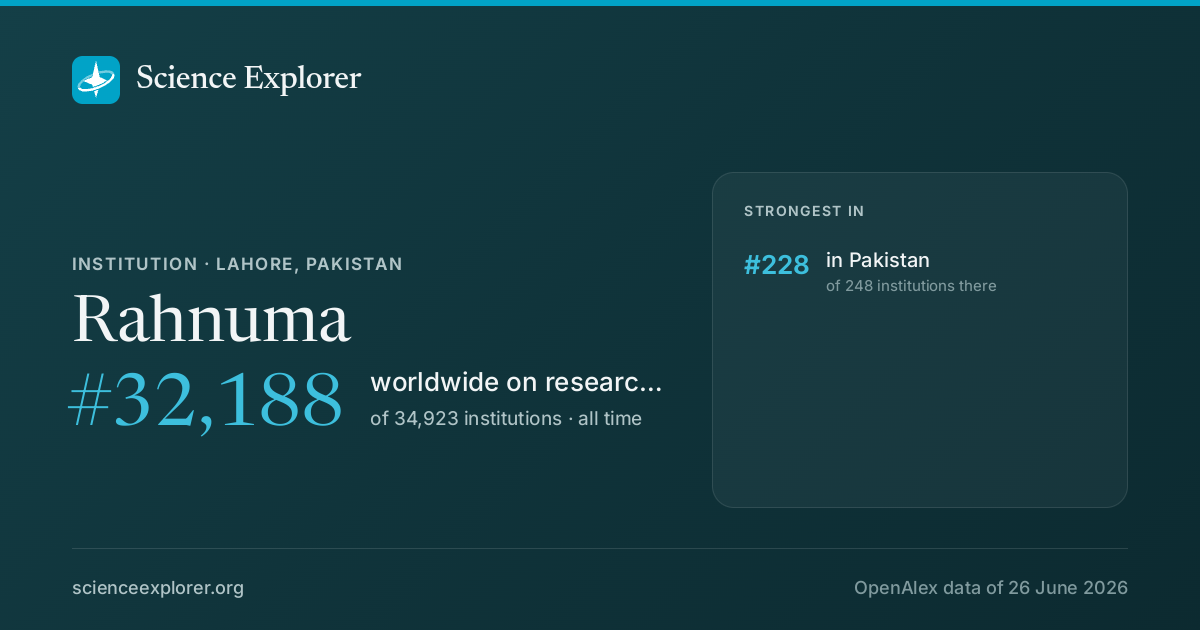
Rahnuma

World rank, all time
#32,188
of 34,923
Rank in Pakistan
#228
of 248
Research works
143
▲ 123% vs 2018-21
Citations
1.2k
8.1 per fractional work
Top-10% rate
8.2%
all institutions 10.0%
vs its own fields
0.84×
1.00× is exactly expected
Open access
48%
world 40%
International
24%
world 18%

Which fields of science does Rahnuma work in?

In 2022-now, 57% of research at Rahnuma is in Social Sciences, 27% in Health Sciences. Its largest fields are Social Sciences (33%), Medicine (21%), Psychology (11%). It does 2.1× the world's share of Social Sciences.

Social Sciences: 33 fractional works · 56.7% of its workSocial Sciences: 20 fractional works · 33.3% of its workSociology and Political Science: 8 fractional works · 13.4% of its workPolitical Science and International Relations: 8 fractional works · 12.8% of its workEducation: 1 fractional works · 1.7% of its workUrban Studies: 1 fractional works · 1.1% of its workLaw: 0 fractional works · 0.8% of its workDemography: 0 fractional works · 0.8% of its workCommunication: 0 fractional works · 0.7% of its workGender Studies: 0 fractional works · 0.6% of its workTransportation: 0 fractional works · 0.6% of its workSafety Research: 0 fractional works · 0.4% of its workHealth: 0 fractional works · 0.3% of its workPsychology: 7 fractional works · 11.4% of its workClinical Psychology: 4 fractional works · 6.5% of its workSocial Psychology: 2 fractional works · 3.0% of its workExperimental and Cognitive Psychology: 0 fractional works · 0.7% of its workApplied Psychology: 0 fractional works · 0.6% of its workDevelopmental and Educational Psychology: 0 fractional works · 0.4% of its workSmaller subfields together: 0 fractional works · 0.1% of its workBusiness, Management and Accounting: 3 fractional works · 5.3% of its workStrategy and Management: 1 fractional works · 2.4% of its workMarketing: 1 fractional works · 1.1% of its workManagement Information Systems: 0 fractional works · 0.8% of its workManagement of Technology and Innovation: 0 fractional works · 0.7% of its workOrganizational Behavior and Human Resource Management: 0 fractional works · 0.3% of its workEconomics, Econometrics and Finance: 3 fractional works · 5.1% of its workEconomics and Econometrics: 3 fractional works · 4.5% of its workFinance: 0 fractional works · 0.7% of its workArts and Humanities: 1 fractional works · 1.5% of its workPhilosophy: 1 fractional works · 1.4% of its workSmaller subfields together: 0 fractional works · 0.1% of its workDecision Sciences: 0 fractional works · 0.1% of its workHealth Sciences: 16 fractional works · 27.0% of its workMedicine: 12 fractional works · 20.5% of its workSurgery: 2 fractional works · 2.6% of its workPediatrics, Perinatology and Child Health: 1 fractional works · 2.3% of its workEndocrinology, Diabetes and Metabolism: 1 fractional works · 1.9% of its workPublic Health, Environmental and Occupational Health: 1 fractional works · 1.6% of its workRehabilitation: 1 fractional works · 1.6% of its workInfectious Diseases: 1 fractional works · 1.3% of its workOrthopedics and Sports Medicine: 1 fractional works · 1.3% of its workPulmonary and Respiratory Medicine: 1 fractional works · 1.3% of its workCardiology and Cardiovascular Medicine: 1 fractional works · 1.2% of its workEpidemiology: 1 fractional works · 1.2% of its workPathology and Forensic Medicine: 1 fractional works · 1.0% of its workPsychiatry and Mental health: 0 fractional works · 0.6% of its workDermatology: 0 fractional works · 0.6% of its workObstetrics and Gynecology: 0 fractional works · 0.6% of its workHealth Informatics: 0 fractional works · 0.5% of its workRheumatology: 0 fractional works · 0.3% of its workPhysiology: 0 fractional works · 0.3% of its workPharmacology: 0 fractional works · 0.2% of its workSmaller subfields together: 0 fractional works · 0.4% of its workHealth Professions: 3 fractional works · 4.8% of its workGeneral Health Professions: 1 fractional works · 2.3% of its workEmergency Medical Services: 1 fractional works · 0.9% of its workOccupational Therapy: 0 fractional works · 0.6% of its workRadiological and Ultrasound Technology: 0 fractional works · 0.6% of its workPhysical Therapy, Sports Therapy and Rehabilitation: 0 fractional works · 0.3% of its workSmaller subfields together: 0 fractional works · 0.2% of its workDentistry: 1 fractional works · 1.4% of its workOrthodontics: 0 fractional works · 0.5% of its workOral Surgery: 0 fractional works · 0.5% of its workPeriodontics: 0 fractional works · 0.3% of its workSmaller subfields together: 0 fractional works · 0.1% of its workNursing: 0 fractional works · 0.3% of its workNutrition and Dietetics: 0 fractional works · 0.3% of its workPhysical Sciences: 6 fractional works · 10.5% of its workEnvironmental Science: 2 fractional works · 3.8% of its workGlobal and Planetary Change: 1 fractional works · 1.4% of its workEnvironmental Engineering: 1 fractional works · 1.0% of its workManagement, Monitoring, Policy and Law: 0 fractional works · 0.6% of its workEcological Modeling: 0 fractional works · 0.3% of its workEcology: 0 fractional works · 0.3% of its workHealth, Toxicology and Mutagenesis: 0 fractional works · 0.3% of its workEngineering: 1 fractional works · 2.4% of its workBuilding and Construction: 1 fractional works · 1.1% of its workMechanics of Materials: 0 fractional works · 0.4% of its workMedia Technology: 0 fractional works · 0.3% of its workCivil and Structural Engineering: 0 fractional works · 0.3% of its workSmaller subfields together: 0 fractional works · 0.4% of its workComputer Science: 1 fractional works · 2.0% of its workInformation Systems: 1 fractional works · 1.5% of its workArtificial Intelligence: 0 fractional works · 0.4% of its workSmaller subfields together: 0 fractional works · 0.2% of its workMathematics: 1 fractional works · 1.1% of its workApplied Mathematics: 0 fractional works · 0.6% of its workMathematical Physics: 0 fractional works · 0.6% of its workEarth and Planetary Sciences: 0 fractional works · 0.7% of its workPaleontology: 0 fractional works · 0.4% of its workGeology: 0 fractional works · 0.3% of its workEnergy: 0 fractional works · 0.4% of its workRenewable Energy, Sustainability and the Environment: 0 fractional works · 0.4% of its workLife Sciences: 3 fractional works · 5.9% of its workBiochemistry, Genetics and Molecular Biology: 2 fractional works · 2.8% of its workMolecular Biology: 1 fractional works · 1.5% of its workEndocrinology: 0 fractional works · 0.6% of its workCell Biology: 0 fractional works · 0.4% of its workGenetics: 0 fractional works · 0.2% of its workSmaller subfields together: 0 fractional works · 0.1% of its workAgricultural and Biological Sciences: 1 fractional works · 2.4% of its workPlant Science: 1 fractional works · 1.4% of its workSoil Science: 0 fractional works · 0.6% of its workEcology, Evolution, Behavior and Systematics: 0 fractional works · 0.3% of its workSmaller subfields together: 0 fractional works · 0.1% of its workNeuroscience: 0 fractional works · 0.5% of its workImmunology and Microbiology: 0 fractional works · 0.1% of its workALL ITS WORKRahnuma59fractional works, 2022-now
Life Sciences6%Physical Sciences10%Health Sciences27%Social Sciences57%

Each ring splits the one inside it: the four domains of science, their fields, their subfields. Size is fractional works in 2022-now. Every slice is a page; the interactive view zooms down to single topics and colours each by how much more of it this institution does than the world.

Its 4 domains and 20 fields, with their numbers
    1. Social Sciences2033.3%
    2. Psychology711.4%
    3. Business, Management and Accounting35.3%
    4. Economics, Econometrics and Finance35.1%
    5. Arts and Humanities11.5%
    6. Decision Sciences00.1%
    1. Medicine1220.5%
    2. Health Professions34.8%
    3. Dentistry11.4%
    4. Nursing00.3%
    1. Environmental Science23.8%
    2. Engineering12.4%
    3. Computer Science12.0%
    4. Mathematics11.1%
    5. Earth and Planetary Sciences00.7%
    6. Energy00.4%
    1. Biochemistry, Genetics and Molecular Biology22.8%
    2. Agricultural and Biological Sciences12.4%
    3. Neuroscience00.5%
    4. Immunology and Microbiology00.1%
All of science, and how each field's share has moved since 1950: the Science domain explorer

Field profile

Location quotient across every field it publishes in: outside the ring is more than an institution of this size would be expected to publish, inside it is less.

Agricultural and Biological Sciences: 0.50× its world share, 1 worksAgricultural and Bio…Biochemistry, Genetics and Molecular Biology: 0.53× its world share, 2 worksBiochemistry, Geneti…Immunology and Microbiology: 0.11× its world share, 0 worksImmunology and Micro…Neuroscience: 0.32× its world share, 0 worksNeuroscienceComputer Science: 0.26× its world share, 1 worksComputer ScienceEarth and Planetary Sciences: 0.42× its world share, 0 worksEarth and Planetary …Energy: 0.46× its world share, 0 worksEnergyEngineering: 0.16× its world share, 1 worksEngineeringEnvironmental Science: 0.77× its world share, 2 worksEnvironmental ScienceMathematics: 0.96× its world share, 1 worksMathematicsDentistry: 2.95× its world share, 1 worksDentistryHealth Professions: 1.82× its world share, 3 worksHealth ProfessionsMedicine: 1.07× its world share, 12 worksMedicineNursing: 0.51× its world share, 0 worksNursingArts and Humanities: 0.52× its world share, 1 worksArts and HumanitiesBusiness, Management and Accounting: 1.64× its world share, 3 worksBusiness, Management…Decision Sciences: 0.10× its world share, 0 worksDecision SciencesEconomics, Econometrics and Finance: 2.39× its world share, 3 worksEconomics, Econometr…Psychology: 3.73× its world share, 7 worksPsychologySocial Sciences: 2.63× its world share, 20 worksSocial Sciences1×world share
more than its size predictsabout as predictedless

Rings at 0.5×, 1× and 2×. Widest outward: Psychology, 3.7×. Every wedge is a field page.

All 20 fields, with their numbers
  1. Psychology3.73×7 works
  2. Dentistry2.95×1 works
  3. Social Sciences2.63×20 works
  4. Economics, Econometrics and Finance2.39×3 works
  5. Health Professions1.82×3 works
  6. Business, Management and Accounting1.64×3 works
  7. Medicine1.07×12 works
  8. Mathematics0.96×1 works
  9. Environmental Science0.77×2 works
  10. Biochemistry, Genetics and Molecular Biology0.53×2 works
  11. Arts and Humanities0.52×1 works
  12. Nursing0.51×0 works
  13. Agricultural and Biological Sciences0.50×1 works
  14. Energy0.46×0 works
  15. Earth and Planetary Sciences0.42×0 works
  16. Neuroscience0.32×0 works
  17. Computer Science0.26×1 works
  18. Engineering0.16×1 works
  19. Immunology and Microbiology0.11×0 works
  20. Decision Sciences0.10×0 works

What are the most cited papers from Rahnuma?

The most cited paper from Rahnuma is "ISPCAN Child Abuse Screening Tool Children's Version (ICAST-C): Instrument development and multi-national pilot testing" (Adam J. Zolotor, Desmond K. Runyan, Michael P. Dunne et al., 2009), with 316 citations. Next come "Measurement of natural radioactivity and dose rate assessment of terrestrial gamma radiation in the soil of southern Punjab, Pakistan" (75) and "Contraceptive use and associations with intimate partner violence among a population‐based sample of New Zealand women" (70).

Most cited papers
#PaperReleasedCitations
1 ISPCAN Child Abuse Screening Tool Children's Version (ICAST-C): Instrument development and multi-national pilot testing Adam J. Zolotor, Desmond K. Runyan, Michael P. Dunne et al. · Child Abuse & Neglect 26 Oct 2009 316
2 Measurement of natural radioactivity and dose rate assessment of terrestrial gamma radiation in the soil of southern Punjab, Pakistan Ishrat Fatima, J. H. Zaidi, Mohammad Arif et al. · Radiation Protection Dosimetry 26 May 2007 75
3 Contraceptive use and associations with intimate partner violence among a population‐based sample of New Zealand women Janet Fanslow, Anna Whitehead, Martha Silva et al. · Australian and New Zealand Journal of Obstetrics and Gynaecology Feb 2008 70
4 Breakage and slippage of condoms in family planning clients M J Sparrow, Kay Lavill · Contraception Aug 1994 50
5 Barriers to mental health treatment in primary care practice in low- and middle-income countries in a post-covid era: A systematic review Sahar Rameez, Almas Nasir · Journal of Family Medicine and Primary Care ReviewOpen access Aug 2023 44
All 64 most cited papers, with filters and sorting

Which keywords describe research at Rahnuma?

By fractional works in 2022-now, weighted toward what it does more of than the world: Conflict, Terrorism, Afghanistan, Extremism, Pakistan, Radicalization, Globalization and Depression.

▲ more of its work than of the world's◆ about the world's share▼ less than the world's

Size is fractional works in 2022-now in the topics tagged with each word; colour is the word's share of this institution's work against its share of the world's. The 40 words are chosen for being large and distinctive. Each links to the topic it comes from most.

All 40 words, with their numbers
  1. Globalization5▲ 4.1×6 topics
  2. Conflict5▲ 49×3 topics
  3. Terrorism5▲ 174×2 topics
  4. Afghanistan4▲ 312×1 topic
  5. Extremism4▲ 286×1 topic
  6. Pakistan4▲ 312×1 topic
  7. Radicalization4▲ 286×1 topic
  8. Epidemiology4▲ 1.75×26 topics
  9. Mental Health4▲ 4.5×13 topics
  10. Depression4▲ 7.0×9 topics
  11. Psychological Distress3▲ 21×4 topics
  12. Public Health3▲ 3.1×12 topics
  13. Human Rights2▲ 4.1×11 topics
  14. Diabetes2▲ 6.5×4 topics
  15. Anxiety2▲ 5.9×5 topics
  16. COVID-192▲ 2.3×7 topics
  17. Quality of Life2▲ 2.0×9 topics
  18. Pandemic2▲ 2.6×5 topics
  19. Prevalence2▲ 6.6×4 topics
  20. Prevention2▲ 6.3×5 topics
  21. E-commerce2▲ 4.4×3 topics
  22. Economic Growth2▲ 3.1×8 topics
  23. Healthcare Workers2▲ 11×4 topics
  24. Wound Healing2▲ 9.3×2 topics
  25. Coping Strategies1▲ 9.3×3 topics
  26. Global Burden1▲ 4.2×4 topics
  27. Risk Management1▲ 4.5×2 topics
  28. Global Health1▲ 13×2 topics
  29. International Law1▲ 6.3×4 topics
  30. Mental Disorders1▲ 18×2 topics
  31. Stigma1▲ 15×2 topics
  32. Arbitration1▲ 70×2 topics
  33. Global Governance1▲ 7.5×6 topics
  34. Health Equity1▲ 6.4×4 topics
  35. Help-Seeking Behavior1▲ 40×1 topic
  36. Public Attitudes1▲ 40×1 topic
  37. Mediation1▲ 71×2 topics
  38. Quarantine1▲ 11×1 topic
  39. Securitization1▲ 112×1 topic
  40. Security Studies1▲ 120×1 topic

Which research topics does Rahnuma publish most on?

By volume in 2022-now: Politics and Conflicts in Afghanistan, Pakistan, and Middle East, Terrorism, Counterterrorism, and Political Violence, Mental Health Treatment and Access and Global Security and Public Health.

  1. 1 Politics and Conflicts in Afghanistan, Pakistan, and Middle East Political Science and International Relations 4 works
  2. 2 Terrorism, Counterterrorism, and Political Violence Sociology and Political Science 4 works
  3. 3 Mental Health Treatment and Access Social Psychology 1 works
  4. 4 Global Security and Public Health Sociology and Political Science 1 works
  5. 5 COVID-19 and Mental Health Clinical Psychology 1 works
  6. 6 Wound Healing and Treatments Rehabilitation 1 works
  7. 7 Military History and Strategy Political Science and International Relations 1 works
  8. 8 Diabetic Foot Ulcer Assessment and Management Endocrinology, Diabetes and Metabolism 1 works
  9. 9 Dispute Resolution and Class Actions Strategy and Management 1 works
  10. 10 Islamic Studies and History Political Science and International Relations 1 works

How open and international is its research?

Against the world's own shares: the tick on each track. Both are shares of its output, so they sit on one scale and can be read against each other as well as against the world.

openly available47.7%not open52.3%

World: 40% of research is openly available.

with international co-authors23.9%domestic only76.1%

World: 18% is written across borders.

How has Rahnuma's research output changed?

Output in 2022-2025 was 123% higher than in 2018-2021.

still counting1990200020102020
grewheldshrank

The same series as a ribbon: one cell per year, darker for more. The line above answers how much; this answers when.

Its share of all research

Growing output can still be a shrinking share: all of science grows. This is Rahnuma as a percentage of every work published that year, 0.00018% in 2024.

still counting0.00010%0.00020%0.00030%Rahnuma0.00027% in 20251990200020102020

Fractional works of Rahnuma over all fractional works that year. How the balance of science has shifted.

Other research institutions in Lahore

All research institutions in Lahore

Share Rahnuma's ranking

Rahnuma on Science Explorer

A card with Rahnuma's standing and the fields it leads in, for a post or a slide. A link to this page previews as the same card.

Download the card

1200 × 630 PNG, sized for social posts, drawn from the latest snapshot.

Badges for a website1Each links back here and updates with every snapshot

Research measures only: rankings here say nothing about teaching, admissions or student experience. Comparable institutions and collaboration partners have tabs of their own, above.

Discussion

Ask a question or share a note about Rahnuma. Posts are plain text and can be reported.