Rensselaer Polytechnic Institute

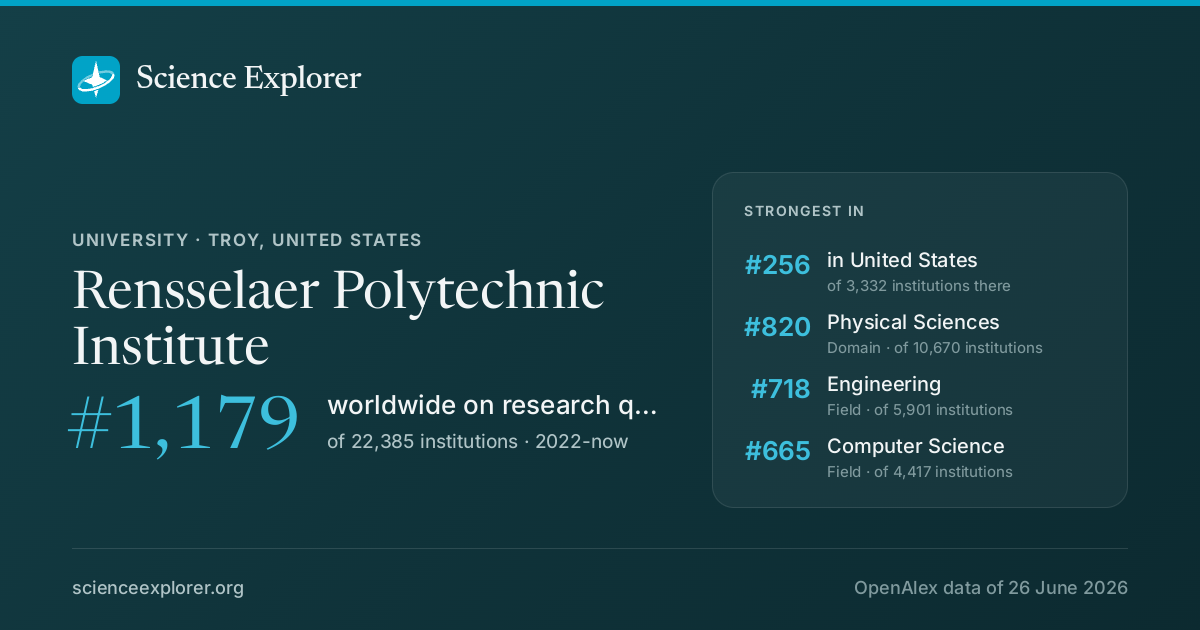
In research, Rensselaer Polytechnic Institute stands highest in Physical Sciences (#820 of 10,670 worldwide), Engineering (#718 of 5,901 worldwide) and Computer Science (#665 of 4,417 worldwide), 2022-now. Relative to its size it is most specialised in Computational Mechanics (Computational Mechanics is 3.9× its share of world research).
- World rank, 2022-now
- #1,179 of 22,385 · #894 all time
- Rank in United States
- #256 of 3,332
- Research works
- 36k ▼ 24% vs 2018-21
- Citations
- 1.1M 30.2 per fractional work
- Top-10% rate
- 9.0% all institutions 10.0%
- vs its own fields
- 0.90× 1.00× is exactly expected
- Open access
- 18% world 40%
- International
- 13% world 18%
What is Rensselaer Polytechnic Institute known for in research?
The fields where it stands highest, 2022-now, ranked among every institution above the floor in each field.
| Field | World rank | Where that sits | Top-10% rate | Works | All time |
|---|---|---|---|---|---|
| Physical SciencesDomain | #820 of 10,670 | 8.2% | 1,716 | #709 | |
| EngineeringField | #718 of 5,901 | 7.5% | 744 | #370 | |
| Computer ScienceField | #665 of 4,417 | 10.1% | 400 | #577 | |
| Life SciencesDomain | #1,444 of 6,403 | 7.9% | 218 | #1138 | |
| Health SciencesDomain | #2,429 of 9,902 | 13.2% | 157 | #1555 | |
| Artificial IntelligenceSubfield | #487 of 1,862 | 10.2% | 191 | #594 | |
| Electrical and Electronic EngineeringSubfield | #580 of 2,176 | 8.6% | 201 | #426 | |
| MedicineField | #2,623 of 8,541 | 13.4% | 132 | #1633 | |
| Social SciencesDomain | #2,950 of 9,585 | 10.1% | 345 | #1715 | |
| Biochemistry, Genetics and Molecular BiologyField | #952 of 2,964 | 7.2% | 138 | #862 |
Each strip is that field's whole ranked pool, with the notch where Rensselaer Polytechnic Institute sits in it, in the colour of the band that rank falls in. The track under the rate is the rate itself: it carries no average mark, because the average differs by field (from about 6% in Dentistry to 21% in Economics).
Which of those standings moved
The same fields on both windows: where it stood over the whole record, and where it stands in 2022-now. The distance is the story, and it is the one thing the two rank columns above cannot show.
- Physical Sciences#709 #820
- Engineering#370 #718
- Computer Science#577 #665
- Life Sciences#1,138 #1,444
- Health Sciences#1,555 #2,429
- Artificial Intelligence#594 #487
- Electrical and Electronic Engineering#426 #580
- Medicine#1,633 #2,623
- Social Sciences#1,715 #2,950
- Biochemistry, Genetics and Molecular Biology#862 #952
A dot further right is a better standing. Fields it was not ranked in over the whole record are left out.
Which fields of science does Rensselaer Polytechnic Institute work in?
In 2022-now, 70% of research at Rensselaer Polytechnic Institute is in Physical Sciences, 14% in Social Sciences. Its largest fields are Engineering (30%), Computer Science (17%), Materials Science (7%). It does 1.8× the world's share of Physical Sciences.
Each ring splits the one inside it: the four domains of science, their fields, their subfields. Size is fractional works in 2022-now. Every slice is a page; the interactive view zooms down to single topics and colours each by how much more of it this institution does than the world.
Its 4 domains and 26 fields, with their numbers
- Physical Sciences1,89270.3%
- Engineering80630.0%
- Computer Science44916.7%
- Materials Science1957.3%
- Physics and Astronomy1756.5%
- Environmental Science983.6%
- Earth and Planetary Sciences562.1%
- Chemistry431.6%
- Mathematics401.5%
- Energy210.8%
- Chemical Engineering100.4%
- Social Sciences37614.0%
- Social Sciences1234.6%
- Economics, Econometrics and Finance652.4%
- Decision Sciences612.3%
- Business, Management and Accounting592.2%
- Psychology381.4%
- Arts and Humanities281.1%
- Life Sciences2469.2%
- Health Sciences1776.6%
- Medicine1505.6%
- Health Professions220.8%
- Dentistry30.1%
- Nursing10.1%
- Veterinary10.0%
What does Rensselaer Polytechnic Institute specialise in?
Where its research is concentrated relative to its size: Computational Mechanics takes 3.9× the share of its output that it takes of world research.
- Computational MechanicsSubfield · 61.3 works3.9×
Location quotient, a volume reading rather than an impact one. It surfaces small, lopsided specialities.
Field profile
Location quotient across every field it publishes in: outside the ring is more than an institution of this size would be expected to publish, inside it is less.
Rings at 0.5×, 1× and 2×. Widest outward: Physics and Astronomy, 2.9×. Every wedge is a field page.
All 26 fields, with their numbers
- Physics and Astronomy2.92×175 works
- Decision Sciences2.36×62 works
- Computer Science2.14×449 works
- Materials Science2.08×195 works
- Engineering2.00×806 works
- Earth and Planetary Sciences1.32×56 works
- Mathematics1.26×40 works
- Economics, Econometrics and Finance1.14×66 works
- Biochemistry, Genetics and Molecular Biology1.10×157 works
- Chemical Engineering1.08×10 works
- Neuroscience1.06×46 works
- Chemistry1.01×43 works
- Energy0.84×21 works
- Environmental Science0.73×98 works
- Business, Management and Accounting0.68×59 works
- Psychology0.46×38 works
- Pharmacology, Toxicology and Pharmaceutics0.37×4 works
- Immunology and Microbiology0.36×10 works
- Arts and Humanities0.36×28 works
- Social Sciences0.36×124 works
- Health Professions0.30×22 works
- Medicine0.29×150 works
- Dentistry0.24×3 works
- Agricultural and Biological Sciences0.23×29 works
- Veterinary0.21×1 works
- Nursing0.11×1 works
- Physics and Astronomy 2.9×
- Decision Sciences 2.4×
- Computer Science 2.1×
- Materials Science 2.1×
- Engineering 2.0×
- Earth and Planetary Sciences 1.3×
- Mathematics 1.3×
- Economics, Econometrics and Finance 1.1×
- Biochemistry, Genetics and Molecular Biology 1.1×
- Chemical Engineering 1.1×
- Neuroscience 1.1×
- Chemistry 1.0×
- Energy 0.8×
- Environmental Science 0.7×
- Business, Management and Accounting 0.7×
- Psychology 0.5×
- Pharmacology, Toxicology and Pharmaceutics 0.4×
- Immunology and Microbiology 0.4×
- Arts and Humanities 0.4×
- Social Sciences 0.4×
- Health Professions 0.3×
- Medicine 0.3×
- Dentistry 0.2×
- Agricultural and Biological Sciences 0.2×
- Veterinary 0.2×
- Nursing 0.1×
Who are the top researchers at Rensselaer Polytechnic Institute?
Ranked on the quality score, Nikhil A. Koratkar, E. Bruce Watson and Robert Alan Baron lead among researchers whose main affiliation is Rensselaer Polytechnic Institute.
- 1
Nikhil A. Koratkar
 United States · #19,974 worldwide
35k citations · 348 works
- 2
E. Bruce Watson
United States · #45,070 worldwide
43k citations · 391 works
- 3
Robert Alan Baron
United States · #46,000 worldwide
36k citations · 284 works
- 4
Linda S. Schadler
United States · #50,839 worldwide
25k citations · 322 works
- 5
Pawel Keblinski
United States · #72,181 worldwide
27k citations · 281 works
- 6
Deepak Vashishth
United States · #86,215 worldwide
9.4k citations · 187 works
- 7
Shengbai Zhang
United States · #88,237 worldwide
45k citations · 678 works
- 8
Bill B. Francis
United States · #97,224 worldwide
7.6k citations · 262 works
- 9
Ravi S. Kane
United States · #109,341 worldwide
17k citations · 224 works
- 10
Daniel Gall
United States · #110,223 worldwide
13k citations · 309 works
Which keywords describe research at Rensselaer Polytechnic Institute?
By fractional works in 2022-now, weighted toward what it does more of than the world: Deep Learning, Machine Learning, Neural Networks, Heat Transfer, Tomography, Molecular Dynamics, Large-Eddy Simulation and Thermal Management.
- Adaptive Mesh Refinement
- Molten Salt
- Reliability
- Power Devices
- Vibration Control
- Fault Detection
- Fluid-Structure Interaction
- Integrated Circuits
- Wave Propagation
- Nonlinear Systems
- Two-Dimensional Materials
- Monte Carlo Simulation
- Molecular Dynamics
- Tomography
- Power Electronics
- Security
- Convolutional Neural Networks
- Big Data
- Biomedical Applications
- Machine Learning
- Deep Learning
- Neural Networks
- Artificial Intelligence
- Heat Transfer
- Nanocomposites
- Thermal Management
- Biosensors
- Large-Eddy Simulation
- Control Systems
- Convex Optimization
- Thin Films
- Turbulent Flow
- Optical Modulators
- Nanowires
- Knowledge Representation
- Metamaterials
- Nanoelectronics
- Description Logics
- Flow Control
- Nuclear Reactor
Size is fractional works in 2022-now in the topics tagged with each word; colour is the word's share of this institution's work against its share of the world's. The 40 words are chosen for being large and distinctive. Each links to the topic it comes from most.
All 40 words, with their numbers
- Deep Learning204▲ 2.2×76 topics
- Machine Learning169▲ 1.89×77 topics
- Neural Networks117▲ 2.8×38 topics
- Biomedical Applications50▲ 1.59×34 topics
- Artificial Intelligence48▲ 1.26×32 topics
- Big Data43▲ 1.66×23 topics
- Heat Transfer40▲ 3.0×16 topics
- Convolutional Neural Networks36▲ 1.85×13 topics
- Nanocomposites36▲ 1.70×21 topics
- Security33▲ 1.83×16 topics
- Thermal Management33▲ 3.8×8 topics
- Power Electronics30▲ 3.5×8 topics
- Biosensors29▲ 2.2×12 topics
- Tomography28▲ 6.0×5 topics
- Large-Eddy Simulation28▲ 5.5×5 topics
- Molecular Dynamics27▲ 5.8×6 topics
- Control Systems23▲ 4.7×7 topics
- Monte Carlo Simulation23▲ 4.2×9 topics
- Convex Optimization22▲ 9.8×5 topics
- Two-Dimensional Materials22▲ 3.6×4 topics
- Thin Films22▲ 4.2×9 topics
- Nonlinear Systems22▲ 3.7×7 topics
- Turbulent Flow21▲ 6.6×3 topics
- Wave Propagation21▲ 7.0×4 topics
- Optical Modulators21▲ 5.4×3 topics
- Integrated Circuits20▲ 5.2×3 topics
- Nanowires20▲ 5.1×5 topics
- Fluid-Structure Interaction19▲ 4.8×5 topics
- Knowledge Representation19▲ 8.4×4 topics
- Fault Detection19▲ 5.1×3 topics
- Metamaterials19▲ 4.9×5 topics
- Vibration Control18▲ 11×4 topics
- Nanoelectronics18▲ 8.2×2 topics
- Power Devices16▲ 8.9×2 topics
- Description Logics16▲ 13×2 topics
- Reliability16▲ 7.6×3 topics
- Flow Control15▲ 10×2 topics
- Molten Salt15▲ 18×1 topic
- Nuclear Reactor15▲ 18×1 topic
- Adaptive Mesh Refinement15▲ 9.0×2 topics
Which research topics does Rensselaer Polytechnic Institute publish most on?
By volume in 2022-now: Nuclear reactor physics and engineering, Topic Modeling, Semiconductor materials and devices and Quantum Computing Algorithms and Architecture.
Area is fractional works; colour is the subfield each topic belongs to.
- 1 Nuclear reactor physics and engineering Aerospace Engineering 15 works
- 2 Topic Modeling Artificial Intelligence 15 works
- 3 Semiconductor materials and devices Electrical and Electronic Engineering 15 works
- 4 Quantum Computing Algorithms and Architecture Artificial Intelligence 14 works
- 5 Silicon Carbide Semiconductor Technologies Electrical and Electronic Engineering 13 works
- 6 Photonic and Optical Devices Electrical and Electronic Engineering 13 works
- 7 Acoustic Wave Phenomena Research Biomedical Engineering 12 works
- 8 Fluid Dynamics and Turbulent Flows Computational Mechanics 12 works
- 9 Structural Health Monitoring Techniques Civil and Structural Engineering 12 works
- 10 Model Reduction and Neural Networks Statistical and Nonlinear Physics 12 works
How open and international is its research?
Against the world's own shares: the tick on each track. Both are shares of its output, so they sit on one scale and can be read against each other as well as against the world.
World: 40% of research is openly available.
World: 18% is written across borders.
How has Rensselaer Polytechnic Institute's research output changed?
Output in 2022-2025 was 24% lower than in 2018-2021.
The same series as a ribbon: one cell per year, darker for more. The line above answers how much; this answers when.
Its share of all research
Growing output can still be a shrinking share: all of science grows. This is Rensselaer Polytechnic Institute as a percentage of every work published that year, 0.012% in 2024.
Fractional works of Rensselaer Polytechnic Institute over all fractional works that year. How the balance of science has shifted.
How much of it reaches the world top 10%
Year by year, against all institutions in the same year.
Of each year's output, the share that reached the world's 10% most cited for its field and year. Peak 16.8% in 2006.
Other research institutions in Troy
- InterScience (United States)
- Russell Sage College
- Samaritan Hospital
- Applied BioPhysics (United States)
- Northeast Health
- Hudson Valley Community College
- International Electronic Machines (United States)
- Troy Public Library
Share Rensselaer Polytechnic Institute's ranking



Research measures only: rankings here say nothing about teaching, admissions or student experience. Comparable institutions and collaboration partners have tabs of their own, above.
Discussion
Ask a question or share a note about Rensselaer Polytechnic Institute. Posts are plain text and can be reported.