RWTH Aachen University
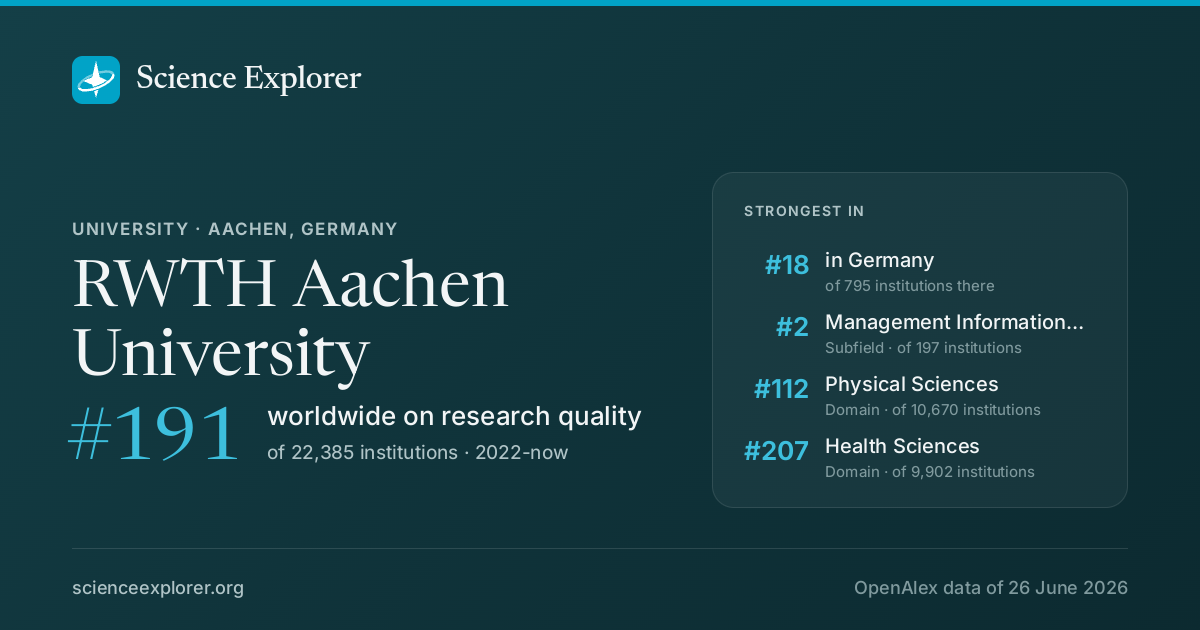
In research, RWTH Aachen University stands highest in Management Information Systems (#2 of 197 worldwide), Physical Sciences (#112 of 10,670 worldwide) and Health Sciences (#207 of 9,902 worldwide), 2022-now. Relative to its size it is most specialised in Structural Biology, Fluid Flow and Transfer Processes and Industrial and Manufacturing Engineering (Structural Biology is 7.1× its share of world research).
- World rank, 2022-now
- #191 of 22,385 · #113 all time
- Rank in Germany
- #18 of 795
- Research works
- 94k ▲ 2% vs 2018-21
- Citations
- 1.9M 20.7 per fractional work
- Top-10% rate
- 8.6% all institutions 10.0%
- vs its own fields
- 1.10× 1.00× is exactly expected
- Open access
- 36% world 40%
- International
- 19% world 18%
What is RWTH Aachen University known for in research?
The fields where it stands highest, 2022-now, ranked among every institution above the floor in each field.
| Field | World rank | Where that sits | Top-10% rate | Works | All time |
|---|---|---|---|---|---|
| Management Information SystemsSubfield | #2 of 197 | 14.0% | 129 | #26 | |
| Physical SciencesDomain | #112 of 10,670 | 7.9% | 10,305 | #68 | |
| Health SciencesDomain | #207 of 9,902 | 11.5% | 2,573 | #176 | |
| MedicineField | #210 of 8,541 | 11.3% | 2,268 | #174 | |
| EngineeringField | #165 of 5,901 | 7.6% | 5,358 | #88 | |
| Social SciencesDomain | #328 of 9,585 | 10.5% | 2,042 | #272 | |
| Computer ScienceField | #173 of 4,417 | 9.0% | 1,442 | #52 | |
| ChemistryField | #74 of 1,299 | 13.1% | 443 | #70 | |
| Life SciencesDomain | #382 of 6,403 | 9.6% | 1,404 | #282 | |
| Organic ChemistrySubfield | #47 of 618 | 15.4% | 263 | #41 |
Each strip is that field's whole ranked pool, with the notch where RWTH Aachen University sits in it, in the colour of the band that rank falls in. The track under the rate is the rate itself: it carries no average mark, because the average differs by field (from about 6% in Dentistry to 21% in Economics).
Which of those standings moved
The same fields on both windows: where it stood over the whole record, and where it stands in 2022-now. The distance is the story, and it is the one thing the two rank columns above cannot show.
- Management Information Systems#26 #2
- Physical Sciences#68 #112
- Health Sciences#176 #207
- Medicine#174 #210
- Engineering#88 #165
- Social Sciences#272 #328
- Computer Science#52 #173
- Chemistry#70 #74
- Life Sciences#282 #382
- Organic Chemistry#41 #47
A dot further right is a better standing. Fields it was not ranked in over the whole record are left out.
Which fields of science does RWTH Aachen University work in?
In 2022-now, 63% of research at RWTH Aachen University is in Physical Sciences, 16% in Health Sciences. Its largest fields are Engineering (33%), Medicine (14%), Computer Science (9%). It does 1.6× the world's share of Physical Sciences.
Each ring splits the one inside it: the four domains of science, their fields, their subfields. Size is fractional works in 2022-now. Every slice is a page; the interactive view zooms down to single topics and colours each by how much more of it this institution does than the world.
Its 4 domains and 26 fields, with their numbers
- Physical Sciences12k63.4%
- Engineering6,28532.6%
- Computer Science1,7168.9%
- Materials Science1,1255.8%
- Physics and Astronomy8314.3%
- Environmental Science7153.7%
- Chemistry5152.7%
- Energy3151.6%
- Earth and Planetary Sciences2641.4%
- Mathematics2471.3%
- Chemical Engineering2031.1%
- Health Sciences3,00515.6%
- Medicine2,64513.7%
- Health Professions2241.2%
- Dentistry830.4%
- Nursing420.2%
- Veterinary110.1%
- Social Sciences2,36812.3%
- Social Sciences7674.0%
- Business, Management and Accounting5733.0%
- Psychology3451.8%
- Decision Sciences2801.5%
- Arts and Humanities2641.4%
- Economics, Econometrics and Finance1390.7%
- Life Sciences1,6748.7%
What does RWTH Aachen University specialise in?
Where its research is concentrated relative to its size: Structural Biology takes 7.1× the share of its output that it takes of world research.
- Structural BiologySubfield · 21.8 works7.1×
- Fluid Flow and Transfer ProcessesSubfield · 94.0 works6.3×
- Industrial and Manufacturing EngineeringSubfield · 474.3 works4.8×
- SoftwareSubfield · 53.3 works4.3×
- Nuclear and High Energy PhysicsSubfield · 254.2 works4.2×
- Hardware and ArchitectureSubfield · 78.9 works3.6×
- Computational MechanicsSubfield · 395.4 works3.5×
- Metals and AlloysSubfield · 22.4 works3.5×
Location quotient, a volume reading rather than an impact one. It surfaces small, lopsided specialities.
Field profile
Location quotient across every field it publishes in: outside the ring is more than an institution of this size would be expected to publish, inside it is less.
Rings at 0.5×, 1× and 2×. Widest outward: Chemical Engineering, 3.0×. Every wedge is a field page.
All 26 fields, with their numbers
- Chemical Engineering3.02×203 works
- Engineering2.17×6,285 works
- Physics and Astronomy1.94×831 works
- Energy1.78×315 works
- Chemistry1.70×515 works
- Materials Science1.67×1,126 works
- Decision Sciences1.51×280 works
- Neuroscience1.31×409 works
- Computer Science1.15×1,716 works
- Mathematics1.09×247 works
- Business, Management and Accounting0.92×573 works
- Biochemistry, Genetics and Molecular Biology0.91×933 works
- Dentistry0.89×83 works
- Earth and Planetary Sciences0.87×264 works
- Environmental Science0.75×715 works
- Pharmacology, Toxicology and Pharmaceutics0.71×48 works
- Medicine0.71×2,645 works
- Immunology and Microbiology0.60×116 works
- Psychology0.59×344 works
- Arts and Humanities0.47×264 works
- Health Professions0.44×224 works
- Nursing0.44×42 works
- Veterinary0.40×11 works
- Economics, Econometrics and Finance0.34×139 works
- Social Sciences0.31×767 works
- Agricultural and Biological Sciences0.18×168 works
- Chemical Engineering 3.0×
- Engineering 2.2×
- Physics and Astronomy 1.9×
- Energy 1.8×
- Chemistry 1.7×
- Materials Science 1.7×
- Decision Sciences 1.5×
- Neuroscience 1.3×
- Computer Science 1.1×
- Mathematics 1.1×
- Business, Management and Accounting 0.9×
- Biochemistry, Genetics and Molecular Biology 0.9×
- Dentistry 0.9×
- Earth and Planetary Sciences 0.9×
- Environmental Science 0.8×
- Pharmacology, Toxicology and Pharmaceutics 0.7×
- Medicine 0.7×
- Immunology and Microbiology 0.6×
- Psychology 0.6×
- Arts and Humanities 0.5×
- Health Professions 0.4×
- Nursing 0.4×
- Veterinary 0.4×
- Economics, Econometrics and Finance 0.3×
- Social Sciences 0.3×
- Agricultural and Biological Sciences 0.2×
Who are the top researchers at RWTH Aachen University?
Ranked on the quality score, V. Kumar, Daniel R. Williams and P. Van Mulders lead among researchers whose main affiliation is RWTH Aachen University.
- 1
V. Kumar
 Germany · #2,201 worldwide
78k citations · 921 works
- 2
Daniel R. Williams
Germany · #2,559 worldwide
76k citations · 575 works
- 3
P. Van Mulders
Germany · #2,790 worldwide
77k citations · 792 works
- 4
A. Zhokin
Germany · #3,661 worldwide
69k citations · 787 works
- 5
L. Lyons
Germany · #4,476 worldwide
63k citations · 876 works
- 6
J. Milošević
Germany · #4,683 worldwide
126k citations · 1,949 works
- 7
E. Locci
Germany · #4,706 worldwide
93k citations · 1,093 works
- 8
O. Kodolova
Germany · #4,768 worldwide
53k citations · 662 works
- 9
S. Padhi
Germany · #4,900 worldwide
86k citations · 1,030 works
- 10
H. Reithler
Germany · #5,071 worldwide
70k citations · 684 works
Which keywords describe research at RWTH Aachen University?
By fractional works in 2022-now, weighted toward what it does more of than the world: Mechanical Properties, Sustainability, Renewable Energy, Machine Learning, Microstructure, Additive Manufacturing, Deep Learning and Energy Efficiency.
- Design for Manufacture
- Process Parameters
- Microstructural Evolution
- Reconfigurable Manufacturing Systems
- Tool Wear
- Fluid Dynamics
- Chemical Kinetics
- Materials
- Model Predictive Control
- Smart Grid
- Thermal Management
- Optimization
- Catalysis
- Energy Storage
- Additive Manufacturing
- Nanoparticles
- Microstructure
- Environmental Impact
- Renewable Energy
- Machine Learning
- Sustainability
- Deep Learning
- Mechanical Properties
- Energy Efficiency
- Big Data
- Biomedical Applications
- Heat Transfer
- Lithium-ion Batteries
- Electric Vehicles
- Renewable Energy Integration
- Artificial Neural Networks
- Renewable Resources
- Composite Materials
- Large-Eddy Simulation
- Software Engineering
- Industrial Automation
- Flexible Automation
- Construction
- Grain Refinement
- Assembly Planning
Size is fractional works in 2022-now in the topics tagged with each word; colour is the word's share of this institution's work against its share of the world's. The 40 words are chosen for being large and distinctive. Each links to the topic it comes from most.
All 40 words, with their numbers
- Sustainability692▲ 1.47×91 topics
- Machine Learning678◆ 1.06×85 topics
- Deep Learning661◆ 1.00×80 topics
- Renewable Energy558▲ 2.0×52 topics
- Mechanical Properties536▲ 2.8×38 topics
- Environmental Impact400▲ 1.22×58 topics
- Energy Efficiency357▲ 2.0×42 topics
- Microstructure324▲ 3.2×19 topics
- Big Data317▲ 1.72×29 topics
- Nanoparticles309▲ 1.27×43 topics
- Biomedical Applications296▲ 1.30×35 topics
- Additive Manufacturing270▲ 4.5×8 topics
- Heat Transfer262▲ 2.8×20 topics
- Energy Storage260▲ 2.1×13 topics
- Lithium-ion Batteries230▲ 2.9×4 topics
- Catalysis224▲ 1.75×29 topics
- Electric Vehicles223▲ 4.0×4 topics
- Optimization221▲ 2.5×25 topics
- Renewable Energy Integration218▲ 3.4×6 topics
- Thermal Management218▲ 3.5×8 topics
- Artificial Neural Networks199▲ 2.3×10 topics
- Smart Grid193▲ 2.8×10 topics
- Renewable Resources188▲ 5.5×6 topics
- Model Predictive Control172▲ 3.5×6 topics
- Composite Materials163▲ 4.0×11 topics
- Materials160▲ 3.6×6 topics
- Large-Eddy Simulation152▲ 4.2×5 topics
- Chemical Kinetics140▲ 7.9×3 topics
- Software Engineering139▲ 8.2×2 topics
- Fluid Dynamics138▲ 5.1×6 topics
- Industrial Automation137▲ 11×3 topics
- Tool Wear135▲ 5.5×3 topics
- Flexible Automation134▲ 28×1 topic
- Reconfigurable Manufacturing Systems134▲ 28×1 topic
- Construction131▲ 5.1×3 topics
- Microstructural Evolution130▲ 4.6×4 topics
- Grain Refinement124▲ 5.6×4 topics
- Process Parameters120▲ 5.8×3 topics
- Assembly Planning106▲ 7.9×1 topic
- Design for Manufacture106▲ 7.9×1 topic
Which research topics does RWTH Aachen University publish most on?
By volume in 2022-now: Flexible and Reconfigurable Manufacturing Systems, Advanced Battery Technologies Research, Manufacturing Process and Optimization and Digital Transformation in Industry.
Area is fractional works; colour is the subfield each topic belongs to.
- 1 Flexible and Reconfigurable Manufacturing Systems Industrial and Manufacturing Engineering 134 works
- 2 Advanced Battery Technologies Research Automotive Engineering 110 works
- 3 Manufacturing Process and Optimization Industrial and Manufacturing Engineering 106 works
- 4 Digital Transformation in Industry Industrial and Manufacturing Engineering 96 works
- 5 Business Process Modeling and Analysis Management Information Systems 89 works
- 6 Additive Manufacturing and 3D Printing Technologies Automotive Engineering 76 works
- 7 Advanced machining processes and optimization Mechanical Engineering 76 works
- 8 Advanced Memory and Neural Computing Electrical and Electronic Engineering 74 works
- 9 Advancements in Battery Materials Electrical and Electronic Engineering 72 works
- 10 Particle physics theoretical and experimental studies Nuclear and High Energy Physics 71 works
How open and international is its research?
Against the world's own shares: the tick on each track. Both are shares of its output, so they sit on one scale and can be read against each other as well as against the world.
World: 40% of research is openly available.
World: 18% is written across borders.
How has RWTH Aachen University's research output changed?
Output in 2022-2025 was 2% higher than in 2018-2021.
The same series as a ribbon: one cell per year, darker for more. The line above answers how much; this answers when.
Its share of all research
Growing output can still be a shrinking share: all of science grows. This is RWTH Aachen University as a percentage of every work published that year, 0.065% in 2024.
Fractional works of RWTH Aachen University over all fractional works that year. How the balance of science has shifted.
How much of it reaches the world top 10%
Year by year, against all institutions in the same year.
Of each year's output, the share that reached the world's 10% most cited for its field and year. Peak 12.3% in 2011.
Other research institutions in Aachen
- FH Aachen
- Ophthalmology Clinic
- FEV (Germany)
- Inform (Germany)
- Grünenthal Group (Germany)
- Forschungsgesellschaft Kraftfahrwesen Aachen (Germany)
- Access
- AMO (Germany)


Which institutions have research most like RWTH Aachen University's?
Among the world's leading institutions, Xi'an Jiaotong University has the research profile closest to RWTH Aachen University's, with both strong in Chemical Engineering.
- 1
Xi'an Jiaotong University
 China · Both strong in Chemical Engineering, Engineering, Energy
0.87 Compare
- 2
Tsinghua UniversityChina · Both strong in Chemical Engineering, Engineering, Physics and Astronomy
0.85 Compare
- 3
ShanghaiTech UniversityChina · Both strong in Chemical Engineering, Engineering, Physics and Astronomy
0.84 Compare
- 4
Northwestern Polytechnical UniversityChina · Both strong in Engineering, Chemical Engineering, Materials Science
0.84 Compare
- 5
Beijing Institute of TechnologyChina · Both strong in Chemical Engineering, Engineering, Physics and Astronomy
0.83 Compare
Similarity is the correlation of each side's location quotients across every field it publishes in, on a log scale: 1 is the same shape of research, 0 is unrelated. It ignores size. How it is measured.
Compare RWTH Aachen University with
- vs
 The University of Texas Southwestern Medical Center
- vs University of Tübingen
- vs Memorial Sloan Kettering Cancer Center
- vs University of Würzburg
- vs
 Weizmann Institute of Science
- vs Goethe University Frankfurt
Share RWTH Aachen University's ranking



Research measures only: rankings here say nothing about teaching, admissions or student experience. Comparable institutions and collaboration partners have tabs of their own, above.
Discussion
Ask a question or share a note about RWTH Aachen University. Posts are plain text and can be reported.