Science Explorer Back to mapMap
Discussion
University · Willemstad · Curaçao

St. Martinus University

World rank, 2022-now
#19,140
of 22,385
Rank in Curaçao
#3
of 4
Research works
87
▲ 991% vs 2018-21
Citations
118
1.4 per fractional work
Top-10% rate
1.9%
all institutions 10.0%
vs its own fields
0.97×
1.00× is exactly expected
Open access
48%
world 40%
International
25%
world 18%

Which fields of science does St. Martinus University work in?

In 2022-now, 57% of research at St. Martinus University is in Health Sciences, 28% in Social Sciences. Its largest fields are Medicine (54%), Social Sciences (14%), Arts and Humanities (10%). It does 2.3× the world's share of Health Sciences.

Health Sciences: 44 fractional works · 57.2% of its workMedicine: 42 fractional works · 54.5% of its workSurgery: 5 fractional works · 6.1% of its workPsychiatry and Mental health: 4 fractional works · 5.0% of its workPublic Health, Environmental and Occupational Health: 4 fractional works · 4.7% of its workPulmonary and Respiratory Medicine: 4 fractional works · 4.6% of its workRheumatology: 3 fractional works · 3.5% of its workPediatrics, Perinatology and Child Health: 2 fractional works · 2.8% of its workEpidemiology: 2 fractional works · 2.6% of its workPhysiology: 2 fractional works · 2.5% of its workHematology: 2 fractional works · 2.4% of its workCardiology and Cardiovascular Medicine: 2 fractional works · 2.4% of its workInfectious Diseases: 1 fractional works · 1.9% of its workRadiology, Nuclear Medicine and Imaging: 1 fractional works · 1.8% of its workGenetics: 1 fractional works · 1.7% of its workEndocrinology, Diabetes and Metabolism: 1 fractional works · 1.5% of its workReproductive Medicine: 1 fractional works · 1.2% of its workOncology: 1 fractional works · 1.1% of its workPathology and Forensic Medicine: 1 fractional works · 1.1% of its workPharmacology: 1 fractional works · 1.1% of its workObstetrics and Gynecology: 1 fractional works · 0.9% of its workNeurology: 1 fractional works · 0.8% of its workOphthalmology: 1 fractional works · 0.7% of its workEmergency Medicine: 0 fractional works · 0.6% of its workOrthopedics and Sports Medicine: 0 fractional works · 0.6% of its workFamily Practice: 0 fractional works · 0.5% of its workUrology: 0 fractional works · 0.5% of its workInternal Medicine: 0 fractional works · 0.4% of its workNephrology: 0 fractional works · 0.4% of its workDermatology: 0 fractional works · 0.3% of its workGastroenterology: 0 fractional works · 0.2% of its workHepatology: 0 fractional works · 0.2% of its workSmaller subfields together: 0 fractional works · 0.6% of its workHealth Professions: 1 fractional works · 1.6% of its workGeneral Health Professions: 1 fractional works · 1.0% of its workHealth Information Management: 0 fractional works · 0.5% of its workSmaller subfields together: 0 fractional works · 0.1% of its workDentistry: 0 fractional works · 0.6% of its workPeriodontics: 0 fractional works · 0.4% of its workGeneral Dentistry: 0 fractional works · 0.2% of its workNursing: 0 fractional works · 0.4% of its workNutrition and Dietetics: 0 fractional works · 0.4% of its workVeterinary: 0 fractional works · 0.0% of its workSocial Sciences: 22 fractional works · 28.3% of its workSocial Sciences: 11 fractional works · 14.0% of its workEducation: 3 fractional works · 4.2% of its workSociology and Political Science: 3 fractional works · 4.1% of its workCultural Studies: 3 fractional works · 3.5% of its workLaw: 1 fractional works · 1.0% of its workDemography: 1 fractional works · 0.9% of its workHealth: 0 fractional works · 0.3% of its workSmaller subfields together: 0 fractional works · 0.1% of its workArts and Humanities: 8 fractional works · 9.8% of its workReligious studies: 7 fractional works · 9.3% of its workPhilosophy: 0 fractional works · 0.4% of its workSmaller subfields together: 0 fractional works · 0.1% of its workPsychology: 2 fractional works · 3.2% of its workClinical Psychology: 1 fractional works · 1.9% of its workDevelopmental and Educational Psychology: 0 fractional works · 0.6% of its workExperimental and Cognitive Psychology: 0 fractional works · 0.5% of its workSmaller subfields together: 0 fractional works · 0.1% of its workBusiness, Management and Accounting: 1 fractional works · 1.1% of its workManagement Information Systems: 1 fractional works · 1.1% of its workDecision Sciences: 0 fractional works · 0.2% of its workManagement Science and Operations Research: 0 fractional works · 0.2% of its workLife Sciences: 10 fractional works · 13.1% of its workBiochemistry, Genetics and Molecular Biology: 6 fractional works · 7.8% of its workMolecular Biology: 3 fractional works · 4.2% of its workGenetics: 1 fractional works · 1.7% of its workEndocrinology: 1 fractional works · 1.0% of its workCell Biology: 0 fractional works · 0.5% of its workClinical Biochemistry: 0 fractional works · 0.4% of its workImmunology and Microbiology: 3 fractional works · 3.8% of its workMicrobiology: 1 fractional works · 1.4% of its workImmunology: 1 fractional works · 1.4% of its workVirology: 0 fractional works · 0.6% of its workParasitology: 0 fractional works · 0.4% of its workNeuroscience: 1 fractional works · 1.0% of its workCognitive Neuroscience: 1 fractional works · 0.7% of its workNeurology: 0 fractional works · 0.2% of its workSmaller subfields together: 0 fractional works · 0.1% of its workAgricultural and Biological Sciences: 0 fractional works · 0.4% of its workPharmacology, Toxicology and Pharmaceutics: 0 fractional works · 0.1% of its workPhysical Sciences: 1 fractional works · 1.5% of its workComputer Science: 1 fractional works · 0.9% of its workArtificial Intelligence: 0 fractional works · 0.5% of its workInformation Systems: 0 fractional works · 0.4% of its workMathematics: 0 fractional works · 0.2% of its workGeometry and Topology: 0 fractional works · 0.2% of its workEngineering: 0 fractional works · 0.1% of its workEnvironmental Science: 0 fractional works · 0.1% of its workPhysics and Astronomy: 0 fractional works · 0.1% of its workALL ITS WORKSt. MartinusUniversity77fractional works, 2022-now
Life Sciences13%Physical Sciences1%Health Sciences57%Social Sciences28%

Each ring splits the one inside it: the four domains of science, their fields, their subfields. Size is fractional works in 2022-now. Every slice is a page; the interactive view zooms down to single topics and colours each by how much more of it this institution does than the world.

Its 4 domains and 20 fields, with their numbers
    1. Medicine4254.5%
    2. Health Professions11.6%
    3. Dentistry00.6%
    4. Nursing00.4%
    5. Veterinary00.0%
    1. Social Sciences1114.0%
    2. Arts and Humanities89.8%
    3. Psychology23.2%
    4. Business, Management and Accounting11.1%
    5. Decision Sciences00.2%
    1. Biochemistry, Genetics and Molecular Biology67.8%
    2. Immunology and Microbiology33.8%
    3. Neuroscience11.0%
    4. Agricultural and Biological Sciences00.4%
    5. Pharmacology, Toxicology and Pharmaceutics00.1%
    1. Computer Science10.9%
    2. Mathematics00.2%
    3. Engineering00.1%
    4. Environmental Science00.1%
    5. Physics and Astronomy00.1%
All of science, and how each field's share has moved since 1950: the Science domain explorer

Field profile

Location quotient across every field it publishes in: outside the ring is more than an institution of this size would be expected to publish, inside it is less.

Agricultural and Biological Sciences: 0.08× its world share, 0 worksAgricultural and Bio…Biochemistry, Genetics and Molecular Biology: 1.47× its world share, 6 worksBiochemistry, Geneti…Immunology and Microbiology: 3.78× its world share, 3 worksImmunology and Micro…Neuroscience: 0.61× its world share, 1 worksNeurosciencePharmacology, Toxicology and Pharmaceutics: 0.18× its world share, 0 worksPharmacology, Toxico…Computer Science: 0.12× its world share, 1 worksComputer ScienceEngineering: 0.01× its world share, 0 worksEngineeringEnvironmental Science: 0.03× its world share, 0 worksEnvironmental ScienceMathematics: 0.18× its world share, 0 worksMathematicsPhysics and Astronomy: 0.03× its world share, 0 worksPhysics and AstronomyDentistry: 1.33× its world share, 0 worksDentistryHealth Professions: 0.59× its world share, 1 worksHealth ProfessionsMedicine: 2.83× its world share, 42 worksMedicineNursing: 0.88× its world share, 0 worksNursingVeterinary: 0.26× its world share, 0 worksVeterinaryArts and Humanities: 3.39× its world share, 8 worksArts and HumanitiesBusiness, Management and Accounting: 0.33× its world share, 1 worksBusiness, Management…Decision Sciences: 0.22× its world share, 0 worksDecision SciencesPsychology: 1.04× its world share, 2 worksPsychologySocial Sciences: 1.11× its world share, 11 worksSocial Sciences1×world share
more than its size predictsabout as predictedless

Rings at 0.5×, 1× and 2×. Widest outward: Immunology and Microbiology, 3.8×. Every wedge is a field page.

All 20 fields, with their numbers
  1. Immunology and Microbiology3.78×3 works
  2. Arts and Humanities3.39×8 works
  3. Medicine2.83×42 works
  4. Biochemistry, Genetics and Molecular Biology1.47×6 works
  5. Dentistry1.33×0 works
  6. Social Sciences1.11×11 works
  7. Psychology1.04×2 works
  8. Nursing0.88×0 works
  9. Neuroscience0.61×1 works
  10. Health Professions0.59×1 works
  11. Business, Management and Accounting0.33×1 works
  12. Veterinary0.26×0 works
  13. Decision Sciences0.22×0 works
  14. Pharmacology, Toxicology and Pharmaceutics0.18×0 works
  15. Mathematics0.18×0 works
  16. Computer Science0.12×1 works
  17. Agricultural and Biological Sciences0.08×0 works
  18. Environmental Science0.03×0 works
  19. Physics and Astronomy0.03×0 works
  20. Engineering0.01×0 works

What are the most cited papers from St. Martinus University?

The most cited paper from St. Martinus University is "A Systematic Review of the Effects of Smoking on the Cardiovascular System and General Health" (Mihirkumar P Parmar, Mankirat Kaur, Sravani Bhavanam et al., 2023), with 85 citations. Next come "Healthcare Cost and Outcomes Associated With Surgical Site Infection and Patient Outcomes in Low- and Middle-Income Countries" (67) and "Global epidemiology of cannabis use disorders and its trend from 1990 to 2019: Benchmarking analysis of the global burden of disease study" (30).

Most cited papers
#PaperReleasedCitations
1 A Systematic Review of the Effects of Smoking on the Cardiovascular System and General Health Mihirkumar P Parmar, Mankirat Kaur, Sravani Bhavanam et al. · Cureus ReviewOpen access 24 Apr 2023 85
2 Healthcare Cost and Outcomes Associated With Surgical Site Infection and Patient Outcomes in Low- and Middle-Income Countries Fernando Costabella, Keval B Patel, Adedimeji V Adepoju et al. · Cureus Open access 26 Jul 2023 67
3 Global epidemiology of cannabis use disorders and its trend from 1990 to 2019: Benchmarking analysis of the global burden of disease study Kinjal J. Shah, Umm E. Farwa, Ankitha Vanaparti et al. · Journal of Family Medicine and Primary Care Open access Mar 2024 30
4 Ill Effects and Complications Associated to Removable Dentures With Improper Use and Poor Oral Hygiene: A Systematic Review Amulya Dakka, Zahra Nazir, Humaira Shamim et al. · Cureus ReviewOpen access 18 Aug 2022 28
5 Complications in Diabetes Mellitus: Social Determinants and Trends Gaurav Venkat Cuddapah, Pujitha Vallivedu Chennakesavulu, Pradeep Pentapurthy et al. · Cureus Open access 23 Apr 2022 25
All 65 most cited papers, with filters and sorting

Which keywords describe research at St. Martinus University?

By fractional works in 2022-now, weighted toward what it does more of than the world: Christian Education, Church Leadership, Treatment, Diagnosis, Epidemiology, Islamic Education, Local Wisdom and Inflammation.

▲ more of its work than of the world's◆ about the world's share▼ less than the world's

Size is fractional works in 2022-now in the topics tagged with each word; colour is the word's share of this institution's work against its share of the world's. The 40 words are chosen for being large and distinctive. Each links to the topic it comes from most.

All 40 words, with their numbers
  1. Epidemiology7▲ 2.3×34 topics
  2. Christian Education6▲ 332×1 topic
  3. Church Leadership6▲ 332×1 topic
  4. Treatment6▲ 5.9×21 topics
  5. Diagnosis4▲ 6.3×13 topics
  6. Inflammation4▲ 2.4×14 topics
  7. Islamic Education3▲ 10×2 topics
  8. Local Wisdom2▲ 7.0×5 topics
  9. Genetics2▲ 4.3×5 topics
  10. Human Rights2▲ 2.8×4 topics
  11. Indonesia2▲ 6.4×2 topics
  12. Neuroimaging2▲ 10×5 topics
  13. Neurobiology2▲ 10×3 topics
  14. Community Empowerment2▲ 3.6×2 topics
  15. Risk Factors2▲ 2.4×9 topics
  16. Tolerance2▲ 32×2 topics
  17. Chemotherapy2▲ 3.3×5 topics
  18. Metabolic Syndrome2▲ 2.9×8 topics
  19. Radicalism2▲ 33×1 topic
  20. Religious Moderation2▲ 33×1 topic
  21. Guidelines2▲ 4.5×6 topics
  22. Pathogenesis2▲ 4.1×6 topics
  23. Diagnostic Criteria2▲ 8.6×5 topics
  24. Prevalence2▲ 4.8×3 topics
  25. Cultural Practices1▲ 14×2 topics
  26. Genetic Variants1▲ 10×3 topics
  27. Genomic Analysis1▲ 7.0×4 topics
  28. Prenatal Diagnosis1▲ 12×3 topics
  29. Bipolar Spectrum Disorder1▲ 72×1 topic
  30. Clinical Guidelines1▲ 5.8×6 topics
  31. Cognitive Function1▲ 9.1×2 topics
  32. Genetic Susceptibility1▲ 17×4 topics
  33. Global Christianity1▲ 116×1 topic
  34. Short-Term Missions1▲ 116×1 topic
  35. Treatment Guidelines1▲ 7.6×1 topic
  36. Cultural Syncretism1▲ 51×1 topic
  37. Islam Nusantara1▲ 51×1 topic
  38. Multicultural Education1▲ 9.6×2 topics
  39. Sexually Transmitted Infections1▲ 31×2 topics
  40. Cardiac Amyloidosis1▲ 67×1 topic

Which research topics does St. Martinus University publish most on?

By volume in 2022-now: Contemporary Christian Leadership and Education, Islamic Studies and Radicalism, Christian Theology and Mission and Bipolar Disorder and Treatment.

  1. 1 Contemporary Christian Leadership and Education Religious studies 6 works
  2. 2 Islamic Studies and Radicalism Sociology and Political Science 2 works
  3. 3 Christian Theology and Mission Religious studies 1 works
  4. 4 Bipolar Disorder and Treatment Psychiatry and Mental health 1 works
  5. 5 Cultural and Religious Practices in Indonesia Cultural Studies 1 works
  6. 6 Amyloidosis: Diagnosis, Treatment, Outcomes Molecular Biology 1 works
  7. 7 Marriage and Family Dynamics Sociology and Political Science 1 works
  8. 8 Education and Character Development Education 1 works
  9. 9 Urologic and reproductive health conditions Rheumatology 1 works
  10. 10 Educational Methods and Impacts Education 1 works

How open and international is its research?

Against the world's own shares: the tick on each track. Both are shares of its output, so they sit on one scale and can be read against each other as well as against the world.

openly available47.5%not open52.5%

World: 40% of research is openly available.

with international co-authors24.6%domestic only75.4%

World: 18% is written across borders.

How has St. Martinus University's research output changed?

Output in 2022-2025 was 991% higher than in 2018-2021.

still counting1990200020102020
grewheldshrank

The same series as a ribbon: one cell per year, darker for more. The line above answers how much; this answers when.

Its share of all research

Growing output can still be a shrinking share: all of science grows. This is St. Martinus University as a percentage of every work published that year, 0.00014% in 2024.

still counting0.00050%0.0010%0.0015%St. Martinus University0.00011% in 20251990200020102020

Fractional works of St. Martinus University over all fractional works that year. How the balance of science has shifted.

Other research institutions in Willemstad

All research institutions in Willemstad

Share St. Martinus University's ranking
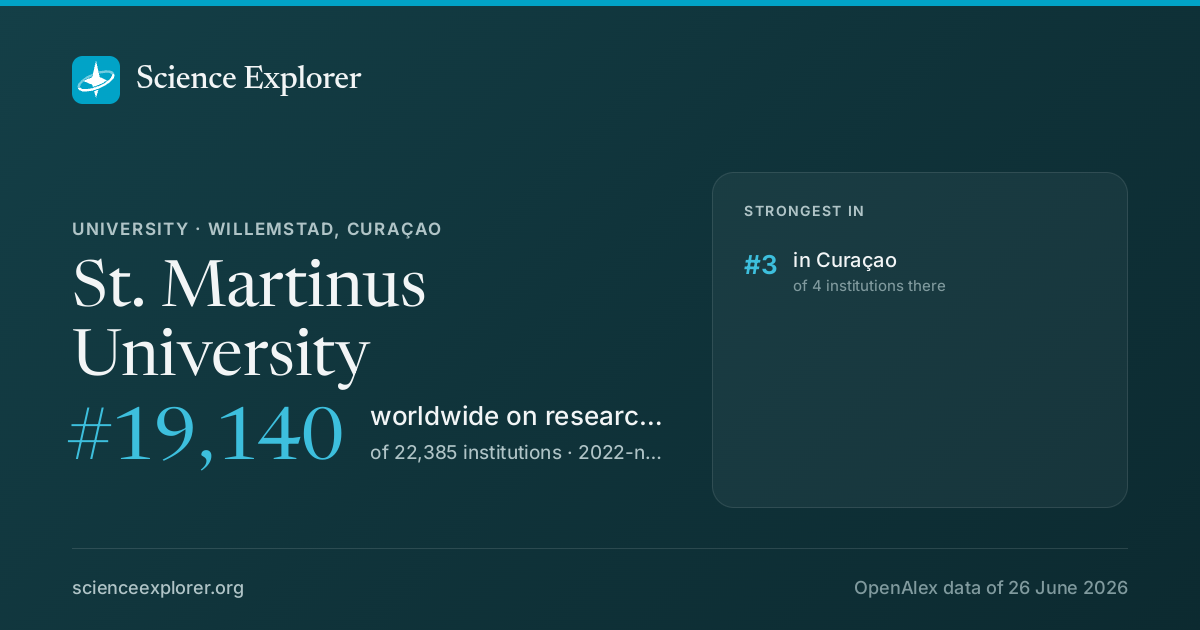
St. Martinus University on Science Explorer

A card with St. Martinus University's standing and the fields it leads in, for a post or a slide. A link to this page previews as the same card.

Download the card

1200 × 630 PNG, sized for social posts, drawn from the latest snapshot.

Badges for a website1Each links back here and updates with every snapshot

Research measures only: rankings here say nothing about teaching, admissions or student experience. Comparable institutions and collaboration partners have tabs of their own, above.

Discussion

Ask a question or share a note about St. Martinus University. Posts are plain text and can be reported.