Science Explorer Back to mapMap
Discussion
Hospital / health system · San Antonio · United States

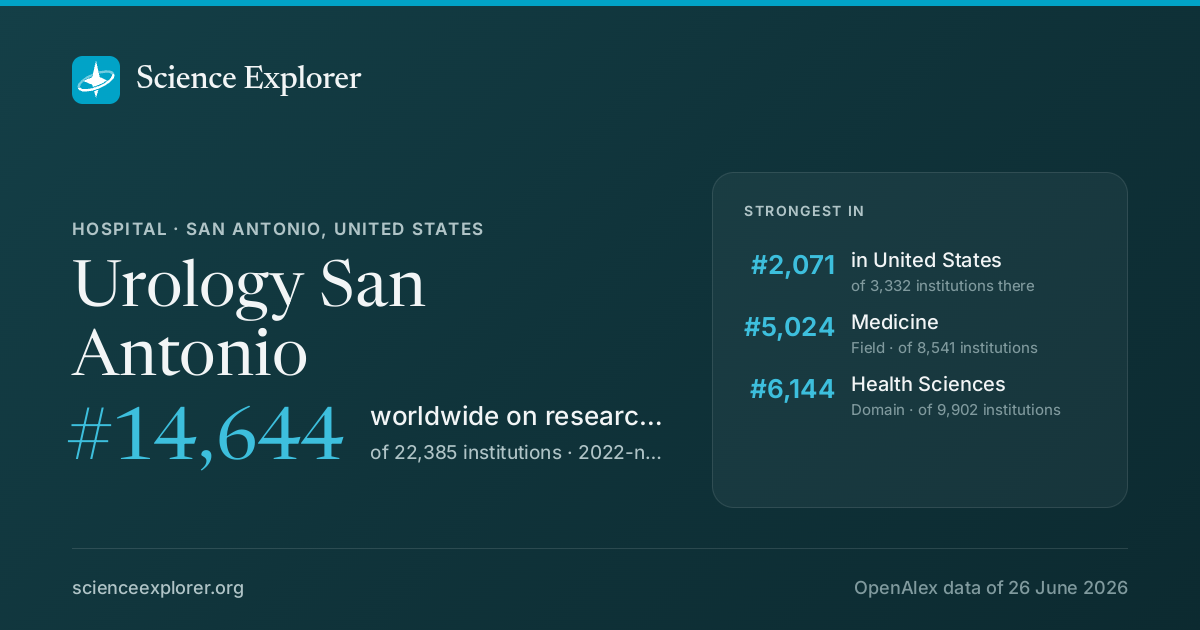
Urology San Antonio

In research, Urology San Antonio stands highest in Medicine (#5,024 of 8,541 worldwide) and Health Sciences (#6,144 of 9,902 worldwide), 2022-now.

World rank, 2022-now
#14,644
of 22,385 · #13,833 all time
Rank in United States
#2,071
of 3,332
Research works
922
◆ 1% vs 2018-21
Citations
14k
15.0 per fractional work
Top-10% rate
6.3%
all institutions 10.0%
vs its own fields
0.84×
1.00× is exactly expected
Open access
25%
world 40%
International
11%
world 18%

What is Urology San Antonio known for in research?

The fields where it stands highest, 2022-now, ranked among every institution above the floor in each field.

FieldWorld rankWhere that sitsTop-10% rateWorksAll time
MedicineField #5,024 of 8,541 7.0%115 #4413
Health SciencesDomain #6,144 of 9,902 6.8%126 #5079

Each strip is that field's whole ranked pool, with the notch where Urology San Antonio sits in it, in the colour of the band that rank falls in. The track under the rate is the rate itself: it carries no average mark, because the average differs by field (from about 6% in Dentistry to 21% in Economics).

Which fields of science does Urology San Antonio work in?

In 2022-now, 69% of research at Urology San Antonio is in Health Sciences, 13% in Life Sciences. Its largest fields are Medicine (64%), Biochemistry, Genetics and Molecular Biology (10%), Engineering (7%). It does 2.9× the world's share of Health Sciences.

Health Sciences: 157 fractional works · 69.5% of its workMedicine: 146 fractional works · 64.5% of its workSurgery: 21 fractional works · 9.3% of its workEndocrinology, Diabetes and Metabolism: 16 fractional works · 7.1% of its workPulmonary and Respiratory Medicine: 13 fractional works · 5.8% of its workCardiology and Cardiovascular Medicine: 11 fractional works · 4.9% of its workEpidemiology: 8 fractional works · 3.6% of its workOncology: 8 fractional works · 3.3% of its workPhysiology: 7 fractional works · 3.1% of its workPublic Health, Environmental and Occupational Health: 6 fractional works · 2.9% of its workPsychiatry and Mental health: 5 fractional works · 2.4% of its workRadiology, Nuclear Medicine and Imaging: 5 fractional works · 2.0% of its workPathology and Forensic Medicine: 4 fractional works · 1.7% of its workRheumatology: 4 fractional works · 1.6% of its workNeurology: 4 fractional works · 1.5% of its workPediatrics, Perinatology and Child Health: 3 fractional works · 1.4% of its workUrology: 2 fractional works · 1.0% of its workRehabilitation: 2 fractional works · 1.0% of its workDermatology: 2 fractional works · 0.9% of its workCritical Care and Intensive Care Medicine: 2 fractional works · 0.9% of its workGenetics: 2 fractional works · 0.8% of its workNephrology: 2 fractional works · 0.8% of its workReproductive Medicine: 2 fractional works · 0.8% of its workOrthopedics and Sports Medicine: 2 fractional works · 0.8% of its workEmergency Medicine: 2 fractional works · 0.7% of its workImmunology and Allergy: 2 fractional works · 0.7% of its workAnesthesiology and Pain Medicine: 1 fractional works · 0.6% of its workHematology: 1 fractional works · 0.6% of its workInfectious Diseases: 1 fractional works · 0.6% of its workPharmacology: 1 fractional works · 0.5% of its workHepatology: 1 fractional works · 0.5% of its workTransplantation: 1 fractional works · 0.5% of its workObstetrics and Gynecology: 1 fractional works · 0.4% of its workGastroenterology: 1 fractional works · 0.4% of its workBiochemistry: 1 fractional works · 0.3% of its workOphthalmology: 1 fractional works · 0.3% of its workInternal Medicine: 1 fractional works · 0.2% of its workSmaller subfields together: 1 fractional works · 0.5% of its workHealth Professions: 8 fractional works · 3.6% of its workGeneral Health Professions: 5 fractional works · 2.1% of its workPhysical Therapy, Sports Therapy and Rehabilitation: 1 fractional works · 0.3% of its workEmergency Medical Services: 1 fractional works · 0.3% of its workRadiological and Ultrasound Technology: 1 fractional works · 0.2% of its workOccupational Therapy: 0 fractional works · 0.2% of its workSmaller subfields together: 1 fractional works · 0.5% of its workDentistry: 2 fractional works · 0.9% of its workOral Surgery: 1 fractional works · 0.4% of its workOrthodontics: 0 fractional works · 0.2% of its workSmaller subfields together: 0 fractional works · 0.2% of its workNursing: 1 fractional works · 0.4% of its workNutrition and Dietetics: 1 fractional works · 0.4% of its workVeterinary: 0 fractional works · 0.1% of its workLife Sciences: 29 fractional works · 12.6% of its workBiochemistry, Genetics and Molecular Biology: 22 fractional works · 9.8% of its workMolecular Biology: 13 fractional works · 5.7% of its workGenetics: 4 fractional works · 1.7% of its workCancer Research: 2 fractional works · 0.8% of its workCell Biology: 1 fractional works · 0.5% of its workClinical Biochemistry: 1 fractional works · 0.4% of its workBiophysics: 1 fractional works · 0.3% of its workBiochemistry: 1 fractional works · 0.2% of its workSmaller subfields together: 1 fractional works · 0.3% of its workImmunology and Microbiology: 3 fractional works · 1.4% of its workImmunology: 3 fractional works · 1.3% of its workSmaller subfields together: 0 fractional works · 0.1% of its workNeuroscience: 3 fractional works · 1.3% of its workNeurology: 1 fractional works · 0.3% of its workEndocrine and Autonomic Systems: 1 fractional works · 0.2% of its workCellular and Molecular Neuroscience: 1 fractional works · 0.2% of its workCognitive Neuroscience: 0 fractional works · 0.2% of its workSmaller subfields together: 1 fractional works · 0.2% of its workPharmacology, Toxicology and Pharmaceutics: 0 fractional works · 0.1% of its workAgricultural and Biological Sciences: 0 fractional works · 0.0% of its workPhysical Sciences: 28 fractional works · 12.5% of its workEngineering: 16 fractional works · 7.3% of its workCivil and Structural Engineering: 3 fractional works · 1.2% of its workMechanical Engineering: 2 fractional works · 1.1% of its workBiomedical Engineering: 2 fractional works · 0.9% of its workComputational Mechanics: 2 fractional works · 0.9% of its workElectrical and Electronic Engineering: 2 fractional works · 0.9% of its workControl and Systems Engineering: 2 fractional works · 0.9% of its workMechanics of Materials: 1 fractional works · 0.6% of its workAerospace Engineering: 1 fractional works · 0.3% of its workAutomotive Engineering: 1 fractional works · 0.3% of its workSmaller subfields together: 1 fractional works · 0.3% of its workComputer Science: 3 fractional works · 1.1% of its workComputer Networks and Communications: 1 fractional works · 0.4% of its workArtificial Intelligence: 1 fractional works · 0.3% of its workInformation Systems: 0 fractional works · 0.2% of its workSmaller subfields together: 0 fractional works · 0.2% of its workEnvironmental Science: 3 fractional works · 1.1% of its workWater Science and Technology: 1 fractional works · 0.3% of its workEcology: 0 fractional works · 0.2% of its workSmaller subfields together: 1 fractional works · 0.6% of its workChemical Engineering: 2 fractional works · 0.7% of its workFluid Flow and Transfer Processes: 2 fractional works · 0.7% of its workChemistry: 1 fractional works · 0.6% of its workOrganic Chemistry: 1 fractional works · 0.5% of its workSmaller subfields together: 0 fractional works · 0.1% of its workMathematics: 1 fractional works · 0.6% of its workApplied Mathematics: 1 fractional works · 0.4% of its workSmaller subfields together: 0 fractional works · 0.2% of its workMaterials Science: 1 fractional works · 0.6% of its workGeneral Materials Science: 1 fractional works · 0.3% of its workMaterials Chemistry: 1 fractional works · 0.2% of its workSmaller subfields together: 0 fractional works · 0.0% of its workEarth and Planetary Sciences: 1 fractional works · 0.4% of its workGeochemistry and Petrology: 1 fractional works · 0.3% of its workSmaller subfields together: 0 fractional works · 0.2% of its workSocial Sciences: 12 fractional works · 5.4% of its workSocial Sciences: 5 fractional works · 2.1% of its workGender Studies: 2 fractional works · 0.7% of its workSociology and Political Science: 1 fractional works · 0.5% of its workEducation: 1 fractional works · 0.4% of its workSmaller subfields together: 1 fractional works · 0.4% of its workPsychology: 4 fractional works · 1.8% of its workClinical Psychology: 3 fractional works · 1.1% of its workSocial Psychology: 1 fractional works · 0.5% of its workSmaller subfields together: 1 fractional works · 0.3% of its workDecision Sciences: 1 fractional works · 0.5% of its workInformation Systems and Management: 1 fractional works · 0.3% of its workSmaller subfields together: 1 fractional works · 0.2% of its workBusiness, Management and Accounting: 1 fractional works · 0.5% of its workManagement of Technology and Innovation: 1 fractional works · 0.3% of its workSmaller subfields together: 1 fractional works · 0.2% of its workEconomics, Econometrics and Finance: 1 fractional works · 0.3% of its workEconomics and Econometrics: 1 fractional works · 0.3% of its workArts and Humanities: 0 fractional works · 0.1% of its workALL ITS WORKUrology SanAntonio227fractional works, 2022-now
Life Sciences13%Physical Sciences12%Health Sciences69%Social Sciences5%

Each ring splits the one inside it: the four domains of science, their fields, their subfields. Size is fractional works in 2022-now. Every slice is a page; the interactive view zooms down to single topics and colours each by how much more of it this institution does than the world.

Its 4 domains and 25 fields, with their numbers
    1. Medicine14664.5%
    2. Health Professions83.6%
    3. Dentistry20.9%
    4. Nursing10.4%
    5. Veterinary00.1%
    1. Biochemistry, Genetics and Molecular Biology229.8%
    2. Immunology and Microbiology31.4%
    3. Neuroscience31.3%
    4. Pharmacology, Toxicology and Pharmaceutics00.1%
    5. Agricultural and Biological Sciences00.0%
    1. Engineering167.3%
    2. Computer Science31.1%
    3. Environmental Science31.1%
    4. Chemical Engineering20.7%
    5. Chemistry10.6%
    6. Mathematics10.6%
    7. Materials Science10.6%
    8. Earth and Planetary Sciences10.4%
    9. Physics and Astronomy00.0%
    1. Social Sciences52.1%
    2. Psychology41.8%
    3. Decision Sciences10.5%
    4. Business, Management and Accounting10.5%
    5. Economics, Econometrics and Finance10.3%
    6. Arts and Humanities00.1%
All of science, and how each field's share has moved since 1950: the Science domain explorer

Field profile

Location quotient across every field it publishes in: outside the ring is more than an institution of this size would be expected to publish, inside it is less.

Agricultural and Biological Sciences: 0.01× its world share, 0 worksAgricultural and Bio…Biochemistry, Genetics and Molecular Biology: 1.85× its world share, 22 worksBiochemistry, Geneti…Immunology and Microbiology: 1.37× its world share, 3 worksImmunology and Micro…Neuroscience: 0.77× its world share, 3 worksNeurosciencePharmacology, Toxicology and Pharmaceutics: 0.35× its world share, 0 worksPharmacology, Toxico…Chemical Engineering: 2.10× its world share, 2 worksChemical EngineeringChemistry: 0.38× its world share, 1 worksChemistryComputer Science: 0.15× its world share, 3 worksComputer ScienceEarth and Planetary Sciences: 0.28× its world share, 1 worksEarth and Planetary …Engineering: 0.48× its world share, 16 worksEngineeringEnvironmental Science: 0.23× its world share, 3 worksEnvironmental ScienceMaterials Science: 0.17× its world share, 1 worksMaterials ScienceMathematics: 0.50× its world share, 1 worksMathematicsDentistry: 1.78× its world share, 2 worksDentistryHealth Professions: 1.38× its world share, 8 worksHealth ProfessionsMedicine: 3.35× its world share, 146 worksMedicineNursing: 0.79× its world share, 1 worksNursingVeterinary: 1.08× its world share, 0 worksVeterinaryArts and Humanities: 0.03× its world share, 0 worksArts and HumanitiesBusiness, Management and Accounting: 0.16× its world share, 1 worksBusiness, Management…Decision Sciences: 0.55× its world share, 1 worksDecision SciencesEconomics, Econometrics and Finance: 0.16× its world share, 1 worksEconomics, Econometr…Psychology: 0.60× its world share, 4 worksPsychologySocial Sciences: 0.16× its world share, 5 worksSocial Sciences1×world share
more than its size predictsabout as predictedless

Rings at 0.5×, 1× and 2×. Widest outward: Medicine, 3.4×. Every wedge is a field page.

All 24 fields, with their numbers
  1. Medicine3.35×146 works
  2. Chemical Engineering2.10×2 works
  3. Biochemistry, Genetics and Molecular Biology1.85×22 works
  4. Dentistry1.78×2 works
  5. Health Professions1.38×8 works
  6. Immunology and Microbiology1.37×3 works
  7. Veterinary1.08×0 works
  8. Nursing0.79×1 works
  9. Neuroscience0.77×3 works
  10. Psychology0.60×4 works
  11. Decision Sciences0.55×1 works
  12. Mathematics0.50×1 works
  13. Engineering0.48×16 works
  14. Chemistry0.38×1 works
  15. Pharmacology, Toxicology and Pharmaceutics0.35×0 works
  16. Earth and Planetary Sciences0.28×1 works
  17. Environmental Science0.23×3 works
  18. Materials Science0.17×1 works
  19. Business, Management and Accounting0.16×1 works
  20. Economics, Econometrics and Finance0.16×1 works
  21. Social Sciences0.16×5 works
  22. Computer Science0.15×3 works
  23. Arts and Humanities0.03×0 works
  24. Agricultural and Biological Sciences0.01×0 works

Who are the top researchers at Urology San Antonio?

Ranked on the quality score, Daniel R. Saltzstein, David P. Richards and Christopher H. Cantrill lead among researchers whose main affiliation is Urology San Antonio.

  1. 1 Daniel R. Saltzstein United States · #405,056 worldwide 3.5k citations · 136 works
  2. 2 David P. Richards United States · #1,086,065 worldwide 2.7k citations · 48 works
  3. 3 Christopher H. Cantrill United States · #1,279,970 worldwide 920 citations · 26 works
  4. 4 Ann Doan-Do Bass United States · #1,569,288 worldwide 2.1k citations · 44 works
  5. 5 LeRoy A. Jones United States · #3,118,798 worldwide 1.7k citations · 92 works
  6. 6 Bryan Kansas United States · #3,597,567 worldwide 435 citations · 41 works
  7. 7 Anthony T. Bella United States · #3,648,553 worldwide 436 citations · 22 works
  8. 8 Jose De La Cerda United States · #3,706,947 worldwide 208 citations · 20 works
  9. 9 Patrick Bastian United States · #4,010,137 worldwide 13 citations · 36 works
  10. 10 Damien Broderick United States · #4,449,542 worldwide 378 citations · 67 works
All ranked researchers at Urology San Antonio

What are the most cited papers from Urology San Antonio?

The most cited paper from Urology San Antonio is "Methane storage in metal–organic frameworks" (Yabing He, Wei Zhou, Guodong Qian et al., 2014), with 1,683 citations. Next come "Diabetic Foot Disorders: A Clinical Practice Guideline (2006 Revision)" (831) and "Evolving Concept of Bipolar Bone Loss and the Hill‐Sachs Lesion: From “Engaging/Non‐Engaging” Lesion to “On‐Track/Off‐Track” Lesion" (741).

Most cited papers
#PaperReleasedCitations
1 Methane storage in metal–organic frameworks Yabing He, Wei Zhou, Guodong Qian et al. · Chemical Society Reviews Review 2014 1,683
2 Diabetic Foot Disorders: A Clinical Practice Guideline (2006 Revision) Robert G. Frykberg, Thomas Zgonis, David G. Armstrong et al. · The Journal of Foot & Ankle Surgery Sep 2006 831
3 Evolving Concept of Bipolar Bone Loss and the Hill‐Sachs Lesion: From “Engaging/Non‐Engaging” Lesion to “On‐Track/Off‐Track” Lesion Giovanni Di Giacomo, Eiji Itoi, Stephen S. Burkhart · Arthroscopy The Journal of Arthroscopic and Related Surgery 2014 741
4 Results of Modified Latarjet Reconstruction in Patients With Anteroinferior Instability and Significant Bone Loss Stephen S. Burkhart, Joe F. De Beer, Johannes R.H. Barth et al. · Arthroscopy The Journal of Arthroscopic and Related Surgery Oct 2007 584
5 The ASK1 inhibitor selonsertib in patients with nonalcoholic steatohepatitis: A randomized, phase 2 trial Rohit Seth Loomba, Eric Lawitz, Parvez Mantry et al. · Hepatology Open access 11 Sep 2017 561
All 59 most cited papers, with filters and sorting

Which keywords describe research at Urology San Antonio?

By fractional works in 2022-now, weighted toward what it does more of than the world: Epidemiology, Glycemic Control, Insulin Therapy, Diabetes, Heart Failure, Clinical Guidelines, Type 2 Diabetes and Cardiovascular Outcomes.

▲ more of its work than of the world's◆ about the world's share▼ less than the world's

Size is fractional works in 2022-now in the topics tagged with each word; colour is the word's share of this institution's work against its share of the world's. The 40 words are chosen for being large and distinctive. Each links to the topic it comes from most.

All 40 words, with their numbers
  1. Epidemiology26▲ 2.9×77 topics
  2. Glycemic Control12▲ 33×4 topics
  3. Insulin Therapy11▲ 40×3 topics
  4. Inflammation10▲ 2.2×38 topics
  5. Diabetes10▲ 8.9×10 topics
  6. Heart Failure10▲ 9.7×11 topics
  7. Clinical Guidelines10▲ 15×8 topics
  8. Type 2 Diabetes10▲ 18×3 topics
  9. Quality of Life9▲ 2.8×32 topics
  10. Cardiovascular Disease9▲ 3.4×17 topics
  11. Immunotherapy8▲ 4.8×16 topics
  12. Obesity8▲ 4.4×14 topics
  13. Risk Factors8▲ 3.0×18 topics
  14. Metabolic Syndrome7▲ 4.0×14 topics
  15. Complications7▲ 6.5×14 topics
  16. Cardiovascular Outcomes7▲ 55×1 topic
  17. Glucose Control7▲ 55×1 topic
  18. Management7▲ 3.8×23 topics
  19. Oxidative Stress7▲ 1.82×31 topics
  20. Biomarkers6▲ 4.0×14 topics
  21. Prostate Cancer6▲ 20×5 topics
  22. Clinical Trials6▲ 3.9×12 topics
  23. Guidelines5▲ 4.8×11 topics
  24. Cancer Therapy5▲ 3.9×13 topics
  25. Genetic Mutations5▲ 4.9×15 topics
  26. Weight Loss5▲ 13×4 topics
  27. Cancer Risk4▲ 9.0×6 topics
  28. Tumor Suppression4▲ 27×3 topics
  29. Insulin Signaling4▲ 22×4 topics
  30. Alzheimer's Disease4▲ 6.6×3 topics
  31. Rehabilitation4▲ 4.7×8 topics
  32. AMP-Activated Protein Kinase4▲ 45×1 topic
  33. Metformin4▲ 63×1 topic
  34. Surgical Management4▲ 4.4×13 topics
  35. Critical Care4▲ 7.0×8 topics
  36. Diabetes Mellitus4▲ 8.0×6 topics
  37. Type 1 Diabetes4▲ 19×2 topics
  38. Continuous Glucose Monitoring3▲ 31×1 topic
  39. Hypoglycemia3▲ 31×1 topic
  40. Ideal Cardiovascular Health3▲ 40×1 topic

Which research topics does Urology San Antonio publish most on?

By volume in 2022-now: Diabetes Treatment and Management, Metabolism, Diabetes, and Cancer, Diabetes Management and Research and Cardiovascular Health and Risk Factors.

  1. 1 Diabetes Treatment and Management Endocrinology, Diabetes and Metabolism 7 works
  2. 2 Metabolism, Diabetes, and Cancer Molecular Biology 4 works
  3. 3 Diabetes Management and Research Endocrinology, Diabetes and Metabolism 3 works
  4. 4 Cardiovascular Health and Risk Factors Cardiology and Cardiovascular Medicine 3 works
  5. 5 Diet and metabolism studies Physiology 3 works
  6. 6 Prostate Cancer Treatment and Research Pulmonary and Respiratory Medicine 2 works
  7. 7 Diabetic Foot Ulcer Assessment and Management Endocrinology, Diabetes and Metabolism 2 works
  8. 8 Prostate Cancer Diagnosis and Treatment Pulmonary and Respiratory Medicine 2 works
  9. 9 Pancreatic function and diabetes Surgery 2 works
  10. 10 Advanced Combustion Engine Technologies Fluid Flow and Transfer Processes 2 works

How open and international is its research?

Against the world's own shares: the tick on each track. Both are shares of its output, so they sit on one scale and can be read against each other as well as against the world.

openly available25.0%not open75.0%

World: 40% of research is openly available.

with international co-authors10.8%domestic only89.2%

World: 18% is written across borders.

How has Urology San Antonio's research output changed?

Output in 2022-2025 was 1% higher than in 2018-2021.

still counting1990200020102020
grewheldshrank

The same series as a ribbon: one cell per year, darker for more. The line above answers how much; this answers when.

Its share of all research

Growing output can still be a shrinking share: all of science grows. This is Urology San Antonio as a percentage of every work published that year, 0.00074% in 2024.

still counting0.0020%0.0040%Urology San Antonio0.00091% in 202519801990200020102020

Fractional works of Urology San Antonio over all fractional works that year. How the balance of science has shifted.

How much of it reaches the world top 10%

Year by year, against all institutions in the same year.

still counting5%10%15%all institutions10.0% in 2025Urology San Antonio7.8% in 202520102020

Of each year's output, the share that reached the world's 10% most cited for its field and year. Peak 13.6% in 2014.

Other research institutions in San Antonio

All research institutions in San Antonio

Share Urology San Antonio's ranking

Urology San Antonio on Science Explorer

A card with Urology San Antonio's standing and the fields it leads in, for a post or a slide. A link to this page previews as the same card.

Download the card

1200 × 630 PNG, sized for social posts, drawn from the latest snapshot.

Badges for a website1Each links back here and updates with every snapshot

Research measures only: rankings here say nothing about teaching, admissions or student experience. Comparable institutions and collaboration partners have tabs of their own, above.

Discussion

Ask a question or share a note about Urology San Antonio. Posts are plain text and can be reported.