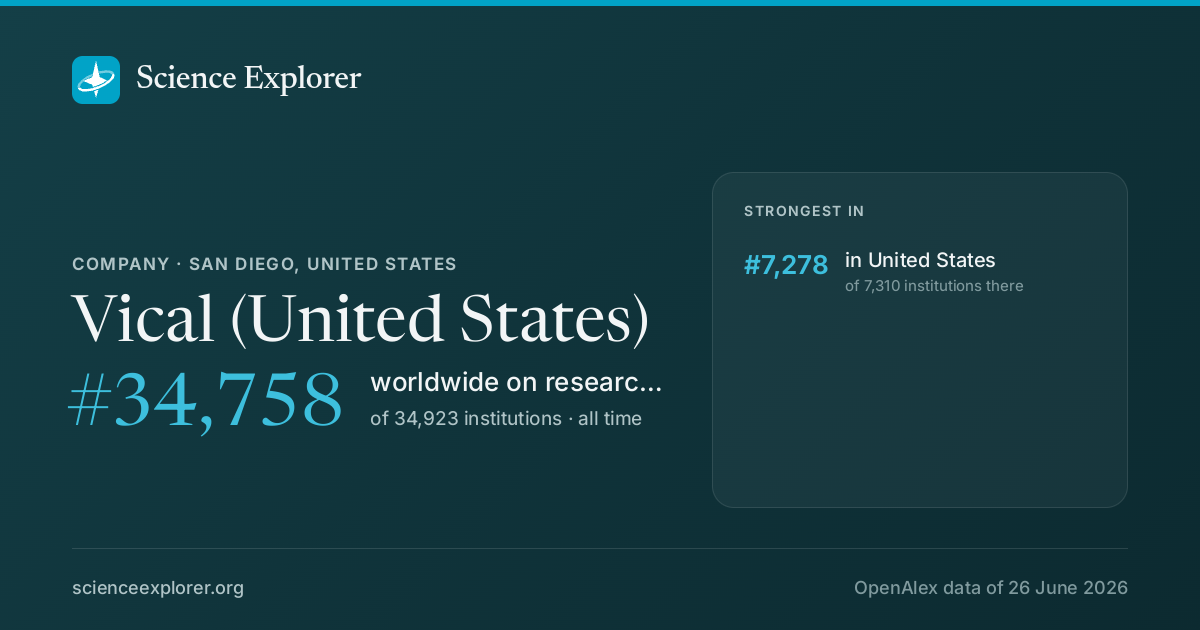
- World rank, all time
- #34,758 of 34,923
- Rank in United States
- #7,278 of 7,310
- Research works
- 128 ▼ 100% vs 2018-21
- Citations
- 13k 100.0 per fractional work
- Top-10% rate
- 15.6% all institutions 10.0%
- vs its own fields
- 1.12× 1.00× is exactly expected
- Open access
- 22% world 40%
- International
- 7% world 18%
Which fields of science does Vical (United States) work in?
In all years, 70% of research at Vical (United States) is in Life Sciences, 25% in Health Sciences. Its largest fields are Biochemistry, Genetics and Molecular Biology (48%), Medicine (25%), Immunology and Microbiology (18%). It does 4.2× the world's share of Life Sciences.
Each ring splits the one inside it: the four domains of science, their fields, their subfields. Size is fractional works in all years. Every slice is a page; the interactive view zooms down to single topics and colours each by how much more of it this institution does than the world.
Its 4 domains and 16 fields, with their numbers
- Life Sciences8969.9%
- Health Sciences3224.9%
- Medicine3224.8%
- Veterinary00.1%
- Nursing00.0%
- Physical Sciences64.9%
- Environmental Science32.3%
- Engineering10.9%
- Materials Science10.7%
- Chemistry10.5%
- Chemical Engineering00.3%
- Mathematics00.1%
- Computer Science00.1%
- Social Sciences00.3%
What does Vical (United States) specialise in?
Where its research is concentrated relative to its size: Immunology and Microbiology takes 14.6× the share of its output that it takes of world research.
- Immunology and MicrobiologyField · 22.8 works15×
- Molecular BiologySubfield · 41.6 works8.2×
- Biochemistry, Genetics and Molecular BiologyField · 61.6 works7.0×
Location quotient, a volume reading rather than an impact one. It surfaces small, lopsided specialities.
Field profile
Location quotient across every field it publishes in: outside the ring is more than an institution of this size would be expected to publish, inside it is less.
Who are the top researchers at Vical (United States)?
Ranked on the quality score, Suezanne E. Parker, Peter M. Hobart and Jon A. Norman lead among researchers whose main affiliation is Vical (United States).
- 1
Suezanne E. Parker
 United States · #237,742 worldwide
6.3k citations · 55 works
- 2
Peter M. Hobart
United States · #429,740 worldwide
6k citations · 63 works
- 3
Jon A. Norman
United States · #1,007,463 worldwide
4.9k citations · 70 works
- 4
Jukka Hartikka
United States · #1,121,664 worldwide
4.9k citations · 50 works
- 5
Holly M. Horton
United States · #1,261,439 worldwide
2.6k citations · 89 works
- 6
Ya-Li Tsai
United States · #1,976,302 worldwide
2.4k citations · 22 works
- 7
Carl J. Wheeler
United States · #2,022,200 worldwide
2k citations · 32 works
- 8
Kerry M. Barnhart
United States · #2,075,319 worldwide
2.2k citations · 49 works
- 9
Xiaolan Liang
United States · #2,160,728 worldwide
972 citations · 22 works
- 10
Marilyn E. Ferrari
United States · #3,112,107 worldwide
2k citations · 23 works
Which keywords describe research at Vical (United States)?
By fractional works in all years, weighted toward what it does more of than the world: Gene Therapy, RNA Interference, siRNA Delivery, Antigen Presentation, Cancer Immunotherapy, Epidemiology, Innate Immunity and Genomic Integration.
- RNA-Guided
- Evolution
- Cell Culture
- Biopharmaceutical Production
- Metagenomics
- Pandemic
- Glycosylation
- Rotavirus
- Antibodies
- DNA nanotechnology
- Genomics
- Vaccine Development
- Nanoparticles
- AAV
- Tumor Antigen
- Pathogenesis
- Genomic Integration
- Cancer Immunotherapy
- Epidemiology
- RNA Interference
- Gene Therapy
- siRNA Delivery
- Antigen Presentation
- Innate Immunity
- Immunity
- Dendritic Cells
- Vaccine
- Viral Vectors
- Immune Response
- Infection
- Virus
- Self-Assembly
- Norovirus
- Antiviral Therapy
- Immune Evasion
- Tumor Regression
- Antiretroviral Therapy
- Pattern Recognition Receptors
- Cytomegalovirus
- Genome Engineering
Size is fractional works in all years in the topics tagged with each word; colour is the word's share of this institution's work against its share of the world's. The 40 words are chosen for being large and distinctive. Each links to the topic it comes from most.
All 40 words, with their numbers
- Gene Therapy35▲ 104×4 topics
- RNA Interference21▲ 143×1 topic
- siRNA Delivery21▲ 213×1 topic
- Epidemiology19▲ 3.6×22 topics
- Antigen Presentation14▲ 111×2 topics
- Cancer Immunotherapy13▲ 74×2 topics
- Innate Immunity13▲ 28×6 topics
- Genomic Integration12▲ 94×2 topics
- Immunity12▲ 28×4 topics
- Pathogenesis12▲ 16×7 topics
- Dendritic Cells12▲ 78×1 topic
- Tumor Antigen12▲ 111×1 topic
- Vaccine12▲ 23×9 topics
- AAV12▲ 139×1 topic
- Viral Vectors12▲ 139×1 topic
- Nanoparticles10▲ 5.8×4 topics
- Immune Response8▲ 10×9 topics
- Vaccine Development8▲ 21×5 topics
- Infection7▲ 20×2 topics
- Genomics6▲ 14×4 topics
- Virus6▲ 40×3 topics
- DNA nanotechnology6▲ 44×1 topic
- Self-Assembly6▲ 11×1 topic
- Antibodies5▲ 46×2 topics
- Norovirus4▲ 56×1 topic
- Rotavirus4▲ 56×1 topic
- Antiviral Therapy4▲ 20×3 topics
- Glycosylation4▲ 13×2 topics
- Immune Evasion4▲ 50×2 topics
- Pandemic4▲ 6.1×2 topics
- Tumor Regression4▲ 31×2 topics
- Metagenomics3▲ 21×2 topics
- Antiretroviral Therapy3▲ 11×2 topics
- Biopharmaceutical Production3▲ 32×2 topics
- Pattern Recognition Receptors3▲ 17×3 topics
- Cell Culture3▲ 22×2 topics
- Cytomegalovirus3▲ 50×1 topic
- Evolution3▲ 8.0×2 topics
- Genome Engineering3▲ 41×1 topic
- RNA-Guided3▲ 41×1 topic
Which research topics does Vical (United States) publish most on?
By volume: RNA Interference and Gene Delivery, Immunotherapy and Immune Responses, Virus-based gene therapy research and Advanced biosensing and bioanalysis techniques.
Area is fractional works; colour is the subfield each topic belongs to.
- 1 RNA Interference and Gene Delivery Molecular Biology 21 works
- 2 Immunotherapy and Immune Responses Immunology 12 works
- 3 Virus-based gene therapy research Genetics 12 works
- 4 Advanced biosensing and bioanalysis techniques Molecular Biology 6 works
- 5 Viral gastroenteritis research and epidemiology Infectious Diseases 4 works
- 6 Cytomegalovirus and herpesvirus research Epidemiology 3 works
- 7 CRISPR and Genetic Engineering Molecular Biology 3 works
- 8 Influenza Virus Research Studies Epidemiology 3 works
- 9 Bacteriophages and microbial interactions Ecology 3 works
- 10 vaccines and immunoinformatics approaches Molecular Biology 3 works
How open and international is its research?
Against the world's own shares: the tick on each track. Both are shares of its output, so they sit on one scale and can be read against each other as well as against the world.
World: 40% of research is openly available.
World: 18% is written across borders.
How has Vical (United States)'s research output changed?
Output in 2022-2025 was 100% lower than in 2018-2021.
The same series as a ribbon: one cell per year, darker for more. The line above answers how much; this answers when.
Its share of all research
Growing output can still be a shrinking share: all of science grows. This is Vical (United States) as a percentage of every work published that year, 0.0000035% in 2020.
Fractional works of Vical (United States) over all fractional works that year. How the balance of science has shifted.
Other research institutions in San Diego
- University of California San Diego
- San Diego State University
- Scripps Research Institute
- Scripps Health
- University of San Diego
- General Atomics (United States)
- UC San Diego Health System
- Alliant International University

Share Vical (United States)'s ranking
Badges for a website1Each links back here and updates with every snapshot

Research measures only: rankings here say nothing about teaching, admissions or student experience. Comparable institutions and collaboration partners have tabs of their own, above.
Discussion
Ask a question or share a note about Vical (United States). Keep it to the research: no personal attacks, advertising or links. Any reader can report a post, which collapses it for everyone until it is opened.