Science Explorer Back to mapMap
Discussion
University · Wheeling · United States

Wheeling Jesuit University

In research, Wheeling Jesuit University stands highest in Health Sciences (#8,602 of 16,688 worldwide), Medicine (#9,270 of 14,558 worldwide) and Social Sciences (#10,937 of 14,833 worldwide), over all time.

World rank, all time
#13,213
of 34,923
Rank in United States
#2,733
of 7,310
Research works
414
▼ 62% vs 2018-21
Citations
6.9k
16.6 per fractional work
Top-10% rate
11.7%
all institutions 10.0%
vs its own fields
1.00×
1.00× is exactly expected
Open access
16%
world 40%
International
5%
world 18%

What is Wheeling Jesuit University known for in research?

The fields where it stands highest, over all time, ranked among every institution above the floor in each field.

FieldWorld rankWhere that sitsTop-10% rateWorks
Health SciencesDomain #8,602 of 16,688 6.7%148
MedicineField #9,270 of 14,558 7.5%130
Social SciencesDomain #10,937 of 14,833 7.1%173

Each strip is that field's whole ranked pool, with the notch where Wheeling Jesuit University sits in it, in the colour of the band that rank falls in. The track under the rate is the rate itself: it carries no average mark, because the average differs by field (from about 6% in Dentistry to 21% in Economics).

Which fields of science does Wheeling Jesuit University work in?

In all years, 42% of research at Wheeling Jesuit University is in Social Sciences, 36% in Health Sciences. Its largest fields are Medicine (31%), Social Sciences (22%), Psychology (10%). It does 2.0× the world's share of Social Sciences.

Social Sciences: 173 fractional works · 41.8% of its workSocial Sciences: 93 fractional works · 22.5% of its workEducation: 31 fractional works · 7.4% of its workPolitical Science and International Relations: 24 fractional works · 5.9% of its workSociology and Political Science: 20 fractional works · 4.7% of its workCommunication: 4 fractional works · 0.9% of its workCultural Studies: 2 fractional works · 0.5% of its workGeography, Planning and Development: 2 fractional works · 0.5% of its workAnthropology: 2 fractional works · 0.5% of its workDevelopment: 2 fractional works · 0.4% of its workHealth: 2 fractional works · 0.4% of its workDemography: 1 fractional works · 0.3% of its workSafety Research: 1 fractional works · 0.3% of its workGender Studies: 1 fractional works · 0.2% of its workSmaller subfields together: 1 fractional works · 0.3% of its workPsychology: 40 fractional works · 9.7% of its workDevelopmental and Educational Psychology: 15 fractional works · 3.7% of its workSocial Psychology: 12 fractional works · 2.8% of its workClinical Psychology: 6 fractional works · 1.5% of its workExperimental and Cognitive Psychology: 3 fractional works · 0.8% of its workGeneral Psychology: 3 fractional works · 0.6% of its workApplied Psychology: 1 fractional works · 0.3% of its workArts and Humanities: 29 fractional works · 7.1% of its workHistory: 8 fractional works · 1.8% of its workPhilosophy: 7 fractional works · 1.6% of its workReligious studies: 6 fractional works · 1.5% of its workLiterature and Literary Theory: 3 fractional works · 0.7% of its workHistory and Philosophy of Science: 2 fractional works · 0.6% of its workConservation: 1 fractional works · 0.2% of its workArcheology: 1 fractional works · 0.2% of its workSmaller subfields together: 1 fractional works · 0.3% of its workEconomics, Econometrics and Finance: 4 fractional works · 1.1% of its workEconomics and Econometrics: 4 fractional works · 1.0% of its workSmaller subfields together: 0 fractional works · 0.0% of its workDecision Sciences: 3 fractional works · 0.8% of its workInformation Systems and Management: 2 fractional works · 0.5% of its workManagement Science and Operations Research: 1 fractional works · 0.2% of its workSmaller subfields together: 0 fractional works · 0.0% of its workBusiness, Management and Accounting: 3 fractional works · 0.8% of its workManagement Information Systems: 1 fractional works · 0.3% of its workMarketing: 1 fractional works · 0.2% of its workSmaller subfields together: 1 fractional works · 0.2% of its workHealth Sciences: 148 fractional works · 35.8% of its workMedicine: 130 fractional works · 31.5% of its workPulmonary and Respiratory Medicine: 62 fractional works · 15.0% of its workRadiology, Nuclear Medicine and Imaging: 10 fractional works · 2.3% of its workUrology: 8 fractional works · 1.9% of its workSurgery: 7 fractional works · 1.7% of its workPublic Health, Environmental and Occupational Health: 6 fractional works · 1.3% of its workPsychiatry and Mental health: 4 fractional works · 0.9% of its workOncology: 3 fractional works · 0.8% of its workPhysiology: 3 fractional works · 0.8% of its workRheumatology: 3 fractional works · 0.7% of its workNephrology: 3 fractional works · 0.7% of its workEpidemiology: 2 fractional works · 0.5% of its workEndocrinology, Diabetes and Metabolism: 2 fractional works · 0.5% of its workCardiology and Cardiovascular Medicine: 2 fractional works · 0.5% of its workRehabilitation: 2 fractional works · 0.4% of its workPathology and Forensic Medicine: 2 fractional works · 0.4% of its workPharmacology: 2 fractional works · 0.4% of its workOrthopedics and Sports Medicine: 1 fractional works · 0.4% of its workHepatology: 1 fractional works · 0.3% of its workInfectious Diseases: 1 fractional works · 0.3% of its workPediatrics, Perinatology and Child Health: 1 fractional works · 0.2% of its workAnatomy: 1 fractional works · 0.2% of its workComplementary and alternative medicine: 1 fractional works · 0.2% of its workDermatology: 1 fractional works · 0.2% of its workReproductive Medicine: 1 fractional works · 0.2% of its workSmaller subfields together: 3 fractional works · 0.6% of its workHealth Professions: 14 fractional works · 3.3% of its workGeneral Health Professions: 9 fractional works · 2.1% of its workOccupational Therapy: 2 fractional works · 0.4% of its workHealth Information Management: 1 fractional works · 0.2% of its workSmaller subfields together: 2 fractional works · 0.6% of its workNursing: 3 fractional works · 0.7% of its workNutrition and Dietetics: 2 fractional works · 0.5% of its workSmaller subfields together: 1 fractional works · 0.2% of its workDentistry: 1 fractional works · 0.3% of its workPhysical Sciences: 71 fractional works · 17.2% of its workPhysics and Astronomy: 25 fractional works · 6.1% of its workRadiation: 17 fractional works · 4.2% of its workAstronomy and Astrophysics: 6 fractional works · 1.4% of its workStatistical and Nonlinear Physics: 2 fractional works · 0.4% of its workSmaller subfields together: 1 fractional works · 0.2% of its workEngineering: 16 fractional works · 3.8% of its workBiomedical Engineering: 5 fractional works · 1.3% of its workAerospace Engineering: 2 fractional works · 0.6% of its workMedia Technology: 1 fractional works · 0.3% of its workSafety, Risk, Reliability and Quality: 1 fractional works · 0.3% of its workArchitecture: 1 fractional works · 0.2% of its workControl and Systems Engineering: 1 fractional works · 0.2% of its workSmaller subfields together: 4 fractional works · 0.9% of its workComputer Science: 14 fractional works · 3.4% of its workComputer Vision and Pattern Recognition: 4 fractional works · 0.9% of its workInformation Systems: 3 fractional works · 0.8% of its workArtificial Intelligence: 3 fractional works · 0.7% of its workComputational Theory and Mathematics: 1 fractional works · 0.3% of its workComputer Science Applications: 1 fractional works · 0.2% of its workSmaller subfields together: 2 fractional works · 0.5% of its workEnvironmental Science: 6 fractional works · 1.4% of its workNature and Landscape Conservation: 2 fractional works · 0.4% of its workEcology: 1 fractional works · 0.3% of its workIndustrial and Manufacturing Engineering: 1 fractional works · 0.3% of its workManagement, Monitoring, Policy and Law: 1 fractional works · 0.2% of its workSmaller subfields together: 1 fractional works · 0.2% of its workChemistry: 4 fractional works · 1.0% of its workPhysical and Theoretical Chemistry: 2 fractional works · 0.4% of its workSpectroscopy: 1 fractional works · 0.2% of its workSmaller subfields together: 1 fractional works · 0.3% of its workMathematics: 3 fractional works · 0.7% of its workStatistics and Probability: 1 fractional works · 0.3% of its workMathematical Physics: 1 fractional works · 0.3% of its workSmaller subfields together: 1 fractional works · 0.2% of its workEarth and Planetary Sciences: 2 fractional works · 0.5% of its workAtmospheric Science: 1 fractional works · 0.2% of its workSmaller subfields together: 1 fractional works · 0.3% of its workMaterials Science: 1 fractional works · 0.2% of its workChemical Engineering: 0 fractional works · 0.1% of its workLife Sciences: 22 fractional works · 5.3% of its workAgricultural and Biological Sciences: 7 fractional works · 1.8% of its workFood Science: 3 fractional works · 0.8% of its workGeneral Agricultural and Biological Sciences: 3 fractional works · 0.6% of its workSmaller subfields together: 1 fractional works · 0.3% of its workNeuroscience: 7 fractional works · 1.8% of its workSensory Systems: 4 fractional works · 1.1% of its workCognitive Neuroscience: 2 fractional works · 0.6% of its workSmaller subfields together: 0 fractional works · 0.1% of its workBiochemistry, Genetics and Molecular Biology: 6 fractional works · 1.5% of its workMolecular Biology: 2 fractional works · 0.4% of its workGenetics: 2 fractional works · 0.4% of its workCancer Research: 1 fractional works · 0.3% of its workCell Biology: 1 fractional works · 0.2% of its workSmaller subfields together: 1 fractional works · 0.3% of its workPharmacology, Toxicology and Pharmaceutics: 1 fractional works · 0.2% of its workImmunology and Microbiology: 0 fractional works · 0.1% of its workALL ITS WORKWheeling JesuitUniversity414fractional works, all years
Life Sciences5%Physical Sciences17%Health Sciences36%Social Sciences42%

Each ring splits the one inside it: the four domains of science, their fields, their subfields. Size is fractional works in all years. Every slice is a page; the interactive view zooms down to single topics and colours each by how much more of it this institution does than the world.

Its 4 domains and 24 fields, with their numbers
    1. Social Sciences9322.5%
    2. Psychology409.7%
    3. Arts and Humanities297.1%
    4. Economics, Econometrics and Finance41.1%
    5. Decision Sciences30.8%
    6. Business, Management and Accounting30.8%
    1. Medicine13031.5%
    2. Health Professions143.3%
    3. Nursing30.7%
    4. Dentistry10.3%
    1. Physics and Astronomy256.1%
    2. Engineering163.8%
    3. Computer Science143.4%
    4. Environmental Science61.4%
    5. Chemistry41.0%
    6. Mathematics30.7%
    7. Earth and Planetary Sciences20.5%
    8. Materials Science10.2%
    9. Chemical Engineering00.1%
    1. Agricultural and Biological Sciences71.8%
    2. Neuroscience71.8%
    3. Biochemistry, Genetics and Molecular Biology61.5%
    4. Pharmacology, Toxicology and Pharmaceutics10.2%
    5. Immunology and Microbiology00.1%
All of science, and how each field's share has moved since 1950: the Science domain explorer

Field profile

Location quotient across every field it publishes in: outside the ring is more than an institution of this size would be expected to publish, inside it is less.

Biochemistry, Genetics and Molecular Biology: 0.57× its world share, 0 worksBiochemistry, Geneti…Immunology and Microbiology: 0.30× its world share, 0 worksImmunology and Micro…Computer Science: 0.53× its world share, 0 worksComputer SciencePhysics and Astronomy: 0.04× its world share, 0 worksPhysics and AstronomyDentistry: 17.05× its world share, 1 worksDentistryHealth Professions: 0.35× its world share, 0 worksHealth ProfessionsMedicine: 2.86× its world share, 7 worksMedicineArts and Humanities: 6.69× its world share, 2 worksArts and HumanitiesEconomics, Econometrics and Finance: 0.21× its world share, 0 worksEconomics, Econometr…Psychology: 0.21× its world share, 0 worksPsychologySocial Sciences: 0.62× its world share, 1 worksSocial Sciences1×world share
more than its size predictsabout as predictedless

Rings at 0.5×, 1× and 2×. Widest outward: Dentistry, 17.1×. Every wedge is a field page.

All 11 fields, with their numbers
  1. Dentistry17.05×1 works
  2. Arts and Humanities6.69×2 works
  3. Medicine2.86×7 works
  4. Social Sciences0.62×1 works
  5. Biochemistry, Genetics and Molecular Biology0.57×0 works
  6. Computer Science0.53×0 works
  7. Health Professions0.35×0 works
  8. Immunology and Microbiology0.30×0 works
  9. Economics, Econometrics and Finance0.21×0 works
  10. Psychology0.21×0 works
  11. Physics and Astronomy0.04×0 works

Who are the top researchers at Wheeling Jesuit University?

Ranked on the quality score, Jeff Rutherford, Peter Grimm and John C. Blasko lead among researchers whose main affiliation is Wheeling Jesuit University.

  1. 1 Jeff Rutherford United States · #344,389 worldwide 1.4k citations · 90 works
  2. 2 Peter Grimm United States · #426,113 worldwide 6.6k citations · 169 works
  3. 3 John C. Blasko United States · #432,569 worldwide 6.9k citations · 144 works
  4. 4 John E. Sylvester United States · #674,526 worldwide 2.7k citations · 58 works
  5. 5 Jonathan H. Lief United States · #1,596,869 worldwide 3.6k citations · 115 works
  6. 6 Al V. Taira United States · #2,325,111 worldwide 2k citations · 69 works
  7. 7 Bruce C. Howard United States · #2,431,378 worldwide 1.4k citations · 46 works
  8. 8 Debbie Denise Reese United States · #2,472,611 worldwide 1.1k citations · 39 works
  9. 9 John Sylvester United States · #2,712,314 worldwide 1.8k citations · 122 works
  10. 10 C. James Goodwin United States · #3,112,236 worldwide 865 citations · 37 works
All ranked researchers at Wheeling Jesuit University

What are the most cited papers from Wheeling Jesuit University?

The most cited paper from Wheeling Jesuit University is "Research in Psychology: Methods and Design" (C. James Goodwin, 1995), with 610 citations. Next come "PROSTATE SPECIFIC ANTIGEN: A DECADE OF DISCOVERY-WHAT WE HAVE LEARNED AND WHERE WE ARE GOING" (606) and "The lakes of Titan" (590).

Most cited papers
#PaperReleasedCitations
1 Research in Psychology: Methods and Design C. James Goodwin 28 Feb 1995 610
2 PROSTATE SPECIFIC ANTIGEN: A DECADE OF DISCOVERY-WHAT WE HAVE LEARNED AND WHERE WE ARE GOING Thomas J. Polascik, Joseph E. Oesterling, Alan Wayne Partin · The Journal of Urology Aug 1999 606
3 The lakes of Titan ELLEN R. STOFAN et al. · Nature 2007 590
4 Multi-institutional analysis of long-term outcome for stages T1–T2 prostate cancer treated with permanent seed implantation Michael J. Zeléfsky, Deborah Ann Kuban, Larry B. Levy et al. · International Journal of Radiation Oncology*Biology*Physics 3 Nov 2006 468
5 Comparative analysis of prostate‐specific antigen free survival outcomes for patients with low, intermediate and high risk prostate cancer treatment by radical therapy. Results from the Prostate Cancer Results Study Group Peter Grimm et al. · British Journal of Urology 12 Jan 2012 461
All 60 most cited papers, with filters and sorting

Which keywords describe research at Wheeling Jesuit University?

By fractional works in all years, weighted toward what it does more of than the world: Prostate Cancer, Clinical Guidelines, Survival Rates, Genetic Variants, Radiation Therapy, Gleason Grading, Screening and Clinical Trials.

▲ more of its work than of the world's◆ about the world's share▼ less than the world's

Size is fractional works in all years in the topics tagged with each word; colour is the word's share of this institution's work against its share of the world's. The 40 words are chosen for being large and distinctive. Each links to the topic it comes from most.

All 40 words, with their numbers
  1. Prostate Cancer58▲ 94×2 topics
  2. Clinical Guidelines36▲ 28×4 topics
  3. Survival Rates35▲ 83×2 topics
  4. Genetic Variants35▲ 39×2 topics
  5. Gleason Grading35▲ 195×1 topic
  6. Radiation Therapy35▲ 58×2 topics
  7. Screening35▲ 90×1 topic
  8. Clinical Trials26▲ 10×8 topics
  9. Immunotherapy25▲ 9.4×7 topics
  10. Biomarkers25▲ 9.7×4 topics
  11. Hormone Therapy24▲ 56×3 topics
  12. Genetic Mutations24▲ 11×5 topics
  13. Genomic Profiling24▲ 58×2 topics
  14. Androgen Receptor24▲ 62×1 topic
  15. Metastatic Prostate Cancer24▲ 129×1 topic
  16. Identity19▲ 5.9×16 topics
  17. Dosimetry19▲ 49×2 topics
  18. Quality Assurance18▲ 23×3 topics
  19. Monte Carlo Simulation17▲ 14×2 topics
  20. Image-Guided Radiotherapy17▲ 80×1 topic
  21. Radiotherapy Physics17▲ 80×1 topic
  22. Nationalism16▲ 6.6×10 topics
  23. Motivation14▲ 12×5 topics
  24. Gender13▲ 5.5×12 topics
  25. Educational Technology13▲ 4.7×12 topics
  26. Religion13▲ 5.3×13 topics
  27. Student Engagement12▲ 11×9 topics
  28. Colonialism10▲ 4.9×11 topics
  29. Online Learning10▲ 5.3×5 topics
  30. Instructional Design10▲ 25×3 topics
  31. Cognitive Engagement9▲ 30×2 topics
  32. Distance Education8▲ 14×2 topics
  33. Learning Outcomes8▲ 9.0×5 topics
  34. Student Satisfaction8▲ 18×2 topics
  35. Urinary Incontinence8▲ 22×2 topics
  36. Federalism8▲ 18×2 topics
  37. Blended Learning8▲ 21×1 topic
  38. Community of Inquiry8▲ 32×1 topic
  39. Collaborative Learning8▲ 28×2 topics
  40. Intrinsic Motivation8▲ 20×3 topics

Which research topics does Wheeling Jesuit University publish most on?

By volume in 2022-now: Gout, Hyperuricemia, Uric Acid, Classical Philosophy and Thought, Disaster Management and Resilience and Kidney Stones and Urolithiasis Treatments.

  1. 1 Gout, Hyperuricemia, Uric Acid Nephrology 3 works
  2. 2 Classical Philosophy and Thought Philosophy 1 works
  3. 3 Disaster Management and Resilience Sociology and Political Science 0 works
  4. 4 Kidney Stones and Urolithiasis Treatments Pulmonary and Respiratory Medicine 0 works
  5. 5 Oral microbiology and periodontitis research Periodontics 0 works
  6. 6 Dental Research and COVID-19 General Dentistry 0 works
  7. 7 Historical Philosophy and Science History and Philosophy of Science 0 works
  8. 8 Biochemical and Molecular Research Molecular Biology 0 works
  9. 9 Dental Health and Care Utilization Periodontics 0 works
  10. 10 Philosophical Ethics and Theory Philosophy 0 works

How open and international is its research?

Against the world's own shares: the tick on each track. Both are shares of its output, so they sit on one scale and can be read against each other as well as against the world.

openly available16.1%not open83.9%

World: 40% of research is openly available.

with international co-authors5.1%domestic only94.9%

World: 18% is written across borders.

How has Wheeling Jesuit University's research output changed?

Output in 2022-2025 was 62% lower than in 2018-2021.

still counting1990200020102020
grewheldshrank

The same series as a ribbon: one cell per year, darker for more. The line above answers how much; this answers when.

Its share of all research

Growing output can still be a shrinking share: all of science grows. This is Wheeling Jesuit University as a percentage of every work published that year, 0.000082% in 2024.

still counting0.0010%0.0020%Wheeling Jesuit University0.000028% in 202519801990200020102020

Fractional works of Wheeling Jesuit University over all fractional works that year. How the balance of science has shifted.

How much of it reaches the world top 10%

Year by year, against all institutions in the same year.

5%10%15%all institutions10.0% in 2014Wheeling Jesuit University2.6% in 20142010

Of each year's output, the share that reached the world's 10% most cited for its field and year. Peak 7.9% in 2002.

Other research institutions in Wheeling

All research institutions in Wheeling

Share Wheeling Jesuit University's ranking
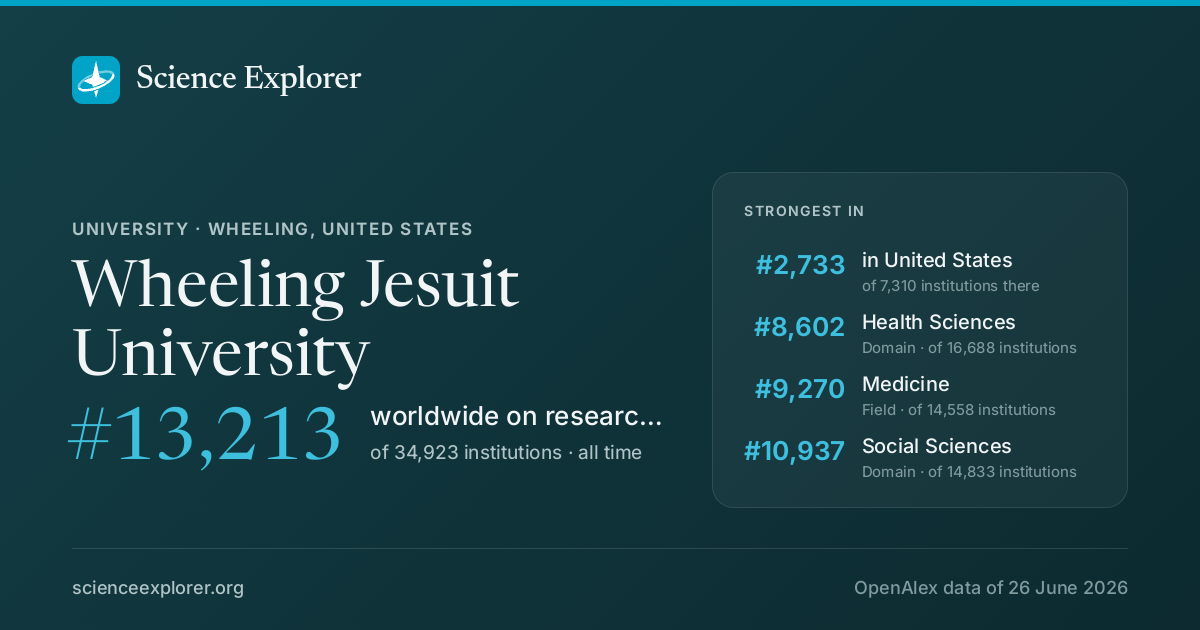
Wheeling Jesuit University on Science Explorer

A card with Wheeling Jesuit University's standing and the fields it leads in, for a post or a slide. A link to this page previews as the same card.

Download the card

1200 × 630 PNG, sized for social posts, drawn from the latest snapshot.

Badges for a website1Each links back here and updates with every snapshot

Research measures only: rankings here say nothing about teaching, admissions or student experience. Comparable institutions and collaboration partners have tabs of their own, above.

Discussion

Ask a question or share a note about Wheeling Jesuit University. Keep it to the research: no personal attacks, advertising or links. Any reader can report a post, which collapses it for everyone until it is opened.
