- World rank, all time
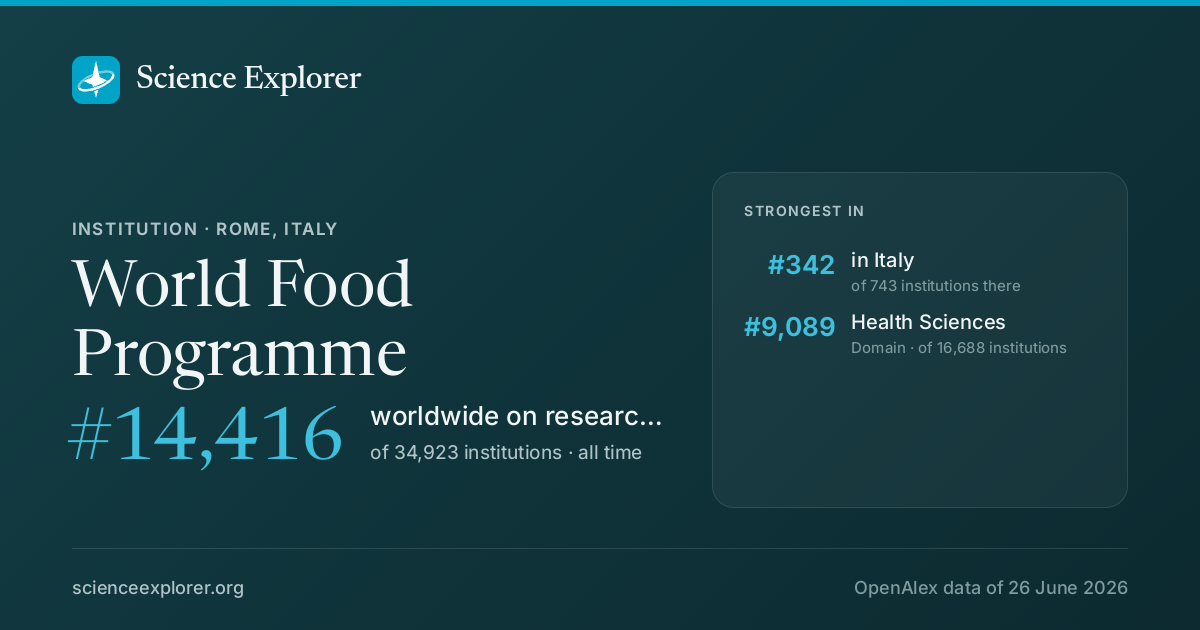
- #14,416 of 34,923
- Rank in Italy
- #342 of 743
- Research works
- 307 ▼ 2% vs 2018-21
- Citations
- 8.2k 26.8 per fractional work
- Top-10% rate
- 15.2% all institutions 10.0%
- vs its own fields
- 1.08× 1.00× is exactly expected
- Open access
- 58% world 40%
- International
- 55% world 18%
What is World Food Programme known for in research?
The fields where it stands highest, over all time, ranked among every institution above the floor in each field.
| Field | World rank | Where that sits | Top-10% rate | Works |
|---|---|---|---|---|
| Health SciencesDomain | #9,089 of 16,688 | 14.1% | 121 |
Each strip is that field's whole ranked pool, with the notch where World Food Programme sits in it, in the colour of the band that rank falls in. The track under the rate is the rate itself: it carries no average mark, because the average differs by field (from about 6% in Dentistry to 21% in Economics).
Which fields of science does World Food Programme work in?
In 2022-now, 40% of research at World Food Programme is in Health Sciences, 22% in Life Sciences. Its largest fields are Medicine (21%), Agricultural and Biological Sciences (15%), Nursing (12%). It does 1.6× the world's share of Health Sciences.
Each ring splits the one inside it: the four domains of science, their fields, their subfields. Size is fractional works in 2022-now. Every slice is a page; the interactive view zooms down to single topics and colours each by how much more of it this institution does than the world.
Its 4 domains and 22 fields, with their numbers
- Health Sciences3340.4%
- Medicine1720.8%
- Nursing1011.9%
- Health Professions67.6%
- Veterinary00.1%
- Life Sciences1821.9%
- Social Sciences1821.5%
- Physical Sciences1316.2%
- Environmental Science910.3%
- Engineering33.7%
- Computer Science10.6%
- Earth and Planetary Sciences00.6%
- Mathematics00.4%
- Chemistry00.3%
- Energy00.2%
Field profile
Location quotient across every field it publishes in: outside the ring is more than an institution of this size would be expected to publish, inside it is less.
Rings at 0.5×, 1× and 2×. Widest outward: Nursing, 24.4×. Every wedge is a field page.
All 22 fields, with their numbers
- Nursing24.36×10 works
- Agricultural and Biological Sciences3.10×12 works
- Health Professions2.88×6 works
- Pharmacology, Toxicology and Pharmaceutics2.76×1 works
- Economics, Econometrics and Finance2.20×4 works
- Decision Sciences2.13×2 works
- Environmental Science2.08×8 works
- Medicine1.08×17 works
- Business, Management and Accounting0.99×3 works
- Biochemistry, Genetics and Molecular Biology0.94×4 works
- Social Sciences0.69×7 works
- Neuroscience0.50×1 works
- Arts and Humanities0.49×1 works
- Psychology0.46×1 works
- Veterinary0.43×0 works
- Earth and Planetary Sciences0.38×0 works
- Mathematics0.37×0 works
- Immunology and Microbiology0.31×0 works
- Engineering0.25×3 works
- Energy0.22×0 works
- Chemistry0.18×0 works
- Computer Science0.08×0 works
- Nursing 24.4×
- Agricultural and Biological Sciences 3.1×
- Health Professions 2.9×
- Pharmacology, Toxicology and Pharmaceutics 2.8×
- Economics, Econometrics and Finance 2.2×
- Decision Sciences 2.1×
- Environmental Science 2.1×
- Medicine 1.1×
- Business, Management and Accounting 1.0×
- Biochemistry, Genetics and Molecular Biology 0.9×
- Social Sciences 0.7×
- Neuroscience 0.5×
- Arts and Humanities 0.5×
- Psychology 0.5×
- Veterinary 0.4×
- Earth and Planetary Sciences 0.4×
- Mathematics 0.4×
- Immunology and Microbiology 0.3×
- Engineering 0.2×
- Energy 0.2×
- Chemistry 0.2×
- Computer Science 0.1×
Who are the top researchers at World Food Programme?
Ranked on the quality score, Saskia de Pee, Rogério Manuel Lemos Pereira Bonifácio and P. Krishna Krishnamurthy lead among researchers whose main affiliation is World Food Programme.
- 1
Saskia de Pee
 Italy · #232,625 worldwide
11k citations · 245 works
- 2
Rogério Manuel Lemos Pereira Bonifácio
Italy · #532,827 worldwide
1.4k citations · 42 works
- 3
P. Krishna Krishnamurthy
Italy · #701,842 worldwide
1.1k citations · 24 works
- 4
Nils Grede
Italy · #1,482,862 worldwide
863 citations · 25 works
- 5
Nancy Aburto
Italy · #1,527,501 worldwide
3.6k citations · 55 works
- 6
Carmen Cecilia Muñoz Burbano
Italy · #1,981,576 worldwide
988 citations · 27 works
- 7
Wayne Jordash
Italy · #2,001,290 worldwide
107 citations · 23 works
- 8
Amit Wadhwa
Italy · #2,023,727 worldwide
354 citations · 21 works
- 9
Tina van den Briel
Italy · #2,171,048 worldwide
926 citations · 20 works
- 10
Frances Knight
Italy · #2,228,771 worldwide
147 citations · 18 works
Which keywords describe research at World Food Programme?
By fractional works in 2022-now, weighted toward what it does more of than the world: Child Development, Maternal and Child Undernutrition, Water Sanitation Hygiene, Climate Change, Vulnerability, Food Security, Chronic Disease and Inflammation.
- Phenolic Compounds
- Health Benefits
- Adaptation
- School Subsidies
- Antioxidant Activity
- Weather Shocks
- Insurance
- Global Warming
- Cancer
- Environmental Impact
- Poverty Reduction
- Health Effects
- Social Determinants
- Food Insecurity
- Health Outcomes
- Chronic Disease
- Food Security
- Vulnerability
- Water Sanitation Hygiene
- Child Development
- Climate Change
- Maternal and Child Undernutrition
- Inflammation
- Sustainability
- Oxidative Stress
- Antioxidant
- Mental Health
- Metabolism
- Agriculture
- Cardiovascular Disease
- Risk Management
- Social Networks
- Cancer Prevention
- Gender Inequality
- Poverty
- Metabolic Syndrome
- Conditional Cash Transfers
- Social Justice
- Gender Equality
- Social Capital
Size is fractional works in 2022-now in the topics tagged with each word; colour is the word's share of this institution's work against its share of the world's. The 40 words are chosen for being large and distinctive. Each links to the topic it comes from most.
All 40 words, with their numbers
- Climate Change8▲ 3.8×25 topics
- Child Development7▲ 22×2 topics
- Maternal and Child Undernutrition7▲ 101×1 topic
- Water Sanitation Hygiene7▲ 101×1 topic
- Inflammation6▲ 3.7×16 topics
- Vulnerability6▲ 31×5 topics
- Sustainability6▲ 2.7×16 topics
- Food Security5▲ 12×8 topics
- Oxidative Stress5▲ 3.7×10 topics
- Chronic Disease5▲ 34×3 topics
- Antioxidant4▲ 7.7×14 topics
- Health Outcomes4▲ 19×4 topics
- Mental Health4▲ 3.6×4 topics
- Food Insecurity4▲ 86×1 topic
- Metabolism4▲ 9.5×12 topics
- Social Determinants4▲ 24×1 topic
- Agriculture4▲ 13×2 topics
- Health Effects4▲ 8.0×10 topics
- Cardiovascular Disease4▲ 4.1×12 topics
- Poverty Reduction4▲ 34×3 topics
- Risk Management4▲ 9.2×4 topics
- Environmental Impact4▲ 2.5×10 topics
- Social Networks3▲ 15×3 topics
- Cancer3▲ 2.7×8 topics
- Cancer Prevention3▲ 14×8 topics
- Global Warming3▲ 8.5×5 topics
- Gender Inequality3▲ 25×3 topics
- Insurance3▲ 45×2 topics
- Poverty3▲ 35×1 topic
- Weather Shocks3▲ 114×1 topic
- Metabolic Syndrome3▲ 4.0×8 topics
- Antioxidant Activity2▲ 4.8×11 topics
- Conditional Cash Transfers2▲ 83×1 topic
- School Subsidies2▲ 83×1 topic
- Social Justice2▲ 5.0×5 topics
- Adaptation2▲ 9.4×4 topics
- Gender Equality2▲ 9.3×4 topics
- Health Benefits2▲ 8.2×9 topics
- Social Capital2▲ 5.0×4 topics
- Phenolic Compounds2▲ 13×7 topics
Which research topics does World Food Programme publish most on?
By volume in 2022-now: Child Nutrition and Water Access, Food Security and Health in Diverse Populations, Agricultural risk and resilience and Poverty, Education, and Child Welfare.
Area is fractional works; colour is the subfield each topic belongs to.
- 1 Child Nutrition and Water Access Nutrition and Dietetics 7 works
- 2 Food Security and Health in Diverse Populations General Health Professions 4 works
- 3 Agricultural risk and resilience Soil Science 3 works
- 4 Poverty, Education, and Child Welfare Safety Research 2 works
- 5 Agriculture Sustainability and Environmental Impact Ecology 1 works
- 6 Climate change impacts on agriculture Ecology, Evolution, Behavior and Systematics 1 works
- 7 Obesity, Physical Activity, Diet Public Health, Environmental and Occupational Health 1 works
- 8 Energy and Environment Impacts Pollution 1 works
- 9 Iron Metabolism and Disorders Hematology 1 works
- 10 Sleep and related disorders Experimental and Cognitive Psychology 1 works
How open and international is its research?
Against the world's own shares: the tick on each track. Both are shares of its output, so they sit on one scale and can be read against each other as well as against the world.
World: 40% of research is openly available.
World: 18% is written across borders.
How has World Food Programme's research output changed?
Output in 2022-2025 was 2% lower than in 2018-2021.
The same series as a ribbon: one cell per year, darker for more. The line above answers how much; this answers when.
Its share of all research
Growing output can still be a shrinking share: all of science grows. This is World Food Programme as a percentage of every work published that year, 0.00033% in 2024.
Fractional works of World Food Programme over all fractional works that year. How the balance of science has shifted.
Other research institutions in Rome
- National Research Council
- Sapienza University of Rome
- University of Rome Tor Vergata
- Istituti di Ricovero e Cura a Carattere Scientifico
- National Institute for Astrophysics
- Istituto Nazionale di Fisica Nucleare
- Roma Tre University
- Istituto Superiore di Sanità

Share World Food Programme's ranking
Badges for a website1Each links back here and updates with every snapshot

Research measures only: rankings here say nothing about teaching, admissions or student experience. Comparable institutions and collaboration partners have tabs of their own, above.
Discussion
Ask a question or share a note about World Food Programme. Keep it to the research: no personal attacks, advertising or links. Any reader can report a post, which collapses it for everyone until it is opened.