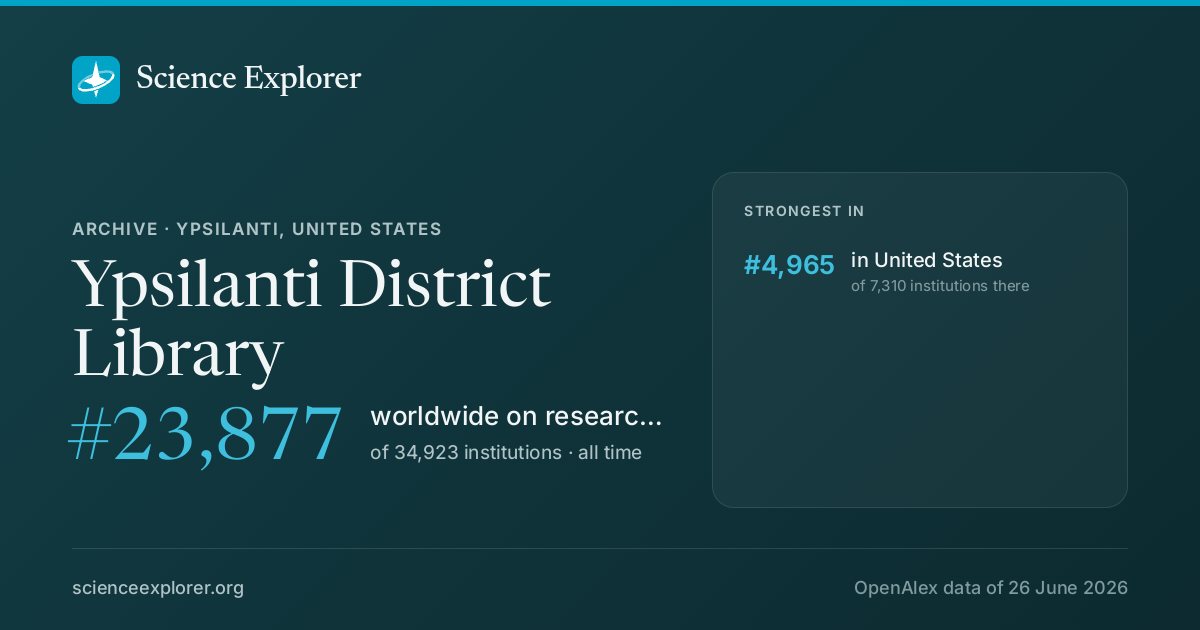
- World rank, all time
- #23,877 of 34,923
- Rank in United States
- #4,965 of 7,310
- Research works
- 200 ▲ 97% vs 2018-21
- Citations
- 2.7k 13.5 per fractional work
- Top-10% rate
- 5.5% all institutions 10.0%
- vs its own fields
- 0.89× 1.00× is exactly expected
- Open access
- 23% world 40%
- International
- 10% world 18%
Which fields of science does Ypsilanti District Library work in?
In 2022-now, 41% of research at Ypsilanti District Library is in Social Sciences, 29% in Physical Sciences. Its largest fields are Medicine (23%), Social Sciences (16%), Psychology (10%). It does 1.5× the world's share of Social Sciences.
Each ring splits the one inside it: the four domains of science, their fields, their subfields. Size is fractional works in 2022-now. Every slice is a page; the interactive view zooms down to single topics and colours each by how much more of it this institution does than the world.
Its 4 domains and 21 fields, with their numbers
- Social Sciences1640.7%
- Physical Sciences1129.1%
- Engineering49.4%
- Environmental Science37.4%
- Physics and Astronomy13.4%
- Computer Science13.3%
- Energy11.8%
- Mathematics11.5%
- Materials Science01.0%
- Chemical Engineering00.8%
- Earth and Planetary Sciences00.4%
- Health Sciences1127.5%
- Medicine923.2%
- Health Professions23.9%
- Dentistry00.3%
- Life Sciences12.7%
Field profile
Location quotient across every field it publishes in: outside the ring is more than an institution of this size would be expected to publish, inside it is less.
Rings at 0.5×, 1× and 2×. Widest outward: Decision Sciences, 4.5×. Every wedge is a field page.
All 21 fields, with their numbers
- Decision Sciences4.53×2 works
- Psychology3.20×4 works
- Arts and Humanities2.49×3 works
- Chemical Engineering2.42×0 works
- Energy2.00×1 works
- Physics and Astronomy1.52×1 works
- Health Professions1.50×2 works
- Environmental Science1.49×3 works
- Mathematics1.30×1 works
- Social Sciences1.26×6 works
- Medicine1.21×9 works
- Business, Management and Accounting0.92×1 works
- Engineering0.63×4 works
- Dentistry0.58×0 works
- Computer Science0.42×1 works
- Biochemistry, Genetics and Molecular Biology0.39×1 works
- Materials Science0.28×0 works
- Earth and Planetary Sciences0.27×0 works
- Immunology and Microbiology0.21×0 works
- Economics, Econometrics and Finance0.20×0 works
- Agricultural and Biological Sciences0.09×0 works
- Decision Sciences 4.5×
- Psychology 3.2×
- Arts and Humanities 2.5×
- Chemical Engineering 2.4×
- Energy 2.0×
- Physics and Astronomy 1.5×
- Health Professions 1.5×
- Environmental Science 1.5×
- Mathematics 1.3×
- Social Sciences 1.3×
- Medicine 1.2×
- Business, Management and Accounting 0.9×
- Engineering 0.6×
- Dentistry 0.6×
- Computer Science 0.4×
- Biochemistry, Genetics and Molecular Biology 0.4×
- Materials Science 0.3×
- Earth and Planetary Sciences 0.3×
- Immunology and Microbiology 0.2×
- Economics, Econometrics and Finance 0.2×
- Agricultural and Biological Sciences 0.1×
Who are the top researchers at Ypsilanti District Library?
Ranked on the quality score, Mark S. W. Jefferson, John Turtle Wood and Charles Frederick Harrold lead among researchers whose main affiliation is Ypsilanti District Library.
- 1
Mark S. W. Jefferson
 United States · #1,789,354 worldwide
1.4k citations · 213 works
- 2
John Turtle Wood
United States · #1,979,612 worldwide
53 citations · 34 works
- 3
Charles Frederick Harrold
United States · #2,512,770 worldwide
187 citations · 55 works
- 4
Orland O. Norris
United States · #2,933,550 worldwide
10 citations · 16 works
- 4
F. R. Gorton
United States · #2,933,550 worldwide
4 citations · 16 works
- 6
Soon K. Cho
United States · #3,151,266 worldwide
84 citations · 16 works
- 7
E. A. Strong
United States · #3,319,526 worldwide
4 citations · 12 works
- 8
A. M. LORENTZ DE HAAS
United States · #4,578,468 worldwide
139 citations · 20 works
- 9
JITHIN SAM VARGHESE
United States · #5,576,001 worldwide
10 citations · 26 works
Which keywords describe research at Ypsilanti District Library?
By fractional works in 2022-now, weighted toward what it does more of than the world: Health Outcomes, Control Systems, Social Interaction, Humor Styles Questionnaire, Psychological Well-being, Depression, Glycemic Control and Feminism.
- Scintillation Detectors
- Online Learning
- Mechanistic Explanation
- Inorganic Scintillators
- Evolutionary Synthesis
- Ecosystem-Based Management
- Data Mining
- Cardiovascular Diseases
- Sustainable Development Goals
- Primary Care
- Public Health
- Medical Imaging
- Glycemic Control
- Diabetes
- Renewable Energy
- Risk Factors
- Humor Styles Questionnaire
- Depression
- Control Systems
- Health Outcomes
- Social Interaction
- Globalization
- Psychological Well-being
- Environmental Impact
- Artificial Intelligence
- Feminism
- Machine Learning
- Prevention
- Internet of Things
- Social Justice
- Big Data Analytics
- Cultural Differences
- E-Learning
- Energy Efficiency
- Identity
- Marine Spatial Planning
- Mortality Trends
- Quality Improvement
- Smart Factory
Size is fractional works in 2022-now in the topics tagged with each word; colour is the word's share of this institution's work against its share of the world's. The 39 words are chosen for being large and distinctive. Each links to the topic it comes from most.
All 39 words, with their numbers
- Health Outcomes2▲ 19×4 topics
- Control Systems2▲ 23×3 topics
- Social Interaction2▲ 11×2 topics
- Depression2▲ 4.7×3 topics
- Globalization2▲ 1.94×7 topics
- Humor Styles Questionnaire2▲ 321×1 topic
- Psychological Well-being2▲ 26×1 topic
- Risk Factors1▲ 3.1×6 topics
- Environmental Impact1▲ 1.99×2 topics
- Renewable Energy1▲ 2.3×2 topics
- Artificial Intelligence1▲ 2.1×2 topics
- Diabetes1▲ 5.9×2 topics
- Feminism1▲ 10×4 topics
- Glycemic Control1▲ 19×3 topics
- Machine Learning1◆ 0.89×3 topics
- Medical Imaging1▲ 5.6×2 topics
- Prevention1▲ 7.3×4 topics
- Public Health1▲ 2.1×5 topics
- Internet of Things1▲ 3.3×2 topics
- Primary Care1▲ 7.4×2 topics
- Social Justice1▲ 4.7×4 topics
- Sustainable Development Goals1▲ 16×2 topics
- Big Data Analytics1▲ 12×1 topic
- Cardiovascular Diseases1▲ 29×1 topic
- Cultural Differences1▲ 52×2 topics
- Data Mining1▲ 3.5×2 topics
- E-Learning1▲ 2.6×2 topics
- Ecosystem-Based Management1▲ 79×1 topic
- Energy Efficiency1▲ 2.8×2 topics
- Evolutionary Synthesis1▲ 150×1 topic
- Identity1▲ 3.5×4 topics
- Inorganic Scintillators1▲ 80×1 topic
- Marine Spatial Planning1▲ 79×1 topic
- Mechanistic Explanation1▲ 150×1 topic
- Mortality Trends1▲ 66×1 topic
- Online Learning1▲ 3.1×2 topics
- Quality Improvement1▲ 13×2 topics
- Scintillation Detectors1▲ 80×1 topic
- Smart Factory1▲ 25×1 topic
Which research topics does Ypsilanti District Library publish most on?
By volume in 2022-now: Humor Studies and Applications, Coastal and Marine Management, Radiation Detection and Scintillator Technologies and Philosophy and History of Science.
Area is fractional works; colour is the subfield each topic belongs to.
- 1 Humor Studies and Applications Social Psychology 2 works
- 2 Coastal and Marine Management Management, Monitoring, Policy and Law 1 works
- 3 Radiation Detection and Scintillator Technologies Radiation 1 works
- 4 Philosophy and History of Science History and Philosophy of Science 1 works
- 5 Healthcare Systems and Public Health Epidemiology 1 works
- 6 Impact of AI and Big Data on Business and Society Management Science and Operations Research 1 works
- 7 Diabetes Management and Education Endocrinology, Diabetes and Metabolism 1 works
- 8 Engine and Fuel Emissions Automotive Engineering 1 works
- 9 Theology and Philosophy of Evil Philosophy 1 works
- 10 Mechanical Systems and Engineering Renewable Energy, Sustainability and the Environment 1 works
How open and international is its research?
Against the world's own shares: the tick on each track. Both are shares of its output, so they sit on one scale and can be read against each other as well as against the world.
World: 40% of research is openly available.
World: 18% is written across borders.
How has Ypsilanti District Library's research output changed?
Output in 2022-2025 was 97% higher than in 2018-2021.
The same series as a ribbon: one cell per year, darker for more. The line above answers how much; this answers when.
Its share of all research
Growing output can still be a shrinking share: all of science grows. This is Ypsilanti District Library as a percentage of every work published that year, 0.000054% in 2024.
Fractional works of Ypsilanti District Library over all fractional works that year. How the balance of science has shifted.
Other research institutions in Ypsilanti
- Eastern Michigan University
- Huron Gastro
- HighScope
- Integrated Sensing Systems (United States)
- Hemophilia Foundation of Michigan
- IHA Hematology Oncology Consultants
Share Ypsilanti District Library's ranking
Badges for a website1Each links back here and updates with every snapshot

Research measures only: rankings here say nothing about teaching, admissions or student experience. Comparable institutions and collaboration partners have tabs of their own, above.
Discussion
Ask a question or share a note about Ypsilanti District Library. Keep it to the research: no personal attacks, advertising or links. Any reader can report a post, which collapses it for everyone until it is opened.