 Science in Iceland
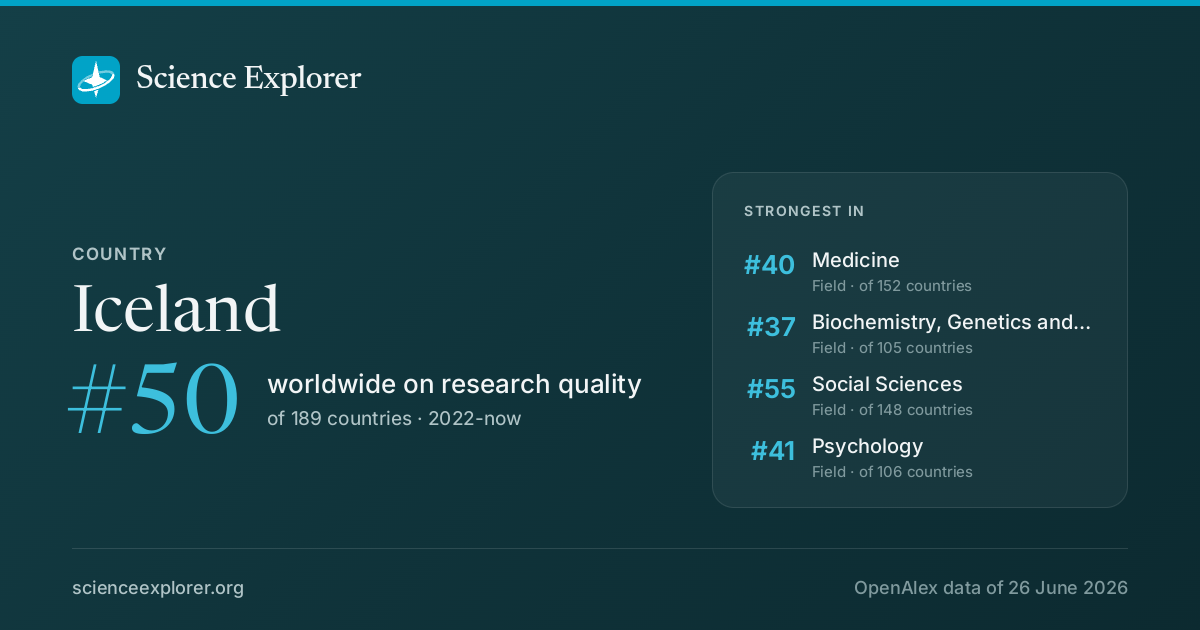
Iceland ranks #50 of 189 countries on research quality in 2022-now (#42 all time), with 5.2k research works and 10.0% of them in the world's top 10%.
- World rank, 2022-now
- #50 of 189 · #42 all time
- Works, 2022-now
- 5.2k ▲ 11% vs 2018-21
- Citations
- 641k 25.7 per fractional work, all time
- Top-10% rate
- 10.0% all institutions 10.0%
- vs its own fields
- 0.95× 1.00× is exactly expected
- In the world top 100
- 0 1 in the top 1,000
- Open access
- 46% world 40%
- International
- 42% world 18%
IcelandWhat is Iceland strongest at in science?
On research quality in 2022-now, Iceland ranks highest in Medicine (#40 of 152), Biochemistry, Genetics and Molecular Biology (#37 of 105) and Social Sciences (#55 of 148). Relative to its size it is most specialised in Chemical Health and Safety, Classics and Geophysics.
| Field | World rank | Where that sits | Top-10% rate | Works | All time | Institutions |
|---|---|---|---|---|---|---|
| MedicineField | #40 of 152 | 11.3% | 971 | #32 | Institutions | |
| Biochemistry, Genetics and Molecular BiologyField | #37 of 105 | 12.4% | 228 | #34 | Institutions | |
| Social SciencesField | #55 of 148 | 9.1% | 831 | #48 | Institutions | |
| PsychologyField | #41 of 106 | 9.0% | 304 | #37 | Institutions | |
| Arts and HumanitiesField | #40 of 103 | 12.6% | 249 | #41 | Institutions | |
| Environmental ScienceField | #49 of 122 | 9.1% | 428 | #46 | Institutions | |
| EngineeringField | #54 of 131 | 11.3% | 443 | #52 | Institutions | |
| Sociology and Political ScienceSubfield | #50 of 119 | 9.2% | 254 | #46 | Institutions | |
| Earth and Planetary SciencesField | #34 of 78 | 11.0% | 221 | #29 | Institutions | |
| Computer ScienceField | #69 of 128 | 5.8% | 255 | #54 | Institutions |
Where its research is concentrated
Location quotient: how much more (or less) of each node it does than its size predicts. Drawn around 1×, where "twice the world share" and "half of it" are the same distance apart in opposite directions. A volume reading, which on a country axis is largely population and industrial structure.
- Chemical Health and SafetySubfield · 5.5 works · #48 of 139 active here14×
- ClassicsSubfield · 24.2 works · #49 of 153 active here6.8×
- GeophysicsSubfield · 97.2 works · #66 of 208 active here4.7×
- Atmospheric ScienceSubfield · 102.9 works · #65 of 217 active here3.9×
- Aquatic ScienceSubfield · 42.1 works · #77 of 214 active here3.9×
- EquineSubfield · 3.0 works · #67 of 135 active here3.9×
- Nature and Landscape ConservationSubfield · 52.4 works · #77 of 222 active here3.7×
- Earth and Planetary SciencesField · 282.8 works · #66 of 222 active here3.0×
The whole field profile
All 26 fields at once. A specialist and a generalist produce the same ranked list and a completely different shape.
Rings at 0.5×, 1× and 2×. Widest outward: Earth and Planetary Sciences, 3.0×. Every wedge is a field page.
All 26 fields, with their numbers
- Earth and Planetary Sciences3.03×283 works
- Psychology1.92×349 works
- Environmental Science1.67×494 works
- Arts and Humanities1.65×283 works
- Chemical Engineering1.37×28 works
- Pharmacology, Toxicology and Pharmaceutics1.29×27 works
- Neuroscience1.27×123 works
- Health Professions1.27×199 works
- Social Sciences1.24×936 works
- Economics, Econometrics and Finance1.15×146 works
- Nursing1.12×33 works
- Energy1.00×55 works
- Veterinary0.99×8 works
- Medicine0.98×1,120 works
- Physics and Astronomy0.92×122 works
- Immunology and Microbiology0.89×53 works
- Business, Management and Accounting0.86×165 works
- Biochemistry, Genetics and Molecular Biology0.84×267 works
- Decision Sciences0.84×48 works
- Agricultural and Biological Sciences0.74×209 works
- Mathematics0.71×50 works
- Computer Science0.61×282 works
- Dentistry0.59×17 works
- Engineering0.56×503 works
- Chemistry0.50×47 works
- Materials Science0.48×100 works
Which fields of science does Iceland work in?
In 2022-now, 33% of research in Iceland is in Physical Sciences, 32% in Social Sciences. Its largest fields are Medicine (19%), Social Sciences (16%), Engineering (8%). It does 1.3× the world's share of Social Sciences.
Each ring splits the one inside it: the four domains of science, their fields, their subfields. Size is fractional works in 2022-now. Every slice is a page; the interactive view zooms down to single topics and colours each by how much more of it this country does than the world.
Its 4 domains and 26 fields, with their numbers
- Physical Sciences1,96433.0%
- Engineering5038.5%
- Environmental Science4948.3%
- Earth and Planetary Sciences2834.8%
- Computer Science2824.7%
- Physics and Astronomy1222.1%
- Materials Science1001.7%
- Energy550.9%
- Mathematics500.8%
- Chemistry470.8%
- Chemical Engineering280.5%
- Social Sciences1,92832.4%
- Social Sciences93715.7%
- Psychology3495.9%
- Arts and Humanities2834.8%
- Business, Management and Accounting1652.8%
- Economics, Econometrics and Finance1462.5%
- Decision Sciences480.8%
- Health Sciences1,37623.1%
- Medicine1,12018.8%
- Health Professions1993.3%
- Nursing330.6%
- Dentistry170.3%
- Veterinary80.1%
- Life Sciences67911.4%
Which keywords describe research in Iceland?
By fractional works in 2022-now, weighted toward what it does more of than the world: Climate Change, Epidemiology, Globalization, Sustainability, Mental Health, Arctic, Fisheries Sustainability and Inflammation.
- Northern Sea Route
- Oil and Gas
- Iceland
- Shipping
- Holocene
- Medieval
- Hydrology
- Aquaculture
- Labor Market
- Arctic
- Religion
- Resilience
- Literature
- Depression
- Treatment
- Quality of Life
- Environmental Impact
- Inflammation
- Globalization
- Epidemiology
- Climate Change
- Sustainability
- Mental Health
- Remote Sensing
- Public Health
- Cardiovascular Disease
- Risk Factors
- Biodiversity
- Meta-Analysis
- Invasive Species
- Prevalence
- Fisheries Sustainability
- Governance
- International Relations
- Plate Tectonics
- Financial Crisis
- Freshwater Biodiversity
- Banking Sector
- Socioeconomic Inequality
- Maritime Transport
Size is fractional works in 2022-now in the topics tagged with each word; colour is the word's share of this country's work against its share of the world's. The 40 words are chosen for being large and distinctive. Each links to the topic it comes from most.
All 40 words, with their numbers
- Climate Change398▲ 2.5×100 topics
- Epidemiology292▲ 1.23×130 topics
- Sustainability196▲ 1.35×88 topics
- Globalization185▲ 1.58×95 topics
- Mental Health156▲ 1.83×41 topics
- Inflammation143◆ 1.13×76 topics
- Remote Sensing110▲ 1.52×31 topics
- Environmental Impact109◆ 1.08×52 topics
- Public Health104▲ 1.20×59 topics
- Quality of Life97◆ 1.13×52 topics
- Cardiovascular Disease96▲ 1.41×37 topics
- Treatment93▲ 1.29×49 topics
- Risk Factors87▲ 1.33×36 topics
- Depression87▲ 1.66×22 topics
- Biodiversity78▲ 1.72×34 topics
- Literature72▲ 2.2×37 topics
- Meta-Analysis67▲ 1.92×18 topics
- Resilience67▲ 2.3×17 topics
- Invasive Species66▲ 2.6×20 topics
- Religion64▲ 2.3×29 topics
- Prevalence63▲ 2.6×14 topics
- Arctic62▲ 9.4×4 topics
- Fisheries Sustainability60▲ 12×2 topics
- Labor Market58▲ 3.5×14 topics
- Governance56▲ 2.9×16 topics
- Aquaculture51▲ 3.4×8 topics
- International Relations49▲ 3.4×17 topics
- Hydrology45▲ 5.8×4 topics
- Plate Tectonics44▲ 4.9×3 topics
- Medieval43▲ 21×3 topics
- Financial Crisis41▲ 6.2×12 topics
- Holocene40▲ 6.0×3 topics
- Freshwater Biodiversity36▲ 9.9×2 topics
- Shipping35▲ 12×2 topics
- Banking Sector34▲ 43×3 topics
- Iceland34▲ 138×1 topic
- Socioeconomic Inequality34▲ 69×1 topic
- Oil and Gas33▲ 16×2 topics
- Maritime Transport33▲ 21×1 topic
- Northern Sea Route33▲ 21×1 topic
Which research topics does Iceland publish the most in?
Its largest topics in 2022-now are European Socioeconomic and Political Studies, Arctic and Russian Policy Studies, Fish Ecology and Management Studies.
Area is fractional works in 2022-now; colour is the subfield each topic belongs to. Every tile is a topic page.
- 1 European Socioeconomic and Political Studies Economics and Econometrics 34 works
- 2 Arctic and Russian Policy Studies Sociology and Political Science 33 works
- 3 Fish Ecology and Management Studies Nature and Landscape Conservation 33 works
- 4 Geology and Paleoclimatology Research Atmospheric Science 31 works
- 5 Geological and Geochemical Analysis Geophysics 29 works
- 6 earthquake and tectonic studies Geophysics 29 works
- 7 Marine and fisheries research Global and Planetary Change 27 works
- 8 Historical and Archaeological Studies History 27 works
- 9 Microwave Engineering and Waveguides Electrical and Electronic Engineering 24 works
- 10 Cryospheric studies and observations Atmospheric Science 23 works
- 11 Aquaculture Nutrition and Growth Aquatic Science 22 works
- 12 Antenna Design and Analysis Aerospace Engineering 21 works
How many world-class institutions does Iceland hold?
Average quality and elite capacity disagree by construction, and both are worth knowing: the first is decided by a country's whole institution population, the second counts the institutions it holds at the top. One square per institution.
| Standing among countries | 2022-now | Where that sits | All time |
|---|---|---|---|
| Average qualityits whole institution population | #50 of 189 | #42 of 203 | |
| Elite capacitythe institutions it holds at the top | #42 of 204 | #37 of 216 |
Elite capacity counts a country's institutions by their worldwide rank, weighted so a place at #1 counts for more than one at #480. Countries under 100 fractional works are left out.
Bands are exclusive, so the squares add up to 1 (the institutions it holds in the world top 1,000), not to four times it.
Which universities in Iceland lead research?
University of Iceland, Reykjavík University and Directorate of Health rank highest in Iceland on research quality in 2022-now.
One dot per institution in the list below. The upper left is the interesting corner.
- 1University of IcelandUniversity · Reykjavik · #743 worldwide10.7% top 10% · 2.7k works
- 2Reykjavík UniversityUniversity · Reykjavik · #2,239 worldwide13.8% top 10% · 690 works
- 3Directorate of HealthGovernment institution · Reykjavik · #7,103 worldwide4.1% top 10% · 610 works
- 4University of AkureyriUniversity · Akureyri · #10,102 worldwide7.6% top 10% · 236 works
- 5Matís (Iceland)Company · Reykjavik · #20,546 worldwide3.4% top 10% · 84 works
- 6Árni Magnússon Institute for Icelandic StudiesUniversity · Reykjavik · #21,183 worldwide8.9% top 10% · 70 works
- 7Marine and Freshwater Research InstituteResearch facility · Hafnarfjordur · #21,713 worldwide10.8% top 10% · 74 works

The track on each row is its top-10% rate; the tick is the average of all institutions, 10.0% (how it is set): teal above it, red below.
All ranked institutions in IcelandWho are the top researchers in Iceland?
Unnur Arna Thorsteinsdottir, Kāri Stefánsson and Augustine Kong rank highest among researchers based in Iceland.
- 1 Unnur Arna Thorsteinsdottir #13 worldwide 144k citations · 597 works
- 2 Kāri Stefánsson #43 worldwide 211k citations · 1,140 works
- 3 Augustine Kong #84 worldwide 97k citations · 293 works
- 4 Guðmar Þorleifsson #122 worldwide 120k citations · 579 works
- 5 Daniel Fannar Gudbjartsson #133 worldwide 88k citations · 524 works
- 6 Patrick Sulem #860 worldwide 56k citations · 378 works
- 7 Hreinn Stefánsson #1,420 worldwide 93k citations · 470 works
- 8 Hilma Hólm #1,717 worldwide 35k citations · 260 works
- 9 Sólveig Grétarsdóttir #2,210 worldwide 28k citations · 123 works
- 10 Stacy Steinberg #2,850 worldwide 60k citations · 153 works
Which cities in Iceland are research hubs?
How open and international is Iceland's research?
46% of its research is openly available (world: 40%), and 42% is written with international co-authors (world: 18%).
World: 40% of research is openly available.
World: 18% is written across borders.
In 2022-now, 68% of its research is openly available (world 63%) and 49% is written with co-authors abroad (world 22%). Against what its own mix of topics predicts, that is 1.06× the expected open access and 2.04× the expected international share, which puts it #85 of 173 countries on openness.
How has Iceland's research grown?
Output in 2022-2025 was 11% higher than in 2018-2021.
The same series as a ribbon: one cell per year, darker for more. The line above answers how much; this answers when.
Its share of all research
Growing output can still be a shrinking share: all of science grows. This is Iceland as a percentage of every work published that year, 0.023% in 2024.
Fractional works of Iceland over all fractional works that year. How the balance of science has shifted.
How much of it reaches the world top 10%
Over the whole record, 11.8% of its 25k works since 1950 reached the world top 10% for their field and year.
Of each year's output, the share that reached the world's 10% most cited for its field and year. Peak 16.6% in 2010.
Which countries have research most like Iceland's?
Norway is Iceland's closest research twin: of all countries, its research is spread across the fields most like Iceland's, with both strong in Earth and Planetary Sciences.
- 1
 NorwayBoth strong in Earth and Planetary Sciences, Psychology, Environmental Science
0.74 Compare
- 2
 BahamasBoth strong in Earth and Planetary Sciences, Environmental Science, Arts and Humanities
0.72 Compare
- 3
 GreenlandBoth strong in Earth and Planetary Sciences, Environmental Science, Health Professions
0.64 Compare
- 4
 AustraliaBoth strong in Psychology, Neuroscience, Health Professions
0.64 Compare
- 5
 Faroe IslandsBoth strong in Earth and Planetary Sciences, Environmental Science, Psychology
0.63 Compare
Similarity is the correlation of each side's location quotients across every field it publishes in, on a log scale: 1 is the same shape of research, 0 is unrelated. It ignores size. How it is measured.
Compare Iceland with
 Russia
 Ethiopia
 Cyprus
 Croatia
 Uganda
 Peru
Share Iceland's ranking
Badges for a website1Each links back here and updates with every snapshot

Research fields in Iceland
Discussion
Ask a question or share a note about Iceland. Posts are plain text and can be reported.