Al Jalila Foundation
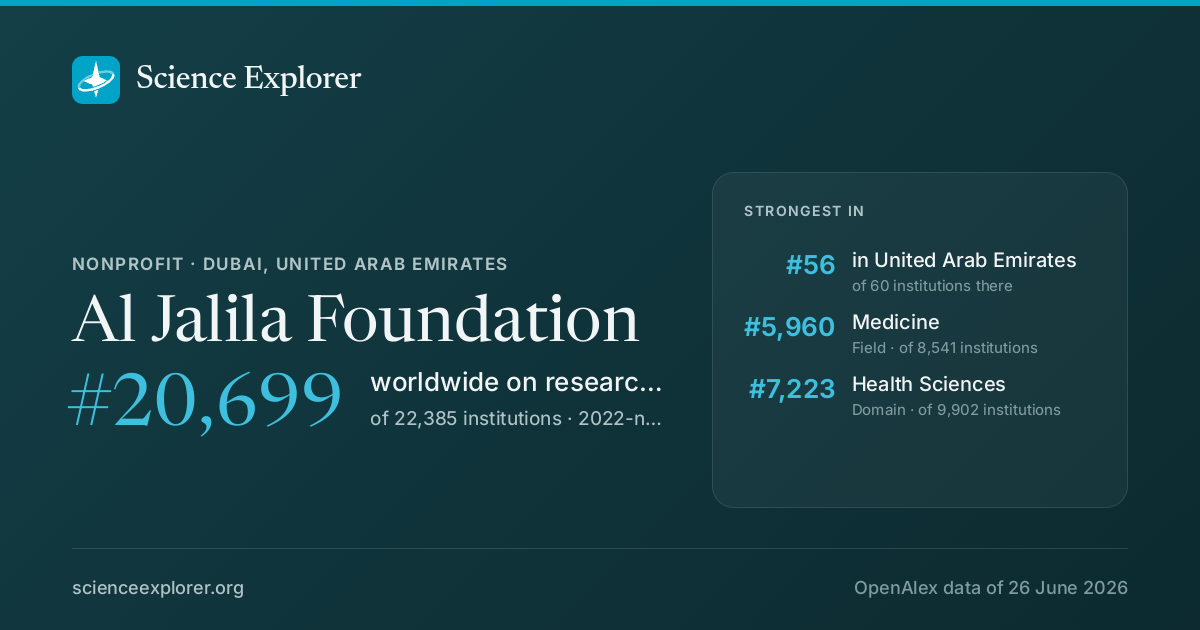
In research, Al Jalila Foundation stands highest in Medicine (#5,960 of 8,541 worldwide) and Health Sciences (#7,223 of 9,902 worldwide), 2022-now.
- World rank, 2022-now
- #20,699 of 22,385 · #32,614 all time
- Rank in United Arab Emirates
- #56 of 60
- Research works
- 190 ▲ 112% vs 2018-21
- Citations
- 1.5k 8.1 per fractional work
- Top-10% rate
- 5.7% all institutions 10.0%
- vs its own fields
- 0.90× 1.00× is exactly expected
- Open access
- 78% world 40%
- International
- 38% world 18%
What is Al Jalila Foundation known for in research?
The fields where it stands highest, 2022-now, ranked among every institution above the floor in each field.
| Field | World rank | Where that sits | Top-10% rate | Works | All time |
|---|---|---|---|---|---|
| MedicineField | #5,960 of 8,541 | 4.2% | 76 | #10649 | |
| Health SciencesDomain | #7,223 of 9,902 | 4.2% | 82 | #12636 |
Each strip is that field's whole ranked pool, with the notch where Al Jalila Foundation sits in it, in the colour of the band that rank falls in. The track under the rate is the rate itself: it carries no average mark, because the average differs by field (from about 6% in Dentistry to 21% in Economics).
Which fields of science does Al Jalila Foundation work in?
In 2022-now, 76% of research at Al Jalila Foundation is in Health Sciences, 18% in Life Sciences. Its largest fields are Medicine (71%), Biochemistry, Genetics and Molecular Biology (12%), Psychology (3%). It does 3.1× the world's share of Health Sciences.
Each ring splits the one inside it: the four domains of science, their fields, their subfields. Size is fractional works in 2022-now. Every slice is a page; the interactive view zooms down to single topics and colours each by how much more of it this institution does than the world.
Its 4 domains and 20 fields, with their numbers
- Health Sciences10176.3%
- Medicine9470.9%
- Health Professions43.3%
- Nursing21.6%
- Dentistry00.2%
- Veterinary00.2%
- Life Sciences2317.6%
- Social Sciences75.0%
- Physical Sciences11.1%
- Engineering10.8%
- Computer Science00.1%
- Materials Science00.1%
- Environmental Science00.1%
- Mathematics00.0%
Field profile
Location quotient across every field it publishes in: outside the ring is more than an institution of this size would be expected to publish, inside it is less.
Rings at 0.5×, 1× and 2×. Widest outward: Medicine, 3.7×. Every wedge is a field page.
All 20 fields, with their numbers
- Medicine3.69×94 works
- Nursing3.26×2 works
- Immunology and Microbiology2.54×3 works
- Biochemistry, Genetics and Molecular Biology2.32×16 works
- Veterinary1.86×0 works
- Neuroscience1.35×3 works
- Health Professions1.24×4 works
- Psychology1.07×4 works
- Dentistry0.52×0 works
- Decision Sciences0.18×0 works
- Agricultural and Biological Sciences0.11×1 works
- Social Sciences0.10×2 works
- Business, Management and Accounting0.07×0 works
- Engineering0.05×1 works
- Economics, Econometrics and Finance0.05×0 works
- Materials Science0.02×0 works
- Mathematics0.02×0 works
- Arts and Humanities0.02×0 works
- Computer Science0.01×0 works
- Environmental Science0.01×0 works
- Medicine 3.7×
- Nursing 3.3×
- Immunology and Microbiology 2.5×
- Biochemistry, Genetics and Molecular Biology 2.3×
- Veterinary 1.9×
- Neuroscience 1.4×
- Health Professions 1.2×
- Psychology 1.1×
- Dentistry 0.5×
- Decision Sciences 0.2×
- Agricultural and Biological Sciences 0.1×
- Social Sciences 0.1×
- Business, Management and Accounting 0.1×
- Engineering 0.1×
- Economics, Econometrics and Finance 0.1×
- Materials Science 0.0×
- Mathematics 0.0×
- Arts and Humanities 0.0×
- Computer Science 0.0×
- Environmental Science 0.0×
Who are the top researchers at Al Jalila Foundation?
Ranked on the quality score, Christos Tzivinikos, Eva Šimková and Alan W. Taylor lead among researchers whose main affiliation is Al Jalila Foundation.
- 1
Christos Tzivinikos
 United Arab Emirates · #697,038 worldwide
2.6k citations · 103 works
- 2
Eva Šimková
United Arab Emirates · #721,610 worldwide
3.1k citations · 97 works
- 3
Alan W. Taylor
United Arab Emirates · #1,094,882 worldwide
857 citations · 33 works
- 4
Ahmed Abd Alwahab Nugud
United Arab Emirates · #1,583,437 worldwide
413 citations · 25 works
- 5
Haitham Elbashir
United Arab Emirates · #2,026,689 worldwide
268 citations · 15 works
- 6
Ibrar Majid
United Arab Emirates · #2,429,113 worldwide
339 citations · 25 works
- 7
Ali Alsarhan
United Arab Emirates · #2,770,380 worldwide
155 citations · 19 works
- 8
Nandu K S Thalange
United Arab Emirates · #3,204,315 worldwide
951 citations · 80 works
- 9
Lemis Yavuz
United Arab Emirates · #3,779,304 worldwide
152 citations · 22 works
- 10
Pawan Subhash Kashyape
United Arab Emirates · #3,878,353 worldwide
309 citations · 26 works
Which keywords describe research at Al Jalila Foundation?
By fractional works in 2022-now, weighted toward what it does more of than the world: Epidemiology, Treatment, Complications, Diagnosis, Genetic Mutations, Genetics, Surgical Management and Neurodevelopmental Outcomes.
- Hearing Loss
- Bacteremia
- Pediatric
- Prenatal Diagnosis
- SARS-CoV-2
- Preterm Infants
- Children
- Mechanical Ventilation
- Guidelines
- Neurological Complications
- Mortality
- Pulmonary Valve Replacement
- Cardiac Surgery
- Cardiovascular Disease
- Meta-Analysis
- Surgical Management
- Management
- Genetics
- Complications
- Treatment
- Epidemiology
- Diagnosis
- Genetic Mutations
- Inflammation
- Pathogenesis
- Neurodevelopmental Outcomes
- Surgery
- Congenital Heart Disease
- Genetic Variants
- Heart Failure
- Prevalence
- Neurological Disorders
- Critical Care
- Prognosis
- Pathophysiology
- Prophylaxis
- Inflammatory Bowel Disease
- Pulmonary Hypertension
- Airway Stenosis
- Tracheostomy
Size is fractional works in 2022-now in the topics tagged with each word; colour is the word's share of this institution's work against its share of the world's. The 40 words are chosen for being large and distinctive. Each links to the topic it comes from most.
All 40 words, with their numbers
- Epidemiology21▲ 3.9×62 topics
- Treatment9▲ 5.6×23 topics
- Diagnosis7▲ 5.8×23 topics
- Complications6▲ 9.8×12 topics
- Genetic Mutations6▲ 10×17 topics
- Genetics5▲ 5.5×12 topics
- Inflammation5▲ 1.65×28 topics
- Management5▲ 4.4×16 topics
- Pathogenesis4▲ 6.2×14 topics
- Surgical Management4▲ 7.7×11 topics
- Neurodevelopmental Outcomes4▲ 16×4 topics
- Meta-Analysis4▲ 5.0×9 topics
- Surgery4▲ 8.2×7 topics
- Cardiovascular Disease3▲ 2.1×15 topics
- Congenital Heart Disease3▲ 28×3 topics
- Cardiac Surgery3▲ 30×1 topic
- Genetic Variants3▲ 12×4 topics
- Pulmonary Valve Replacement3▲ 41×1 topic
- Heart Failure3▲ 4.6×8 topics
- Mortality3▲ 3.6×8 topics
- Prevalence3▲ 5.0×9 topics
- Neurological Complications2▲ 29×4 topics
- Neurological Disorders2▲ 3.4×8 topics
- Guidelines2▲ 3.8×6 topics
- Critical Care2▲ 7.2×6 topics
- Mechanical Ventilation2▲ 16×2 topics
- Prognosis2▲ 5.2×7 topics
- Children2▲ 7.4×5 topics
- Pathophysiology2▲ 5.7×7 topics
- Preterm Infants2▲ 14×4 topics
- Prophylaxis2▲ 12×4 topics
- SARS-CoV-22▲ 5.4×5 topics
- Inflammatory Bowel Disease2▲ 13×3 topics
- Prenatal Diagnosis2▲ 10×5 topics
- Pulmonary Hypertension2▲ 11×3 topics
- Pediatric2▲ 24×4 topics
- Airway Stenosis2▲ 24×1 topic
- Bacteremia2▲ 19×3 topics
- Tracheostomy2▲ 24×1 topic
- Hearing Loss2▲ 11×4 topics
Which research topics does Al Jalila Foundation publish most on?
By volume in 2022-now: Congenital Heart Disease Studies, Tracheal and airway disorders, Genomics and Rare Diseases and Infective Endocarditis Diagnosis and Management.
Area is fractional works; colour is the subfield each topic belongs to.
- 1 Congenital Heart Disease Studies Epidemiology 3 works
- 2 Tracheal and airway disorders Pulmonary and Respiratory Medicine 2 works
- 3 Genomics and Rare Diseases Genetics 2 works
- 4 Infective Endocarditis Diagnosis and Management Epidemiology 2 works
- 5 Esophageal and GI Pathology Surgery 2 works
- 6 Autoimmune and Inflammatory Disorders Research Hematology 1 works
- 7 Immunodeficiency and Autoimmune Disorders Immunology 1 works
- 8 Pediatric Urology and Nephrology Studies Pediatrics, Perinatology and Child Health 1 works
- 9 Inflammatory Bowel Disease Genetics 1 works
- 10 Neonatal Health and Biochemistry Pediatrics, Perinatology and Child Health 1 works
How open and international is its research?
Against the world's own shares: the tick on each track. Both are shares of its output, so they sit on one scale and can be read against each other as well as against the world.
World: 40% of research is openly available.
World: 18% is written across borders.
How has Al Jalila Foundation's research output changed?
Output in 2022-2025 was 112% higher than in 2018-2021.
The same series as a ribbon: one cell per year, darker for more. The line above answers how much; this answers when.
Its share of all research
Growing output can still be a shrinking share: all of science grows. This is Al Jalila Foundation as a percentage of every work published that year, 0.00047% in 2024.
Fractional works of Al Jalila Foundation over all fractional works that year. How the balance of science has shifted.
Other research institutions in Dubai
- Central Veterinary Research Laboratory
- University of Dubai
- Dubai Hospital
- University of Modern Sciences
- British University in Dubai
- Dubai Health Authority
- Mohammed Bin Rashid University of Medicine and Health Sciences
- Canadian University of Dubai
Share Al Jalila Foundation's ranking
Badges for a website1Each links back here and updates with every snapshot

Research measures only: rankings here say nothing about teaching, admissions or student experience. Comparable institutions and collaboration partners have tabs of their own, above.
Discussion
Ask a question or share a note about Al Jalila Foundation. Posts are plain text and can be reported.