Science Explorer Back to mapMap
Discussion
Hospital / health system · Bad Oeynhausen · Germany

Auguste-Viktoria-Klinik

In research, Auguste-Viktoria-Klinik stands highest in Medicine (#3,203 of 14,558 worldwide), Health Sciences (#3,898 of 16,688 worldwide) and Surgery (#1,605 of 3,248 worldwide), over all time.

World rank, all time
#11,222
of 34,923
Rank in Germany
#560
of 1,603
Research works
898
▼ 18% vs 2018-21
Citations
17k
19.3 per fractional work
Top-10% rate
8.1%
all institutions 10.0%
vs its own fields
0.96×
1.00× is exactly expected
Open access
14%
world 40%
International
42%
world 18%

What is Auguste-Viktoria-Klinik known for in research?

The fields where it stands highest, over all time, ranked among every institution above the floor in each field.

FieldWorld rankWhere that sitsTop-10% rateWorks
MedicineField #3,203 of 14,558 7.2%643
Health SciencesDomain #3,898 of 16,688 7.1%682
SurgerySubfield #1,605 of 3,248 5.8%130

Each strip is that field's whole ranked pool, with the notch where Auguste-Viktoria-Klinik sits in it, in the colour of the band that rank falls in. The track under the rate is the rate itself: it carries no average mark, because the average differs by field (from about 6% in Dentistry to 21% in Economics).

Which fields of science does Auguste-Viktoria-Klinik work in?

In 2022-now, 72% of research at Auguste-Viktoria-Klinik is in Health Sciences, 12% in Social Sciences. Its largest fields are Medicine (68%), Social Sciences (5%), Engineering (5%). It does 2.7× the world's share of Health Sciences.

Health Sciences: 37 fractional works · 71.5% of its workMedicine: 35 fractional works · 68.4% of its workSurgery: 11 fractional works · 21.4% of its workEpidemiology: 3 fractional works · 5.4% of its workPublic Health, Environmental and Occupational Health: 2 fractional works · 4.4% of its workOncology: 2 fractional works · 4.3% of its workPulmonary and Respiratory Medicine: 2 fractional works · 4.2% of its workCardiology and Cardiovascular Medicine: 2 fractional works · 4.1% of its workOrthopedics and Sports Medicine: 1 fractional works · 2.8% of its workRehabilitation: 1 fractional works · 2.5% of its workPathology and Forensic Medicine: 1 fractional works · 2.2% of its workPharmacology: 1 fractional works · 1.9% of its workRheumatology: 1 fractional works · 1.9% of its workEmergency Medicine: 1 fractional works · 1.5% of its workOphthalmology: 1 fractional works · 1.2% of its workInfectious Diseases: 1 fractional works · 1.1% of its workHematology: 0 fractional works · 0.9% of its workGenetics: 0 fractional works · 0.8% of its workEndocrinology, Diabetes and Metabolism: 0 fractional works · 0.8% of its workUrology: 0 fractional works · 0.8% of its workPsychiatry and Mental health: 0 fractional works · 0.8% of its workRadiology, Nuclear Medicine and Imaging: 0 fractional works · 0.8% of its workPediatrics, Perinatology and Child Health: 0 fractional works · 0.6% of its workReproductive Medicine: 0 fractional works · 0.6% of its workAnesthesiology and Pain Medicine: 0 fractional works · 0.5% of its workObstetrics and Gynecology: 0 fractional works · 0.5% of its workDermatology: 0 fractional works · 0.4% of its workHealth Informatics: 0 fractional works · 0.3% of its workGastroenterology: 0 fractional works · 0.3% of its workCritical Care and Intensive Care Medicine: 0 fractional works · 0.3% of its workOtorhinolaryngology: 0 fractional works · 0.3% of its workPhysiology: 0 fractional works · 0.3% of its workFamily Practice: 0 fractional works · 0.2% of its workHepatology: 0 fractional works · 0.2% of its workHealth Professions: 1 fractional works · 2.1% of its workGeneral Health Professions: 1 fractional works · 1.3% of its workOccupational Therapy: 0 fractional works · 0.5% of its workSmaller subfields together: 0 fractional works · 0.3% of its workVeterinary: 0 fractional works · 0.6% of its workEquine: 0 fractional works · 0.3% of its workSmall Animals: 0 fractional works · 0.3% of its workNursing: 0 fractional works · 0.4% of its workIssues, ethics and legal aspects: 0 fractional works · 0.4% of its workSocial Sciences: 6 fractional works · 11.7% of its workSocial Sciences: 3 fractional works · 5.4% of its workSociology and Political Science: 2 fractional works · 3.0% of its workGender Studies: 1 fractional works · 1.2% of its workHealth: 0 fractional works · 0.5% of its workTransportation: 0 fractional works · 0.4% of its workSmaller subfields together: 0 fractional works · 0.3% of its workPsychology: 2 fractional works · 3.0% of its workSocial Psychology: 1 fractional works · 1.8% of its workClinical Psychology: 0 fractional works · 0.9% of its workExperimental and Cognitive Psychology: 0 fractional works · 0.3% of its workSmaller subfields together: 0 fractional works · 0.1% of its workArts and Humanities: 1 fractional works · 1.3% of its workPhilosophy: 0 fractional works · 0.6% of its workArcheology: 0 fractional works · 0.3% of its workSmaller subfields together: 0 fractional works · 0.3% of its workBusiness, Management and Accounting: 1 fractional works · 1.0% of its workOrganizational Behavior and Human Resource Management: 0 fractional works · 1.0% of its workSmaller subfields together: 0 fractional works · 0.1% of its workEconomics, Econometrics and Finance: 0 fractional works · 0.6% of its workEconomics and Econometrics: 0 fractional works · 0.3% of its workGeneral Economics, Econometrics and Finance: 0 fractional works · 0.3% of its workDecision Sciences: 0 fractional works · 0.4% of its workStatistics, Probability and Uncertainty: 0 fractional works · 0.2% of its workSmaller subfields together: 0 fractional works · 0.2% of its workLife Sciences: 4 fractional works · 8.7% of its workBiochemistry, Genetics and Molecular Biology: 2 fractional works · 3.8% of its workGenetics: 1 fractional works · 1.0% of its workCell Biology: 0 fractional works · 0.9% of its workCancer Research: 0 fractional works · 0.6% of its workMolecular Biology: 0 fractional works · 0.4% of its workBiotechnology: 0 fractional works · 0.3% of its workMolecular Medicine: 0 fractional works · 0.3% of its workSmaller subfields together: 0 fractional works · 0.3% of its workImmunology and Microbiology: 1 fractional works · 2.5% of its workImmunology: 1 fractional works · 1.0% of its workApplied Microbiology and Biotechnology: 0 fractional works · 0.7% of its workVirology: 0 fractional works · 0.3% of its workMicrobiology: 0 fractional works · 0.3% of its workSmaller subfields together: 0 fractional works · 0.2% of its workAgricultural and Biological Sciences: 1 fractional works · 1.5% of its workFood Science: 0 fractional works · 0.6% of its workPlant Science: 0 fractional works · 0.3% of its workEcology, Evolution, Behavior and Systematics: 0 fractional works · 0.2% of its workSmaller subfields together: 0 fractional works · 0.3% of its workNeuroscience: 0 fractional works · 0.6% of its workCognitive Neuroscience: 0 fractional works · 0.4% of its workSmaller subfields together: 0 fractional works · 0.2% of its workPharmacology, Toxicology and Pharmaceutics: 0 fractional works · 0.3% of its workToxicology: 0 fractional works · 0.2% of its workSmaller subfields together: 0 fractional works · 0.1% of its workPhysical Sciences: 4 fractional works · 8.1% of its workEngineering: 2 fractional works · 4.5% of its workBiomedical Engineering: 1 fractional works · 2.6% of its workOcean Engineering: 0 fractional works · 1.0% of its workAerospace Engineering: 0 fractional works · 0.4% of its workBuilding and Construction: 0 fractional works · 0.3% of its workSmaller subfields together: 0 fractional works · 0.2% of its workEnergy: 0 fractional works · 1.0% of its workFuel Technology: 0 fractional works · 1.0% of its workComputer Science: 0 fractional works · 0.8% of its workArtificial Intelligence: 0 fractional works · 0.6% of its workSmaller subfields together: 0 fractional works · 0.2% of its workEnvironmental Science: 0 fractional works · 0.7% of its workManagement, Monitoring, Policy and Law: 0 fractional works · 0.6% of its workSmaller subfields together: 0 fractional works · 0.1% of its workMaterials Science: 0 fractional works · 0.3% of its workBiomaterials: 0 fractional works · 0.3% of its workPhysics and Astronomy: 0 fractional works · 0.3% of its workAtomic and Molecular Physics, and Optics: 0 fractional works · 0.3% of its workEarth and Planetary Sciences: 0 fractional works · 0.2% of its workPaleontology: 0 fractional works · 0.2% of its workChemistry: 0 fractional works · 0.1% of its workALL ITS WORKAuguste-Viktoria-Klinik51fractional works, 2022-now
Life Sciences9%Physical Sciences8%Health Sciences72%Social Sciences12%

Each ring splits the one inside it: the four domains of science, their fields, their subfields. Size is fractional works in 2022-now. Every slice is a page; the interactive view zooms down to single topics and colours each by how much more of it this institution does than the world.

Its 4 domains and 23 fields, with their numbers
    1. Medicine3568.4%
    2. Health Professions12.1%
    3. Veterinary00.6%
    4. Nursing00.4%
    1. Social Sciences35.4%
    2. Psychology23.0%
    3. Arts and Humanities11.3%
    4. Business, Management and Accounting11.0%
    5. Economics, Econometrics and Finance00.6%
    6. Decision Sciences00.4%
    1. Biochemistry, Genetics and Molecular Biology23.8%
    2. Immunology and Microbiology12.5%
    3. Agricultural and Biological Sciences11.5%
    4. Neuroscience00.6%
    5. Pharmacology, Toxicology and Pharmaceutics00.3%
    1. Engineering24.5%
    2. Energy01.0%
    3. Computer Science00.8%
    4. Environmental Science00.7%
    5. Materials Science00.3%
    6. Physics and Astronomy00.3%
    7. Earth and Planetary Sciences00.2%
    8. Chemistry00.1%
All of science, and how each field's share has moved since 1950: the Science domain explorer

Field profile

Location quotient across every field it publishes in: outside the ring is more than an institution of this size would be expected to publish, inside it is less.

Agricultural and Biological Sciences: 0.31× its world share, 1 worksAgricultural and Bio…Biochemistry, Genetics and Molecular Biology: 0.72× its world share, 2 worksBiochemistry, Geneti…Immunology and Microbiology: 2.44× its world share, 1 worksImmunology and Micro…Neuroscience: 0.36× its world share, 0 worksNeurosciencePharmacology, Toxicology and Pharmaceutics: 0.93× its world share, 0 worksPharmacology, Toxico…Chemistry: 0.06× its world share, 0 worksChemistryComputer Science: 0.10× its world share, 0 worksComputer ScienceEarth and Planetary Sciences: 0.14× its world share, 0 worksEarth and Planetary …Energy: 1.07× its world share, 0 worksEnergyEngineering: 0.30× its world share, 2 worksEngineeringEnvironmental Science: 0.15× its world share, 0 worksEnvironmental ScienceMaterials Science: 0.09× its world share, 0 worksMaterials SciencePhysics and Astronomy: 0.15× its world share, 0 worksPhysics and AstronomyHealth Professions: 0.79× its world share, 1 worksHealth ProfessionsMedicine: 3.56× its world share, 35 worksMedicineNursing: 0.86× its world share, 0 worksNursingVeterinary: 4.80× its world share, 0 worksVeterinaryArts and Humanities: 0.45× its world share, 1 worksArts and HumanitiesBusiness, Management and Accounting: 0.32× its world share, 0 worksBusiness, Management…Decision Sciences: 0.38× its world share, 0 worksDecision SciencesEconomics, Econometrics and Finance: 0.27× its world share, 0 worksEconomics, Econometr…Psychology: 0.99× its world share, 2 worksPsychologySocial Sciences: 0.43× its world share, 3 worksSocial Sciences1×world share
more than its size predictsabout as predictedless

Rings at 0.5×, 1× and 2×. Widest outward: Veterinary, 4.8×. Every wedge is a field page.

All 23 fields, with their numbers
  1. Veterinary4.80×0 works
  2. Medicine3.56×35 works
  3. Immunology and Microbiology2.44×1 works
  4. Energy1.07×0 works
  5. Psychology0.99×2 works
  6. Pharmacology, Toxicology and Pharmaceutics0.93×0 works
  7. Nursing0.86×0 works
  8. Health Professions0.79×1 works
  9. Biochemistry, Genetics and Molecular Biology0.72×2 works
  10. Arts and Humanities0.45×1 works
  11. Social Sciences0.43×3 works
  12. Decision Sciences0.38×0 works
  13. Neuroscience0.36×0 works
  14. Business, Management and Accounting0.32×0 works
  15. Agricultural and Biological Sciences0.31×1 works
  16. Engineering0.30×2 works
  17. Economics, Econometrics and Finance0.27×0 works
  18. Environmental Science0.15×0 works
  19. Physics and Astronomy0.15×0 works
  20. Earth and Planetary Sciences0.14×0 works
  21. Computer Science0.10×0 works
  22. Materials Science0.09×0 works
  23. Chemistry0.06×0 works

Who are the top researchers at Auguste-Viktoria-Klinik?

Ranked on the quality score, Rainer M. Kuntz, Keikawus Arastéh and Karin Lehrich lead among researchers whose main affiliation is Auguste-Viktoria-Klinik.

  1. 1 Rainer M. Kuntz Germany · #511,512 worldwide 4.4k citations · 31 works
  2. 2 Keikawus Arastéh Germany · #1,048,640 worldwide 5.6k citations · 654 works
  3. 3 Karin Lehrich Germany · #1,166,346 worldwide 2.1k citations · 34 works
  4. 4 HERMANN VOLLMER Germany · #2,803,199 worldwide 410 citations · 71 works
  5. 5 Caroline Isner Germany · #2,894,614 worldwide 177 citations · 22 works
  6. 6 Rudolf Weiß Germany · #2,988,764 worldwide 354 citations · 17 works
  7. 7 Schwester Antonie Zerwer Germany · #3,116,483 worldwide 4 citations · 27 works
  8. 8 L. Doxiades Germany · #3,327,149 worldwide 124 citations · 23 works
  9. 9 Carl Hart Germany · #3,347,277 worldwide 288 citations · 27 works
  10. 10 Carl Pototzky Germany · #3,409,259 worldwide 76 citations · 20 works
All ranked researchers at Auguste-Viktoria-Klinik

What are the most cited papers from Auguste-Viktoria-Klinik?

The most cited paper from Auguste-Viktoria-Klinik is "Complications of Transurethral Resection of the Prostate (TURP)—Incidence, Management, and Prevention" (Jens Jochen Rassweiler, Doğu Teber, Rainer M. Kuntz et al., 2006), with 1,327 citations. Next come "Presentation of a new magnetic field therapy system for the treatment of human solid tumors with magnetic fluid hyperthermia" (731) and "Efficacy of Enfuvirtide in Patients Infected with Drug-Resistant HIV-1 in Europe and Australia" (656).

Most cited papers
#PaperReleasedCitations
1 Complications of Transurethral Resection of the Prostate (TURP)—Incidence, Management, and Prevention Jens Jochen Rassweiler, Doğu Teber, Rainer M. Kuntz et al. · European Urology 31 Jan 2006 1,327
2 Presentation of a new magnetic field therapy system for the treatment of human solid tumors with magnetic fluid hyperthermia Andreas Jordan, Regina Scholz, K. Maier-Hauff et al. · Journal of Magnetism and Magnetic Materials Open access 2001 731
3 Efficacy of Enfuvirtide in Patients Infected with Drug-Resistant HIV-1 in Europe and Australia Adriano Lazzarin, Bonaventura Clotet, David A. Cooper et al. · New England Journal of Medicine Open access 28 May 2003 656
4 Meta-analysis of Functional Outcomes and Complications Following Transurethral Procedures for Lower Urinary Tract Symptoms Resulting from Benign Prostatic Enlargement Sascha Ahyai, Peter John Gilling, Steven A. Kaplan et al. · European Urology Review 12 Jun 2010 642
5 Holmium Laser Enucleation of the Prostate versus Open Prostatectomy for Prostates Greater than 100 Grams: 5-Year Follow-Up Results of a Randomised Clinical Trial Rainer M. Kuntz, Karin Lehrich, Sascha Ahyai · European Urology 29 Aug 2007 605
All 60 most cited papers, with filters and sorting

Which keywords describe research at Auguste-Viktoria-Klinik?

By fractional works in 2022-now, weighted toward what it does more of than the world: Epidemiology, Complications, Rehabilitation, Mortality, Surgery, Biomechanics, Surgical Management and Shoulder Function.

▲ more of its work than of the world's◆ about the world's share▼ less than the world's

Size is fractional works in 2022-now in the topics tagged with each word; colour is the word's share of this institution's work against its share of the world's. The 36 words are chosen for being large and distinctive. Each links to the topic it comes from most.

All 36 words, with their numbers
  1. Epidemiology8▲ 3.8×57 topics
  2. Complications3▲ 13×11 topics
  3. Rehabilitation3▲ 16×7 topics
  4. Mortality2▲ 7.4×5 topics
  5. Management2▲ 4.8×14 topics
  6. Treatment2▲ 3.2×19 topics
  7. Surgery2▲ 10×7 topics
  8. Biomechanics2▲ 11×6 topics
  9. Inflammation2▲ 1.61×14 topics
  10. Surgical Management2▲ 8.0×9 topics
  11. Clinical Trials2▲ 4.8×9 topics
  12. Quality of Life2▲ 2.2×12 topics
  13. Shoulder Function2▲ 37×2 topics
  14. COVID-192▲ 2.3×8 topics
  15. Outcomes2▲ 37×2 topics
  16. Patient Satisfaction2▲ 9.5×4 topics
  17. Regeneration2▲ 14×5 topics
  18. Rotator Cuff Tears2▲ 48×1 topic
  19. Shoulder Pathology2▲ 48×1 topic
  20. Global Burden1▲ 4.7×7 topics
  21. Health-related Quality of Life1▲ 10×4 topics
  22. Low Back Pain1▲ 15×3 topics
  23. Pain Management1▲ 11×5 topics
  24. Revision Surgery1▲ 20×2 topics
  25. Total Hip Replacement1▲ 20×2 topics
  26. Arthroplasty1▲ 24×2 topics
  27. Diagnosis1▲ 2.6×15 topics
  28. Elderly Patients1▲ 13×3 topics
  29. Guidelines1▲ 4.9×6 topics
  30. Clinical Guidelines1▲ 7.1×6 topics
  31. Clinical Practice Guidelines1▲ 4.0×9 topics
  32. Heart Failure1▲ 4.8×4 topics
  33. Osteoarthritis1▲ 16×3 topics
  34. Public Health1▲ 1.42×9 topics
  35. Surgical Treatment1▲ 11×5 topics
  36. Healthcare1▲ 1.73×6 topics

Which research topics does Auguste-Viktoria-Klinik publish most on?

By volume in 2022-now: Shoulder Injury and Treatment, Elbow and Forearm Trauma Treatment, Hip and Femur Fractures and Total Knee Arthroplasty Outcomes.

  1. 1 Shoulder Injury and Treatment Surgery 2 works
  2. 2 Elbow and Forearm Trauma Treatment Rehabilitation 1 works
  3. 3 Hip and Femur Fractures Surgery 1 works
  4. 4 Total Knee Arthroplasty Outcomes Surgery 1 works
  5. 5 Psychology, Coaching, and Therapy Social Psychology 1 works
  6. 6 Mechanical Circulatory Support Devices Biomedical Engineering 1 works
  7. 7 Congenital Heart Disease Studies Epidemiology 1 works
  8. 8 Tendon Structure and Treatment Orthopedics and Sports Medicine 1 works
  9. 9 Musculoskeletal pain and rehabilitation Pharmacology 1 works
  10. 10 Cardiac Valve Diseases and Treatments Cardiology and Cardiovascular Medicine 1 works

How open and international is its research?

Against the world's own shares: the tick on each track. Both are shares of its output, so they sit on one scale and can be read against each other as well as against the world.

openly available13.6%not open86.4%

World: 40% of research is openly available.

with international co-authors42.3%domestic only57.7%

World: 18% is written across borders.

How has Auguste-Viktoria-Klinik's research output changed?

Output in 2022-2025 was 18% lower than in 2018-2021.

still counting1990200020102020
grewheldshrank

The same series as a ribbon: one cell per year, darker for more. The line above answers how much; this answers when.

Its share of all research

Growing output can still be a shrinking share: all of science grows. This is Auguste-Viktoria-Klinik as a percentage of every work published that year, 0.000093% in 2024.

still counting0.0010%0.0020%0.0030%Auguste-Viktoria-Klinik0.00015% in 202519801990200020102020

Fractional works of Auguste-Viktoria-Klinik over all fractional works that year. How the balance of science has shifted.

How much of it reaches the world top 10%

Year by year, against all institutions in the same year.

10%20%all institutions10.0% in 2017Auguste-Viktoria-Klinik5.2% in 201720002010

Of each year's output, the share that reached the world's 10% most cited for its field and year. Peak 16.9% in 2004.

Other research institutions in Bad Oeynhausen

All research institutions in Bad Oeynhausen

Share Auguste-Viktoria-Klinik's ranking
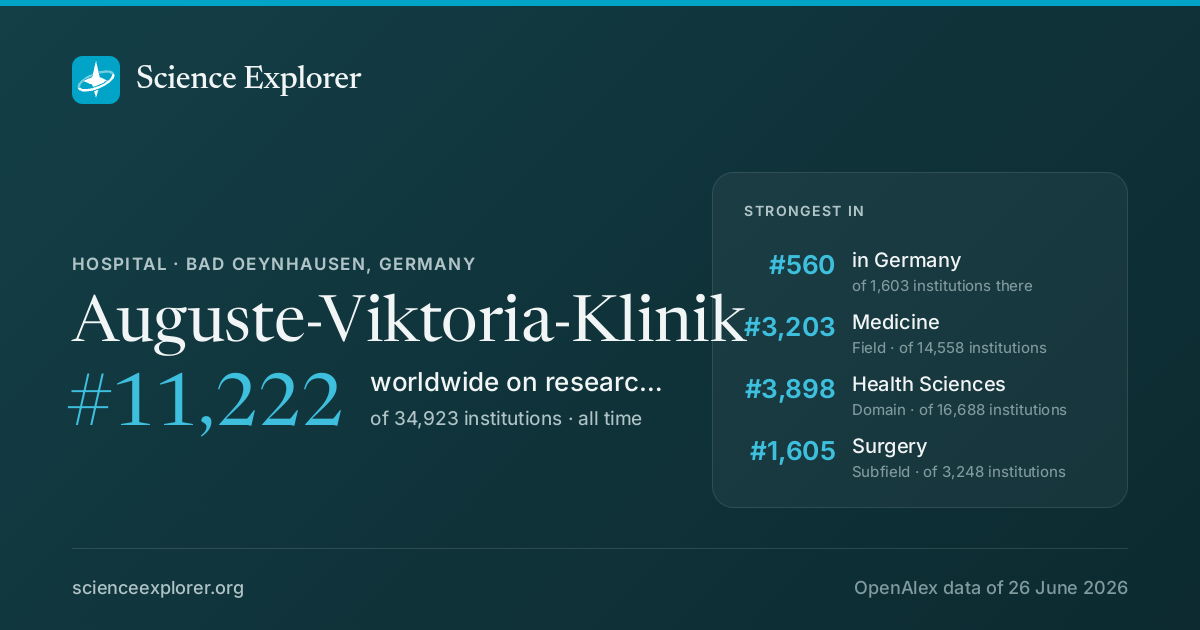
Auguste-Viktoria-Klinik on Science Explorer

A card with Auguste-Viktoria-Klinik's standing and the fields it leads in, for a post or a slide. A link to this page previews as the same card.

Download the card

1200 × 630 PNG, sized for social posts, drawn from the latest snapshot.

Badges for a website1Each links back here and updates with every snapshot

Research measures only: rankings here say nothing about teaching, admissions or student experience. Comparable institutions and collaboration partners have tabs of their own, above.

Discussion

Ask a question or share a note about Auguste-Viktoria-Klinik. Keep it to the research: no personal attacks, advertising or links. Any reader can report a post, which collapses it for everyone until it is opened.
