Science Explorer Back to mapMap
Discussion
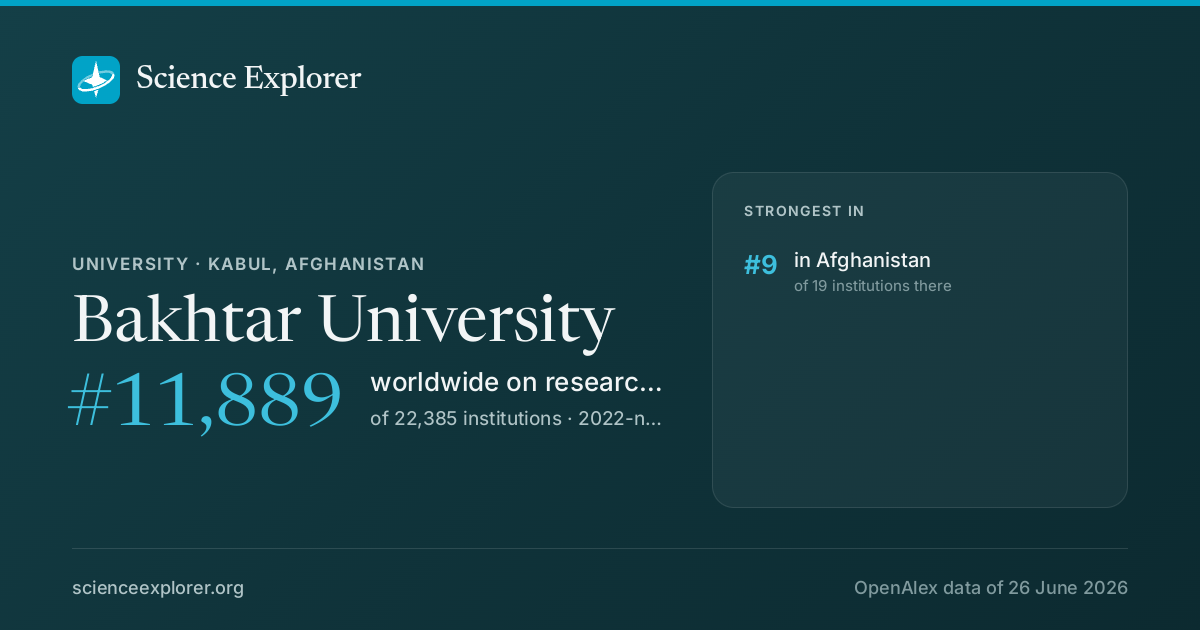
University · Kabul · Afghanistan

Bakhtar University

World rank, 2022-now
#11,889
of 22,385 · #19,231 all time
Rank in Afghanistan
#9
of 19
Research works
209
▲ 229% vs 2018-21
Citations
672
3.2 per fractional work
Top-10% rate
8.9%
all institutions 10.0%
vs its own fields
1.17×
1.00× is exactly expected
Open access
80%
world 40%
International
66%
world 18%

Which fields of science does Bakhtar University work in?

In 2022-now, 38% of research at Bakhtar University is in Social Sciences, 37% in Physical Sciences. Its largest fields are Social Sciences (17%), Computer Science (15%), Engineering (10%). It does 1.5× the world's share of Social Sciences.

Social Sciences: 40 fractional works · 38.3% of its workSocial Sciences: 18 fractional works · 16.7% of its workPolitical Science and International Relations: 7 fractional works · 7.0% of its workEducation: 5 fractional works · 4.6% of its workSociology and Political Science: 3 fractional works · 2.6% of its workDemography: 1 fractional works · 1.2% of its workHuman Factors and Ergonomics: 0 fractional works · 0.5% of its workGender Studies: 0 fractional works · 0.3% of its workTransportation: 0 fractional works · 0.3% of its workSmaller subfields together: 0 fractional works · 0.3% of its workBusiness, Management and Accounting: 11 fractional works · 10.2% of its workAccounting: 5 fractional works · 5.2% of its workOrganizational Behavior and Human Resource Management: 2 fractional works · 2.4% of its workStrategy and Management: 1 fractional works · 1.2% of its workManagement Information Systems: 1 fractional works · 0.6% of its workMarketing: 0 fractional works · 0.4% of its workManagement of Technology and Innovation: 0 fractional works · 0.3% of its workSmaller subfields together: 0 fractional works · 0.2% of its workEconomics, Econometrics and Finance: 6 fractional works · 5.8% of its workEconomics and Econometrics: 4 fractional works · 3.8% of its workFinance: 1 fractional works · 1.3% of its workGeneral Economics, Econometrics and Finance: 1 fractional works · 0.8% of its workPsychology: 4 fractional works · 3.4% of its workSocial Psychology: 3 fractional works · 2.8% of its workDevelopmental and Educational Psychology: 0 fractional works · 0.4% of its workClinical Psychology: 0 fractional works · 0.3% of its workArts and Humanities: 1 fractional works · 1.1% of its workArcheology: 0 fractional works · 0.3% of its workHistory: 0 fractional works · 0.3% of its workLiterature and Literary Theory: 0 fractional works · 0.3% of its workSmaller subfields together: 0 fractional works · 0.2% of its workDecision Sciences: 1 fractional works · 1.0% of its workManagement Science and Operations Research: 1 fractional works · 0.9% of its workSmaller subfields together: 0 fractional works · 0.1% of its workPhysical Sciences: 39 fractional works · 37.5% of its workComputer Science: 16 fractional works · 15.4% of its workInformation Systems: 4 fractional works · 3.9% of its workArtificial Intelligence: 4 fractional works · 3.5% of its workComputer Networks and Communications: 3 fractional works · 3.0% of its workComputer Vision and Pattern Recognition: 3 fractional works · 2.8% of its workSignal Processing: 1 fractional works · 0.8% of its workComputer Science Applications: 1 fractional works · 0.6% of its workComputational Theory and Mathematics: 0 fractional works · 0.4% of its workHardware and Architecture: 0 fractional works · 0.2% of its workSmaller subfields together: 0 fractional works · 0.3% of its workEngineering: 11 fractional works · 10.3% of its workElectrical and Electronic Engineering: 3 fractional works · 2.5% of its workBiomedical Engineering: 1 fractional works · 1.4% of its workMechanical Engineering: 1 fractional works · 1.4% of its workControl and Systems Engineering: 1 fractional works · 1.0% of its workCivil and Structural Engineering: 1 fractional works · 0.6% of its workMechanics of Materials: 1 fractional works · 0.5% of its workAerospace Engineering: 1 fractional works · 0.5% of its workOcean Engineering: 0 fractional works · 0.5% of its workMedia Technology: 0 fractional works · 0.4% of its workComputational Mechanics: 0 fractional works · 0.4% of its workAutomotive Engineering: 0 fractional works · 0.3% of its workIndustrial and Manufacturing Engineering: 0 fractional works · 0.3% of its workBuilding and Construction: 0 fractional works · 0.2% of its workSafety, Risk, Reliability and Quality: 0 fractional works · 0.2% of its workEnvironmental Science: 3 fractional works · 3.2% of its workPollution: 1 fractional works · 0.9% of its workIndustrial and Manufacturing Engineering: 1 fractional works · 0.8% of its workEcology: 1 fractional works · 0.6% of its workWater Science and Technology: 1 fractional works · 0.5% of its workSmaller subfields together: 0 fractional works · 0.5% of its workPhysics and Astronomy: 2 fractional works · 2.0% of its workStatistical and Nonlinear Physics: 1 fractional works · 0.9% of its workAtomic and Molecular Physics, and Optics: 1 fractional works · 0.9% of its workSmaller subfields together: 0 fractional works · 0.3% of its workChemistry: 2 fractional works · 1.9% of its workOrganic Chemistry: 2 fractional works · 1.5% of its workPhysical and Theoretical Chemistry: 0 fractional works · 0.3% of its workSmaller subfields together: 0 fractional works · 0.0% of its workMathematics: 2 fractional works · 1.5% of its workApplied Mathematics: 1 fractional works · 1.1% of its workSmaller subfields together: 0 fractional works · 0.4% of its workEnergy: 1 fractional works · 1.4% of its workRenewable Energy, Sustainability and the Environment: 1 fractional works · 0.9% of its workEnergy Engineering and Power Technology: 0 fractional works · 0.5% of its workEarth and Planetary Sciences: 1 fractional works · 1.0% of its workGeochemistry and Petrology: 0 fractional works · 0.4% of its workOceanography: 0 fractional works · 0.2% of its workSmaller subfields together: 0 fractional works · 0.4% of its workMaterials Science: 1 fractional works · 0.7% of its workMaterials Chemistry: 0 fractional works · 0.4% of its workSmaller subfields together: 0 fractional works · 0.2% of its workChemical Engineering: 0 fractional works · 0.1% of its workHealth Sciences: 15 fractional works · 14.4% of its workMedicine: 8 fractional works · 7.6% of its workPulmonary and Respiratory Medicine: 1 fractional works · 1.1% of its workPublic Health, Environmental and Occupational Health: 1 fractional works · 0.9% of its workEpidemiology: 1 fractional works · 0.7% of its workOncology: 1 fractional works · 0.7% of its workRadiology, Nuclear Medicine and Imaging: 1 fractional works · 0.6% of its workPharmacology: 1 fractional works · 0.5% of its workPathology and Forensic Medicine: 0 fractional works · 0.5% of its workPhysiology: 0 fractional works · 0.5% of its workPsychiatry and Mental health: 0 fractional works · 0.5% of its workHematology: 0 fractional works · 0.3% of its workHepatology: 0 fractional works · 0.3% of its workComplementary and alternative medicine: 0 fractional works · 0.2% of its workSmaller subfields together: 1 fractional works · 0.7% of its workHealth Professions: 4 fractional works · 3.3% of its workGeneral Health Professions: 1 fractional works · 1.0% of its workPharmacy: 1 fractional works · 1.0% of its workHealth Information Management: 1 fractional works · 0.6% of its workSpeech and Hearing: 0 fractional works · 0.3% of its workRadiological and Ultrasound Technology: 0 fractional works · 0.2% of its workSmaller subfields together: 0 fractional works · 0.3% of its workDentistry: 2 fractional works · 2.3% of its workOral Surgery: 2 fractional works · 1.7% of its workGeneral Dentistry: 0 fractional works · 0.2% of its workPeriodontics: 0 fractional works · 0.2% of its workSmaller subfields together: 0 fractional works · 0.1% of its workNursing: 1 fractional works · 1.1% of its workNutrition and Dietetics: 1 fractional works · 1.1% of its workLife Sciences: 10 fractional works · 9.8% of its workAgricultural and Biological Sciences: 7 fractional works · 6.6% of its workPlant Science: 2 fractional works · 2.2% of its workSoil Science: 1 fractional works · 1.0% of its workFood Science: 1 fractional works · 0.9% of its workInsect Science: 1 fractional works · 0.9% of its workGeneral Agricultural and Biological Sciences: 1 fractional works · 0.7% of its workAgronomy and Crop Science: 1 fractional works · 0.7% of its workSmaller subfields together: 0 fractional works · 0.2% of its workBiochemistry, Genetics and Molecular Biology: 2 fractional works · 2.1% of its workMolecular Biology: 1 fractional works · 1.0% of its workGenetics: 0 fractional works · 0.5% of its workCancer Research: 0 fractional works · 0.4% of its workSmaller subfields together: 0 fractional works · 0.3% of its workNeuroscience: 1 fractional works · 0.5% of its workSensory Systems: 0 fractional works · 0.5% of its workSmaller subfields together: 0 fractional works · 0.1% of its workImmunology and Microbiology: 0 fractional works · 0.5% of its workApplied Microbiology and Biotechnology: 0 fractional works · 0.5% of its workPharmacology, Toxicology and Pharmaceutics: 0 fractional works · 0.1% of its workALL ITS WORKBakhtarUniversity105fractional works, 2022-now
Life Sciences10%Physical Sciences37%Health Sciences14%Social Sciences38%

Each ring splits the one inside it: the four domains of science, their fields, their subfields. Size is fractional works in 2022-now. Every slice is a page; the interactive view zooms down to single topics and colours each by how much more of it this institution does than the world.

Its 4 domains and 25 fields, with their numbers
    1. Social Sciences1816.7%
    2. Business, Management and Accounting1110.2%
    3. Economics, Econometrics and Finance65.8%
    4. Psychology43.4%
    5. Arts and Humanities11.1%
    6. Decision Sciences11.0%
    1. Computer Science1615.4%
    2. Engineering1110.3%
    3. Environmental Science33.2%
    4. Physics and Astronomy22.0%
    5. Chemistry21.9%
    6. Mathematics21.5%
    7. Energy11.4%
    8. Earth and Planetary Sciences11.0%
    9. Materials Science10.7%
    10. Chemical Engineering00.1%
    1. Medicine87.6%
    2. Health Professions43.3%
    3. Dentistry22.3%
    4. Nursing11.1%
    1. Agricultural and Biological Sciences76.6%
    2. Biochemistry, Genetics and Molecular Biology22.1%
    3. Neuroscience10.5%
    4. Immunology and Microbiology00.5%
    5. Pharmacology, Toxicology and Pharmaceutics00.1%
All of science, and how each field's share has moved since 1950: the Science domain explorer

Field profile

Location quotient across every field it publishes in: outside the ring is more than an institution of this size would be expected to publish, inside it is less.

Agricultural and Biological Sciences: 1.38× its world share, 7 worksAgricultural and Bio…Biochemistry, Genetics and Molecular Biology: 0.40× its world share, 2 worksBiochemistry, Geneti…Immunology and Microbiology: 0.47× its world share, 0 worksImmunology and Micro…Neuroscience: 0.33× its world share, 1 worksNeurosciencePharmacology, Toxicology and Pharmaceutics: 0.30× its world share, 0 worksPharmacology, Toxico…Chemical Engineering: 0.30× its world share, 0 worksChemical EngineeringChemistry: 1.20× its world share, 2 worksChemistryComputer Science: 1.98× its world share, 16 worksComputer ScienceEarth and Planetary Sciences: 0.64× its world share, 1 worksEarth and Planetary …Energy: 1.50× its world share, 1 worksEnergyEngineering: 0.69× its world share, 11 worksEngineeringEnvironmental Science: 0.65× its world share, 3 worksEnvironmental ScienceMaterials Science: 0.19× its world share, 1 worksMaterials ScienceMathematics: 1.24× its world share, 2 worksMathematicsPhysics and Astronomy: 0.92× its world share, 2 worksPhysics and AstronomyDentistry: 4.80× its world share, 2 worksDentistryHealth Professions: 1.27× its world share, 4 worksHealth ProfessionsMedicine: 0.39× its world share, 8 worksMedicineNursing: 2.28× its world share, 1 worksNursingArts and Humanities: 0.38× its world share, 1 worksArts and HumanitiesBusiness, Management and Accounting: 3.17× its world share, 11 worksBusiness, Management…Decision Sciences: 1.01× its world share, 1 worksDecision SciencesEconomics, Econometrics and Finance: 2.73× its world share, 6 worksEconomics, Econometr…Psychology: 1.13× its world share, 4 worksPsychologySocial Sciences: 1.32× its world share, 18 worksSocial Sciences1×world share
more than its size predictsabout as predictedless

Rings at 0.5×, 1× and 2×. Widest outward: Dentistry, 4.8×. Every wedge is a field page.

All 25 fields, with their numbers
  1. Dentistry4.80×2 works
  2. Business, Management and Accounting3.17×11 works
  3. Economics, Econometrics and Finance2.73×6 works
  4. Nursing2.28×1 works
  5. Computer Science1.98×16 works
  6. Energy1.50×1 works
  7. Agricultural and Biological Sciences1.38×7 works
  8. Social Sciences1.32×18 works
  9. Health Professions1.27×4 works
  10. Mathematics1.24×2 works
  11. Chemistry1.20×2 works
  12. Psychology1.13×4 works
  13. Decision Sciences1.01×1 works
  14. Physics and Astronomy0.92×2 works
  15. Engineering0.69×11 works
  16. Environmental Science0.65×3 works
  17. Earth and Planetary Sciences0.64×1 works
  18. Immunology and Microbiology0.47×0 works
  19. Biochemistry, Genetics and Molecular Biology0.40×2 works
  20. Medicine0.39×8 works
  21. Arts and Humanities0.38×1 works
  22. Neuroscience0.33×1 works
  23. Pharmacology, Toxicology and Pharmaceutics0.30×0 works
  24. Chemical Engineering0.30×0 works
  25. Materials Science0.19×1 works

Who are the top researchers at Bakhtar University?

Ranked on the quality score, Liping Liu, Adil Rasool and Syed Abid Hussain lead among researchers whose main affiliation is Bakhtar University.

  1. 1 Liping Liu Afghanistan · #1,579,538 worldwide 525 citations · 25 works

  2. 2 Adil Rasool Afghanistan · #1,664,695 worldwide 226 citations · 26 works
  3. 3 Syed Abid Hussain Afghanistan · #1,781,300 worldwide 650 citations · 52 works
All ranked researchers at Bakhtar University

What are the most cited papers from Bakhtar University?

The most cited paper from Bakhtar University is "Classification and diagnostic prediction of breast cancer metastasis on clinical data using machine learning algorithms" (Mahendran Botlagunta, Madhavi Devi Botlagunta, Madhavi Devi Botlagunta et al., 2023), with 196 citations. Next come "Investigation and modeling of cutting forces and surface roughness when hard turning of AISI 52100 steel with mixed ceramic tool: cutting conditions optimization" (90) and "Bright and dark solitons of the Rosenau-Kawahara equation with power law nonlinearity" (70).

Most cited papers
#PaperReleasedCitations
1 Classification and diagnostic prediction of breast cancer metastasis on clinical data using machine learning algorithms Mahendran Botlagunta, Madhavi Devi Botlagunta, Madhavi Devi Botlagunta et al. · Scientific Reports Open access 10 Jan 2023 196
2 Investigation and modeling of cutting forces and surface roughness when hard turning of AISI 52100 steel with mixed ceramic tool: cutting conditions optimization Ikhlas Meddour, Mohamed Athmane Yallese, Riad Khattabi et al. · The International Journal of Advanced Manufacturing Technology 9 Nov 2014 90
3 Bright and dark solitons of the Rosenau-Kawahara equation with power law nonlinearity Anjan Biswas, Houria Triki, Manel Labidi · Physics of Wave Phenomena Mar 2011 70
4 Interaction dynamics of optical dark bound solitons for a defocusing Lakshmanan-Porsezian-Daniel equation Cui-Cui Ding, Qin Yuan Zhou, Houria Triki et al. · Optics Express Open access 14 Oct 2022 65
5 Speaker identification using multimodal neural networks and wavelet analysis Noor Almaadeed, Amar Aggoun, Abbes Amira · IET Biometrics Open access 19 Jan 2015 61
All 56 most cited papers, with filters and sorting

Which keywords describe research at Bakhtar University?

By fractional works in 2022-now, weighted toward what it does more of than the world: Corporate Governance, Security, Risk Management, Deep Learning, Central Asia, Reconstruction, Afghanistan and Financial Stability.

▲ more of its work than of the world's◆ about the world's share▼ less than the world's

Size is fractional works in 2022-now in the topics tagged with each word; colour is the word's share of this institution's work against its share of the world's. The 40 words are chosen for being large and distinctive. Each links to the topic it comes from most.

All 40 words, with their numbers
  1. Deep Learning8▲ 2.4×34 topics
  2. Machine Learning7▲ 2.1×31 topics
  3. Corporate Governance6▲ 8.1×9 topics
  4. Security6▲ 8.2×7 topics
  5. Risk Management5▲ 10×6 topics
  6. Central Asia4▲ 57×2 topics
  7. Reconstruction4▲ 23×2 topics
  8. Sustainable Development4▲ 2.6×12 topics
  9. Afghanistan4▲ 164×1 topic
  10. Financial Stability4▲ 20×3 topics
  11. Pakistan4▲ 164×1 topic
  12. Finance4▲ 21×2 topics
  13. Ethical Identity4▲ 31×1 topic
  14. Islamic Banking4▲ 9.8×1 topic
  15. Leadership4▲ 6.8×6 topics
  16. Renewable Energy3▲ 2.1×14 topics
  17. Healthcare3▲ 2.4×8 topics
  18. Job Satisfaction3▲ 5.7×5 topics
  19. Economic Growth2▲ 3.0×7 topics
  20. Health2▲ 5.8×4 topics
  21. Internet of Things2▲ 2.7×7 topics
  22. Convolutional Neural Networks2▲ 2.8×7 topics
  23. Workplace2▲ 23×3 topics
  24. IoT Security2▲ 6.4×3 topics
  25. Stress2▲ 5.5×4 topics
  26. Regional Integration2▲ 49×2 topics
  27. Transport Infrastructure2▲ 21×2 topics
  28. Human Resource Management2▲ 10×2 topics
  29. Language Teaching2▲ 6.0×4 topics
  30. Mineral Trioxide Aggregate2▲ 42×1 topic
  31. Root Canal Irrigants2▲ 42×1 topic
  32. Smart Cities2▲ 6.3×4 topics
  33. Social Interaction2▲ 4.2×3 topics
  34. 5G Networks2▲ 7.0×2 topics
  35. China-Pakistan Economic Corridor2▲ 130×1 topic
  36. Infrastructure Development2▲ 66×1 topic
  37. Emotional Intelligence1▲ 9.1×2 topics
  38. Genetic Improvement1▲ 15×2 topics
  39. Psychological Capital1▲ 9.2×2 topics
  40. Transformational Leadership1▲ 7.4×2 topics

Which research topics does Bakhtar University publish most on?

By volume in 2022-now: Politics and Conflicts in Afghanistan, Pakistan, and Middle East, Islamic Finance and Banking Studies, Endodontics and Root Canal Treatments and Belt and Road Initiative.

  1. 1 Politics and Conflicts in Afghanistan, Pakistan, and Middle East Political Science and International Relations 4 works
  2. 2 Islamic Finance and Banking Studies Accounting 4 works
  3. 3 Endodontics and Root Canal Treatments Oral Surgery 2 works
  4. 4 Belt and Road Initiative Economics and Econometrics 2 works
  5. 5 Emotional Intelligence and Performance Social Psychology 1 works
  6. 6 E-Government and Public Services Political Science and International Relations 1 works
  7. 7 Employer Branding and e-HRM Organizational Behavior and Human Resource Management 1 works
  8. 8 Medical Malpractice and Liability Issues Pharmacy 1 works
  9. 9 IoT and Edge/Fog Computing Computer Networks and Communications 1 works
  10. 10 Phase Equilibria and Thermodynamics Biomedical Engineering 1 works

How open and international is its research?

Against the world's own shares: the tick on each track. Both are shares of its output, so they sit on one scale and can be read against each other as well as against the world.

openly available79.9%not open20.1%

World: 40% of research is openly available.

with international co-authors65.6%domestic only34.4%

World: 18% is written across borders.

How has Bakhtar University's research output changed?

Output in 2022-2025 was 229% higher than in 2018-2021.

still counting20052010201520202025
grewheldshrank

The same series as a ribbon: one cell per year, darker for more. The line above answers how much; this answers when.

Its share of all research

Growing output can still be a shrinking share: all of science grows. This is Bakhtar University as a percentage of every work published that year, 0.00050% in 2024.

still counting0.00050%0.0010%0.0015%Bakhtar University0.00026% in 202520102020

Fractional works of Bakhtar University over all fractional works that year. How the balance of science has shifted.

Other research institutions in Kabul

All research institutions in Kabul

Share Bakhtar University's ranking

Bakhtar University on Science Explorer

A card with Bakhtar University's standing and the fields it leads in, for a post or a slide. A link to this page previews as the same card.

Download the card

1200 × 630 PNG, sized for social posts, drawn from the latest snapshot.

Badges for a website1Each links back here and updates with every snapshot

Research measures only: rankings here say nothing about teaching, admissions or student experience. Comparable institutions and collaboration partners have tabs of their own, above.

Discussion

Ask a question or share a note about Bakhtar University. Posts are plain text and can be reported.