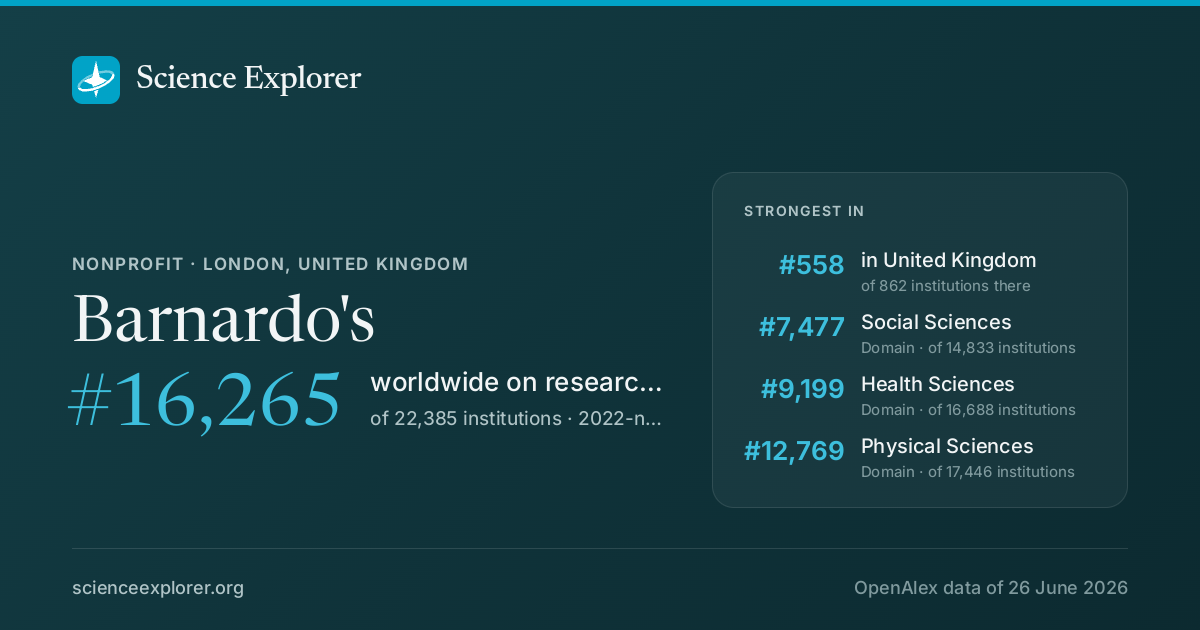
Barnardo's
In research, Barnardo's stands highest in Social Sciences (#7,477 of 14,833 worldwide), Health Sciences (#9,199 of 16,688 worldwide) and Social Sciences (#5,796 of 9,330 worldwide), over all time.
- World rank, 2022-now
- #16,265 of 22,385 · #8,977 all time
- Rank in United Kingdom
- #558 of 862
- Research works
- 762 ▲ 4% vs 2018-21
- Citations
- 9.6k 12.6 per fractional work
- Top-10% rate
- 7.9% all institutions 10.0%
- vs its own fields
- 0.95× 1.00× is exactly expected
- Open access
- 34% world 40%
- International
- 25% world 18%
What is Barnardo's known for in research?
The fields where it stands highest, over all time, ranked among every institution above the floor in each field.
| Field | World rank | Where that sits | Top-10% rate | Works |
|---|---|---|---|---|
| Social SciencesDomain | #7,477 of 14,833 | 7.8% | 390 | |
| Health SciencesDomain | #9,199 of 16,688 | 8.9% | 148 | |
| Social SciencesField | #5,796 of 9,330 | 8.5% | 188 | |
| Physical SciencesDomain | #12,769 of 17,446 | 6.8% | 155 |
Each strip is that field's whole ranked pool, with the notch where Barnardo's sits in it, in the colour of the band that rank falls in. The track under the rate is the rate itself: it carries no average mark, because the average differs by field (from about 6% in Dentistry to 21% in Economics).
Which fields of science does Barnardo's work in?
In 2022-now, 48% of research at Barnardo's is in Social Sciences, 23% in Health Sciences. Its largest fields are Social Sciences (26%), Medicine (15%), Arts and Humanities (10%). It does 1.8× the world's share of Social Sciences.
Each ring splits the one inside it: the four domains of science, their fields, their subfields. Size is fractional works in 2022-now. Every slice is a page; the interactive view zooms down to single topics and colours each by how much more of it this institution does than the world.
Its 4 domains and 25 fields, with their numbers
- Social Sciences4647.9%
- Health Sciences2223.4%
- Medicine1515.3%
- Health Professions65.9%
- Veterinary21.9%
- Nursing00.3%
- Physical Sciences2122.0%
- Engineering66.8%
- Environmental Science66.5%
- Computer Science44.4%
- Earth and Planetary Sciences21.9%
- Chemical Engineering10.7%
- Materials Science00.5%
- Chemistry00.4%
- Mathematics00.4%
- Physics and Astronomy00.3%
- Energy00.1%
- Life Sciences66.7%
Field profile
Location quotient across every field it publishes in: outside the ring is more than an institution of this size would be expected to publish, inside it is less.
Rings at 0.5×, 1× and 2×. Widest outward: Veterinary, 14.0×. Every wedge is a field page.
All 25 fields, with their numbers
- Veterinary14.01×2 works
- Arts and Humanities3.37×9 works
- Health Professions2.23×6 works
- Social Sciences2.09×25 works
- Chemical Engineering2.00×1 works
- Psychology1.68×5 works
- Environmental Science1.31×6 works
- Business, Management and Accounting1.30×4 works
- Earth and Planetary Sciences1.21×2 works
- Agricultural and Biological Sciences1.12×5 works
- Decision Sciences1.10×1 works
- Medicine0.80×15 works
- Economics, Econometrics and Finance0.65×1 works
- Nursing0.59×0 works
- Pharmacology, Toxicology and Pharmaceutics0.57×0 works
- Computer Science0.56×4 works
- Immunology and Microbiology0.47×0 works
- Engineering0.45×6 works
- Mathematics0.32×0 works
- Chemistry0.28×0 works
- Neuroscience0.15×0 works
- Materials Science0.15×0 works
- Physics and Astronomy0.12×0 works
- Energy0.11×0 works
- Biochemistry, Genetics and Molecular Biology0.09×0 works
- Veterinary 14.0×
- Arts and Humanities 3.4×
- Health Professions 2.2×
- Social Sciences 2.1×
- Chemical Engineering 2.0×
- Psychology 1.7×
- Environmental Science 1.3×
- Business, Management and Accounting 1.3×
- Earth and Planetary Sciences 1.2×
- Agricultural and Biological Sciences 1.1×
- Decision Sciences 1.1×
- Medicine 0.8×
- Economics, Econometrics and Finance 0.7×
- Nursing 0.6×
- Pharmacology, Toxicology and Pharmaceutics 0.6×
- Computer Science 0.6×
- Immunology and Microbiology 0.5×
- Engineering 0.5×
- Mathematics 0.3×
- Chemistry 0.3×
- Neuroscience 0.1×
- Materials Science 0.1×
- Physics and Astronomy 0.1×
- Energy 0.1×
- Biochemistry, Genetics and Molecular Biology 0.1×
Who are the top researchers at Barnardo's?
Ranked on the quality score, John M. Barnard, Alison Byrne and Guy Hart-Davis lead among researchers whose main affiliation is Barnardo's.
- 1
John M. Barnard
 United Kingdom · #1,824,700 worldwide
3.3k citations · 59 works
- 2
Alison Byrne
United Kingdom · #2,165,630 worldwide
908 citations · 20 works
- 3
Guy Hart-Davis
United Kingdom · #2,571,562 worldwide
39 citations · 221 works
- 4
Colin Murray Parkes
United Kingdom · #3,196,865 worldwide
54 citations · 51 works
- 5
Tony Newman
United Kingdom · #3,505,067 worldwide
449 citations · 20 works
- 6
W. B. Emery
United Kingdom · #3,566,083 worldwide
181 citations · 18 works
- 7
Chris Burgess
United Kingdom · #3,795,593 worldwide
533 citations · 60 works
- 8
Hannah Russ
United Kingdom · #4,007,230 worldwide
103 citations · 23 works
- 9
Irene Renzenbrink
United Kingdom · #4,031,889 worldwide
78 citations · 20 works
- 10
Roy L. Tranter
United Kingdom · #4,162,892 worldwide
960 citations · 27 works
Which keywords describe research at Barnardo's?
By fractional works in 2022-now, weighted toward what it does more of than the world: Mental Health, Curriculum Development, History, Digital Learning, Sustainable Development, Qualitative Research, Religion and Online Learning.
- Environmental Participation
- Cultural Politics
- Citizen Participation
- Religious Values
- Welfare State
- Family Support
- Palliative Care
- Archaeology
- Educational Policy
- Cultural Heritage
- Public Policy
- Learning Outcomes
- Teacher Training
- Education
- Environmental Impact
- Educational Technology
- Qualitative Research
- Curriculum Development
- Climate Change
- Epidemiology
- Mental Health
- Sustainable Development
- Sustainability
- History
- Digital Learning
- Online Learning
- E-Learning
- Religion
- Character Education
- Social Justice
- Colonialism
- Identity
- Inclusive Education
- Culture
- Resilience
- Politics
- Cultural Exchange
- Active Learning
- Social Work
- Raman Spectroscopy
Size is fractional works in 2022-now in the topics tagged with each word; colour is the word's share of this institution's work against its share of the world's. The 40 words are chosen for being large and distinctive. Each links to the topic it comes from most.
All 40 words, with their numbers
- Mental Health6▲ 4.2×18 topics
- Epidemiology6▲ 1.46×36 topics
- Sustainable Development5▲ 3.3×15 topics
- Climate Change5▲ 1.76×24 topics
- Sustainability4▲ 1.88×19 topics
- Curriculum Development4▲ 6.3×7 topics
- History4▲ 5.9×8 topics
- Qualitative Research4▲ 4.8×11 topics
- Digital Learning4▲ 7.2×4 topics
- Educational Technology3▲ 3.0×12 topics
- Online Learning3▲ 4.3×9 topics
- Environmental Impact3▲ 1.89×13 topics
- E-Learning3▲ 3.2×9 topics
- Education3▲ 1.76×10 topics
- Religion3▲ 6.6×6 topics
- Teacher Training3▲ 4.9×8 topics
- Character Education3▲ 5.8×3 topics
- Learning Outcomes2▲ 6.2×3 topics
- Social Justice2▲ 4.2×5 topics
- Public Policy2▲ 4.9×6 topics
- Colonialism2▲ 4.6×4 topics
- Cultural Heritage2▲ 4.2×5 topics
- Identity2▲ 3.1×6 topics
- Educational Policy2▲ 8.2×4 topics
- Inclusive Education2▲ 5.4×5 topics
- Archaeology2▲ 15×5 topics
- Culture2▲ 3.7×3 topics
- Palliative Care2▲ 12×3 topics
- Resilience2▲ 3.9×5 topics
- Family Support2▲ 27×2 topics
- Politics2▲ 6.2×3 topics
- Welfare State2▲ 22×2 topics
- Cultural Exchange2▲ 12×3 topics
- Religious Values2▲ 8.6×1 topic
- Active Learning1▲ 8.0×3 topics
- Citizen Participation1▲ 13×2 topics
- Social Work1▲ 22×2 topics
- Cultural Politics1▲ 21×2 topics
- Raman Spectroscopy1▲ 7.3×3 topics
- Environmental Participation1▲ 18×1 topic
Which research topics does Barnardo's publish most on?
By volume in 2022-now: Education and Character Development, Health, Medicine and Society, French Urban and Social Studies and Social Sciences and Policies.
Area is fractional works; colour is the subfield each topic belongs to.
- 1 Education and Character Development Education 2 works
- 2 Health, Medicine and Society General Health Professions 1 works
- 3 French Urban and Social Studies Sociology and Political Science 1 works
- 4 Social Sciences and Policies General Social Sciences 1 works
- 5 Vietnamese History and Culture Studies Sociology and Political Science 1 works
- 6 Mineralogy and Gemology Studies Geochemistry and Petrology 1 works
- 7 Scottish History and National Identity History 1 works
- 8 Cutaneous Melanoma Detection and Management Oncology 1 works
- 9 Arabic Language Education Studies Education 1 works
- 10 Educational Curriculum and Learning Methods Education 1 works
How open and international is its research?
Against the world's own shares: the tick on each track. Both are shares of its output, so they sit on one scale and can be read against each other as well as against the world.
World: 40% of research is openly available.
World: 18% is written across borders.
How has Barnardo's's research output changed?
Output in 2022-2025 was 4% higher than in 2018-2021.
The same series as a ribbon: one cell per year, darker for more. The line above answers how much; this answers when.
Its share of all research
Growing output can still be a shrinking share: all of science grows. This is Barnardo's as a percentage of every work published that year, 0.00031% in 2024.
Fractional works of Barnardo's over all fractional works that year. How the balance of science has shifted.
How much of it reaches the world top 10%
Year by year, against all institutions in the same year.
Of each year's output, the share that reached the world's 10% most cited for its field and year. Peak 14.1% in 2012.
Other research institutions in London
- University College London
- Imperial College London
- King's College London
- Queen Mary University of London
- London School of Economics and Political Science
- University of London
- Barts Health NHS Trust
- Brunel University of London





Share Barnardo's's ranking
Badges for a website1Each links back here and updates with every snapshot

Research measures only: rankings here say nothing about teaching, admissions or student experience. Comparable institutions and collaboration partners have tabs of their own, above.
Discussion
Ask a question or share a note about Barnardo's. Keep it to the research: no personal attacks, advertising or links. Any reader can report a post, which collapses it for everyone until it is opened.