Science Explorer Back to mapMap
Discussion
Company · Newton · United States

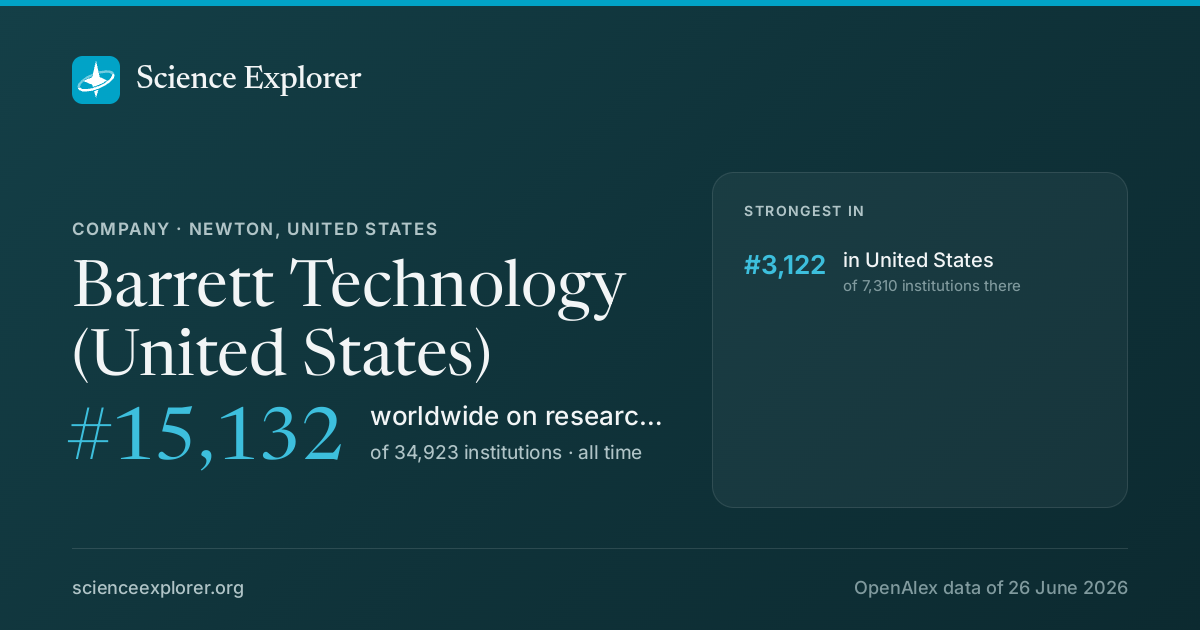
Barrett Technology (United States)

World rank, all time
#15,132
of 34,923
Rank in United States
#3,122
of 7,310
Research works
254
▲ 4% vs 2018-21
Citations
6.8k
26.8 per fractional work
Top-10% rate
6.9%
all institutions 10.0%
vs its own fields
0.99×
1.00× is exactly expected
Open access
33%
world 40%
International
27%
world 18%

Which fields of science does Barrett Technology (United States) work in?

In 2022-now, 56% of research at Barrett Technology (United States) is in Social Sciences, 23% in Health Sciences. Its largest fields are Social Sciences (28%), Arts and Humanities (14%), Medicine (14%). It does 1.9× the world's share of Social Sciences.

Social Sciences: 19 fractional works · 55.8% of its workSocial Sciences: 9 fractional works · 28.3% of its workEducation: 4 fractional works · 12.5% of its workSociology and Political Science: 2 fractional works · 5.4% of its workGender Studies: 2 fractional works · 5.0% of its workSafety Research: 0 fractional works · 1.5% of its workGeography, Planning and Development: 0 fractional works · 1.0% of its workHealth: 0 fractional works · 1.0% of its workTransportation: 0 fractional works · 0.6% of its workAnthropology: 0 fractional works · 0.5% of its workCommunication: 0 fractional works · 0.5% of its workUrban Studies: 0 fractional works · 0.3% of its workArts and Humanities: 5 fractional works · 14.3% of its workConservation: 1 fractional works · 3.3% of its workArcheology: 1 fractional works · 3.0% of its workHistory: 1 fractional works · 2.0% of its workPhilosophy: 0 fractional works · 1.5% of its workReligious studies: 0 fractional works · 1.5% of its workHistory and Philosophy of Science: 0 fractional works · 1.3% of its workClassics: 0 fractional works · 1.0% of its workLanguage and Linguistics: 0 fractional works · 0.4% of its workLiterature and Literary Theory: 0 fractional works · 0.4% of its workPsychology: 2 fractional works · 5.7% of its workClinical Psychology: 1 fractional works · 1.7% of its workDevelopmental and Educational Psychology: 0 fractional works · 1.5% of its workSocial Psychology: 0 fractional works · 1.5% of its workExperimental and Cognitive Psychology: 0 fractional works · 1.0% of its workDecision Sciences: 1 fractional works · 3.5% of its workManagement Science and Operations Research: 1 fractional works · 3.0% of its workInformation Systems and Management: 0 fractional works · 0.2% of its workStatistics, Probability and Uncertainty: 0 fractional works · 0.2% of its workSmaller subfields together: 0 fractional works · 0.0% of its workBusiness, Management and Accounting: 1 fractional works · 2.2% of its workAccounting: 0 fractional works · 1.0% of its workStrategy and Management: 0 fractional works · 0.5% of its workManagement of Technology and Innovation: 0 fractional works · 0.3% of its workMarketing: 0 fractional works · 0.3% of its workEconomics, Econometrics and Finance: 1 fractional works · 1.9% of its workEconomics and Econometrics: 1 fractional works · 1.6% of its workFinance: 0 fractional works · 0.3% of its workHealth Sciences: 8 fractional works · 22.9% of its workMedicine: 5 fractional works · 13.7% of its workComplementary and alternative medicine: 1 fractional works · 2.0% of its workSurgery: 0 fractional works · 1.5% of its workEmergency Medicine: 0 fractional works · 1.4% of its workEndocrinology, Diabetes and Metabolism: 0 fractional works · 1.3% of its workPhysiology: 0 fractional works · 1.2% of its workPublic Health, Environmental and Occupational Health: 0 fractional works · 1.0% of its workEpidemiology: 0 fractional works · 0.9% of its workPediatrics, Perinatology and Child Health: 0 fractional works · 0.9% of its workRadiology, Nuclear Medicine and Imaging: 0 fractional works · 0.7% of its workCritical Care and Intensive Care Medicine: 0 fractional works · 0.5% of its workHealth Informatics: 0 fractional works · 0.5% of its workCardiology and Cardiovascular Medicine: 0 fractional works · 0.4% of its workInfectious Diseases: 0 fractional works · 0.3% of its workPharmacology: 0 fractional works · 0.3% of its workSmaller subfields together: 0 fractional works · 0.8% of its workHealth Professions: 3 fractional works · 7.9% of its workGeneral Health Professions: 1 fractional works · 3.9% of its workPhysical Therapy, Sports Therapy and Rehabilitation: 1 fractional works · 2.0% of its workSpeech and Hearing: 0 fractional works · 0.6% of its workPharmacy: 0 fractional works · 0.3% of its workRadiological and Ultrasound Technology: 0 fractional works · 0.3% of its workOccupational Therapy: 0 fractional works · 0.2% of its workSmaller subfields together: 0 fractional works · 0.5% of its workNursing: 0 fractional works · 1.0% of its workNutrition and Dietetics: 0 fractional works · 1.0% of its workVeterinary: 0 fractional works · 0.3% of its workSmall Animals: 0 fractional works · 0.3% of its workPhysical Sciences: 4 fractional works · 10.9% of its workComputer Science: 1 fractional works · 3.8% of its workInformation Systems: 1 fractional works · 3.2% of its workComputer Science Applications: 0 fractional works · 0.5% of its workSmaller subfields together: 0 fractional works · 0.1% of its workEngineering: 1 fractional works · 3.2% of its workCivil and Structural Engineering: 0 fractional works · 0.7% of its workControl and Systems Engineering: 0 fractional works · 0.6% of its workMedia Technology: 0 fractional works · 0.5% of its workBuilding and Construction: 0 fractional works · 0.4% of its workOcean Engineering: 0 fractional works · 0.3% of its workMechanics of Materials: 0 fractional works · 0.2% of its workSafety, Risk, Reliability and Quality: 0 fractional works · 0.2% of its workSmaller subfields together: 0 fractional works · 0.1% of its workEnvironmental Science: 0 fractional works · 1.4% of its workManagement, Monitoring, Policy and Law: 0 fractional works · 0.6% of its workHealth, Toxicology and Mutagenesis: 0 fractional works · 0.3% of its workPollution: 0 fractional works · 0.3% of its workSmaller subfields together: 0 fractional works · 0.1% of its workMathematics: 0 fractional works · 1.0% of its workApplied Mathematics: 0 fractional works · 1.0% of its workMaterials Science: 0 fractional works · 0.8% of its workMaterials Chemistry: 0 fractional works · 0.8% of its workEarth and Planetary Sciences: 0 fractional works · 0.7% of its workPaleontology: 0 fractional works · 0.5% of its workGeophysics: 0 fractional works · 0.2% of its workLife Sciences: 3 fractional works · 10.3% of its workNeuroscience: 1 fractional works · 3.8% of its workSensory Systems: 0 fractional works · 1.5% of its workNeurology: 0 fractional works · 1.0% of its workCellular and Molecular Neuroscience: 0 fractional works · 0.5% of its workCognitive Neuroscience: 0 fractional works · 0.4% of its workEndocrine and Autonomic Systems: 0 fractional works · 0.3% of its workAgricultural and Biological Sciences: 1 fractional works · 3.4% of its workFood Science: 1 fractional works · 2.5% of its workGeneral Agricultural and Biological Sciences: 0 fractional works · 0.5% of its workAnimal Science and Zoology: 0 fractional works · 0.3% of its workSmaller subfields together: 0 fractional works · 0.1% of its workPharmacology, Toxicology and Pharmaceutics: 1 fractional works · 2.0% of its workPharmacology: 1 fractional works · 2.0% of its workBiochemistry, Genetics and Molecular Biology: 0 fractional works · 1.1% of its workMolecular Biology: 0 fractional works · 0.9% of its workSmaller subfields together: 0 fractional works · 0.2% of its workALL ITS WORKBarrettTechnology…33fractional works, 2022-now
Life Sciences10%Physical Sciences11%Health Sciences23%Social Sciences56%

Each ring splits the one inside it: the four domains of science, their fields, their subfields. Size is fractional works in 2022-now. Every slice is a page; the interactive view zooms down to single topics and colours each by how much more of it this institution does than the world.

Its 4 domains and 20 fields, with their numbers
    1. Social Sciences928.3%
    2. Arts and Humanities514.3%
    3. Psychology25.7%
    4. Decision Sciences13.5%
    5. Business, Management and Accounting12.2%
    6. Economics, Econometrics and Finance11.9%
    1. Medicine513.7%
    2. Health Professions37.9%
    3. Nursing01.0%
    4. Veterinary00.3%
    1. Computer Science13.8%
    2. Engineering13.2%
    3. Environmental Science01.4%
    4. Mathematics01.0%
    5. Materials Science00.8%
    6. Earth and Planetary Sciences00.7%
    1. Neuroscience13.8%
    2. Agricultural and Biological Sciences13.4%
    3. Pharmacology, Toxicology and Pharmaceutics12.0%
    4. Biochemistry, Genetics and Molecular Biology01.1%
All of science, and how each field's share has moved since 1950: the Science domain explorer

Field profile

Location quotient across every field it publishes in: outside the ring is more than an institution of this size would be expected to publish, inside it is less.

Agricultural and Biological Sciences: 0.72× its world share, 1 worksAgricultural and Bio…Biochemistry, Genetics and Molecular Biology: 0.21× its world share, 0 worksBiochemistry, Geneti…Neuroscience: 2.32× its world share, 1 worksNeurosciencePharmacology, Toxicology and Pharmaceutics: 5.65× its world share, 1 worksPharmacology, Toxico…Computer Science: 0.49× its world share, 1 worksComputer ScienceEarth and Planetary Sciences: 0.48× its world share, 0 worksEarth and Planetary …Engineering: 0.21× its world share, 1 worksEngineeringEnvironmental Science: 0.28× its world share, 0 worksEnvironmental ScienceMaterials Science: 0.24× its world share, 0 worksMaterials ScienceMathematics: 0.85× its world share, 0 worksMathematicsHealth Professions: 2.99× its world share, 3 worksHealth ProfessionsMedicine: 0.71× its world share, 5 worksMedicineNursing: 1.98× its world share, 0 worksNursingVeterinary: 2.44× its world share, 0 worksVeterinaryArts and Humanities: 4.94× its world share, 5 worksArts and HumanitiesBusiness, Management and Accounting: 0.67× its world share, 1 worksBusiness, Management…Decision Sciences: 3.61× its world share, 1 worksDecision SciencesEconomics, Econometrics and Finance: 0.90× its world share, 1 worksEconomics, Econometr…Psychology: 1.87× its world share, 2 worksPsychologySocial Sciences: 2.24× its world share, 10 worksSocial Sciences1×world share
more than its size predictsabout as predictedless

Rings at 0.5×, 1× and 2×. Widest outward: Pharmacology, Toxicology and Pharmaceutics, 5.7×. Every wedge is a field page.

All 20 fields, with their numbers
  1. Pharmacology, Toxicology and Pharmaceutics5.65×1 works
  2. Arts and Humanities4.94×5 works
  3. Decision Sciences3.61×1 works
  4. Health Professions2.99×3 works
  5. Veterinary2.44×0 works
  6. Neuroscience2.32×1 works
  7. Social Sciences2.24×10 works
  8. Nursing1.98×0 works
  9. Psychology1.87×2 works
  10. Economics, Econometrics and Finance0.90×1 works
  11. Mathematics0.85×0 works
  12. Agricultural and Biological Sciences0.72×1 works
  13. Medicine0.71×5 works
  14. Business, Management and Accounting0.67×1 works
  15. Computer Science0.49×1 works
  16. Earth and Planetary Sciences0.48×0 works
  17. Environmental Science0.28×0 works
  18. Materials Science0.24×0 works
  19. Biochemistry, Genetics and Molecular Biology0.21×0 works
  20. Engineering0.21×1 works

Who are the top researchers at Barrett Technology (United States)?

Ranked on the quality score, William T. Townsend, J. Delves‐Broughton and Arthur H. Blanchard lead among researchers whose main affiliation is Barrett Technology (United States).

  1. 1 William T. Townsend United States · #1,312,923 worldwide 1.2k citations · 37 works
  2. 2 J. Delves‐Broughton United States · #1,540,717 worldwide 2.5k citations · 45 works
  3. 3 Arthur H. Blanchard United States · #2,538,321 worldwide 38 citations · 50 works
  4. 4 Prévost Hubbard United States · #2,592,729 worldwide 37 citations · 25 works
  5. 5 Philip P. Sharples United States · #2,976,567 worldwide 1 citations · 12 works
  6. 6 Stephen P. Cumella United States · #3,309,990 worldwide 543 citations · 30 works
  7. 7 Stanton Miller United States · #3,413,206 worldwide 252 citations · 46 works
  8. 8 Larry B. Barrett United States · #4,702,510 worldwide 34 citations · 24 works
All ranked researchers at Barrett Technology (United States)

What are the most cited papers from Barrett Technology (United States)?

The most cited paper from Barrett Technology (United States) is "Cardiovascular mortality and noncontraceptive use of estrogen in women: results from the Lipid Research Clinics Program Follow-up Study." (Trudy L. Bush, E L Barrett-Connor, Linda D. Cowan et al., 1987), with 1,366 citations. Next come "The prevalence of peripheral arterial disease in a defined population." (1,093) and "Applications of the bacteriocin, nisin" (979).

Most cited papers
#PaperReleasedCitations
1 Cardiovascular mortality and noncontraceptive use of estrogen in women: results from the Lipid Research Clinics Program Follow-up Study. Trudy L. Bush, E L Barrett-Connor, Linda D. Cowan et al. · Circulation Jun 1987 1,366
2 The prevalence of peripheral arterial disease in a defined population. Michael H. Criqui, Arnost S. Fronek, Elizabeth L Barrett-Connor et al. · Circulation Mar 1985 1,093
3 Applications of the bacteriocin, nisin J. Delves‐Broughton, Peter Blackburn, Rebeca Evans et al. · Antonie van Leeuwenhoek Feb 1996 979
4 Cardiovascular Disease in Women Lori J. Mosca, JoAnn E. Manson, Susan E. Sutherland et al. · Circulation 7 Oct 1997 737
5 2018 ACC/AHA/HRS Guideline on the Evaluation and Management of Patients With Bradycardia and Cardiac Conduction Delay: A Report of the American College of Cardiology/American Heart Association Task Force on Clinical Practice Guidelines and the Heart Rhythm Society Fred M Kusumoto, Mark H. Schoenfeld, Coletta Barrett et al. · Circulation 3 Jan 2019 606
All 59 most cited papers, with filters and sorting

Which keywords describe research at Barrett Technology (United States)?

By fractional works in 2022-now, weighted toward what it does more of than the world: Philosophy, Digital Literacy, Corporate Governance, History, Religion, Archives, Cultural Resistance and Data Cleaning.

▲ more of its work than of the world's◆ about the world's share▼ less than the world's

Size is fractional works in 2022-now in the topics tagged with each word; colour is the word's share of this institution's work against its share of the world's. The 24 words are chosen for being large and distinctive. Each links to the topic it comes from most.

All 24 words, with their numbers
  1. Corporate Governance1▲ 5.4×3 topics
  2. Big Data1▲ 3.8×3 topics
  3. Digital Literacy1▲ 6.5×4 topics
  4. E-Learning1▲ 3.6×4 topics
  5. Education1▲ 2.0×5 topics
  6. History1▲ 5.4×4 topics
  7. Inflammation1▲ 1.69×5 topics
  8. Philosophy1▲ 8.4×5 topics
  9. Quality of Life1▲ 2.5×8 topics
  10. Neurological Disorders1▲ 5.5×6 topics
  11. Online Learning1▲ 3.9×4 topics
  12. Religion1▲ 7.0×4 topics
  13. Archives1▲ 225×1 topic
  14. Cultural Resistance1▲ 123×2 topics
  15. Data Cleaning1▲ 103×1 topic
  16. Digital Preservation1▲ 197×1 topic
  17. Gender Diversity1▲ 89×1 topic
  18. Leadership1▲ 6.1×1 topic
  19. Maritime Archaeology1▲ 163×1 topic
  20. Mediterranean1▲ 33×1 topic
  21. Motivation1▲ 7.2×3 topics
  22. Physical Education1▲ 24×2 topics
  23. Record Linkage1▲ 103×1 topic
  24. STEM Education1▲ 6.6×4 topics

Which research topics does Barrett Technology (United States) publish most on?

By volume in 2022-now: Digital and Traditional Archives Management, Gender Diversity and Inequality, Data Quality and Management and Maritime and Coastal Archaeology.

  1. 1 Digital and Traditional Archives Management Conservation 1 works
  2. 2 Gender Diversity and Inequality Gender Studies 1 works
  3. 3 Data Quality and Management Management Science and Operations Research 1 works
  4. 4 Maritime and Coastal Archaeology Archeology 1 works
  5. 5 Essential Oils and Antimicrobial Activity Food Science 1 works
  6. 6 Medicinal Plant Extracts Effects Complementary and alternative medicine 1 works
  7. 7 Piperaceae Chemical and Biological Studies Pharmacology 1 works
  8. 8 Physical Education and Pedagogy Physical Therapy, Sports Therapy and Rehabilitation 1 works
  9. 9 Catholicism, Bioethics, Media, Education Safety Research 0 works
  10. 10 Educational Outcomes and Influences Education 0 works

How open and international is its research?

Against the world's own shares: the tick on each track. Both are shares of its output, so they sit on one scale and can be read against each other as well as against the world.

openly available32.7%not open67.3%

World: 40% of research is openly available.

with international co-authors26.9%domestic only73.1%

World: 18% is written across borders.

How has Barrett Technology (United States)'s research output changed?

Output in 2022-2025 was 4% higher than in 2018-2021.

still counting1990200020102020
grewheldshrank

The same series as a ribbon: one cell per year, darker for more. The line above answers how much; this answers when.

Its share of all research

Growing output can still be a shrinking share: all of science grows. This is Barrett Technology (United States) as a percentage of every work published that year, 0.000069% in 2024.

still counting0.00050%0.0010%0.0015%Barrett Technology (United States)0.00014% in 202519801990200020102020

Fractional works of Barrett Technology (United States) over all fractional works that year. How the balance of science has shifted.

Other research institutions in Newton

All research institutions in Newton

Share Barrett Technology (United States)'s ranking

Barrett Technology (United States) on Science Explorer

A card with Barrett Technology (United States)'s standing and the fields it leads in, for a post or a slide. A link to this page previews as the same card.

Download the card

1200 × 630 PNG, sized for social posts, drawn from the latest snapshot.

Badges for a website1Each links back here and updates with every snapshot

Research measures only: rankings here say nothing about teaching, admissions or student experience. Comparable institutions and collaboration partners have tabs of their own, above.

Discussion

Ask a question or share a note about Barrett Technology (United States). Keep it to the research: no personal attacks, advertising or links. Any reader can report a post, which collapses it for everyone until it is opened.

