- World rank, all time
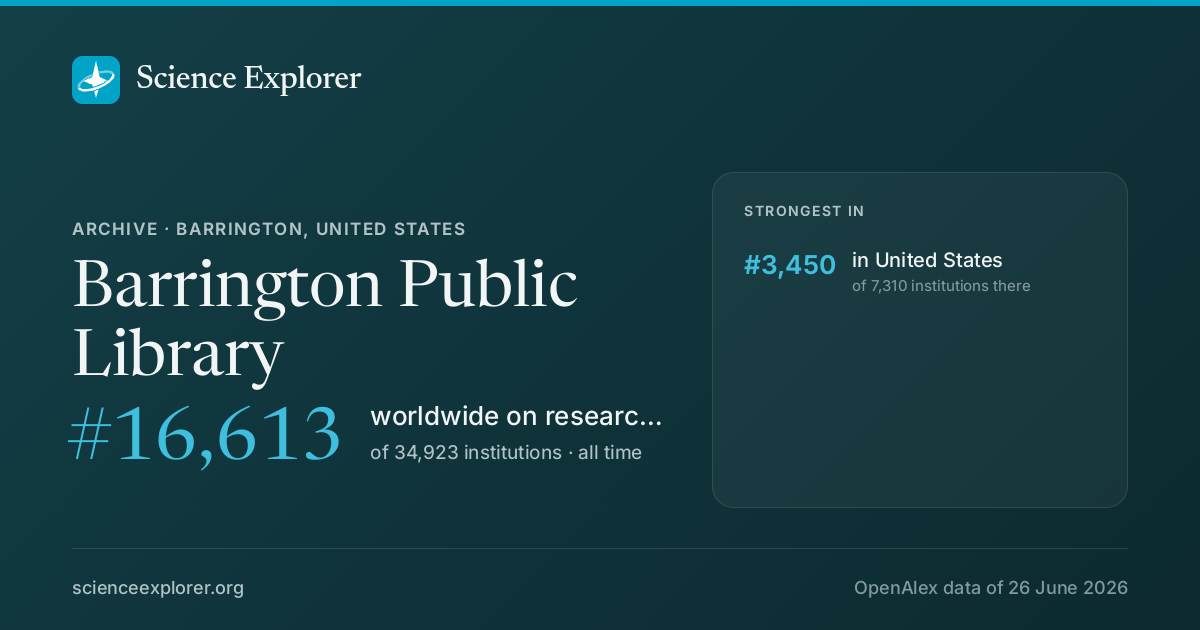
- #16,613 of 34,923
- Rank in United States
- #3,450 of 7,310
- Research works
- 328 ▲ 46% vs 2018-21
- Citations
- 2.4k 7.2 per fractional work
- Top-10% rate
- 1.8% all institutions 10.0%
- vs its own fields
- 0.83× 1.00× is exactly expected
- Open access
- 22% world 40%
- International
- 6% world 18%
Which fields of science does Barrington Public Library work in?
In 2022-now, 46% of research at Barrington Public Library is in Physical Sciences, 38% in Social Sciences. Its largest fields are Engineering (24%), Business, Management and Accounting (19%), Computer Science (14%). It does 1.4× the world's share of Social Sciences.
Each ring splits the one inside it: the four domains of science, their fields, their subfields. Size is fractional works in 2022-now. Every slice is a page; the interactive view zooms down to single topics and colours each by how much more of it this institution does than the world.
Its 4 domains and 17 fields, with their numbers
- Physical Sciences2245.8%
- Engineering1224.2%
- Computer Science714.0%
- Materials Science23.7%
- Physics and Astronomy12.4%
- Environmental Science11.6%
- Social Sciences1837.6%
- Health Sciences510.7%
- Medicine48.5%
- Health Professions11.5%
- Veterinary00.7%
- Life Sciences35.9%
Field profile
Location quotient across every field it publishes in: outside the ring is more than an institution of this size would be expected to publish, inside it is less.
Rings at 0.5×, 1× and 2×. Widest outward: Business, Management and Accounting, 5.8×. Every wedge is a field page.
All 17 fields, with their numbers
- Business, Management and Accounting5.75×9 works
- Veterinary5.02×0 works
- Psychology3.10×5 works
- Neuroscience2.10×2 works
- Computer Science1.80×7 works
- Engineering1.61×12 works
- Decision Sciences1.41×1 works
- Materials Science1.07×2 works
- Physics and Astronomy1.07×1 works
- Arts and Humanities1.06×2 works
- Health Professions0.56×1 works
- Medicine0.44×4 works
- Biochemistry, Genetics and Molecular Biology0.39×1 works
- Social Sciences0.36×2 works
- Economics, Econometrics and Finance0.32×0 works
- Environmental Science0.31×1 works
- Agricultural and Biological Sciences0.07×0 works
- Business, Management and Accounting 5.8×
- Veterinary 5.0×
- Psychology 3.1×
- Neuroscience 2.1×
- Computer Science 1.8×
- Engineering 1.6×
- Decision Sciences 1.4×
- Materials Science 1.1×
- Physics and Astronomy 1.1×
- Arts and Humanities 1.1×
- Health Professions 0.6×
- Medicine 0.4×
- Biochemistry, Genetics and Molecular Biology 0.4×
- Social Sciences 0.4×
- Economics, Econometrics and Finance 0.3×
- Environmental Science 0.3×
- Agricultural and Biological Sciences 0.1×
Who are the top researchers at Barrington Public Library?
Ranked on the quality score, Donald J. Norris, Anbazhagan Prabhakaran and Irene Cooper Willis lead among researchers whose main affiliation is Barrington Public Library.
- 1
Donald J. Norris
 United States · #2,950,337 worldwide
292 citations · 40 works
- 2
Anbazhagan Prabhakaran
United States · #3,334,483 worldwide
16 citations · 30 works
- 3
Irene Cooper Willis
United States · #3,335,344 worldwide
26 citations · 16 works
- 4
E. L. Hyem
United States · #3,374,248 worldwide
31 citations · 18 works
- 5
Rachel A. Fletcher
United States · #3,923,330 worldwide
124 citations · 30 works
- 6
Dorothy Bruce Weske
United States · #4,666,718 worldwide
5 citations · 19 works
- 7
Gail V. Barrington
United States · #4,979,372 worldwide
95 citations · 32 works
- 8
Chris Chiaverina
United States · #6,229,193 worldwide
55 citations · 54 works
Which keywords describe research at Barrington Public Library?
By fractional works in 2022-now, weighted toward what it does more of than the world: Leadership, Strategic Management, Change Management, Performance Improvement, Employee Engagement, Management, Requirements Engineering and Corporate Culture.
- MEMS
- Learning Organization
- Interconnect
- Fiber Optic Sensors
- Blue Ocean Strategy
- Thermal Management
- Executive Functioning
- High Temperature Sensors
- User-Centered Design
- Personas
- Knowledge Management
- Entrepreneurship
- Shared Mental Models
- Knowledge Sharing
- Empirical Studies
- Organizational Development
- Sustainable Development
- Management
- Employee Engagement
- Strategic Management
- Leadership
- Change Management
- Performance Improvement
- Requirements Engineering
- Corporate Culture
- Agile Software Development
- Microfabrication
- Digital Transformation
- Team Processes
- High-Speed Imaging
- Organizational Culture
- Thin Films
- Actuators
- Thin Film Thermocouples
- Psychological Interventions
- Autism Spectrum Disorders
- Business Strategy
- Integrated Circuits
- Leadership Development
- Low-k Dielectrics
Size is fractional works in 2022-now in the topics tagged with each word; colour is the word's share of this institution's work against its share of the world's. The 40 words are chosen for being large and distinctive. Each links to the topic it comes from most.
All 40 words, with their numbers
- Leadership6▲ 25×6 topics
- Strategic Management5▲ 78×3 topics
- Change Management5▲ 470×3 topics
- Employee Engagement5▲ 54×3 topics
- Performance Improvement5▲ 365×2 topics
- Management4▲ 11×2 topics
- Requirements Engineering4▲ 198×2 topics
- Sustainable Development4▲ 5.7×2 topics
- Corporate Culture4▲ 2606×1 topic
- Organizational Development4▲ 499×1 topic
- Agile Software Development3▲ 259×1 topic
- Empirical Studies3▲ 259×1 topic
- Microfabrication2▲ 105×2 topics
- Knowledge Sharing2▲ 28×2 topics
- Digital Transformation2▲ 7.6×4 topics
- Shared Mental Models2▲ 385×1 topic
- Team Processes2▲ 385×1 topic
- Entrepreneurship1▲ 6.9×2 topics
- High-Speed Imaging1▲ 39×3 topics
- Knowledge Management1▲ 4.9×3 topics
- Organizational Culture1▲ 7.1×2 topics
- Personas1▲ 272×1 topic
- Thin Films1▲ 14×2 topics
- User-Centered Design1▲ 100×1 topic
- Actuators1▲ 15×2 topics
- High Temperature Sensors1▲ 211×1 topic
- Thin Film Thermocouples1▲ 211×1 topic
- Executive Functioning1▲ 17×2 topics
- Psychological Interventions1▲ 16×2 topics
- Thermal Management1▲ 7.0×2 topics
- Autism Spectrum Disorders1▲ 20×1 topic
- Blue Ocean Strategy1▲ 225×1 topic
- Business Strategy1▲ 47×1 topic
- Fiber Optic Sensors1▲ 41×1 topic
- Integrated Circuits1▲ 14×2 topics
- Interconnect1▲ 123×1 topic
- Leadership Development1▲ 56×2 topics
- Learning Organization1▲ 154×2 topics
- Low-k Dielectrics1▲ 207×1 topic
- MEMS1▲ 111×1 topic
Which research topics does Barrington Public Library publish most on?
By volume in 2022-now: Leadership and Management in Organizations, Software Engineering Techniques and Practices, Team Dynamics and Performance and Persona Design and Applications.
Area is fractional works; colour is the subfield each topic belongs to.
- 1 Leadership and Management in Organizations Strategy and Management 4 works
- 2 Software Engineering Techniques and Practices Information Systems 3 works
- 3 Team Dynamics and Performance Social Psychology 2 works
- 4 Persona Design and Applications Human-Computer Interaction 1 works
- 5 Advanced Sensor Technologies Research Biomedical Engineering 1 works
- 6 Psychotherapy Techniques and Applications Clinical Psychology 1 works
- 7 3D IC and TSV technologies Electrical and Electronic Engineering 1 works
- 8 Autism Spectrum Disorder Research Cognitive Neuroscience 1 works
- 9 Academic Writing and Publishing History and Philosophy of Science 1 works
- 10 Business Strategies and Innovation Strategy and Management 1 works
How open and international is its research?
Against the world's own shares: the tick on each track. Both are shares of its output, so they sit on one scale and can be read against each other as well as against the world.
World: 40% of research is openly available.
World: 18% is written across borders.
How has Barrington Public Library's research output changed?
Output in 2022-2025 was 46% higher than in 2018-2021.
The same series as a ribbon: one cell per year, darker for more. The line above answers how much; this answers when.
Its share of all research
Growing output can still be a shrinking share: all of science grows. This is Barrington Public Library as a percentage of every work published that year, 0.000069% in 2024.
Fractional works of Barrington Public Library over all fractional works that year. How the balance of science has shifted.
Other research institutions in Barrington
Share Barrington Public Library's ranking
Badges for a website1Each links back here and updates with every snapshot

Research measures only: rankings here say nothing about teaching, admissions or student experience. Comparable institutions and collaboration partners have tabs of their own, above.
Discussion
Ask a question or share a note about Barrington Public Library. Keep it to the research: no personal attacks, advertising or links. Any reader can report a post, which collapses it for everyone until it is opened.