Science Explorer Back to mapMap
Discussion
Hospital / health system · Ankara · Türkiye

Bayındır Hastanesi

In research, Bayındır Hastanesi stands highest in Medicine (#10,270 of 14,558 worldwide) and Health Sciences (#12,520 of 16,688 worldwide), over all time.

World rank, all time
#29,352
of 34,923
Rank in Türkiye
#301
of 335
Research works
294
▲ 19% vs 2018-21
Citations
4.1k
13.8 per fractional work
Top-10% rate
6.9%
all institutions 10.0%
vs its own fields
0.77×
1.00× is exactly expected
Open access
38%
world 40%
International
14%
world 18%

What is Bayındır Hastanesi known for in research?

The fields where it stands highest, over all time, ranked among every institution above the floor in each field.

FieldWorld rankWhere that sitsTop-10% rateWorks
MedicineField #10,270 of 14,558 3.8%221
Health SciencesDomain #12,520 of 16,688 3.9%232

Each strip is that field's whole ranked pool, with the notch where Bayındır Hastanesi sits in it, in the colour of the band that rank falls in. The track under the rate is the rate itself: it carries no average mark, because the average differs by field (from about 6% in Dentistry to 21% in Economics).

Which fields of science does Bayındır Hastanesi work in?

In 2022-now, 75% of research at Bayındır Hastanesi is in Health Sciences, 10% in Life Sciences. Its largest fields are Medicine (68%), Agricultural and Biological Sciences (6%), Health Professions (4%). It does 2.7× the world's share of Health Sciences.

Health Sciences: 33 fractional works · 75.2% of its workMedicine: 30 fractional works · 68.0% of its workSurgery: 7 fractional works · 16.0% of its workCardiology and Cardiovascular Medicine: 2 fractional works · 4.8% of its workNeurology: 2 fractional works · 4.8% of its workPulmonary and Respiratory Medicine: 2 fractional works · 4.4% of its workPathology and Forensic Medicine: 2 fractional works · 4.3% of its workEpidemiology: 2 fractional works · 4.1% of its workRadiology, Nuclear Medicine and Imaging: 2 fractional works · 3.4% of its workRheumatology: 1 fractional works · 2.9% of its workPsychiatry and Mental health: 1 fractional works · 2.3% of its workDermatology: 1 fractional works · 1.6% of its workOphthalmology: 1 fractional works · 1.5% of its workTransplantation: 1 fractional works · 1.5% of its workHematology: 1 fractional works · 1.4% of its workPediatrics, Perinatology and Child Health: 1 fractional works · 1.3% of its workPublic Health, Environmental and Occupational Health: 1 fractional works · 1.2% of its workUrology: 1 fractional works · 1.2% of its workEndocrinology, Diabetes and Metabolism: 1 fractional works · 1.2% of its workHepatology: 0 fractional works · 1.1% of its workNephrology: 0 fractional works · 1.1% of its workInfectious Diseases: 0 fractional works · 1.1% of its workPhysiology: 0 fractional works · 1.1% of its workOncology: 0 fractional works · 1.0% of its workGenetics: 0 fractional works · 1.0% of its workOtorhinolaryngology: 0 fractional works · 0.7% of its workRehabilitation: 0 fractional works · 0.7% of its workGastroenterology: 0 fractional works · 0.4% of its workObstetrics and Gynecology: 0 fractional works · 0.4% of its workReproductive Medicine: 0 fractional works · 0.4% of its workEmergency Medicine: 0 fractional works · 0.2% of its workPharmacology: 0 fractional works · 0.2% of its workHealth Professions: 2 fractional works · 4.0% of its workGeneral Health Professions: 1 fractional works · 1.6% of its workOccupational Therapy: 1 fractional works · 1.3% of its workRadiological and Ultrasound Technology: 0 fractional works · 0.6% of its workMedical Laboratory Technology: 0 fractional works · 0.2% of its workSpeech and Hearing: 0 fractional works · 0.2% of its workDentistry: 1 fractional works · 2.5% of its workOrthodontics: 0 fractional works · 1.0% of its workGeneral Dentistry: 0 fractional works · 0.7% of its workOral Surgery: 0 fractional works · 0.7% of its workSmaller subfields together: 0 fractional works · 0.0% of its workNursing: 0 fractional works · 0.5% of its workNutrition and Dietetics: 0 fractional works · 0.5% of its workVeterinary: 0 fractional works · 0.2% of its workLife Sciences: 4 fractional works · 10.2% of its workAgricultural and Biological Sciences: 3 fractional works · 5.9% of its workPlant Science: 2 fractional works · 3.9% of its workEcology, Evolution, Behavior and Systematics: 0 fractional works · 1.1% of its workAquatic Science: 0 fractional works · 0.4% of its workSoil Science: 0 fractional works · 0.4% of its workSmaller subfields together: 0 fractional works · 0.1% of its workNeuroscience: 1 fractional works · 2.0% of its workCellular and Molecular Neuroscience: 0 fractional works · 1.0% of its workNeurology: 0 fractional works · 0.6% of its workCognitive Neuroscience: 0 fractional works · 0.2% of its workSensory Systems: 0 fractional works · 0.2% of its workBiochemistry, Genetics and Molecular Biology: 1 fractional works · 1.5% of its workGenetics: 0 fractional works · 0.7% of its workMolecular Biology: 0 fractional works · 0.6% of its workSmaller subfields together: 0 fractional works · 0.2% of its workImmunology and Microbiology: 0 fractional works · 0.7% of its workMicrobiology: 0 fractional works · 0.5% of its workSmaller subfields together: 0 fractional works · 0.3% of its workSocial Sciences: 4 fractional works · 8.4% of its workArts and Humanities: 1 fractional works · 2.4% of its workPhilosophy: 0 fractional works · 0.7% of its workLanguage and Linguistics: 0 fractional works · 0.5% of its workReligious studies: 0 fractional works · 0.4% of its workLiterature and Literary Theory: 0 fractional works · 0.3% of its workMuseology: 0 fractional works · 0.2% of its workSmaller subfields together: 0 fractional works · 0.2% of its workSocial Sciences: 1 fractional works · 1.9% of its workSociology and Political Science: 1 fractional works · 1.2% of its workEducation: 0 fractional works · 0.3% of its workPolitical Science and International Relations: 0 fractional works · 0.2% of its workSmaller subfields together: 0 fractional works · 0.2% of its workPsychology: 1 fractional works · 1.9% of its workClinical Psychology: 1 fractional works · 1.6% of its workSocial Psychology: 0 fractional works · 0.3% of its workEconomics, Econometrics and Finance: 1 fractional works · 1.5% of its workEconomics and Econometrics: 1 fractional works · 1.2% of its workGeneral Economics, Econometrics and Finance: 0 fractional works · 0.2% of its workBusiness, Management and Accounting: 0 fractional works · 0.7% of its workMarketing: 0 fractional works · 0.7% of its workPhysical Sciences: 3 fractional works · 6.2% of its workEngineering: 1 fractional works · 2.9% of its workMechanical Engineering: 1 fractional works · 1.6% of its workBiomedical Engineering: 1 fractional works · 1.2% of its workEnvironmental Science: 1 fractional works · 1.9% of its workHealth, Toxicology and Mutagenesis: 0 fractional works · 1.0% of its workEnvironmental Engineering: 0 fractional works · 0.5% of its workGlobal and Planetary Change: 0 fractional works · 0.2% of its workSmaller subfields together: 0 fractional works · 0.2% of its workPhysics and Astronomy: 0 fractional works · 1.1% of its workAstronomy and Astrophysics: 0 fractional works · 0.7% of its workNuclear and High Energy Physics: 0 fractional works · 0.4% of its workMathematics: 0 fractional works · 0.2% of its workStatistics and Probability: 0 fractional works · 0.2% of its workALL ITS WORKBayındırHastanesi44fractional works, 2022-now
Life Sciences10%Physical Sciences6%Health Sciences75%Social Sciences8%

Each ring splits the one inside it: the four domains of science, their fields, their subfields. Size is fractional works in 2022-now. Every slice is a page; the interactive view zooms down to single topics and colours each by how much more of it this institution does than the world.

Its 4 domains and 18 fields, with their numbers
    1. Medicine3068.0%
    2. Health Professions24.0%
    3. Dentistry12.5%
    4. Nursing00.5%
    5. Veterinary00.2%
    1. Agricultural and Biological Sciences35.9%
    2. Neuroscience12.0%
    3. Biochemistry, Genetics and Molecular Biology11.5%
    4. Immunology and Microbiology00.7%
    1. Arts and Humanities12.4%
    2. Social Sciences11.9%
    3. Psychology11.9%
    4. Economics, Econometrics and Finance11.5%
    5. Business, Management and Accounting00.7%
    1. Engineering12.9%
    2. Environmental Science11.9%
    3. Physics and Astronomy01.1%
    4. Mathematics00.2%
All of science, and how each field's share has moved since 1950: the Science domain explorer

Field profile

Location quotient across every field it publishes in: outside the ring is more than an institution of this size would be expected to publish, inside it is less.

Agricultural and Biological Sciences: 1.25× its world share, 3 worksAgricultural and Bio…Biochemistry, Genetics and Molecular Biology: 0.28× its world share, 1 worksBiochemistry, Geneti…Immunology and Microbiology: 0.75× its world share, 0 worksImmunology and Micro…Neuroscience: 1.24× its world share, 1 worksNeuroscienceEngineering: 0.19× its world share, 1 worksEngineeringEnvironmental Science: 0.39× its world share, 1 worksEnvironmental ScienceMathematics: 0.21× its world share, 0 worksMathematicsPhysics and Astronomy: 0.51× its world share, 0 worksPhysics and AstronomyDentistry: 5.18× its world share, 1 worksDentistryHealth Professions: 1.51× its world share, 2 worksHealth ProfessionsMedicine: 3.54× its world share, 30 worksMedicineNursing: 1.03× its world share, 0 worksNursingVeterinary: 1.11× its world share, 0 worksVeterinaryArts and Humanities: 0.84× its world share, 1 worksArts and HumanitiesBusiness, Management and Accounting: 0.23× its world share, 0 worksBusiness, Management…Economics, Econometrics and Finance: 0.69× its world share, 1 worksEconomics, Econometr…Psychology: 0.61× its world share, 1 worksPsychologySocial Sciences: 0.15× its world share, 1 worksSocial Sciences1×world share
more than its size predictsabout as predictedless

Rings at 0.5×, 1× and 2×. Widest outward: Dentistry, 5.2×. Every wedge is a field page.

All 18 fields, with their numbers
  1. Dentistry5.18×1 works
  2. Medicine3.54×30 works
  3. Health Professions1.51×2 works
  4. Agricultural and Biological Sciences1.25×3 works
  5. Neuroscience1.24×1 works
  6. Veterinary1.11×0 works
  7. Nursing1.03×0 works
  8. Arts and Humanities0.84×1 works
  9. Immunology and Microbiology0.75×0 works
  10. Economics, Econometrics and Finance0.69×1 works
  11. Psychology0.61×1 works
  12. Physics and Astronomy0.51×0 works
  13. Environmental Science0.39×1 works
  14. Biochemistry, Genetics and Molecular Biology0.28×1 works
  15. Business, Management and Accounting0.23×0 works
  16. Mathematics0.21×0 works
  17. Engineering0.19×1 works
  18. Social Sciences0.15×1 works

Who are the top researchers at Bayındır Hastanesi?

Ranked on the quality score, Anar Mammadli, Necati Bingöl and Hazım Dinçer lead among researchers whose main affiliation is Bayındır Hastanesi.

  1. 1 Anar Mammadli Türkiye · #4,617,799 worldwide 39 citations · 32 works
  2. 2 Necati Bingöl Türkiye · #4,683,348 worldwide 1.1k citations · 39 works
  3. 3 Hazım Dinçer Türkiye · #4,744,085 worldwide 93 citations · 21 works
  4. 4 Gürler Iliçin Türkiye · #4,747,466 worldwide 136 citations · 18 works
  5. 5 Izak Dalva Türkiye · #4,850,923 worldwide 123 citations · 21 works
  6. 6 Tuncay Özçelik Türkiye · #5,095,685 worldwide 143 citations · 22 works
  7. 7 Tuğba Oskay Türkiye · #5,300,769 worldwide 365 citations · 27 works
  8. 8 Can Özer Türkiye · #5,403,047 worldwide 136 citations · 32 works
  9. 9 Mutlu Güngör Türkiye · #5,430,181 worldwide 257 citations · 33 works
  10. 10 Ali R. Koksal Türkiye · #5,485,476 worldwide 46 citations · 33 works
All ranked researchers at Bayındır Hastanesi

What are the most cited papers from Bayındır Hastanesi?

The most cited paper from Bayındır Hastanesi is "Revisiting the vicious circle of dry eye disease: a focus on the pathophysiology of meibomian gland dysfunction" (Christophe Baudouin, Elisabeth M. Messmer, Pasquale Aragona et al., 2016), with 521 citations. Next come "Role of Hyperosmolarity in the Pathogenesis and Management of Dry Eye Disease: Proceedings of the OCEAN Group Meeting" (507) and "Long-Term Clinical and Angiographic Outcomes Following Pipeline Embolization Device Treatment of Complex Internal Carotid Artery Aneurysms: Five-Year Results of the Pipeline for Uncoilable or Failed Aneurysms Trial" (447).

Most cited papers
#PaperReleasedCitations
1 Revisiting the vicious circle of dry eye disease: a focus on the pathophysiology of meibomian gland dysfunction Christophe Baudouin, Elisabeth M. Messmer, Pasquale Aragona et al. · British Journal of Ophthalmology Open access 18 Jan 2016 521
2 Role of Hyperosmolarity in the Pathogenesis and Management of Dry Eye Disease: Proceedings of the OCEAN Group Meeting Christophe Baudouin, Pasquale Aragona, Elisabeth M. Messmer et al. · The Ocular Surface Open access 9 Aug 2013 507
3 Long-Term Clinical and Angiographic Outcomes Following Pipeline Embolization Device Treatment of Complex Internal Carotid Artery Aneurysms: Five-Year Results of the Pipeline for Uncoilable or Failed Aneurysms Trial Tibor Becske et al. · Neurosurgery 5 Dec 2016 447
4 Chitosan films and hydrogels of chlorhexidine gluconate for oral mucosal delivery Sevda Şenel, G İkinci, S Kaş et al. · International Journal of Pharmaceutics 2000 301
5 Posterior Fixation of Thoracolumbar Burst Fracture Gündüz Tezeren, İlhami Kuru · Journal of Spinal Disorders & Techniques 23 Nov 2005 256
All 60 most cited papers, with filters and sorting

Which keywords describe research at Bayındır Hastanesi?

By fractional works in 2022-now, weighted toward what it does more of than the world: Epidemiology, Treatment, Quality of Life, Genetic Mutations, Surgical Management, Immunosuppressive Therapy, Endothelial Dysfunction and Rehabilitation.

▲ more of its work than of the world's◆ about the world's share▼ less than the world's

Size is fractional works in 2022-now in the topics tagged with each word; colour is the word's share of this institution's work against its share of the world's. The 26 words are chosen for being large and distinctive. Each links to the topic it comes from most.

All 26 words, with their numbers
  1. Epidemiology6▲ 3.5×36 topics
  2. Treatment4▲ 6.7×16 topics
  3. Quality of Life3▲ 4.6×11 topics
  4. Inflammation2▲ 2.2×14 topics
  5. Diagnosis2▲ 3.7×11 topics
  6. Genetic Mutations1▲ 7.3×11 topics
  7. Immunosuppressive Therapy1▲ 15×3 topics
  8. Surgical Management1▲ 7.4×7 topics
  9. Complications1▲ 5.3×7 topics
  10. Endothelial Dysfunction1▲ 12×3 topics
  11. Neurological Disorders1▲ 4.8×6 topics
  12. Prevention1▲ 6.6×6 topics
  13. Rehabilitation1▲ 7.0×4 topics
  14. Autoantibodies1▲ 11×2 topics
  15. Clinical Practice Guidelines1▲ 4.7×6 topics
  16. Cost Analysis1▲ 51×2 topics
  17. Fibrosis1▲ 13×2 topics
  18. Immunotherapy1▲ 3.6×9 topics
  19. Management1▲ 3.1×9 topics
  20. Neuroimaging1▲ 9.1×6 topics
  21. Prognostic Factors1▲ 5.7×8 topics
  22. Risk Factors1▲ 2.4×6 topics
  23. Clinical Guidelines1▲ 7.9×4 topics
  24. Heart Failure1▲ 5.2×5 topics
  25. Pulmonary Involvement1▲ 62×1 topic
  26. Systemic Sclerosis1▲ 62×1 topic

Which research topics does Bayındır Hastanesi publish most on?

By volume in 2022-now: Systemic Sclerosis and Related Diseases, Pressure Ulcer Prevention and Management, Hematopoietic Stem Cell Transplantation and Diagnosis and Treatment of Venous Diseases.

  1. 1 Systemic Sclerosis and Related Diseases Pathology and Forensic Medicine 1 works
  2. 2 Pressure Ulcer Prevention and Management Occupational Therapy 1 works
  3. 3 Hematopoietic Stem Cell Transplantation Hematology 1 works
  4. 4 Diagnosis and Treatment of Venous Diseases Surgery 0 works
  5. 5 Health Systems, Economic Evaluations, Quality of Life Economics and Econometrics 0 works
  6. 6 Surgical site infection prevention Surgery 0 works
  7. 7 Pelvic floor disorders treatments Rheumatology 0 works
  8. 8 Dental materials and restorations Orthodontics 0 works
  9. 9 Shoulder and Clavicle Injuries Epidemiology 0 works
  10. 10 Urinary Bladder and Prostate Research Urology 0 works

How open and international is its research?

Against the world's own shares: the tick on each track. Both are shares of its output, so they sit on one scale and can be read against each other as well as against the world.

openly available38.5%not open61.5%

World: 40% of research is openly available.

with international co-authors13.9%domestic only86.1%

World: 18% is written across borders.

How has Bayındır Hastanesi's research output changed?

Output in 2022-2025 was 19% higher than in 2018-2021.

still counting1990200020102020
grewheldshrank

The same series as a ribbon: one cell per year, darker for more. The line above answers how much; this answers when.

Its share of all research

Growing output can still be a shrinking share: all of science grows. This is Bayındır Hastanesi as a percentage of every work published that year, 0.00015% in 2024.

still counting0.00050%0.0010%0.0015%Bayındır Hastanesi0.00020% in 202519801990200020102020

Fractional works of Bayındır Hastanesi over all fractional works that year. How the balance of science has shifted.

Other research institutions in Ankara

All research institutions in Ankara

Share Bayındır Hastanesi's ranking
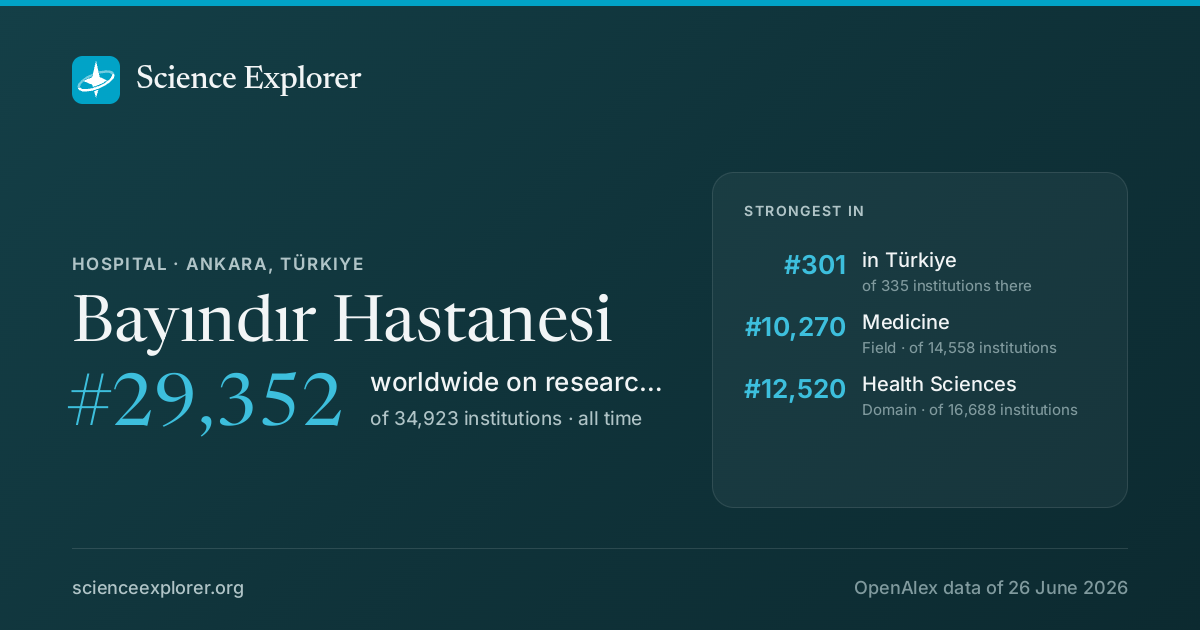
Bayındır Hastanesi on Science Explorer

A card with Bayındır Hastanesi's standing and the fields it leads in, for a post or a slide. A link to this page previews as the same card.

Download the card

1200 × 630 PNG, sized for social posts, drawn from the latest snapshot.

Badges for a website1Each links back here and updates with every snapshot

Research measures only: rankings here say nothing about teaching, admissions or student experience. Comparable institutions and collaboration partners have tabs of their own, above.

Discussion

Ask a question or share a note about Bayındır Hastanesi. Keep it to the research: no personal attacks, advertising or links. Any reader can report a post, which collapses it for everyone until it is opened.