Science Explorer Back to mapMap
Hospital / health system · Sheffield · United Kingdom

BresMed

World rank, all time
#33,626
of 34,923
Rank in United Kingdom
#1,799
of 1,844
Research works
151
▼ 70% vs 2018-21
Citations
1.3k
8.4 per fractional work
Top-10% rate
3.1%
all institutions 10.0%
vs its own fields
0.90×
1.00× is exactly expected
Open access
43%
world 40%
International
43%
world 18%

Which fields of science does BresMed work in?

In all years, 53% of research at BresMed is in Health Sciences, 30% in Social Sciences. Its largest fields are Medicine (50%), Economics, Econometrics and Finance (27%), Biochemistry, Genetics and Molecular Biology (6%). It does 2.2× the world's share of Health Sciences.

Health Sciences: 81 fractional works · 53.5% of its workMedicine: 75 fractional works · 49.8% of its workOncology: 12 fractional works · 7.8% of its workPulmonary and Respiratory Medicine: 7 fractional works · 4.9% of its workHematology: 6 fractional works · 4.3% of its workPublic Health, Environmental and Occupational Health: 5 fractional works · 3.3% of its workGenetics: 4 fractional works · 2.7% of its workPediatrics, Perinatology and Child Health: 4 fractional works · 2.7% of its workPsychiatry and Mental health: 4 fractional works · 2.6% of its workSurgery: 4 fractional works · 2.4% of its workEndocrinology, Diabetes and Metabolism: 4 fractional works · 2.4% of its workPathology and Forensic Medicine: 3 fractional works · 2.0% of its workRheumatology: 3 fractional works · 1.7% of its workGastroenterology: 3 fractional works · 1.7% of its workNephrology: 3 fractional works · 1.7% of its workPharmacology: 2 fractional works · 1.4% of its workOphthalmology: 2 fractional works · 1.3% of its workPhysiology: 2 fractional works · 1.1% of its workEpidemiology: 1 fractional works · 1.0% of its workCardiology and Cardiovascular Medicine: 1 fractional works · 0.9% of its workRadiology, Nuclear Medicine and Imaging: 1 fractional works · 0.8% of its workHepatology: 1 fractional works · 0.8% of its workGeriatrics and Gerontology: 1 fractional works · 0.4% of its workNeurology: 1 fractional works · 0.4% of its workCritical Care and Intensive Care Medicine: 0 fractional works · 0.3% of its workInternal Medicine: 0 fractional works · 0.2% of its workDermatology: 0 fractional works · 0.2% of its workSmaller subfields together: 1 fractional works · 0.7% of its workHealth Professions: 5 fractional works · 3.0% of its workGeneral Health Professions: 3 fractional works · 2.0% of its workEmergency Medical Services: 1 fractional works · 0.9% of its workSmaller subfields together: 0 fractional works · 0.2% of its workNursing: 1 fractional works · 0.4% of its workNutrition and Dietetics: 0 fractional works · 0.3% of its workSmaller subfields together: 0 fractional works · 0.1% of its workDentistry: 0 fractional works · 0.2% of its workVeterinary: 0 fractional works · 0.1% of its workSocial Sciences: 46 fractional works · 30.3% of its workEconomics, Econometrics and Finance: 41 fractional works · 26.9% of its workEconomics and Econometrics: 41 fractional works · 26.9% of its workBusiness, Management and Accounting: 2 fractional works · 1.4% of its workManagement of Technology and Innovation: 1 fractional works · 0.4% of its workMarketing: 0 fractional works · 0.3% of its workOrganizational Behavior and Human Resource Management: 0 fractional works · 0.3% of its workBusiness and International Management: 0 fractional works · 0.2% of its workSmaller subfields together: 0 fractional works · 0.1% of its workSocial Sciences: 2 fractional works · 1.1% of its workSociology and Political Science: 1 fractional works · 0.9% of its workSmaller subfields together: 0 fractional works · 0.2% of its workPsychology: 1 fractional works · 0.8% of its workSocial Psychology: 1 fractional works · 0.7% of its workSmaller subfields together: 0 fractional works · 0.2% of its workDecision Sciences: 0 fractional works · 0.1% of its workLife Sciences: 17 fractional works · 11.6% of its workBiochemistry, Genetics and Molecular Biology: 9 fractional works · 5.9% of its workMolecular Biology: 5 fractional works · 3.4% of its workGenetics: 2 fractional works · 1.4% of its workClinical Biochemistry: 1 fractional works · 0.5% of its workCancer Research: 1 fractional works · 0.4% of its workMolecular Medicine: 0 fractional works · 0.3% of its workImmunology and Microbiology: 5 fractional works · 3.2% of its workImmunology: 4 fractional works · 2.7% of its workApplied Microbiology and Biotechnology: 1 fractional works · 0.5% of its workNeuroscience: 2 fractional works · 1.0% of its workCellular and Molecular Neuroscience: 1 fractional works · 0.5% of its workCognitive Neuroscience: 0 fractional works · 0.3% of its workBiological Psychiatry: 0 fractional works · 0.2% of its workPharmacology, Toxicology and Pharmaceutics: 1 fractional works · 1.0% of its workPharmacology: 1 fractional works · 0.8% of its workSmaller subfields together: 0 fractional works · 0.1% of its workAgricultural and Biological Sciences: 1 fractional works · 0.5% of its workPlant Science: 1 fractional works · 0.5% of its workPhysical Sciences: 7 fractional works · 4.6% of its workMathematics: 3 fractional works · 2.2% of its workStatistics and Probability: 3 fractional works · 2.1% of its workSmaller subfields together: 0 fractional works · 0.1% of its workEngineering: 1 fractional works · 0.9% of its workBiomedical Engineering: 0 fractional works · 0.2% of its workCivil and Structural Engineering: 0 fractional works · 0.2% of its workSafety, Risk, Reliability and Quality: 0 fractional works · 0.2% of its workSmaller subfields together: 0 fractional works · 0.2% of its workMaterials Science: 1 fractional works · 0.4% of its workElectronic, Optical and Magnetic Materials: 0 fractional works · 0.2% of its workMaterials Chemistry: 0 fractional works · 0.2% of its workComputer Science: 1 fractional works · 0.4% of its workInformation Systems: 0 fractional works · 0.2% of its workSmaller subfields together: 0 fractional works · 0.2% of its workEnvironmental Science: 1 fractional works · 0.3% of its workEarth and Planetary Sciences: 0 fractional works · 0.2% of its workAtmospheric Science: 0 fractional works · 0.2% of its workPhysics and Astronomy: 0 fractional works · 0.1% of its workChemistry: 0 fractional works · 0.0% of its workALL ITS WORKBresMed151fractional works, all years
Life Sciences12%Physical Sciences5%Health Sciences53%Social Sciences30%

Each ring splits the one inside it: the four domains of science, their fields, their subfields. Size is fractional works in all years. Every slice is a page; the interactive view zooms down to single topics and colours each by how much more of it this institution does than the world.

Its 4 domains and 23 fields, with their numbers
    1. Medicine7549.8%
    2. Health Professions53.0%
    3. Nursing10.4%
    4. Dentistry00.2%
    5. Veterinary00.1%
    1. Economics, Econometrics and Finance4126.9%
    2. Business, Management and Accounting21.4%
    3. Social Sciences21.1%
    4. Psychology10.8%
    5. Decision Sciences00.1%
    1. Biochemistry, Genetics and Molecular Biology95.9%
    2. Immunology and Microbiology53.2%
    3. Neuroscience21.0%
    4. Pharmacology, Toxicology and Pharmaceutics11.0%
    5. Agricultural and Biological Sciences10.5%
    1. Mathematics32.2%
    2. Engineering10.9%
    3. Materials Science10.4%
    4. Computer Science10.4%
    5. Environmental Science10.3%
    6. Earth and Planetary Sciences00.2%
    7. Physics and Astronomy00.1%
    8. Chemistry00.0%
All of science, and how each field's share has moved since 1950: the Science domain explorer

Field profile

Location quotient across every field it publishes in: outside the ring is more than an institution of this size would be expected to publish, inside it is less.

Biochemistry, Genetics and Molecular Biology: 3.01× its world share, 2 worksBiochemistry, Geneti…Immunology and Microbiology: 7.71× its world share, 1 worksImmunology and Micro…Neuroscience: 0.34× its world share, 0 worksNeuroscienceMathematics: 1.41× its world share, 0 worksMathematicsHealth Professions: 1.12× its world share, 0 worksHealth ProfessionsMedicine: 2.44× its world share, 7 worksMedicineBusiness, Management and Accounting: 0.69× its world share, 0 worksBusiness, Management…Economics, Econometrics and Finance: 10.02× its world share, 3 worksEconomics, Econometr…Social Sciences: 0.04× its world share, 0 worksSocial Sciences1×world share
more than its size predictsabout as predictedless

Rings at 0.5×, 1× and 2×. Widest outward: Economics, Econometrics and Finance, 10.0×. Every wedge is a field page.

All 9 fields, with their numbers
  1. Economics, Econometrics and Finance10.02×3 works
  2. Immunology and Microbiology7.71×1 works
  3. Biochemistry, Genetics and Molecular Biology3.01×2 works
  4. Medicine2.44×7 works
  5. Mathematics1.41×0 works
  6. Health Professions1.12×0 works
  7. Business, Management and Accounting0.69×0 works
  8. Neuroscience0.34×0 works
  9. Social Sciences0.04×0 works

Who are the top researchers at BresMed?

Ranked on the quality score, Sarah C. Smith, Neil Roskell and Ronald R. Kidd lead among researchers whose main affiliation is BresMed.

  1. 1 Sarah C. Smith United Kingdom · #1,368,132 worldwide 1.3k citations · 327 works
  2. 2 Neil Roskell United Kingdom · #2,256,719 worldwide 1.4k citations · 43 works
  3. 3 Ronald R. Kidd United Kingdom · #2,275,184 worldwide 65 citations · 45 works
  4. 4 Matthew Hemstock United Kingdom · #2,326,654 worldwide 87 citations · 16 works
  5. 5 Ann-Marie Chapman United Kingdom · #2,570,643 worldwide 320 citations · 26 works
  6. 6 Joshua K. Porter United Kingdom · #2,840,335 worldwide 225 citations · 17 works
  7. 7 Marieke Schurer United Kingdom · #2,961,471 worldwide 87 citations · 16 works
  8. 8 Owain Saunders United Kingdom · #3,147,384 worldwide 444 citations · 19 works
  9. 9 Ash Bullement United Kingdom · #3,150,195 worldwide 685 citations · 68 works
  10. 10 Elizabeth Thurgar United Kingdom · #3,588,206 worldwide 163 citations · 29 works
All ranked researchers at BresMed

What are the most cited papers from BresMed?

The most cited paper from BresMed is "Using Matching-Adjusted Indirect Comparisons and Network Meta-analyses to Compare Efficacy of Brexanolone Injection with Selective Serotonin Reuptake Inhibitors for Treating Postpartum Depression" (Miranda Cooper, H. Kilvert, Paul Hodgkins et al., 2019), with 192 citations. Next come "Estimated Effects of Different Alcohol Taxation and Price Policies on Health Inequalities: A Mathematical Modelling Study" (166) and "The Budget Impact of Biosimilar Infliximab (Remsima®) for the Treatment of Autoimmune Diseases in Five European Countries" (147).

Most cited papers
#PaperReleasedCitations
1 Using Matching-Adjusted Indirect Comparisons and Network Meta-analyses to Compare Efficacy of Brexanolone Injection with Selective Serotonin Reuptake Inhibitors for Treating Postpartum Depression Miranda Cooper, H. Kilvert, Paul Hodgkins et al. · CNS Drugs Open access Oct 2019 192
2 Estimated Effects of Different Alcohol Taxation and Price Policies on Health Inequalities: A Mathematical Modelling Study Petra Sylvia Meier, John Holmes, Colin Angus et al. · PLoS Medicine Open access 23 Feb 2016 166
3 The Budget Impact of Biosimilar Infliximab (Remsima®) for the Treatment of Autoimmune Diseases in Five European Countries Ashok Kumar Jha, Alex Upton, W. Dunlop et al. · Advances in Therapy Open access Aug 2015 147
4 A Framework for Developing the Structure of Public Health Economic Models Hazel Squires, James B. Chilcott, Ronald L. Akehurst et al. · Value in Health Open access 30 Apr 2016 126
5 Variation in Health Technology Assessment and Reimbursement Processes in Europe Ronald L. Akehurst, Eric C. Abadie, Noël Renaudin et al. · Value in Health Open access 3 Nov 2016 124
All 60 most cited papers, with filters and sorting

Which keywords describe research at BresMed?

By fractional works in all years, weighted toward what it does more of than the world: Quality of Life, Cost-effectiveness Analysis, Health Utility Measures, Pharmaceutical Industry, Clinical Trials, Drug Development Costs, Generic Drugs and Inflammation.

▲ more of its work than of the world's◆ about the world's share▼ less than the world's

Size is fractional works in all years in the topics tagged with each word; colour is the word's share of this institution's work against its share of the world's. The 40 words are chosen for being large and distinctive. Each links to the topic it comes from most.

All 40 words, with their numbers
  1. Quality of Life25▲ 12×8 topics
  2. Cost-effectiveness Analysis23▲ 195×1 topic
  3. Health Utility Measures23▲ 195×1 topic
  4. Inflammation11▲ 3.0×17 topics
  5. Clinical Trials9▲ 9.6×11 topics
  6. Pharmaceutical Industry9▲ 149×2 topics
  7. Epidemiology9▲ 1.41×24 topics
  8. Drug Development Costs8▲ 204×1 topic
  9. Generic Drugs8▲ 204×1 topic
  10. Immunotherapy6▲ 5.7×7 topics
  11. Cost of Care5▲ 192×1 topic
  12. Financial Toxicity5▲ 192×1 topic
  13. Genetics5▲ 4.3×8 topics
  14. Diagnosis5▲ 3.0×13 topics
  15. Classification4▲ 8.1×2 topics
  16. Tumor Microenvironment4▲ 8.3×5 topics
  17. Chemotherapy4▲ 3.9×11 topics
  18. Lymphoma4▲ 18×2 topics
  19. Cardiovascular Risk4▲ 7.2×6 topics
  20. Hypertension3▲ 6.3×3 topics
  21. Prognostic Factors3▲ 5.0×8 topics
  22. Rituximab3▲ 14×3 topics
  23. Minimal Residual Disease3▲ 33×2 topics
  24. Antiepileptic Drugs3▲ 21×2 topics
  25. Medication Adherence3▲ 37×2 topics
  26. Drug Resistance3▲ 6.4×2 topics
  27. Off-Label Drug Use3▲ 55×1 topic
  28. Pediatric Pharmacokinetics3▲ 55×1 topic
  29. Immune Checkpoint Blockade3▲ 34×1 topic
  30. PD-1 and PD-L13▲ 34×1 topic
  31. Prognostic Scoring System3▲ 54×2 topics
  32. Biosimilars3▲ 122×1 topic
  33. Diagnosis Criteria3▲ 61×1 topic
  34. Immunogenicity3▲ 36×1 topic
  35. International Myeloma Working Group3▲ 61×1 topic
  36. JAK2 Mutation3▲ 88×1 topic
  37. Monoclonal Antibodies3▲ 13×2 topics
  38. Myelofibrosis3▲ 88×1 topic
  39. PET Imaging3▲ 8.4×4 topics
  40. Targeted Therapy3▲ 8.3×4 topics

Which research topics does BresMed publish most on?

By volume in 2022-now: Muscle Physiology and Disorders, Innovation Policy and R&D, Health Systems, Economic Evaluations, Quality of Life and Economic and Financial Impacts of Cancer.

  1. 1 Muscle Physiology and Disorders Molecular Biology 2 works
  2. 2 Innovation Policy and R&D Economics and Econometrics 1 works
  3. 3 Health Systems, Economic Evaluations, Quality of Life Economics and Econometrics 1 works
  4. 4 Economic and Financial Impacts of Cancer Economics and Econometrics 1 works
  5. 5 Lung Cancer Treatments and Mutations Pulmonary and Respiratory Medicine 1 works
  6. 6 Mast cells and histamine Immunology 1 works
  7. 7 Multiple Myeloma Research and Treatments Hematology 1 works
  8. 8 Viral-associated cancers and disorders Oncology 0 works
  9. 9 Gastric Cancer Management and Outcomes Pulmonary and Respiratory Medicine 0 works
  10. 10 Antibiotic Use and Resistance Applied Microbiology and Biotechnology 0 works

How open and international is its research?

Against the world's own shares: the tick on each track. Both are shares of its output, so they sit on one scale and can be read against each other as well as against the world.

openly available43.1%not open56.9%

World: 40% of research is openly available.

with international co-authors42.8%domestic only57.2%

World: 18% is written across borders.

How has BresMed's research output changed?

Output in 2022-2025 was 70% lower than in 2018-2021.

still counting1990200020102020
grewheldshrank

The same series as a ribbon: one cell per year, darker for more. The line above answers how much; this answers when.

Its share of all research

Growing output can still be a shrinking share: all of science grows. This is BresMed as a percentage of every work published that year, 0.0000011% in 2024.

still counting0.00020%0.00040%0.00060%BresMed0.0000034% in 20251990200020102020

Fractional works of BresMed over all fractional works that year. How the balance of science has shifted.

Other research institutions in Sheffield

All research institutions in Sheffield

Share BresMed's ranking

BresMed on Science Explorer

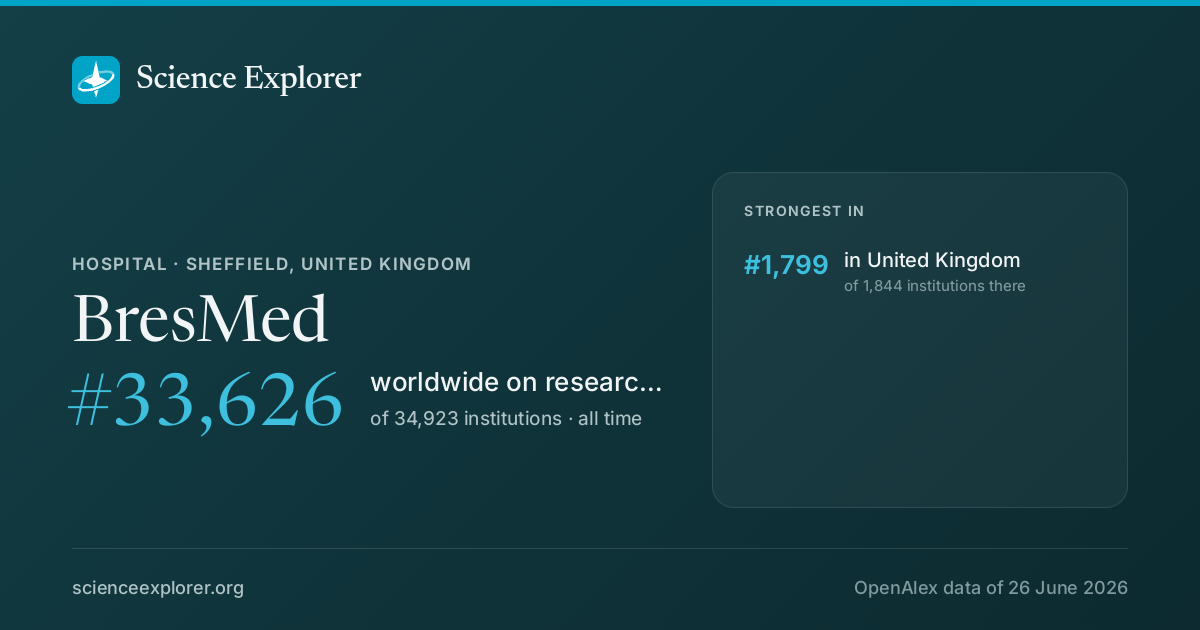
A card with BresMed's standing and the fields it leads in, for a post or a slide. A link to this page previews as the same card.

Download the card

1200 × 630 PNG, sized for social posts, drawn from the latest snapshot.

Badges for a website1Each links back here and updates with every snapshot

Research measures only: rankings here say nothing about teaching, admissions or student experience. Comparable institutions and collaboration partners have tabs of their own, above.

Discussion

Ask a question or share a note about BresMed. Posts are plain text and can be reported.