Science Explorer Back to mapMap
Discussion
Nonprofit · Prague · Czechia

Centre For Innovation And Development

World rank, all time
#30,459
of 34,923
Rank in Czechia
#149
of 198
Research works
143
▼ 5% vs 2018-21
Citations
729
5.1 per fractional work
Top-10% rate
4.9%
all institutions 10.0%
vs its own fields
0.89×
1.00× is exactly expected
Open access
27%
world 40%
International
23%
world 18%

Which fields of science does Centre For Innovation And Development work in?

In all years, 45% of research at Centre For Innovation And Development is in Physical Sciences, 29% in Social Sciences. Its largest fields are Computer Science (24%), Agricultural and Biological Sciences (12%), Engineering (11%). It does 1.3× the world's share of Social Sciences.

Physical Sciences: 65 fractional works · 45.4% of its workComputer Science: 34 fractional works · 24.1% of its workComputer Networks and Communications: 21 fractional works · 14.6% of its workComputer Vision and Pattern Recognition: 5 fractional works · 3.5% of its workArtificial Intelligence: 4 fractional works · 2.7% of its workInformation Systems: 2 fractional works · 1.2% of its workComputer Graphics and Computer-Aided Design: 1 fractional works · 0.7% of its workHuman-Computer Interaction: 1 fractional works · 0.7% of its workSignal Processing: 1 fractional works · 0.7% of its workEngineering: 16 fractional works · 11.0% of its workElectrical and Electronic Engineering: 10 fractional works · 6.9% of its workMedia Technology: 2 fractional works · 1.2% of its workOcean Engineering: 2 fractional works · 1.1% of its workAerospace Engineering: 1 fractional works · 0.6% of its workControl and Systems Engineering: 1 fractional works · 0.5% of its workBiomedical Engineering: 1 fractional works · 0.4% of its workAutomotive Engineering: 0 fractional works · 0.2% of its workSmaller subfields together: 0 fractional works · 0.2% of its workEnvironmental Science: 8 fractional works · 5.8% of its workManagement, Monitoring, Policy and Law: 4 fractional works · 2.7% of its workEcology: 1 fractional works · 0.8% of its workGlobal and Planetary Change: 1 fractional works · 0.5% of its workWater Science and Technology: 1 fractional works · 0.5% of its workEnvironmental Chemistry: 1 fractional works · 0.4% of its workPollution: 0 fractional works · 0.3% of its workSmaller subfields together: 1 fractional works · 0.6% of its workMaterials Science: 2 fractional works · 1.6% of its workMaterials Chemistry: 1 fractional works · 1.0% of its workBiomaterials: 0 fractional works · 0.2% of its workSmaller subfields together: 0 fractional works · 0.3% of its workEarth and Planetary Sciences: 2 fractional works · 1.5% of its workEarth-Surface Processes: 1 fractional works · 0.7% of its workOceanography: 1 fractional works · 0.5% of its workSpace and Planetary Science: 0 fractional works · 0.2% of its workSmaller subfields together: 0 fractional works · 0.1% of its workPhysics and Astronomy: 1 fractional works · 0.9% of its workAtomic and Molecular Physics, and Optics: 1 fractional works · 0.6% of its workStatistical and Nonlinear Physics: 0 fractional works · 0.3% of its workEnergy: 0 fractional works · 0.3% of its workRenewable Energy, Sustainability and the Environment: 0 fractional works · 0.3% of its workChemistry: 0 fractional works · 0.2% of its workMathematics: 0 fractional works · 0.1% of its workChemical Engineering: 0 fractional works · 0.0% of its workSocial Sciences: 41 fractional works · 28.6% of its workSocial Sciences: 15 fractional works · 10.3% of its workSociology and Political Science: 4 fractional works · 3.1% of its workPolitical Science and International Relations: 3 fractional works · 1.9% of its workGender Studies: 2 fractional works · 1.2% of its workSafety Research: 1 fractional works · 0.9% of its workUrban Studies: 1 fractional works · 0.8% of its workEducation: 1 fractional works · 0.8% of its workLaw: 1 fractional works · 0.4% of its workDemography: 0 fractional works · 0.4% of its workTransportation: 0 fractional works · 0.3% of its workCommunication: 0 fractional works · 0.2% of its workSmaller subfields together: 0 fractional works · 0.1% of its workBusiness, Management and Accounting: 13 fractional works · 9.4% of its workStrategy and Management: 7 fractional works · 4.6% of its workManagement of Technology and Innovation: 4 fractional works · 3.0% of its workAccounting: 1 fractional works · 0.7% of its workBusiness and International Management: 0 fractional works · 0.3% of its workMarketing: 0 fractional works · 0.3% of its workOrganizational Behavior and Human Resource Management: 0 fractional works · 0.3% of its workSmaller subfields together: 0 fractional works · 0.1% of its workEconomics, Econometrics and Finance: 4 fractional works · 2.9% of its workEconomics and Econometrics: 2 fractional works · 1.6% of its workGeneral Economics, Econometrics and Finance: 2 fractional works · 1.1% of its workSmaller subfields together: 0 fractional works · 0.2% of its workArts and Humanities: 3 fractional works · 2.3% of its workPhilosophy: 2 fractional works · 1.2% of its workConservation: 1 fractional works · 0.8% of its workVisual Arts and Performing Arts: 0 fractional works · 0.2% of its workSmaller subfields together: 0 fractional works · 0.2% of its workPsychology: 3 fractional works · 2.3% of its workDevelopmental and Educational Psychology: 1 fractional works · 0.9% of its workNeuropsychology and Physiological Psychology: 1 fractional works · 0.7% of its workSocial Psychology: 1 fractional works · 0.5% of its workExperimental and Cognitive Psychology: 0 fractional works · 0.2% of its workDecision Sciences: 2 fractional works · 1.5% of its workManagement Science and Operations Research: 1 fractional works · 1.0% of its workInformation Systems and Management: 1 fractional works · 0.5% of its workLife Sciences: 22 fractional works · 15.4% of its workAgricultural and Biological Sciences: 17 fractional works · 11.7% of its workPlant Science: 4 fractional works · 2.7% of its workGeneral Agricultural and Biological Sciences: 3 fractional works · 2.3% of its workEcology, Evolution, Behavior and Systematics: 3 fractional works · 2.0% of its workAgronomy and Crop Science: 2 fractional works · 1.1% of its workAquatic Science: 2 fractional works · 1.1% of its workFood Science: 1 fractional works · 1.0% of its workAnimal Science and Zoology: 1 fractional works · 0.7% of its workForestry: 1 fractional works · 0.5% of its workSmaller subfields together: 0 fractional works · 0.3% of its workBiochemistry, Genetics and Molecular Biology: 4 fractional works · 2.8% of its workMolecular Biology: 3 fractional works · 1.8% of its workCancer Research: 0 fractional works · 0.3% of its workGenetics: 0 fractional works · 0.3% of its workBiophysics: 0 fractional works · 0.2% of its workSmaller subfields together: 0 fractional works · 0.2% of its workNeuroscience: 1 fractional works · 0.9% of its workCellular and Molecular Neuroscience: 0 fractional works · 0.3% of its workCognitive Neuroscience: 0 fractional works · 0.2% of its workDevelopmental Neuroscience: 0 fractional works · 0.2% of its workSmaller subfields together: 0 fractional works · 0.2% of its workImmunology and Microbiology: 0 fractional works · 0.0% of its workHealth Sciences: 15 fractional works · 10.6% of its workMedicine: 8 fractional works · 5.5% of its workPublic Health, Environmental and Occupational Health: 2 fractional works · 1.1% of its workEpidemiology: 1 fractional works · 1.0% of its workRheumatology: 1 fractional works · 0.8% of its workSurgery: 1 fractional works · 0.7% of its workInfectious Diseases: 0 fractional works · 0.3% of its workCritical Care and Intensive Care Medicine: 0 fractional works · 0.2% of its workSmaller subfields together: 2 fractional works · 1.4% of its workHealth Professions: 7 fractional works · 4.6% of its workGeneral Health Professions: 6 fractional works · 4.2% of its workMedical Laboratory Technology: 0 fractional works · 0.2% of its workSmaller subfields together: 0 fractional works · 0.2% of its workNursing: 0 fractional works · 0.2% of its workNutrition and Dietetics: 0 fractional works · 0.2% of its workDentistry: 0 fractional works · 0.1% of its workVeterinary: 0 fractional works · 0.0% of its workALL ITS WORKCentre ForInnovation And…143fractional works, all years
Life Sciences15%Physical Sciences45%Health Sciences11%Social Sciences29%

Each ring splits the one inside it: the four domains of science, their fields, their subfields. Size is fractional works in all years. Every slice is a page; the interactive view zooms down to single topics and colours each by how much more of it this institution does than the world.

Its 4 domains and 25 fields, with their numbers
    1. Computer Science3424.1%
    2. Engineering1611.0%
    3. Environmental Science85.8%
    4. Materials Science21.6%
    5. Earth and Planetary Sciences21.5%
    6. Physics and Astronomy10.9%
    7. Energy00.3%
    8. Chemistry00.2%
    9. Mathematics00.1%
    10. Chemical Engineering00.0%
    1. Social Sciences1510.3%
    2. Business, Management and Accounting139.4%
    3. Economics, Econometrics and Finance42.9%
    4. Arts and Humanities32.3%
    5. Psychology32.3%
    6. Decision Sciences21.5%
    1. Agricultural and Biological Sciences1711.7%
    2. Biochemistry, Genetics and Molecular Biology42.8%
    3. Neuroscience10.9%
    4. Immunology and Microbiology00.0%
    1. Medicine85.5%
    2. Health Professions74.6%
    3. Nursing00.2%
    4. Dentistry00.1%
    5. Veterinary00.0%
All of science, and how each field's share has moved since 1950: the Science domain explorer

Field profile

Location quotient across every field it publishes in: outside the ring is more than an institution of this size would be expected to publish, inside it is less.

Agricultural and Biological Sciences: 4.68× its world share, 3 worksAgricultural and Bio…Biochemistry, Genetics and Molecular Biology: 0.84× its world share, 1 worksBiochemistry, Geneti…Computer Science: 0.40× its world share, 0 worksComputer ScienceEarth and Planetary Sciences: 0.76× its world share, 0 worksEarth and Planetary …Engineering: 0.45× its world share, 1 worksEngineeringEnvironmental Science: 1.11× its world share, 1 worksEnvironmental ScienceDentistry: 2.66× its world share, 0 worksDentistryHealth Professions: 0.76× its world share, 0 worksHealth ProfessionsMedicine: 0.28× its world share, 1 worksMedicineArts and Humanities: 0.56× its world share, 0 worksArts and HumanitiesBusiness, Management and Accounting: 6.46× its world share, 3 worksBusiness, Management…Decision Sciences: 4.46× its world share, 1 worksDecision SciencesEconomics, Econometrics and Finance: 0.67× its world share, 0 worksEconomics, Econometr…Social Sciences: 1.58× its world share, 3 worksSocial Sciences1×world share
more than its size predictsabout as predictedless

Rings at 0.5×, 1× and 2×. Widest outward: Business, Management and Accounting, 6.5×. Every wedge is a field page.

All 14 fields, with their numbers
  1. Business, Management and Accounting6.46×3 works
  2. Agricultural and Biological Sciences4.68×3 works
  3. Decision Sciences4.46×1 works
  4. Dentistry2.66×0 works
  5. Social Sciences1.58×3 works
  6. Environmental Science1.11×1 works
  7. Biochemistry, Genetics and Molecular Biology0.84×1 works
  8. Earth and Planetary Sciences0.76×0 works
  9. Health Professions0.76×0 works
  10. Economics, Econometrics and Finance0.67×0 works
  11. Arts and Humanities0.56×0 works
  12. Engineering0.45×1 works
  13. Computer Science0.40×0 works
  14. Medicine0.28×1 works

Who are the top researchers at Centre For Innovation And Development?

Ranked on the quality score, F. Alan Andersen, Abdelhamid Mellouk and A Mellouk lead among researchers whose main affiliation is Centre For Innovation And Development.

  1. 1 F. Alan Andersen Czechia · #1,919,503 worldwide 1.3k citations · 31 works
  2. 2 Abdelhamid Mellouk Czechia · #2,806,375 worldwide 237 citations · 19 works
  3. 3 A Mellouk Czechia · #3,044,624 worldwide 187 citations · 43 works
  4. 4 H.L. Zingstra Czechia · #3,334,451 worldwide 43 citations · 28 works
All ranked researchers at Centre For Innovation And Development

What are the most cited papers from Centre For Innovation And Development?

The most cited paper from Centre For Innovation And Development is "Path Creation as a Process of Resource Alignment and Anchoring: Industry Formation for On-Site Water Recycling in Beijing" (Christian Binz, Bernhard Truffer, Lars Coenen, 2015), with 339 citations. Next come "Hierarchical electrospun nanofibers for energy harvesting, production and environmental remediation" (322) and "Endogenous florendoviruses are major components of plant genomes and hallmarks of virus evolution" (129).

Most cited papers
#PaperReleasedCitations
1 Path Creation as a Process of Resource Alignment and Anchoring: Industry Formation for On-Site Water Recycling in Beijing Christian Binz, Bernhard Truffer, Lars Coenen · Economic Geography Open access 7 Dec 2015 339
2 Hierarchical electrospun nanofibers for energy harvesting, production and environmental remediation Palaniswamy Suresh Kumar, Sundaramurthy Jayaraman, Subramanian Sundarrajan et al. · Energy & Environmental Science Open access 2014 322
3 Endogenous florendoviruses are major components of plant genomes and hallmarks of virus evolution Andrew D. W. Geering, Florian Maumus, Dario Copetti et al. · Nature Communications Open access 10 Nov 2014 129
4 Gut : liver : brain axis: the microbial challenge in the hepatic encephalopathy Andrea Mancini, Francesca Campagna, Piero Amodio et al. · Food & Function 2018 90
5 Lower-limb prostheses and wheelchairs in low-income countries [An Overview] Jonathan L. Pearlman, Rory A. Cooper, Marc Krizack et al. · IEEE Engineering in Medicine and Biology Magazine Mar 2008 87
All 61 most cited papers, with filters and sorting

Which keywords describe research at Centre For Innovation And Development?

By fractional works in all years, weighted toward what it does more of than the world: Sustainability, Wireless Networks, Routing Protocols, Energy Efficiency, Innovation, Power Control, Wireless Sensor Networks and Mobile Ad Hoc Networks.

▲ more of its work than of the world's◆ about the world's share▼ less than the world's

Size is fractional works in all years in the topics tagged with each word; colour is the word's share of this institution's work against its share of the world's. The 40 words are chosen for being large and distinctive. Each links to the topic it comes from most.

All 40 words, with their numbers
  1. Sustainability11▲ 4.3×22 topics
  2. Deep Learning8▲ 2.5×10 topics
  3. Wireless Networks7▲ 22×7 topics
  4. Climate Change7▲ 1.83×18 topics
  5. Globalization6▲ 2.4×14 topics
  6. Innovation6▲ 4.7×13 topics
  7. Energy Efficiency6▲ 5.3×7 topics
  8. Routing Protocols6▲ 50×3 topics
  9. Sustainable Development5▲ 3.1×10 topics
  10. Power Control5▲ 29×3 topics
  11. Mobile Ad Hoc Networks5▲ 48×2 topics
  12. Mobility Models5▲ 48×2 topics
  13. Wireless Sensor Networks5▲ 8.4×6 topics
  14. Environmental Impact4▲ 2.3×14 topics
  15. Image Quality Assessment4▲ 170×1 topic
  16. Perceptual Quality4▲ 170×1 topic
  17. Channel Assignment4▲ 26×3 topics
  18. Social Capital4▲ 6.7×8 topics
  19. Smallholder Farmers4▲ 18×5 topics
  20. 5G Networks4▲ 20×3 topics
  21. Mobile Networks4▲ 36×2 topics
  22. Resource Allocation3▲ 10×3 topics
  23. Adaptation3▲ 7.2×5 topics
  24. Ad Hoc Networks3▲ 55×1 topic
  25. Clustering Algorithms3▲ 19×2 topics
  26. Congestion Control3▲ 74×1 topic
  27. TCP3▲ 74×1 topic
  28. Wireless Mesh Networks3▲ 55×1 topic
  29. Content Delivery3▲ 31×2 topics
  30. Intelligent Transportation Systems3▲ 21×2 topics
  31. Sustainable Agriculture3▲ 6.9×4 topics
  32. Strategic Alliances3▲ 17×2 topics
  33. Distributed Systems2▲ 7.2×4 topics
  34. MAC Protocols2▲ 23×2 topics
  35. Network Virtualization2▲ 63×1 topic
  36. Resource Management2▲ 10.0×3 topics
  37. Software-Defined Networking2▲ 63×1 topic
  38. DSRC Standards2▲ 81×1 topic
  39. Vehicular Ad Hoc Networks2▲ 81×1 topic
  40. Participatory Design2▲ 44×2 topics

Which research topics does Centre For Innovation And Development publish most on?

By volume in 2022-now: Agriculture and Rural Development Research, Psychometric Methodologies and Testing, Sensory Analysis and Statistical Methods and Human auditory perception and evaluation.

  1. 1 Agriculture and Rural Development Research Ecology, Evolution, Behavior and Systematics 1 works
  2. 2 Psychometric Methodologies and Testing Management Science and Operations Research 1 works
  3. 3 Sensory Analysis and Statistical Methods Food Science 1 works
  4. 4 Human auditory perception and evaluation Aerospace Engineering 1 works
  5. 5 Private Equity and Venture Capital Accounting 0 works
  6. 6 Innovation and Socioeconomic Development Business and International Management 0 works
  7. 7 Service and Product Innovation Marketing 0 works
  8. 8 Gender Diversity and Inequality Gender Studies 0 works
  9. 9 Social Sciences and Governance Urban Studies 0 works
  10. 10 Coleoptera Taxonomy and Distribution Ecology, Evolution, Behavior and Systematics 0 works

How open and international is its research?

Against the world's own shares: the tick on each track. Both are shares of its output, so they sit on one scale and can be read against each other as well as against the world.

openly available26.7%not open73.3%

World: 40% of research is openly available.

with international co-authors23.0%domestic only77.0%

World: 18% is written across borders.

How has Centre For Innovation And Development's research output changed?

Output in 2022-2025 was 5% lower than in 2018-2021.

still counting1990200020102020
grewheldshrank

The same series as a ribbon: one cell per year, darker for more. The line above answers how much; this answers when.

Its share of all research

Growing output can still be a shrinking share: all of science grows. This is Centre For Innovation And Development as a percentage of every work published that year, 0.000040% in 2024.

still counting0.00020%0.00040%0.00060%Centre For Innovation And Development0.000098% in 202519801990200020102020

Fractional works of Centre For Innovation And Development over all fractional works that year. How the balance of science has shifted.

Other research institutions in Prague

All research institutions in Prague

Share Centre For Innovation And Development's ranking
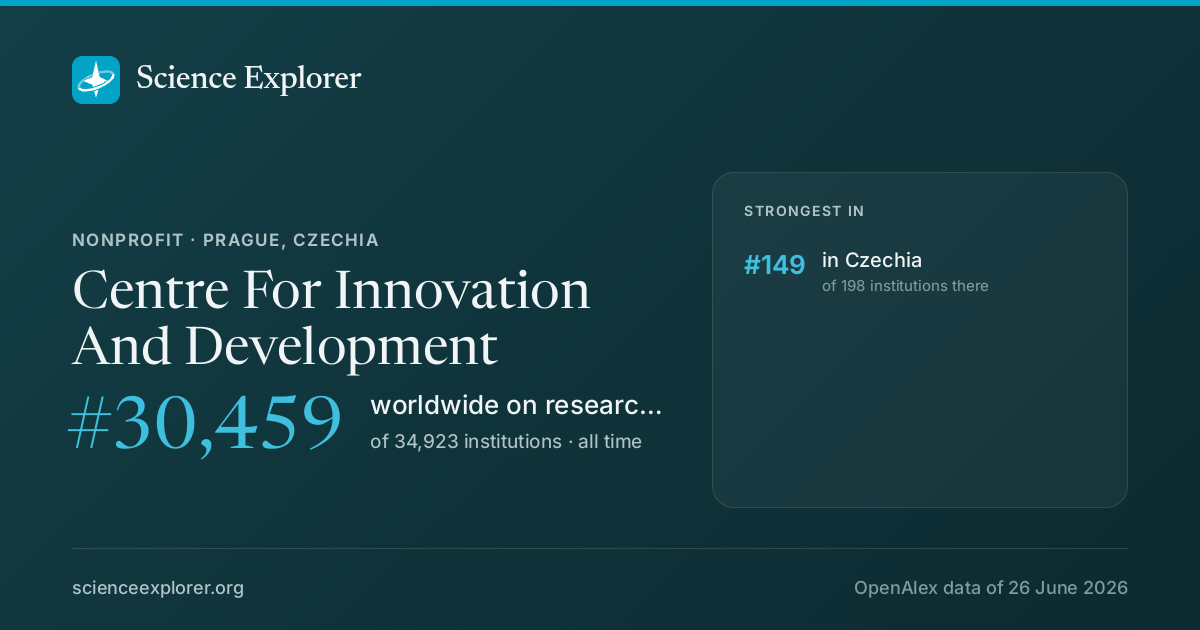
Centre For Innovation And Development on Science Explorer

A card with Centre For Innovation And Development's standing and the fields it leads in, for a post or a slide. A link to this page previews as the same card.

Download the card

1200 × 630 PNG, sized for social posts, drawn from the latest snapshot.

Badges for a website1Each links back here and updates with every snapshot

Research measures only: rankings here say nothing about teaching, admissions or student experience. Comparable institutions and collaboration partners have tabs of their own, above.

Discussion

Ask a question or share a note about Centre For Innovation And Development. Keep it to the research: no personal attacks, advertising or links. Any reader can report a post, which collapses it for everyone until it is opened.