Children's Hospital
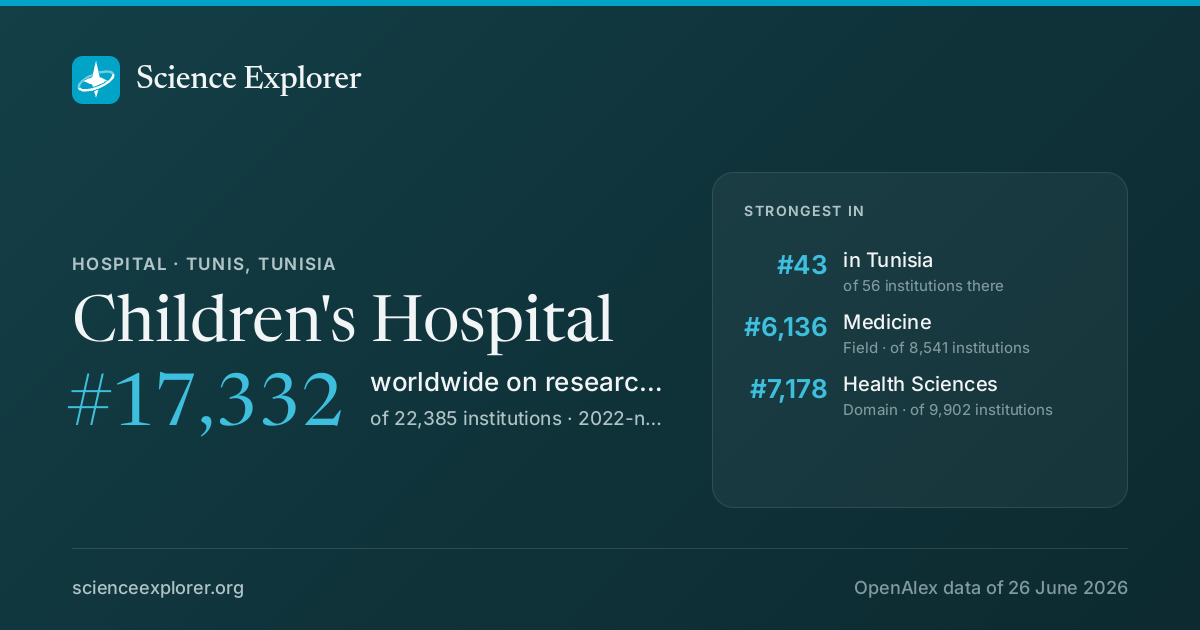
In research, Children's Hospital stands highest in Medicine (#6,136 of 8,541 worldwide) and Health Sciences (#7,178 of 9,902 worldwide), 2022-now.
- World rank, 2022-now
- #17,332 of 22,385 · #9,177 all time
- Rank in Tunisia
- #43 of 56
- Research works
- 1.7k ▼ 13% vs 2018-21
- Citations
- 42k 23.9 per fractional work
- Top-10% rate
- 4.2% all institutions 10.0%
- vs its own fields
- 0.80× 1.00× is exactly expected
- Open access
- 38% world 40%
- International
- 60% world 18%
What is Children's Hospital known for in research?
The fields where it stands highest, 2022-now, ranked among every institution above the floor in each field.
| Field | World rank | Where that sits | Top-10% rate | Works | All time |
|---|---|---|---|---|---|
| MedicineField | #6,136 of 8,541 | 3.8% | 141 | #3579 | |
| Health SciencesDomain | #7,178 of 9,902 | 3.8% | 154 | #4084 |
Each strip is that field's whole ranked pool, with the notch where Children's Hospital sits in it, in the colour of the band that rank falls in. The track under the rate is the rate itself: it carries no average mark, because the average differs by field (from about 6% in Dentistry to 21% in Economics).
Which fields of science does Children's Hospital work in?
In 2022-now, 78% of research at Children's Hospital is in Health Sciences, 15% in Life Sciences. Its largest fields are Medicine (71%), Biochemistry, Genetics and Molecular Biology (9%), Health Professions (5%). It does 3.3× the world's share of Health Sciences.
Each ring splits the one inside it: the four domains of science, their fields, their subfields. Size is fractional works in 2022-now. Every slice is a page; the interactive view zooms down to single topics and colours each by how much more of it this institution does than the world.
Its 4 domains and 26 fields, with their numbers
- Health Sciences17478.4%
- Medicine15971.5%
- Health Professions125.3%
- Nursing31.3%
- Veterinary00.2%
- Dentistry00.1%
- Life Sciences3214.6%
- Social Sciences83.8%
- Physical Sciences73.2%
- Engineering31.2%
- Computer Science10.6%
- Environmental Science10.6%
- Chemistry10.3%
- Physics and Astronomy10.3%
- Mathematics00.1%
- Materials Science00.1%
- Earth and Planetary Sciences00.0%
- Chemical Engineering00.0%
- Energy00.0%
Field profile
Location quotient across every field it publishes in: outside the ring is more than an institution of this size would be expected to publish, inside it is less.
Rings at 0.5×, 1× and 2×. Widest outward: Medicine, 3.7×. Every wedge is a field page.
All 26 fields, with their numbers
- Medicine3.72×159 works
- Immunology and Microbiology2.97×7 works
- Nursing2.66×3 works
- Health Professions2.01×12 works
- Biochemistry, Genetics and Molecular Biology1.66×20 works
- Veterinary1.66×0 works
- Neuroscience1.41×5 works
- Psychology0.79×5 works
- Pharmacology, Toxicology and Pharmaceutics0.33×0 works
- Dentistry0.23×0 works
- Chemistry0.21×1 works
- Decision Sciences0.16×0 works
- Physics and Astronomy0.14×1 works
- Economics, Econometrics and Finance0.12×1 works
- Environmental Science0.11×1 works
- Computer Science0.08×1 works
- Engineering0.08×3 works
- Agricultural and Biological Sciences0.07×1 works
- Mathematics0.06×0 works
- Social Sciences0.06×2 works
- Chemical Engineering0.04×0 works
- Arts and Humanities0.04×0 works
- Earth and Planetary Sciences0.02×0 works
- Materials Science0.02×0 works
- Energy0.01×0 works
- Business, Management and Accounting0.01×0 works
- Medicine 3.7×
- Immunology and Microbiology 3.0×
- Nursing 2.7×
- Health Professions 2.0×
- Biochemistry, Genetics and Molecular Biology 1.7×
- Veterinary 1.7×
- Neuroscience 1.4×
- Psychology 0.8×
- Pharmacology, Toxicology and Pharmaceutics 0.3×
- Dentistry 0.2×
- Chemistry 0.2×
- Decision Sciences 0.2×
- Physics and Astronomy 0.1×
- Economics, Econometrics and Finance 0.1×
- Environmental Science 0.1×
- Computer Science 0.1×
- Engineering 0.1×
- Agricultural and Biological Sciences 0.1×
- Mathematics 0.1×
- Social Sciences 0.1×
- Chemical Engineering 0.0×
- Arts and Humanities 0.0×
- Earth and Planetary Sciences 0.0×
- Materials Science 0.0×
- Energy 0.0×
- Business, Management and Accounting 0.0×
Who are the top researchers at Children's Hospital?
Ranked on the quality score, Amina Bibi, S. Ghorbel and Asma Bouziri lead among researchers whose main affiliation is Children's Hospital.
- 1
Amina Bibi
 Tunisia · #2,512,785 worldwide
1.2k citations · 86 works
- 2
S. Ghorbel
Tunisia · #3,274,007 worldwide
276 citations · 25 works
- 3
Asma Bouziri
Tunisia · #3,334,953 worldwide
1.1k citations · 55 works
- 4
Ammar Khaldi
Tunisia · #3,487,092 worldwide
773 citations · 25 works
- 5
Asma Hamdi
Tunisia · #3,623,418 worldwide
876 citations · 23 works
- 6
Harald Christiansen
Tunisia · #4,129,438 worldwide
890 citations · 36 works
- 7
Saïda Ben Becher
Tunisia · #4,591,617 worldwide
652 citations · 18 works
- 8
Yessine Amri
Tunisia · #4,730,865 worldwide
168 citations · 49 works
- 9
L. Essaddam
Tunisia · #4,753,886 worldwide
315 citations · 45 works
- 10
Nejla Ben Jaballah
Tunisia · #4,776,026 worldwide
922 citations · 33 works
Which keywords describe research at Children's Hospital?
By fractional works in 2022-now, weighted toward what it does more of than the world: Epidemiology, Genetic Mutations, Diagnosis, Prenatal Diagnosis, Treatment, Surgical Management, SARS-CoV-2 and Management.
- Behçet's Disease
- Lung Stem Cells
- Bronchopulmonary Dysplasia
- Thrombosis
- Surgery
- Congenital Diaphragmatic Hernia
- Immunosuppressive Therapy
- Vaccine Development
- Preterm Infants
- Pathogenesis
- Pathophysiology
- Juvenile Idiopathic Arthritis
- Genetics
- Pandemic
- Pulmonary Hypertension
- SARS-CoV-2
- Surgical Management
- Management
- Diagnosis
- Inflammation
- Epidemiology
- Treatment
- Genetic Mutations
- Prenatal Diagnosis
- Complications
- Cardiovascular Disease
- Meta-Analysis
- Children
- Chemotherapy
- Extracorporeal Membrane Oxygenation
- Congenital Anomalies
- Fetal Surgery
- Prognostic Factors
- Immune Response
- ACE2 Receptor
- Lung Volume
- Neurodevelopmental Outcomes
- Respiratory Distress Syndrome
- Clinical Management
- Surfactant Proteins
Size is fractional works in 2022-now in the topics tagged with each word; colour is the word's share of this institution's work against its share of the world's. The 40 words are chosen for being large and distinctive. Each links to the topic it comes from most.
All 40 words, with their numbers
- Epidemiology43▲ 4.9×82 topics
- Inflammation11▲ 2.4×36 topics
- Treatment11▲ 3.9×30 topics
- Diagnosis10▲ 4.8×25 topics
- Genetic Mutations10▲ 10×18 topics
- Management8▲ 4.8×21 topics
- Prenatal Diagnosis8▲ 24×6 topics
- Surgical Management8▲ 8.3×14 topics
- Complications7▲ 6.6×12 topics
- SARS-CoV-27▲ 10×5 topics
- Cardiovascular Disease7▲ 2.7×19 topics
- Pulmonary Hypertension6▲ 19×3 topics
- Meta-Analysis6▲ 4.5×6 topics
- Pandemic6▲ 2.6×7 topics
- Children6▲ 11×7 topics
- Genetics6▲ 3.5×11 topics
- Chemotherapy5▲ 3.4×12 topics
- Juvenile Idiopathic Arthritis5▲ 45×2 topics
- Extracorporeal Membrane Oxygenation5▲ 29×2 topics
- Pathophysiology5▲ 7.5×8 topics
- Congenital Anomalies5▲ 39×3 topics
- Pathogenesis5▲ 4.3×13 topics
- Fetal Surgery5▲ 39×3 topics
- Preterm Infants5▲ 17×4 topics
- Prognostic Factors5▲ 4.9×10 topics
- Vaccine Development5▲ 8.2×7 topics
- Immune Response5▲ 3.6×8 topics
- Immunosuppressive Therapy4▲ 11×7 topics
- ACE2 Receptor4▲ 8.8×3 topics
- Congenital Diaphragmatic Hernia4▲ 70×1 topic
- Lung Volume4▲ 70×1 topic
- Surgery4▲ 5.6×7 topics
- Neurodevelopmental Outcomes4▲ 9.4×5 topics
- Thrombosis4▲ 6.3×5 topics
- Respiratory Distress Syndrome4▲ 20×2 topics
- Bronchopulmonary Dysplasia3▲ 24×2 topics
- Clinical Management3▲ 9.0×6 topics
- Lung Stem Cells3▲ 26×1 topic
- Surfactant Proteins3▲ 26×1 topic
- Behçet's Disease3▲ 50×1 topic
Which research topics does Children's Hospital publish most on?
By volume in 2022-now: Congenital Diaphragmatic Hernia Studies, Neonatal Respiratory Health Research, Ocular Diseases and Behçet’s Syndrome and Immunodeficiency and Autoimmune Disorders.
Area is fractional works; colour is the subfield each topic belongs to.
- 1 Congenital Diaphragmatic Hernia Studies Surgery 4 works
- 2 Neonatal Respiratory Health Research Pulmonary and Respiratory Medicine 3 works
- 3 Ocular Diseases and Behçet’s Syndrome Ophthalmology 3 works
- 4 Immunodeficiency and Autoimmune Disorders Immunology 3 works
- 5 COVID-19 Clinical Research Studies Infectious Diseases 3 works
- 6 Respiratory viral infections research Epidemiology 3 works
- 7 Connective tissue disorders research Genetics 3 works
- 8 Congenital Anomalies and Fetal Surgery Surgery 2 works
- 9 Hemoglobinopathies and Related Disorders Genetics 2 works
- 10 Urological Disorders and Treatments Urology 2 works
How open and international is its research?
Against the world's own shares: the tick on each track. Both are shares of its output, so they sit on one scale and can be read against each other as well as against the world.
World: 40% of research is openly available.
World: 18% is written across borders.
How has Children's Hospital's research output changed?
Output in 2022-2025 was 13% lower than in 2018-2021.
The same series as a ribbon: one cell per year, darker for more. The line above answers how much; this answers when.
Its share of all research
Growing output can still be a shrinking share: all of science grows. This is Children's Hospital as a percentage of every work published that year, 0.00086% in 2024.
Fractional works of Children's Hospital over all fractional works that year. How the balance of science has shifted.
How much of it reaches the world top 10%
Year by year, against all institutions in the same year.
Of each year's output, the share that reached the world's 10% most cited for its field and year. Peak 17.7% in 1999.
Other research institutions in Tunis
- Tunis El Manar University
- Tunis University
- University of Carthage
- Hôpital Charles-Nicolle
- Hôpital La Rabta
- National Institute of Meteorology
- Habib hospital Thameur
- National Institute of Applied Science and Technology
Share Children's Hospital's ranking
Badges for a website1Each links back here and updates with every snapshot

Research measures only: rankings here say nothing about teaching, admissions or student experience. Comparable institutions and collaboration partners have tabs of their own, above.
Discussion
Ask a question or share a note about Children's Hospital. Posts are plain text and can be reported.