Science Explorer Back to mapMap
Discussion
Government institution · Belfast · United Kingdom

Department for Infrastructure

World rank, all time
#25,184
of 34,923
Rank in United Kingdom
#1,334
of 1,844
Research works
154
▲ 34% vs 2018-21
Citations
3.4k
22.0 per fractional work
Top-10% rate
8.7%
all institutions 10.0%
vs its own fields
1.04×
1.00× is exactly expected
Open access
26%
world 40%
International
58%
world 18%

Which fields of science does Department for Infrastructure work in?

In all years, 57% of research at Department for Infrastructure is in Health Sciences, 20% in Social Sciences. Its largest fields are Medicine (32%), Dentistry (12%), Health Professions (11%). It does 2.3× the world's share of Health Sciences.

Health Sciences: 87 fractional works · 56.6% of its workMedicine: 49 fractional works · 31.9% of its workSurgery: 10 fractional works · 6.7% of its workPulmonary and Respiratory Medicine: 3 fractional works · 2.2% of its workPublic Health, Environmental and Occupational Health: 3 fractional works · 2.1% of its workEpidemiology: 3 fractional works · 2.1% of its workRheumatology: 3 fractional works · 1.7% of its workNeurology: 3 fractional works · 1.7% of its workRadiology, Nuclear Medicine and Imaging: 2 fractional works · 1.6% of its workPhysiology: 2 fractional works · 1.4% of its workPsychiatry and Mental health: 2 fractional works · 1.1% of its workInfectious Diseases: 2 fractional works · 1.0% of its workPharmacology: 1 fractional works · 0.9% of its workPathology and Forensic Medicine: 1 fractional works · 0.9% of its workAnesthesiology and Pain Medicine: 1 fractional works · 0.8% of its workDermatology: 1 fractional works · 0.8% of its workGenetics: 1 fractional works · 0.8% of its workOncology: 1 fractional works · 0.7% of its workCardiology and Cardiovascular Medicine: 1 fractional works · 0.6% of its workEmergency Medicine: 1 fractional works · 0.6% of its workOrthopedics and Sports Medicine: 1 fractional works · 0.6% of its workUrology: 1 fractional works · 0.5% of its workPediatrics, Perinatology and Child Health: 1 fractional works · 0.4% of its workComplementary and alternative medicine: 1 fractional works · 0.4% of its workOphthalmology: 1 fractional works · 0.3% of its workCritical Care and Intensive Care Medicine: 0 fractional works · 0.3% of its workHepatology: 0 fractional works · 0.2% of its workGastroenterology: 0 fractional works · 0.2% of its workInternal Medicine: 0 fractional works · 0.2% of its workTransplantation: 0 fractional works · 0.2% of its workSmaller subfields together: 1 fractional works · 0.8% of its workDentistry: 19 fractional works · 12.4% of its workOral Surgery: 9 fractional works · 5.6% of its workPeriodontics: 5 fractional works · 3.3% of its workOrthodontics: 3 fractional works · 2.1% of its workGeneral Dentistry: 2 fractional works · 1.5% of its workHealth Professions: 17 fractional works · 11.4% of its workGeneral Health Professions: 10 fractional works · 6.7% of its workSpeech and Hearing: 2 fractional works · 1.1% of its workEmergency Medical Services: 2 fractional works · 1.0% of its workPharmacy: 1 fractional works · 0.9% of its workOccupational Therapy: 1 fractional works · 0.7% of its workComplementary and Manual Therapy: 1 fractional works · 0.4% of its workMedical Laboratory Technology: 0 fractional works · 0.3% of its workSmaller subfields together: 0 fractional works · 0.3% of its workNursing: 1 fractional works · 0.6% of its workNutrition and Dietetics: 1 fractional works · 0.5% of its workSmaller subfields together: 0 fractional works · 0.1% of its workVeterinary: 0 fractional works · 0.3% of its workSmall Animals: 0 fractional works · 0.3% of its workSocial Sciences: 30 fractional works · 19.8% of its workSocial Sciences: 14 fractional works · 9.2% of its workSociology and Political Science: 5 fractional works · 3.4% of its workPolitical Science and International Relations: 4 fractional works · 2.8% of its workEducation: 2 fractional works · 1.2% of its workLaw: 1 fractional works · 0.4% of its workUrban Studies: 1 fractional works · 0.4% of its workTransportation: 0 fractional works · 0.3% of its workGeography, Planning and Development: 0 fractional works · 0.2% of its workSmaller subfields together: 1 fractional works · 0.6% of its workPsychology: 6 fractional works · 3.9% of its workClinical Psychology: 3 fractional works · 2.1% of its workSocial Psychology: 2 fractional works · 1.4% of its workSmaller subfields together: 1 fractional works · 0.3% of its workArts and Humanities: 4 fractional works · 2.6% of its workPhilosophy: 1 fractional works · 0.7% of its workHistory: 1 fractional works · 0.4% of its workHistory and Philosophy of Science: 0 fractional works · 0.3% of its workArcheology: 0 fractional works · 0.3% of its workLanguage and Linguistics: 0 fractional works · 0.2% of its workLiterature and Literary Theory: 0 fractional works · 0.2% of its workReligious studies: 0 fractional works · 0.2% of its workSmaller subfields together: 0 fractional works · 0.3% of its workEconomics, Econometrics and Finance: 3 fractional works · 2.0% of its workEconomics and Econometrics: 3 fractional works · 1.7% of its workSmaller subfields together: 0 fractional works · 0.3% of its workBusiness, Management and Accounting: 2 fractional works · 1.5% of its workManagement Information Systems: 1 fractional works · 0.7% of its workOrganizational Behavior and Human Resource Management: 1 fractional works · 0.4% of its workStrategy and Management: 1 fractional works · 0.3% of its workDecision Sciences: 1 fractional works · 0.6% of its workStatistics, Probability and Uncertainty: 1 fractional works · 0.4% of its workSmaller subfields together: 0 fractional works · 0.2% of its workPhysical Sciences: 25 fractional works · 16.2% of its workEngineering: 10 fractional works · 6.3% of its workCivil and Structural Engineering: 4 fractional works · 2.3% of its workElectrical and Electronic Engineering: 1 fractional works · 0.6% of its workBiomedical Engineering: 1 fractional works · 0.6% of its workMechanical Engineering: 1 fractional works · 0.5% of its workBuilding and Construction: 1 fractional works · 0.4% of its workOcean Engineering: 1 fractional works · 0.3% of its workAerospace Engineering: 1 fractional works · 0.3% of its workMechanics of Materials: 0 fractional works · 0.3% of its workSafety, Risk, Reliability and Quality: 0 fractional works · 0.2% of its workIndustrial and Manufacturing Engineering: 0 fractional works · 0.2% of its workSmaller subfields together: 1 fractional works · 0.3% of its workEnvironmental Science: 4 fractional works · 2.7% of its workHealth, Toxicology and Mutagenesis: 1 fractional works · 0.8% of its workWater Science and Technology: 1 fractional works · 0.5% of its workEcology: 1 fractional works · 0.5% of its workGlobal and Planetary Change: 0 fractional works · 0.3% of its workEnvironmental Chemistry: 0 fractional works · 0.2% of its workEnvironmental Engineering: 0 fractional works · 0.2% of its workSmaller subfields together: 0 fractional works · 0.1% of its workComputer Science: 3 fractional works · 1.8% of its workInformation Systems: 1 fractional works · 0.4% of its workComputer Vision and Pattern Recognition: 1 fractional works · 0.4% of its workArtificial Intelligence: 0 fractional works · 0.2% of its workHuman-Computer Interaction: 0 fractional works · 0.2% of its workSoftware: 0 fractional works · 0.2% of its workSmaller subfields together: 0 fractional works · 0.3% of its workEarth and Planetary Sciences: 2 fractional works · 1.5% of its workOceanography: 1 fractional works · 0.8% of its workAtmospheric Science: 0 fractional works · 0.3% of its workGeology: 0 fractional works · 0.3% of its workSmaller subfields together: 0 fractional works · 0.2% of its workChemistry: 2 fractional works · 1.4% of its workOrganic Chemistry: 1 fractional works · 0.9% of its workSpectroscopy: 0 fractional works · 0.2% of its workSmaller subfields together: 0 fractional works · 0.2% of its workMaterials Science: 1 fractional works · 1.0% of its workMaterials Chemistry: 1 fractional works · 0.4% of its workPolymers and Plastics: 0 fractional works · 0.3% of its workSmaller subfields together: 0 fractional works · 0.3% of its workPhysics and Astronomy: 1 fractional works · 0.9% of its workAstronomy and Astrophysics: 1 fractional works · 0.7% of its workAtomic and Molecular Physics, and Optics: 0 fractional works · 0.3% of its workEnergy: 1 fractional works · 0.6% of its workRenewable Energy, Sustainability and the Environment: 1 fractional works · 0.6% of its workMathematics: 0 fractional works · 0.1% of its workChemical Engineering: 0 fractional works · 0.1% of its workLife Sciences: 11 fractional works · 7.4% of its workBiochemistry, Genetics and Molecular Biology: 6 fractional works · 4.2% of its workMolecular Biology: 4 fractional works · 2.4% of its workGenetics: 1 fractional works · 0.9% of its workCell Biology: 0 fractional works · 0.3% of its workDevelopmental Biology: 0 fractional works · 0.2% of its workSmaller subfields together: 1 fractional works · 0.4% of its workAgricultural and Biological Sciences: 2 fractional works · 1.5% of its workAnimal Science and Zoology: 1 fractional works · 0.4% of its workSoil Science: 1 fractional works · 0.4% of its workGeneral Agricultural and Biological Sciences: 0 fractional works · 0.2% of its workSmaller subfields together: 1 fractional works · 0.4% of its workImmunology and Microbiology: 1 fractional works · 0.9% of its workImmunology: 0 fractional works · 0.3% of its workParasitology: 0 fractional works · 0.3% of its workMicrobiology: 0 fractional works · 0.2% of its workSmaller subfields together: 0 fractional works · 0.0% of its workPharmacology, Toxicology and Pharmaceutics: 1 fractional works · 0.4% of its workPharmacology: 1 fractional works · 0.4% of its workSmaller subfields together: 0 fractional works · 0.0% of its workNeuroscience: 1 fractional works · 0.4% of its workCellular and Molecular Neuroscience: 0 fractional works · 0.3% of its workSmaller subfields together: 0 fractional works · 0.1% of its workALL ITS WORKDepartment forInfrastructure154fractional works, all years
Life Sciences7%Physical Sciences16%Health Sciences57%Social Sciences20%

Each ring splits the one inside it: the four domains of science, their fields, their subfields. Size is fractional works in all years. Every slice is a page; the interactive view zooms down to single topics and colours each by how much more of it this institution does than the world.

Its 4 domains and 26 fields, with their numbers
    1. Medicine4931.9%
    2. Dentistry1912.4%
    3. Health Professions1711.4%
    4. Nursing10.6%
    5. Veterinary00.3%
    1. Social Sciences149.2%
    2. Psychology63.9%
    3. Arts and Humanities42.6%
    4. Economics, Econometrics and Finance32.0%
    5. Business, Management and Accounting21.5%
    6. Decision Sciences10.6%
    1. Engineering106.3%
    2. Environmental Science42.7%
    3. Computer Science31.8%
    4. Earth and Planetary Sciences21.5%
    5. Chemistry21.4%
    6. Materials Science11.0%
    7. Physics and Astronomy10.9%
    8. Energy10.6%
    9. Mathematics00.1%
    10. Chemical Engineering00.1%
    1. Biochemistry, Genetics and Molecular Biology64.2%
    2. Agricultural and Biological Sciences21.5%
    3. Immunology and Microbiology10.9%
    4. Pharmacology, Toxicology and Pharmaceutics10.4%
    5. Neuroscience10.4%
All of science, and how each field's share has moved since 1950: the Science domain explorer

Field profile

Location quotient across every field it publishes in: outside the ring is more than an institution of this size would be expected to publish, inside it is less.

Agricultural and Biological Sciences: 0.51× its world share, 0 worksAgricultural and Bio…Biochemistry, Genetics and Molecular Biology: 0.79× its world share, 1 worksBiochemistry, Geneti…Computer Science: 1.26× its world share, 2 worksComputer ScienceEarth and Planetary Sciences: 0.89× its world share, 0 worksEarth and Planetary …Engineering: 1.21× its world share, 4 worksEngineeringEnvironmental Science: 1.21× its world share, 1 worksEnvironmental ScienceMaterials Science: 0.34× its world share, 0 worksMaterials ScienceMathematics: 0.18× its world share, 0 worksMathematicsPhysics and Astronomy: 0.38× its world share, 0 worksPhysics and AstronomyDentistry: 2.02× its world share, 0 worksDentistryHealth Professions: 2.94× its world share, 2 worksHealth ProfessionsMedicine: 1.09× its world share, 4 worksMedicineNursing: 5.27× its world share, 0 worksNursingVeterinary: 12.39× its world share, 0 worksVeterinaryArts and Humanities: 0.39× its world share, 0 worksArts and HumanitiesBusiness, Management and Accounting: 1.93× its world share, 1 worksBusiness, Management…Economics, Econometrics and Finance: 3.53× its world share, 2 worksEconomics, Econometr…Psychology: 0.18× its world share, 0 worksPsychologySocial Sciences: 0.50× its world share, 1 worksSocial Sciences1×world share
more than its size predictsabout as predictedless

Rings at 0.5×, 1× and 2×. Widest outward: Veterinary, 12.4×. Every wedge is a field page.

All 19 fields, with their numbers
  1. Veterinary12.39×0 works
  2. Nursing5.27×0 works
  3. Economics, Econometrics and Finance3.53×2 works
  4. Health Professions2.94×2 works
  5. Dentistry2.02×0 works
  6. Business, Management and Accounting1.93×1 works
  7. Computer Science1.26×2 works
  8. Engineering1.21×4 works
  9. Environmental Science1.21×1 works
  10. Medicine1.09×4 works
  11. Earth and Planetary Sciences0.89×0 works
  12. Biochemistry, Genetics and Molecular Biology0.79×1 works
  13. Agricultural and Biological Sciences0.51×0 works
  14. Social Sciences0.50×1 works
  15. Arts and Humanities0.39×0 works
  16. Physics and Astronomy0.38×0 works
  17. Materials Science0.34×0 works
  18. Mathematics0.18×0 works
  19. Psychology0.18×0 works

What are the most cited papers from Department for Infrastructure?

The most cited paper from Department for Infrastructure is "Releasing the therapeutic potential of the psychiatric nurse: a human relations perspective of the nurse–patient relationship" (David Cameron, R. Kapur, Peter Campbell, 2005), with 57 citations. Next come "Bridge Foundation River Scour and Infill Characterisation Using Water-Penetrating Radar" (22) and "Association Between Occupational Exposure to Disinfectants and Asthma in Young Adults Working in Cleaning or Health Services" (21).

Most cited papers
#PaperReleasedCitations
1 Releasing the therapeutic potential of the psychiatric nurse: a human relations perspective of the nurse–patient relationship David Cameron, R. Kapur, Peter Campbell · Journal of Psychiatric and Mental Health Nursing Feb 2005 57
2 Bridge Foundation River Scour and Infill Characterisation Using Water-Penetrating Radar Kristopher Campbell, ALASTAIR H. RUFFELL, Jamie K. Pringle et al. · Remote Sensing Open access 29 Jun 2021 22
3 Association Between Occupational Exposure to Disinfectants and Asthma in Young Adults Working in Cleaning or Health Services Tobias Weinmann, Felix Forster, Erika von Mutius et al. · Journal of Occupational and Environmental Medicine 22 Jun 2019 21
4 Preponderance of the oncogenic V599E and V599K mutations in the B-raf kinase domain is enhanced in melanoma lymph node metastases Martin Kirschner, Burkhard Maria Helmke, Hans Starz et al. · Melanoma Research 22 Sep 2005 20
5 Bridge weigh-in-motion using fibre optic sensors Myra Lydon, Susan E. Taylor, Ciaran Doherty et al. · Proceedings of the Institution of Civil Engineers - Bridge Engineering Open access 16 Jan 2017 17
All 25 most cited papers, with filters and sorting

Which keywords describe research at Department for Infrastructure?

By fractional works in all years, weighted toward what it does more of than the world: Epidemiology, Quality of Life, Surgical Management, Risk Factors, Dental Caries, Prevention, Dental Students and Motivation.

▲ more of its work than of the world's◆ about the world's share▼ less than the world's

Size is fractional works in all years in the topics tagged with each word; colour is the word's share of this institution's work against its share of the world's. The 40 words are chosen for being large and distinctive. Each links to the topic it comes from most.

All 40 words, with their numbers
  1. Epidemiology15▲ 2.4×57 topics
  2. Quality of Life9▲ 4.3×19 topics
  3. Risk Factors6▲ 3.8×15 topics
  4. Surgical Management5▲ 6.8×13 topics
  5. Treatment4▲ 2.2×17 topics
  6. Public Health4▲ 1.92×12 topics
  7. Prevention4▲ 6.4×8 topics
  8. Dental Caries4▲ 30×2 topics
  9. Diagnosis4▲ 2.3×13 topics
  10. Global Burden4▲ 4.4×6 topics
  11. Dental Students3▲ 80×2 topics
  12. Motivation3▲ 7.6×3 topics
  13. COVID-193▲ 3.2×9 topics
  14. Career Choice3▲ 68×1 topic
  15. Professional Expectations3▲ 100×1 topic
  16. Clinical Trials3▲ 3.0×7 topics
  17. Complications3▲ 3.6×10 topics
  18. Social Determinants3▲ 9.8×3 topics
  19. Long-Term Care3▲ 27×2 topics
  20. Psychological Factors3▲ 9.6×4 topics
  21. Quality of Care3▲ 24×2 topics
  22. Virtual Reality3▲ 5.0×4 topics
  23. Nursing Home3▲ 48×1 topic
  24. Person-Centered Care3▲ 48×1 topic
  25. Primary Care3▲ 4.0×6 topics
  26. Fluoride2▲ 34×2 topics
  27. Infection Control2▲ 28×2 topics
  28. Periodontal Disease2▲ 31×2 topics
  29. Dental Practice2▲ 54×1 topic
  30. Diagnostic Criteria2▲ 7.0×5 topics
  31. Oral Health2▲ 33×1 topic
  32. Remineralization2▲ 43×1 topic
  33. Transmission Routes2▲ 54×1 topic
  34. Keratocystic Odontogenic Tumor2▲ 36×1 topic
  35. Odontogenic Tumors2▲ 36×1 topic
  36. Revascularization2▲ 9.6×2 topics
  37. Cone-Beam CT2▲ 32×1 topic
  38. Dental Imaging2▲ 32×1 topic
  39. Dental Materials2▲ 25×1 topic
  40. Restorative Dentistry2▲ 25×1 topic

Which research topics does Department for Infrastructure publish most on?

By volume in 2022-now: Infrastructure Maintenance and Monitoring, Dysphagia Assessment and Management, Insurance and Financial Risk Management and Market Dynamics and Volatility.

  1. 1 Infrastructure Maintenance and Monitoring Civil and Structural Engineering 1 works
  2. 2 Dysphagia Assessment and Management Speech and Hearing 0 works
  3. 3 Insurance and Financial Risk Management Economics and Econometrics 0 works
  4. 4 Market Dynamics and Volatility Economics and Econometrics 0 works
  5. 5 Gastrointestinal disorders and treatments Surgery 0 works
  6. 6 Structural Health Monitoring Techniques Civil and Structural Engineering 0 works
  7. 7 Big Data and Business Intelligence Management Information Systems 0 works
  8. 8 Pneumothorax, Barotrauma, Emphysema Pulmonary and Respiratory Medicine 0 works
  9. 9 Cloud Computing and Resource Management Information Systems 0 works
  10. 10 Military Technology and Strategies Aerospace Engineering 0 works

How open and international is its research?

Against the world's own shares: the tick on each track. Both are shares of its output, so they sit on one scale and can be read against each other as well as against the world.

openly available26.0%not open74.0%

World: 40% of research is openly available.

with international co-authors58.3%domestic only41.7%

World: 18% is written across borders.

How has Department for Infrastructure's research output changed?

Output in 2022-2025 was 34% higher than in 2018-2021.

still counting1990200020102020
grewheldshrank

The same series as a ribbon: one cell per year, darker for more. The line above answers how much; this answers when.

Its share of all research

Growing output can still be a shrinking share: all of science grows. This is Department for Infrastructure as a percentage of every work published that year, 0.000069% in 2024.

still counting0.0010%0.0020%Department for Infrastructure0.00018% in 202519801990200020102020

Fractional works of Department for Infrastructure over all fractional works that year. How the balance of science has shifted.

Other research institutions in Belfast

All research institutions in Belfast

Share Department for Infrastructure's ranking
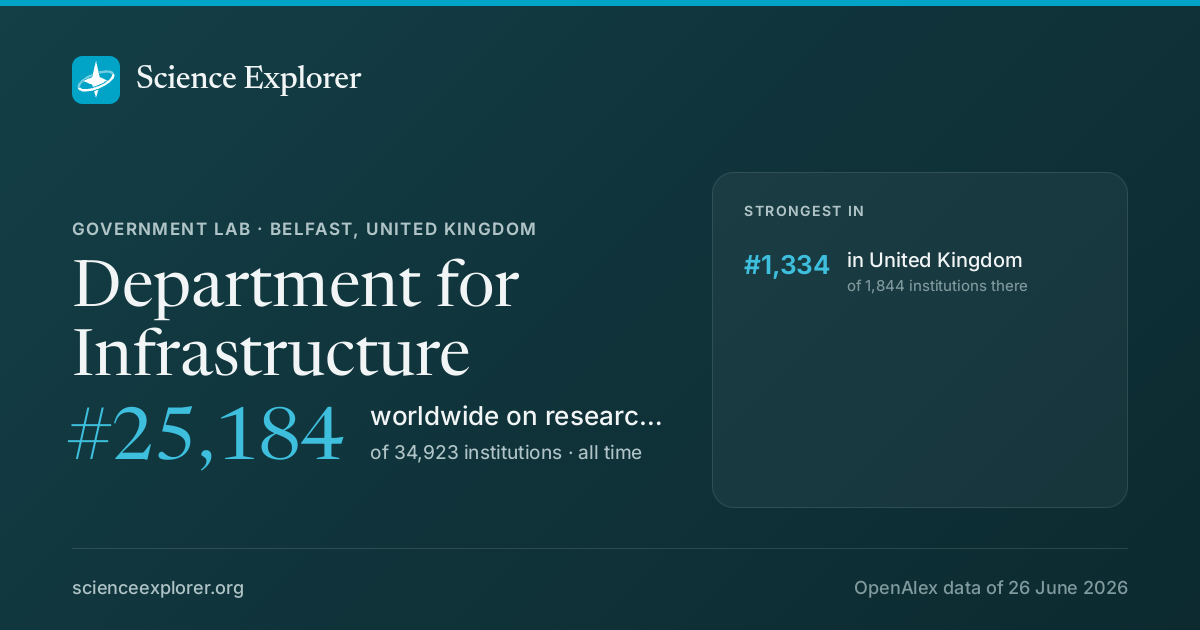
Department for Infrastructure on Science Explorer

A card with Department for Infrastructure's standing and the fields it leads in, for a post or a slide. A link to this page previews as the same card.

Download the card

1200 × 630 PNG, sized for social posts, drawn from the latest snapshot.

Badges for a website1Each links back here and updates with every snapshot

Research measures only: rankings here say nothing about teaching, admissions or student experience. Comparable institutions and collaboration partners have tabs of their own, above.

Discussion

Ask a question or share a note about Department for Infrastructure. Posts are plain text and can be reported.