Science Explorer Back to mapMap
Discussion
Company · Aarhus · Denmark

DNA Diagnostic (Denmark)

World rank, all time
#32,738
of 34,923
Rank in Denmark
#172
of 179
Research works
130
▼ 8% vs 2018-21
Citations
2.9k
22.2 per fractional work
Top-10% rate
5.4%
all institutions 10.0%
vs its own fields
0.97×
1.00× is exactly expected
Open access
54%
world 40%
International
73%
world 18%

Which fields of science does DNA Diagnostic (Denmark) work in?

In 2022-now, 53% of research at DNA Diagnostic (Denmark) is in Health Sciences, 29% in Life Sciences. Its largest fields are Medicine (50%), Biochemistry, Genetics and Molecular Biology (21%), Engineering (5%). It does 1.8× the world's share of Health Sciences.

Health Sciences: 12 fractional works · 52.7% of its workMedicine: 11 fractional works · 50.5% of its workSurgery: 2 fractional works · 9.2% of its workInfectious Diseases: 1 fractional works · 6.1% of its workPulmonary and Respiratory Medicine: 1 fractional works · 5.2% of its workEpidemiology: 1 fractional works · 3.1% of its workOncology: 1 fractional works · 3.1% of its workPublic Health, Environmental and Occupational Health: 1 fractional works · 3.0% of its workNeurology: 1 fractional works · 2.8% of its workPhysiology: 1 fractional works · 2.6% of its workRadiology, Nuclear Medicine and Imaging: 0 fractional works · 2.0% of its workEndocrinology, Diabetes and Metabolism: 0 fractional works · 1.9% of its workPathology and Forensic Medicine: 0 fractional works · 1.5% of its workRheumatology: 0 fractional works · 1.3% of its workCardiology and Cardiovascular Medicine: 0 fractional works · 1.3% of its workOtorhinolaryngology: 0 fractional works · 0.8% of its workEmergency Medicine: 0 fractional works · 0.8% of its workGastroenterology: 0 fractional works · 0.8% of its workHealth Informatics: 0 fractional works · 0.8% of its workHematology: 0 fractional works · 0.8% of its workNephrology: 0 fractional works · 0.8% of its workPediatrics, Perinatology and Child Health: 0 fractional works · 0.6% of its workOphthalmology: 0 fractional works · 0.5% of its workPharmacology: 0 fractional works · 0.4% of its workUrology: 0 fractional works · 0.4% of its workImmunology and Allergy: 0 fractional works · 0.3% of its workGenetics: 0 fractional works · 0.3% of its workVeterinary: 0 fractional works · 1.3% of its workSmall Animals: 0 fractional works · 1.3% of its workHealth Professions: 0 fractional works · 0.9% of its workHealth Information Management: 0 fractional works · 0.5% of its workComplementary and Manual Therapy: 0 fractional works · 0.4% of its workDentistry: 0 fractional works · 0.0% of its workLife Sciences: 6 fractional works · 29.4% of its workBiochemistry, Genetics and Molecular Biology: 5 fractional works · 21.3% of its workMolecular Biology: 2 fractional works · 11.2% of its workCancer Research: 1 fractional works · 4.5% of its workGenetics: 1 fractional works · 2.8% of its workClinical Biochemistry: 0 fractional works · 1.8% of its workEndocrinology: 0 fractional works · 0.5% of its workMolecular Medicine: 0 fractional works · 0.3% of its workNeuroscience: 1 fractional works · 3.0% of its workSensory Systems: 0 fractional works · 1.1% of its workCognitive Neuroscience: 0 fractional works · 1.0% of its workNeurology: 0 fractional works · 0.7% of its workSmaller subfields together: 0 fractional works · 0.2% of its workAgricultural and Biological Sciences: 1 fractional works · 2.5% of its workAnimal Science and Zoology: 0 fractional works · 1.0% of its workInsect Science: 0 fractional works · 1.0% of its workEcology, Evolution, Behavior and Systematics: 0 fractional works · 0.5% of its workSmaller subfields together: 0 fractional works · 0.0% of its workImmunology and Microbiology: 1 fractional works · 2.5% of its workImmunology: 0 fractional works · 1.3% of its workApplied Microbiology and Biotechnology: 0 fractional works · 0.5% of its workMicrobiology: 0 fractional works · 0.5% of its workParasitology: 0 fractional works · 0.2% of its workPhysical Sciences: 3 fractional works · 11.6% of its workEngineering: 1 fractional works · 5.1% of its workBiomedical Engineering: 1 fractional works · 4.7% of its workAerospace Engineering: 0 fractional works · 0.4% of its workSmaller subfields together: 0 fractional works · 0.0% of its workMaterials Science: 1 fractional works · 2.7% of its workGeneral Materials Science: 0 fractional works · 2.3% of its workBiomaterials: 0 fractional works · 0.4% of its workSmaller subfields together: 0 fractional works · 0.0% of its workEnvironmental Science: 0 fractional works · 2.2% of its workPollution: 0 fractional works · 1.1% of its workHealth, Toxicology and Mutagenesis: 0 fractional works · 0.4% of its workWater Science and Technology: 0 fractional works · 0.4% of its workSmaller subfields together: 0 fractional works · 0.4% of its workComputer Science: 0 fractional works · 1.4% of its workArtificial Intelligence: 0 fractional works · 1.1% of its workComputer Networks and Communications: 0 fractional works · 0.2% of its workMathematics: 0 fractional works · 0.1% of its workSocial Sciences: 1 fractional works · 6.4% of its workDecision Sciences: 1 fractional works · 3.0% of its workStatistics, Probability and Uncertainty: 1 fractional works · 3.0% of its workPsychology: 0 fractional works · 1.8% of its workClinical Psychology: 0 fractional works · 1.8% of its workSocial Sciences: 0 fractional works · 1.5% of its workSafety Research: 0 fractional works · 0.8% of its workSociology and Political Science: 0 fractional works · 0.4% of its workTransportation: 0 fractional works · 0.4% of its workALL ITS WORKDNA Diagnostic(Denmark)22fractional works, 2022-now
Life Sciences29%Physical Sciences12%Health Sciences53%Social Sciences6%

Each ring splits the one inside it: the four domains of science, their fields, their subfields. Size is fractional works in 2022-now. Every slice is a page; the interactive view zooms down to single topics and colours each by how much more of it this institution does than the world.

Its 4 domains and 16 fields, with their numbers
    1. Medicine1150.5%
    2. Veterinary01.3%
    3. Health Professions00.9%
    4. Dentistry00.0%
    1. Biochemistry, Genetics and Molecular Biology521.3%
    2. Neuroscience13.0%
    3. Agricultural and Biological Sciences12.5%
    4. Immunology and Microbiology12.5%
    1. Engineering15.1%
    2. Materials Science12.7%
    3. Environmental Science02.2%
    4. Computer Science01.4%
    5. Mathematics00.1%
    1. Decision Sciences13.0%
    2. Psychology01.8%
    3. Social Sciences01.5%
All of science, and how each field's share has moved since 1950: the Science domain explorer

Field profile

Location quotient across every field it publishes in: outside the ring is more than an institution of this size would be expected to publish, inside it is less.

Agricultural and Biological Sciences: 0.53× its world share, 1 worksAgricultural and Bio…Biochemistry, Genetics and Molecular Biology: 3.99× its world share, 5 worksBiochemistry, Geneti…Immunology and Microbiology: 2.47× its world share, 0 worksImmunology and Micro…Neuroscience: 1.87× its world share, 1 worksNeuroscienceComputer Science: 0.17× its world share, 0 worksComputer ScienceEngineering: 0.34× its world share, 1 worksEngineeringEnvironmental Science: 0.45× its world share, 0 worksEnvironmental ScienceMaterials Science: 0.78× its world share, 1 worksMaterials ScienceMathematics: 0.12× its world share, 0 worksMathematicsDentistry: 0.14× its world share, 0 worksDentistryHealth Professions: 0.34× its world share, 0 worksHealth ProfessionsMedicine: 2.63× its world share, 11 worksMedicineVeterinary: 9.31× its world share, 0 worksVeterinaryDecision Sciences: 3.14× its world share, 1 worksDecision SciencesPsychology: 0.60× its world share, 0 worksPsychologySocial Sciences: 0.12× its world share, 0 worksSocial Sciences1×world share
more than its size predictsabout as predictedless

Rings at 0.5×, 1× and 2×. Widest outward: Veterinary, 9.3×. Every wedge is a field page.

All 16 fields, with their numbers
  1. Veterinary9.31×0 works
  2. Biochemistry, Genetics and Molecular Biology3.99×5 works
  3. Decision Sciences3.14×1 works
  4. Medicine2.63×11 works
  5. Immunology and Microbiology2.47×0 works
  6. Neuroscience1.87×1 works
  7. Materials Science0.78×1 works
  8. Psychology0.60×0 works
  9. Agricultural and Biological Sciences0.53×1 works
  10. Environmental Science0.45×0 works
  11. Engineering0.34×1 works
  12. Health Professions0.34×0 works
  13. Computer Science0.17×0 works
  14. Dentistry0.14×0 works
  15. Mathematics0.12×0 works
  16. Social Sciences0.12×0 works

What are the most cited papers from DNA Diagnostic (Denmark)?

The most cited paper from DNA Diagnostic (Denmark) is "68Ga-DOTA-Tyr3-Octreotide PET in Neuroendocrine Tumors: Comparison with Somatostatin Receptor Scintigraphy and CT" (Michael Gabriel, Clemens Decristoforo, Dorota Kendler et al., 2007), with 1,016 citations. Next come "Skin-Sparing Mastectomy with Conservation of the Nipple–Areola Complex and Autologous Reconstruction is an Oncologically Safe Procedure" (393) and "Drug Induced Interstitial Lung Disease" (375).

Most cited papers
#PaperReleasedCitations
1 68Ga-DOTA-Tyr3-Octreotide PET in Neuroendocrine Tumors: Comparison with Somatostatin Receptor Scintigraphy and CT Michael Gabriel, Clemens Decristoforo, Dorota Kendler et al. · Journal of Nuclear Medicine Open access Apr 2007 1,016
2 Skin-Sparing Mastectomy with Conservation of the Nipple–Areola Complex and Autologous Reconstruction is an Oncologically Safe Procedure Bernd Gerber, Annette Krause, Toralf Reimer et al. · Annals of Surgery Open access Jul 2003 393
3 Drug Induced Interstitial Lung Disease Martin Schwaiblmair, Werner Behr, Thomas Haeckel et al. · The Open Respiratory Medicine Journal Open access 27 Jul 2012 375
4 Dynamic Time Course of Typical Childhood Absence Seizures: EEG, Behavior, and Functional Magnetic Resonance Imaging Xiaoxiao Bai, Matthew L. Vestal, Rachel Berman et al. · Journal of Neuroscience Open access 28 Apr 2010 311
5 Vasohibin as an endothelium-derived negative feedback regulator of angiogenesis Kazuhide Watanabe, Yasuhiro Hasegawa, Hiroshi Yamashita et al. · Journal of Clinical Investigation Open access Oct 2004 289
All 60 most cited papers, with filters and sorting

Which research topics does DNA Diagnostic (Denmark) publish most on?

By volume in 2022-now: Material Properties and Applications, Advanced Theoretical and Applied Studies in Material Sciences and Geometry, Cancer Genomics and Diagnostics and Amyloidosis: Diagnosis, Treatment, Outcomes.

  1. 1 Material Properties and Applications General Materials Science 0 works
  2. 2 Advanced Theoretical and Applied Studies in Material Sciences and Geometry Biomedical Engineering 0 works
  3. 3 Cancer Genomics and Diagnostics Cancer Research 0 works
  4. 4 Amyloidosis: Diagnosis, Treatment, Outcomes Molecular Biology 0 works
  5. 5 Meta-analysis and systematic reviews Statistics, Probability and Uncertainty 0 works
  6. 6 Nanopore and Nanochannel Transport Studies Biomedical Engineering 0 works
  7. 7 Advanced biosensing and bioanalysis techniques Molecular Biology 0 works
  8. 8 Eating Disorders and Behaviors Clinical Psychology 0 works
  9. 9 Clinical Laboratory Practices and Quality Control Physiology 0 works
  10. 10 Reliability and Agreement in Measurement Statistics, Probability and Uncertainty 0 works

How open and international is its research?

Against the world's own shares: the tick on each track. Both are shares of its output, so they sit on one scale and can be read against each other as well as against the world.

openly available53.5%not open46.5%

World: 40% of research is openly available.

with international co-authors73.0%domestic only27.0%

World: 18% is written across borders.

How has DNA Diagnostic (Denmark)'s research output changed?

Output in 2022-2025 was 8% lower than in 2018-2021.

still counting1990200020102020
grewheldshrank

The same series as a ribbon: one cell per year, darker for more. The line above answers how much; this answers when.

Its share of all research

Growing output can still be a shrinking share: all of science grows. This is DNA Diagnostic (Denmark) as a percentage of every work published that year, 0.000055% in 2024.

still counting0.00025%0.00050%0.00075%DNA Diagnostic (Denmark)0.00012% in 202519801990200020102020

Fractional works of DNA Diagnostic (Denmark) over all fractional works that year. How the balance of science has shifted.

Other research institutions in Aarhus

All research institutions in Aarhus

Share DNA Diagnostic (Denmark)'s ranking
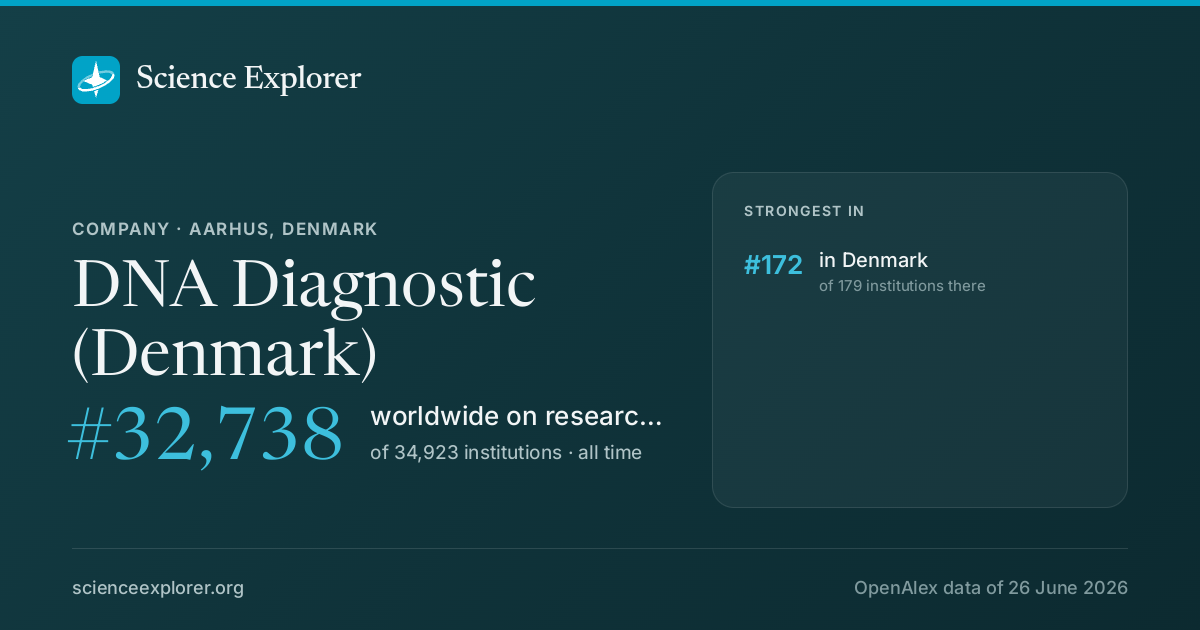
DNA Diagnostic (Denmark) on Science Explorer

A card with DNA Diagnostic (Denmark)'s standing and the fields it leads in, for a post or a slide. A link to this page previews as the same card.

Download the card

1200 × 630 PNG, sized for social posts, drawn from the latest snapshot.

Badges for a website1Each links back here and updates with every snapshot

Research measures only: rankings here say nothing about teaching, admissions or student experience. Comparable institutions and collaboration partners have tabs of their own, above.

Discussion

Ask a question or share a note about DNA Diagnostic (Denmark). Posts are plain text and can be reported.