Science Explorer Back to mapMap
Discussion
University · Tokyo · Japan

Gakushuin University

In research, Gakushuin University stands highest in Physical Sciences (#1,689 of 10,670 worldwide) and Social Sciences (#2,683 of 9,585 worldwide), 2022-now. Relative to its size it is most specialised in Organic Chemistry and Mathematics (Organic Chemistry is 8.9× its share of world research).

World rank, 2022-now
#2,365
of 22,385 · #2,937 all time
Rank in Japan
#44
of 924
Research works
3.8k
▼ 7% vs 2018-21
Citations
63k
16.3 per fractional work
Top-10% rate
6.9%
all institutions 10.0%
vs its own fields
0.95×
1.00× is exactly expected
Open access
32%
world 40%
International
14%
world 18%

What is Gakushuin University known for in research?

The fields where it stands highest, 2022-now, ranked among every institution above the floor in each field.

FieldWorld rankWhere that sitsTop-10% rateWorksAll time
Physical SciencesDomain #1,689 of 10,670 5.3%174 #1992
Social SciencesDomain #2,683 of 9,585 6.7%133 #6404

Each strip is that field's whole ranked pool, with the notch where Gakushuin University sits in it, in the colour of the band that rank falls in. The track under the rate is the rate itself: it carries no average mark, because the average differs by field (from about 6% in Dentistry to 21% in Economics).

Which fields of science does Gakushuin University work in?

In 2022-now, 49% of research at Gakushuin University is in Physical Sciences, 36% in Social Sciences. Its largest fields are Social Sciences (15%), Mathematics (9%), Chemistry (9%). It does 1.5× the world's share of Social Sciences.

Physical Sciences: 193 fractional works · 48.8% of its workMathematics: 37 fractional works · 9.3% of its workMathematical Physics: 14 fractional works · 3.4% of its workGeometry and Topology: 13 fractional works · 3.3% of its workApplied Mathematics: 4 fractional works · 1.1% of its workStatistics and Probability: 3 fractional works · 0.8% of its workDiscrete Mathematics and Combinatorics: 1 fractional works · 0.2% of its workSmaller subfields together: 2 fractional works · 0.4% of its workChemistry: 37 fractional works · 9.3% of its workOrganic Chemistry: 27 fractional works · 6.7% of its workInorganic Chemistry: 5 fractional works · 1.4% of its workPhysical and Theoretical Chemistry: 1 fractional works · 0.3% of its workSpectroscopy: 1 fractional works · 0.3% of its workElectrochemistry: 1 fractional works · 0.3% of its workAnalytical Chemistry: 1 fractional works · 0.2% of its workPhysics and Astronomy: 30 fractional works · 7.5% of its workAtomic and Molecular Physics, and Optics: 12 fractional works · 3.1% of its workCondensed Matter Physics: 6 fractional works · 1.6% of its workStatistical and Nonlinear Physics: 6 fractional works · 1.6% of its workAstronomy and Astrophysics: 4 fractional works · 1.0% of its workNuclear and High Energy Physics: 1 fractional works · 0.3% of its workComputer Science: 24 fractional works · 6.0% of its workArtificial Intelligence: 12 fractional works · 3.0% of its workComputational Theory and Mathematics: 4 fractional works · 0.9% of its workComputer Science Applications: 2 fractional works · 0.6% of its workInformation Systems: 2 fractional works · 0.5% of its workComputer Vision and Pattern Recognition: 2 fractional works · 0.4% of its workSignal Processing: 1 fractional works · 0.3% of its workComputer Networks and Communications: 1 fractional works · 0.3% of its workSmaller subfields together: 0 fractional works · 0.1% of its workEngineering: 22 fractional works · 5.5% of its workElectrical and Electronic Engineering: 8 fractional works · 1.9% of its workAerospace Engineering: 4 fractional works · 0.9% of its workBiomedical Engineering: 3 fractional works · 0.6% of its workComputational Mechanics: 1 fractional works · 0.4% of its workMechanical Engineering: 1 fractional works · 0.3% of its workAutomotive Engineering: 1 fractional works · 0.3% of its workControl and Systems Engineering: 1 fractional works · 0.3% of its workIndustrial and Manufacturing Engineering: 1 fractional works · 0.3% of its workBuilding and Construction: 1 fractional works · 0.2% of its workSmaller subfields together: 2 fractional works · 0.4% of its workMaterials Science: 21 fractional works · 5.3% of its workMaterials Chemistry: 13 fractional works · 3.3% of its workElectronic, Optical and Magnetic Materials: 5 fractional works · 1.3% of its workCeramics and Composites: 1 fractional works · 0.2% of its workSmaller subfields together: 2 fractional works · 0.4% of its workEarth and Planetary Sciences: 13 fractional works · 3.3% of its workGeophysics: 11 fractional works · 2.8% of its workSmaller subfields together: 2 fractional works · 0.5% of its workEnvironmental Science: 9 fractional works · 2.2% of its workGlobal and Planetary Change: 4 fractional works · 0.9% of its workManagement, Monitoring, Policy and Law: 2 fractional works · 0.5% of its workEcology: 1 fractional works · 0.3% of its workEnvironmental Engineering: 1 fractional works · 0.2% of its workSmaller subfields together: 1 fractional works · 0.3% of its workEnergy: 1 fractional works · 0.2% of its workRenewable Energy, Sustainability and the Environment: 1 fractional works · 0.2% of its workChemical Engineering: 1 fractional works · 0.1% of its workSocial Sciences: 144 fractional works · 36.4% of its workSocial Sciences: 59 fractional works · 14.8% of its workSociology and Political Science: 22 fractional works · 5.6% of its workPolitical Science and International Relations: 8 fractional works · 2.1% of its workEducation: 6 fractional works · 1.5% of its workGender Studies: 4 fractional works · 1.1% of its workSafety Research: 4 fractional works · 1.0% of its workDemography: 2 fractional works · 0.6% of its workTransportation: 2 fractional works · 0.6% of its workCommunication: 2 fractional works · 0.4% of its workLaw: 2 fractional works · 0.4% of its workCultural Studies: 1 fractional works · 0.4% of its workDevelopment: 1 fractional works · 0.3% of its workSmaller subfields together: 4 fractional works · 0.9% of its workEconomics, Econometrics and Finance: 31 fractional works · 7.8% of its workEconomics and Econometrics: 19 fractional works · 4.9% of its workGeneral Economics, Econometrics and Finance: 7 fractional works · 1.7% of its workFinance: 5 fractional works · 1.2% of its workBusiness, Management and Accounting: 24 fractional works · 6.1% of its workStrategy and Management: 11 fractional works · 2.8% of its workAccounting: 3 fractional works · 0.9% of its workMarketing: 3 fractional works · 0.7% of its workManagement of Technology and Innovation: 2 fractional works · 0.6% of its workOrganizational Behavior and Human Resource Management: 2 fractional works · 0.6% of its workManagement Information Systems: 2 fractional works · 0.5% of its workSmaller subfields together: 0 fractional works · 0.1% of its workArts and Humanities: 15 fractional works · 3.8% of its workLanguage and Linguistics: 4 fractional works · 1.0% of its workPhilosophy: 4 fractional works · 1.0% of its workLiterature and Literary Theory: 3 fractional works · 0.8% of its workHistory: 2 fractional works · 0.5% of its workMuseology: 1 fractional works · 0.3% of its workSmaller subfields together: 1 fractional works · 0.2% of its workPsychology: 10 fractional works · 2.6% of its workSocial Psychology: 4 fractional works · 1.1% of its workExperimental and Cognitive Psychology: 3 fractional works · 0.7% of its workClinical Psychology: 1 fractional works · 0.4% of its workDevelopmental and Educational Psychology: 1 fractional works · 0.3% of its workSmaller subfields together: 0 fractional works · 0.1% of its workDecision Sciences: 5 fractional works · 1.3% of its workManagement Science and Operations Research: 3 fractional works · 0.8% of its workStatistics, Probability and Uncertainty: 1 fractional works · 0.3% of its workSmaller subfields together: 1 fractional works · 0.2% of its workLife Sciences: 40 fractional works · 10.0% of its workBiochemistry, Genetics and Molecular Biology: 24 fractional works · 6.0% of its workMolecular Biology: 15 fractional works · 3.7% of its workGenetics: 3 fractional works · 0.6% of its workBiophysics: 2 fractional works · 0.6% of its workCell Biology: 2 fractional works · 0.5% of its workBiotechnology: 1 fractional works · 0.2% of its workSmaller subfields together: 1 fractional works · 0.3% of its workPharmacology, Toxicology and Pharmaceutics: 6 fractional works · 1.6% of its workPharmaceutical Science: 3 fractional works · 0.8% of its workToxicology: 2 fractional works · 0.6% of its workSmaller subfields together: 1 fractional works · 0.2% of its workAgricultural and Biological Sciences: 5 fractional works · 1.4% of its workPlant Science: 2 fractional works · 0.6% of its workGeneral Agricultural and Biological Sciences: 1 fractional works · 0.3% of its workEcology, Evolution, Behavior and Systematics: 1 fractional works · 0.2% of its workSmaller subfields together: 1 fractional works · 0.3% of its workNeuroscience: 3 fractional works · 0.8% of its workCellular and Molecular Neuroscience: 2 fractional works · 0.4% of its workCognitive Neuroscience: 1 fractional works · 0.3% of its workSmaller subfields together: 1 fractional works · 0.1% of its workImmunology and Microbiology: 1 fractional works · 0.2% of its workHealth Sciences: 19 fractional works · 4.8% of its workMedicine: 15 fractional works · 3.8% of its workPediatrics, Perinatology and Child Health: 3 fractional works · 0.7% of its workPhysiology: 2 fractional works · 0.6% of its workPharmacology: 2 fractional works · 0.5% of its workOncology: 1 fractional works · 0.3% of its workHealth Informatics: 1 fractional works · 0.3% of its workNeurology: 1 fractional works · 0.2% of its workSmaller subfields together: 5 fractional works · 1.2% of its workHealth Professions: 3 fractional works · 0.7% of its workGeneral Health Professions: 1 fractional works · 0.3% of its workSmaller subfields together: 2 fractional works · 0.4% of its workNursing: 1 fractional works · 0.2% of its workALL ITS WORKGakushuinUniversity396fractional works, 2022-now
Life Sciences10%Physical Sciences49%Health Sciences5%Social Sciences36%

Each ring splits the one inside it: the four domains of science, their fields, their subfields. Size is fractional works in 2022-now. Every slice is a page; the interactive view zooms down to single topics and colours each by how much more of it this institution does than the world.

Its 4 domains and 24 fields, with their numbers
    1. Mathematics379.3%
    2. Chemistry379.3%
    3. Physics and Astronomy307.5%
    4. Computer Science246.0%
    5. Engineering225.5%
    6. Materials Science215.3%
    7. Earth and Planetary Sciences133.3%
    8. Environmental Science92.2%
    9. Energy10.2%
    10. Chemical Engineering10.1%
    1. Social Sciences5914.8%
    2. Economics, Econometrics and Finance317.8%
    3. Business, Management and Accounting246.1%
    4. Arts and Humanities153.8%
    5. Psychology102.6%
    6. Decision Sciences51.3%
    1. Biochemistry, Genetics and Molecular Biology246.0%
    2. Pharmacology, Toxicology and Pharmaceutics61.6%
    3. Agricultural and Biological Sciences51.4%
    4. Neuroscience30.8%
    5. Immunology and Microbiology10.2%
    1. Medicine153.8%
    2. Health Professions30.7%
    3. Nursing10.2%
All of science, and how each field's share has moved since 1950: the Science domain explorer

What does Gakushuin University specialise in?

Where its research is concentrated relative to its size: Organic Chemistry takes 8.9× the share of its output that it takes of world research.

  1. Organic ChemistrySubfield · 26.6 works8.9×
  2. MathematicsField · 36.7 works7.9×
← less than its size predicts1×more →

Location quotient, a volume reading rather than an impact one. It surfaces small, lopsided specialities.

Field profile

Location quotient across every field it publishes in: outside the ring is more than an institution of this size would be expected to publish, inside it is less.

Agricultural and Biological Sciences: 0.29× its world share, 6 worksAgricultural and Bio…Biochemistry, Genetics and Molecular Biology: 1.12× its world share, 24 worksBiochemistry, Geneti…Immunology and Microbiology: 0.21× its world share, 1 worksImmunology and Micro…Neuroscience: 0.51× its world share, 3 worksNeurosciencePharmacology, Toxicology and Pharmaceutics: 4.61× its world share, 6 worksPharmacology, Toxico…Chemical Engineering: 0.40× its world share, 1 worksChemical EngineeringChemistry: 5.91× its world share, 37 worksChemistryComputer Science: 0.77× its world share, 24 worksComputer ScienceEarth and Planetary Sciences: 2.10× its world share, 13 worksEarth and Planetary …Energy: 0.26× its world share, 1 worksEnergyEngineering: 0.37× its world share, 22 worksEngineeringEnvironmental Science: 0.45× its world share, 9 worksEnvironmental ScienceMaterials Science: 1.51× its world share, 21 worksMaterials ScienceMathematics: 7.89× its world share, 37 worksMathematicsPhysics and Astronomy: 3.37× its world share, 30 worksPhysics and AstronomyHealth Professions: 0.26× its world share, 3 worksHealth ProfessionsMedicine: 0.20× its world share, 15 worksMedicineNursing: 0.46× its world share, 1 worksNursingArts and Humanities: 1.33× its world share, 15 worksArts and HumanitiesBusiness, Management and Accounting: 1.90× its world share, 24 worksBusiness, Management…Decision Sciences: 1.29× its world share, 5 worksDecision SciencesEconomics, Econometrics and Finance: 3.63× its world share, 31 worksEconomics, Econometr…Psychology: 0.85× its world share, 10 worksPsychologySocial Sciences: 1.17× its world share, 59 worksSocial Sciences1×world share
more than its size predictsabout as predictedless

Rings at 0.5×, 1× and 2×. Widest outward: Mathematics, 7.9×. Every wedge is a field page.

All 24 fields, with their numbers
  1. Mathematics7.89×37 works
  2. Chemistry5.91×37 works
  3. Pharmacology, Toxicology and Pharmaceutics4.61×6 works
  4. Economics, Econometrics and Finance3.63×31 works
  5. Physics and Astronomy3.37×30 works
  6. Earth and Planetary Sciences2.10×13 works
  7. Business, Management and Accounting1.90×24 works
  8. Materials Science1.51×21 works
  9. Arts and Humanities1.33×15 works
  10. Decision Sciences1.29×5 works
  11. Social Sciences1.17×59 works
  12. Biochemistry, Genetics and Molecular Biology1.12×24 works
  13. Psychology0.85×10 works
  14. Computer Science0.77×24 works
  15. Neuroscience0.51×3 works
  16. Nursing0.46×1 works
  17. Environmental Science0.45×9 works
  18. Chemical Engineering0.40×1 works
  19. Engineering0.37×22 works
  20. Agricultural and Biological Sciences0.29×6 works
  21. Energy0.26×1 works
  22. Health Professions0.26×3 works
  23. Immunology and Microbiology0.21×1 works
  24. Medicine0.20×15 works

Who are the top researchers at Gakushuin University?

Ranked on the quality score, Hal Tasaki, Tomohiro Kiyosue and Junji Itoh lead among researchers whose main affiliation is Gakushuin University.

  1. 1 Hal Tasaki Japan · #136,859 worldwide 11k citations · 171 works
  2. 2 Tomohiro Kiyosue Japan · #400,387 worldwide 6.1k citations · 84 works
  3. 3 Junji Itoh Japan · #578,158 worldwide 5.1k citations · 40 works
  4. 4 Masaki Akaogi Japan · #678,180 worldwide 8.5k citations · 259 works
  5. 5 Arisato Kawabata Japan · #717,628 worldwide 3.8k citations · 80 works
  6. 6 Hirofumi Miwa Japan · #731,374 worldwide 166 citations · 138 works
  7. 7 Takahiko Akiyama Japan · #800,276 worldwide 17k citations · 477 works
  8. 8 Yoshiyuki Inaguma Japan · #807,906 worldwide 9.5k citations · 303 works
  9. 9 Keiji Mori Japan · #1,044,507 worldwide 6.8k citations · 269 works
  10. 10 Thais Satie Iijima Japan · #1,327,822 worldwide 428 citations · 660 works
All ranked researchers at Gakushuin University

What are the most cited papers from Gakushuin University?

The most cited paper from Gakushuin University is "Differences Between Tight and Loose Cultures: A 33-Nation Study" (Michele Joy Gelfand et al., 2011), with 3,323 citations. Next come "Stronger Brønsted Acids" (2,311) and "Enantioselective Mannich‐Type Reaction Catalyzed by a Chiral Brønsted Acid" (1,670).

Most cited papers
#PaperReleasedCitations
1 Differences Between Tight and Loose Cultures: A 33-Nation Study Michele Joy Gelfand et al. · Science Open access 26 May 2011 3,323
2 Stronger Brønsted Acids Takahiko Akiyama · Chemical Reviews Review 6 Nov 2007 2,311
3 Enantioselective Mannich‐Type Reaction Catalyzed by a Chiral Brønsted Acid Takahiko Akiyama, Junji Itoh, Koji Yokota et al. · Angewandte Chemie International Edition 9 Mar 2004 1,670
4 Insights into Land Plant Evolution Garnered from the Marchantia polymorpha Genome John L. Bowman et al. · Cell Open access113 authors Oct 2017 1,314
5 Why Do Firms Imitate Each Other? Marvin B. Lieberman, Shigeru Asaba · Academy of Management Review Apr 2006 1,180
All 58 most cited papers, with filters and sorting

Which keywords describe research at Gakushuin University?

By fractional works in 2022-now, weighted toward what it does more of than the world: Organic Synthesis, Plate Tectonics, Superconductivity, Medicinal Chemistry, Transition Metal Catalysis, Innovation, Transition Metal Complexes and Entanglement.

▲ more of its work than of the world's◆ about the world's share▼ less than the world's

Size is fractional works in 2022-now in the topics tagged with each word; colour is the word's share of this institution's work against its share of the world's. The 40 words are chosen for being large and distinctive. Each links to the topic it comes from most.

All 40 words, with their numbers
  1. Globalization14▲ 1.77×18 topics
  2. Machine Learning13◆ 0.99×26 topics
  3. Innovation12▲ 2.9×12 topics
  4. Organic Synthesis12▲ 25×5 topics
  5. Plate Tectonics9▲ 14×2 topics
  6. Superconductivity8▲ 12×5 topics
  7. Medicinal Chemistry8▲ 7.6×6 topics
  8. Transition Metal Catalysis7▲ 22×4 topics
  9. Transition Metal Complexes7▲ 20×3 topics
  10. Economic Development7▲ 2.2×10 topics
  11. Entanglement7▲ 12×4 topics
  12. Electrocatalysis6▲ 5.3×3 topics
  13. Metal-Catalyzed Reactions6▲ 25×3 topics
  14. Tomography6▲ 7.9×3 topics
  15. Electrochemical Methods5▲ 50×1 topic
  16. Stability5▲ 6.0×4 topics
  17. Visible Light Photoredox Catalysis5▲ 50×1 topic
  18. Aryl Halides5▲ 31×2 topics
  19. Crystal Structure Prediction5▲ 27×1 topic
  20. Mantle Dynamics5▲ 27×1 topic
  21. Catalytic Reactions5▲ 69×5 topics
  22. Embodiment5▲ 6.3×4 topics
  23. Enantioselective Synthesis5▲ 20×6 topics
  24. International Trade5▲ 8.5×4 topics
  25. Symplectic Geometry5▲ 33×2 topics
  26. Topological Order5▲ 25×2 topics
  27. Heterocycles4▲ 12×3 topics
  28. Gender Roles4▲ 8.9×5 topics
  29. Market Size4▲ 15×2 topics
  30. Oxidative Coupling4▲ 21×2 topics
  31. Productivity4▲ 18×2 topics
  32. C-C Bond Formation4▲ 24×3 topics
  33. Drug Design4▲ 16×3 topics
  34. Knot Invariants4▲ 62×1 topic
  35. Symplectic Topology4▲ 62×1 topic
  36. Tropical Geometry4▲ 29×2 topics
  37. Firm-Level Data4▲ 22×1 topic
  38. Hydrogen Bonding4▲ 11×4 topics
  39. Thermodynamic Modeling4▲ 8.1×2 topics
  40. Trade Liberalization4▲ 20×1 topic

Which research topics does Gakushuin University publish most on?

By volume in 2022-now: Radical Photochemical Reactions, High-pressure geophysics and materials, Geometric and Algebraic Topology and Global trade and economics.

  1. 1 Radical Photochemical Reactions Organic Chemistry 5 works
  2. 2 High-pressure geophysics and materials Geophysics 5 works
  3. 3 Geometric and Algebraic Topology Geometry and Topology 4 works
  4. 4 Global trade and economics General Economics, Econometrics and Finance 4 works
  5. 5 Geological and Geochemical Analysis Geophysics 4 works
  6. 6 Catalytic C–H Functionalization Methods Organic Chemistry 4 works
  7. 7 Spectral Theory in Mathematical Physics Mathematical Physics 3 works
  8. 8 Algebraic Geometry and Number Theory Geometry and Topology 3 works
  9. 9 Sulfur-Based Synthesis Techniques Organic Chemistry 3 works
  10. 10 Fluorine in Organic Chemistry Pharmaceutical Science 3 works

How open and international is its research?

Against the world's own shares: the tick on each track. Both are shares of its output, so they sit on one scale and can be read against each other as well as against the world.

openly available31.9%not open68.1%

World: 40% of research is openly available.

with international co-authors14.0%domestic only86.0%

World: 18% is written across borders.

How has Gakushuin University's research output changed?

Output in 2022-2025 was 7% lower than in 2018-2021.

still counting1990200020102020
grewheldshrank

The same series as a ribbon: one cell per year, darker for more. The line above answers how much; this answers when.

Its share of all research

Growing output can still be a shrinking share: all of science grows. This is Gakushuin University as a percentage of every work published that year, 0.0017% in 2024.

still counting0.0050%0.010%0.015%Gakushuin University0.0015% in 202519801990200020102020

Fractional works of Gakushuin University over all fractional works that year. How the balance of science has shifted.

How much of it reaches the world top 10%

Year by year, against all institutions in the same year.

still counting5%10%15%all institutions10.0% in 2025Gakushuin University7.2% in 2025200020102020

Of each year's output, the share that reached the world's 10% most cited for its field and year. Peak 11.2% in 1992.

Other research institutions in Tokyo

All research institutions in Tokyo

Share Gakushuin University's ranking
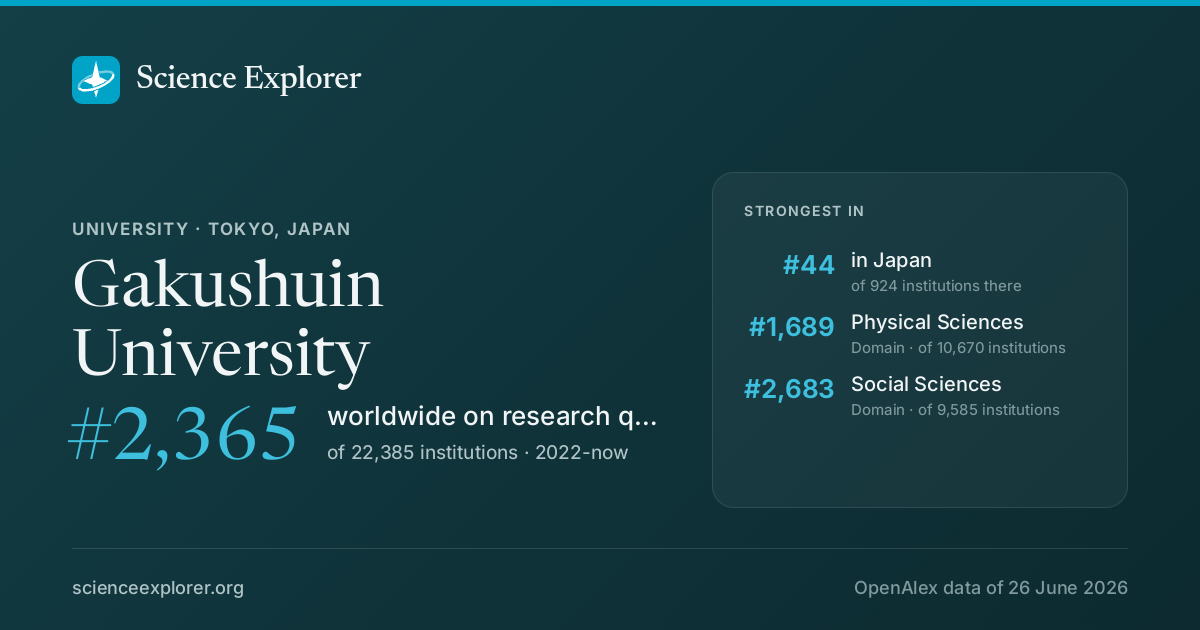
Gakushuin University on Science Explorer

A card with Gakushuin University's standing and the fields it leads in, for a post or a slide. A link to this page previews as the same card.

Download the card

1200 × 630 PNG, sized for social posts, drawn from the latest snapshot.

Badges for a website1Each links back here and updates with every snapshot

Research measures only: rankings here say nothing about teaching, admissions or student experience. Comparable institutions and collaboration partners have tabs of their own, above.

Discussion

Ask a question or share a note about Gakushuin University. Posts are plain text and can be reported.