Science Explorer Back to mapMap
Discussion
University · Kadi · India

Indrashil University

In research, Indrashil University stands highest in Physical Sciences (#10,649 of 10,670 worldwide), 2022-now. Relative to its size it is most specialised in Organic Chemistry and Chemistry (Organic Chemistry is 19.8× its share of world research).

World rank, 2022-now
#22,193
of 22,385 · #33,482 all time
Rank in India
#1,548
of 1,562
Research works
254
▲ 138% vs 2018-21
Citations
2.1k
8.3 per fractional work
Top-10% rate
9.5%
all institutions 10.0%
vs its own fields
0.93×
1.00× is exactly expected
Open access
36%
world 40%
International
21%
world 18%

What is Indrashil University known for in research?

The fields where it stands highest, 2022-now, ranked among every institution above the floor in each field.

FieldWorld rankWhere that sitsTop-10% rateWorksAll time
Physical SciencesDomain #10,649 of 10,670 8.0%90 #17121

Each strip is that field's whole ranked pool, with the notch where Indrashil University sits in it, in the colour of the band that rank falls in. The track under the rate is the rate itself: it carries no average mark, because the average differs by field (from about 6% in Dentistry to 21% in Economics).

Which fields of science does Indrashil University work in?

In 2022-now, 56% of research at Indrashil University is in Physical Sciences, 29% in Life Sciences. Its largest fields are Biochemistry, Genetics and Molecular Biology (20%), Chemistry (19%), Engineering (14%). It does 2.1× the world's share of Life Sciences.

Physical Sciences: 105 fractional works · 56.4% of its workChemistry: 35 fractional works · 19.1% of its workOrganic Chemistry: 28 fractional works · 14.9% of its workSpectroscopy: 4 fractional works · 2.1% of its workInorganic Chemistry: 2 fractional works · 1.0% of its workAnalytical Chemistry: 1 fractional works · 0.6% of its workPhysical and Theoretical Chemistry: 1 fractional works · 0.3% of its workSmaller subfields together: 0 fractional works · 0.1% of its workEngineering: 26 fractional works · 13.8% of its workBiomedical Engineering: 13 fractional works · 7.1% of its workElectrical and Electronic Engineering: 6 fractional works · 3.0% of its workMechanical Engineering: 2 fractional works · 1.1% of its workAutomotive Engineering: 2 fractional works · 1.1% of its workAerospace Engineering: 1 fractional works · 0.7% of its workIndustrial and Manufacturing Engineering: 1 fractional works · 0.4% of its workSmaller subfields together: 1 fractional works · 0.4% of its workMaterials Science: 18 fractional works · 9.9% of its workMaterials Chemistry: 10 fractional works · 5.3% of its workBiomaterials: 4 fractional works · 2.2% of its workElectronic, Optical and Magnetic Materials: 3 fractional works · 1.5% of its workPolymers and Plastics: 1 fractional works · 0.6% of its workSmaller subfields together: 0 fractional works · 0.2% of its workComputer Science: 15 fractional works · 8.2% of its workComputer Networks and Communications: 5 fractional works · 2.5% of its workArtificial Intelligence: 3 fractional works · 1.8% of its workInformation Systems: 3 fractional works · 1.5% of its workComputational Theory and Mathematics: 2 fractional works · 1.2% of its workComputer Vision and Pattern Recognition: 2 fractional works · 0.9% of its workSignal Processing: 0 fractional works · 0.3% of its workSmaller subfields together: 0 fractional works · 0.1% of its workEnvironmental Science: 6 fractional works · 3.1% of its workEcology: 2 fractional works · 1.2% of its workPollution: 1 fractional works · 0.6% of its workWater Science and Technology: 1 fractional works · 0.5% of its workHealth, Toxicology and Mutagenesis: 1 fractional works · 0.3% of its workGlobal and Planetary Change: 0 fractional works · 0.3% of its workSmaller subfields together: 1 fractional works · 0.3% of its workPhysics and Astronomy: 1 fractional works · 0.8% of its workAstronomy and Astrophysics: 0 fractional works · 0.2% of its workCondensed Matter Physics: 0 fractional works · 0.2% of its workSmaller subfields together: 1 fractional works · 0.3% of its workChemical Engineering: 1 fractional works · 0.7% of its workProcess Chemistry and Technology: 1 fractional works · 0.4% of its workSmaller subfields together: 1 fractional works · 0.4% of its workEnergy: 1 fractional works · 0.7% of its workRenewable Energy, Sustainability and the Environment: 1 fractional works · 0.7% of its workMathematics: 0 fractional works · 0.1% of its workLife Sciences: 54 fractional works · 29.3% of its workBiochemistry, Genetics and Molecular Biology: 37 fractional works · 19.8% of its workMolecular Biology: 28 fractional works · 15.0% of its workBiotechnology: 2 fractional works · 1.2% of its workGenetics: 2 fractional works · 1.0% of its workBiochemistry: 2 fractional works · 0.8% of its workCell Biology: 1 fractional works · 0.5% of its workCancer Research: 1 fractional works · 0.4% of its workBiophysics: 1 fractional works · 0.3% of its workSmaller subfields together: 1 fractional works · 0.5% of its workAgricultural and Biological Sciences: 11 fractional works · 5.9% of its workPlant Science: 6 fractional works · 3.2% of its workFood Science: 3 fractional works · 1.5% of its workInsect Science: 1 fractional works · 0.6% of its workEcology, Evolution, Behavior and Systematics: 1 fractional works · 0.3% of its workSmaller subfields together: 1 fractional works · 0.4% of its workPharmacology, Toxicology and Pharmaceutics: 3 fractional works · 1.7% of its workPharmaceutical Science: 2 fractional works · 1.0% of its workPharmacology: 1 fractional works · 0.3% of its workToxicology: 0 fractional works · 0.2% of its workSmaller subfields together: 0 fractional works · 0.2% of its workNeuroscience: 3 fractional works · 1.4% of its workCellular and Molecular Neuroscience: 1 fractional works · 0.6% of its workNeurology: 1 fractional works · 0.4% of its workCognitive Neuroscience: 0 fractional works · 0.2% of its workSmaller subfields together: 0 fractional works · 0.1% of its workImmunology and Microbiology: 1 fractional works · 0.5% of its workImmunology: 0 fractional works · 0.3% of its workSmaller subfields together: 1 fractional works · 0.3% of its workHealth Sciences: 20 fractional works · 11.0% of its workMedicine: 18 fractional works · 9.5% of its workPublic Health, Environmental and Occupational Health: 2 fractional works · 1.1% of its workRadiology, Nuclear Medicine and Imaging: 2 fractional works · 1.0% of its workOncology: 2 fractional works · 0.9% of its workHealth Informatics: 1 fractional works · 0.8% of its workPhysiology: 1 fractional works · 0.8% of its workComplementary and alternative medicine: 1 fractional works · 0.7% of its workPharmacology: 1 fractional works · 0.7% of its workSurgery: 1 fractional works · 0.6% of its workInfectious Diseases: 1 fractional works · 0.5% of its workPulmonary and Respiratory Medicine: 1 fractional works · 0.3% of its workRehabilitation: 0 fractional works · 0.3% of its workHematology: 0 fractional works · 0.3% of its workEpidemiology: 0 fractional works · 0.2% of its workSmaller subfields together: 3 fractional works · 1.5% of its workNursing: 1 fractional works · 0.7% of its workNutrition and Dietetics: 1 fractional works · 0.7% of its workHealth Professions: 1 fractional works · 0.6% of its workHealth Information Management: 1 fractional works · 0.3% of its workGeneral Health Professions: 0 fractional works · 0.3% of its workVeterinary: 0 fractional works · 0.2% of its workDentistry: 0 fractional works · 0.0% of its workSocial Sciences: 6 fractional works · 3.3% of its workSocial Sciences: 3 fractional works · 1.5% of its workEducation: 1 fractional works · 0.4% of its workPolitical Science and International Relations: 1 fractional works · 0.4% of its workDemography: 0 fractional works · 0.2% of its workSmaller subfields together: 1 fractional works · 0.5% of its workBusiness, Management and Accounting: 1 fractional works · 0.6% of its workBusiness and International Management: 1 fractional works · 0.4% of its workSmaller subfields together: 0 fractional works · 0.2% of its workDecision Sciences: 1 fractional works · 0.5% of its workManagement Science and Operations Research: 1 fractional works · 0.3% of its workSmaller subfields together: 0 fractional works · 0.2% of its workEconomics, Econometrics and Finance: 1 fractional works · 0.4% of its workEconomics and Econometrics: 1 fractional works · 0.4% of its workPsychology: 1 fractional works · 0.4% of its workApplied Psychology: 0 fractional works · 0.2% of its workSmaller subfields together: 0 fractional works · 0.1% of its workALL ITS WORKIndrashilUniversity186fractional works, 2022-now
Life Sciences29%Physical Sciences56%Health Sciences11%Social Sciences3%

Each ring splits the one inside it: the four domains of science, their fields, their subfields. Size is fractional works in 2022-now. Every slice is a page; the interactive view zooms down to single topics and colours each by how much more of it this institution does than the world.

Its 4 domains and 24 fields, with their numbers
    1. Chemistry3519.1%
    2. Engineering2613.8%
    3. Materials Science189.9%
    4. Computer Science158.2%
    5. Environmental Science63.1%
    6. Physics and Astronomy10.8%
    7. Chemical Engineering10.7%
    8. Energy10.7%
    9. Mathematics00.1%
    1. Biochemistry, Genetics and Molecular Biology3719.8%
    2. Agricultural and Biological Sciences115.9%
    3. Pharmacology, Toxicology and Pharmaceutics31.7%
    4. Neuroscience31.4%
    5. Immunology and Microbiology10.5%
    1. Medicine189.5%
    2. Nursing10.7%
    3. Health Professions10.6%
    4. Veterinary00.2%
    5. Dentistry00.0%
    1. Social Sciences31.5%
    2. Business, Management and Accounting10.6%
    3. Decision Sciences10.5%
    4. Economics, Econometrics and Finance10.4%
    5. Psychology10.4%
All of science, and how each field's share has moved since 1950: the Science domain explorer

What does Indrashil University specialise in?

Where its research is concentrated relative to its size: Organic Chemistry takes 19.8× the share of its output that it takes of world research.

  1. Organic ChemistrySubfield · 27.7 works20×
  2. ChemistryField · 35.5 works12×
← less than its size predicts1×more →

Location quotient, a volume reading rather than an impact one. It surfaces small, lopsided specialities.

Field profile

Location quotient across every field it publishes in: outside the ring is more than an institution of this size would be expected to publish, inside it is less.

Agricultural and Biological Sciences: 1.24× its world share, 11 worksAgricultural and Bio…Biochemistry, Genetics and Molecular Biology: 3.71× its world share, 37 worksBiochemistry, Geneti…Immunology and Microbiology: 0.54× its world share, 1 worksImmunology and Micro…Neuroscience: 0.86× its world share, 3 worksNeurosciencePharmacology, Toxicology and Pharmaceutics: 4.83× its world share, 3 worksPharmacology, Toxico…Chemical Engineering: 2.09× its world share, 1 worksChemical EngineeringChemistry: 12.17× its world share, 36 worksChemistryComputer Science: 1.06× its world share, 15 worksComputer ScienceEnergy: 0.71× its world share, 1 worksEnergyEngineering: 0.92× its world share, 26 worksEngineeringEnvironmental Science: 0.63× its world share, 6 worksEnvironmental ScienceMaterials Science: 2.82× its world share, 18 worksMaterials ScienceMathematics: 0.10× its world share, 0 worksMathematicsPhysics and Astronomy: 0.36× its world share, 2 worksPhysics and AstronomyDentistry: 0.07× its world share, 0 worksDentistryHealth Professions: 0.23× its world share, 1 worksHealth ProfessionsMedicine: 0.49× its world share, 18 worksMedicineNursing: 1.47× its world share, 1 worksNursingVeterinary: 1.32× its world share, 0 worksVeterinaryBusiness, Management and Accounting: 0.17× its world share, 1 worksBusiness, Management…Decision Sciences: 0.50× its world share, 1 worksDecision SciencesEconomics, Econometrics and Finance: 0.17× its world share, 1 worksEconomics, Econometr…Psychology: 0.12× its world share, 1 worksPsychologySocial Sciences: 0.12× its world share, 3 worksSocial Sciences1×world share
more than its size predictsabout as predictedless

Rings at 0.5×, 1× and 2×. Widest outward: Chemistry, 12.2×. Every wedge is a field page.

All 24 fields, with their numbers
  1. Chemistry12.17×36 works
  2. Pharmacology, Toxicology and Pharmaceutics4.83×3 works
  3. Biochemistry, Genetics and Molecular Biology3.71×37 works
  4. Materials Science2.82×18 works
  5. Chemical Engineering2.09×1 works
  6. Nursing1.47×1 works
  7. Veterinary1.32×0 works
  8. Agricultural and Biological Sciences1.24×11 works
  9. Computer Science1.06×15 works
  10. Engineering0.92×26 works
  11. Neuroscience0.86×3 works
  12. Energy0.71×1 works
  13. Environmental Science0.63×6 works
  14. Immunology and Microbiology0.54×1 works
  15. Decision Sciences0.50×1 works
  16. Medicine0.49×18 works
  17. Physics and Astronomy0.36×2 works
  18. Health Professions0.23×1 works
  19. Business, Management and Accounting0.17×1 works
  20. Economics, Econometrics and Finance0.17×1 works
  21. Psychology0.12×1 works
  22. Social Sciences0.12×3 works
  23. Mathematics0.10×0 works
  24. Dentistry0.07×0 works

Who are the top researchers at Indrashil University?

Ranked on the quality score, Vijai Singh, Kshipra Pandey and Haren B. Gosai lead among researchers whose main affiliation is Indrashil University.

  1. 1 Vijai Singh India · #1,414,745 worldwide 4.8k citations · 262 works
  2. 2 Kshipra Pandey India · #1,433,164 worldwide 123 citations · 19 works
  3. 3 Haren B. Gosai India · #1,452,993 worldwide 943 citations · 42 works
  4. 4 Gargi Bagchi Bhattacharjee India · #1,580,318 worldwide 1.3k citations · 74 works
  5. 5 Sidheswar Routray India · #1,841,318 worldwide 1.4k citations · 78 works
  6. 6 Nisarg Gohil India · #2,256,938 worldwide 1.5k citations · 76 works
  7. 7 Khushal Khambhati India · #2,495,046 worldwide 800 citations · 45 works
  8. 8 Riya Patel India · #3,038,357 worldwide 252 citations · 38 works
  9. 9 Manisha Parmar India · #3,274,634 worldwide 207 citations · 17 works
  10. 10 Raj Dave India · #3,328,135 worldwide 107 citations · 17 works
All ranked researchers at Indrashil University

What are the most cited papers from Indrashil University?

The most cited paper from Indrashil University is "Cytokines: Key Determinants of Resistance or Disease Progression in Visceral Leishmaniasis: Opportunities for Novel Diagnostics and Immunotherapy" (Dayakar Alti, Sambamurthy Chandrasekaran, Suresh Varma Kuchipudi et al., 2019), with 214 citations. Next come "Artificial intelligence and machine learning-based monitoring and design of biological wastewater treatment systems" (193) and "Review on machine learning-based bioprocess optimization, monitoring, and control systems" (165).

Most cited papers
#PaperReleasedCitations
1 Cytokines: Key Determinants of Resistance or Disease Progression in Visceral Leishmaniasis: Opportunities for Novel Diagnostics and Immunotherapy Dayakar Alti, Sambamurthy Chandrasekaran, Suresh Varma Kuchipudi et al. · Frontiers in Immunology Open access 5 Apr 2019 214
2 Artificial intelligence and machine learning-based monitoring and design of biological wastewater treatment systems Nitin Kumar Singh, Manish Kumar Yadav, Vijai Singh et al. · Bioresource Technology 14 Dec 2022 193
3 Review on machine learning-based bioprocess optimization, monitoring, and control systems Partha Pratim Mondal, Abhinav Galodha, Vishal Verma et al. · Bioresource Technology 21 Dec 2022 165
4 Role of calcium nutrition in plant Physiology: Advances in research and insights into acidic soil conditions - A comprehensive review Tao Jing, Jingyang Li, Yingdui He et al. · Plant Physiology and Biochemistry 4 Apr 2024 162
5 Recent advancement and design in supercapacitor hybrid electrode materials: Bridging the gap between energy and power density Soumen Mandal, Arpit B. Mendhe, Hitesh M. Rakhade et al. · Chemical Engineering Journal Advances Open access 28 Nov 2024 147
All 56 most cited papers, with filters and sorting

Which keywords describe research at Indrashil University?

By fractional works in 2022-now, weighted toward what it does more of than the world: Synthesis, Medicinal Chemistry, Anticancer Agents, Heterocyclic Compounds, Drug Discovery, Biomedical Applications, Machine Learning and Nanoparticles.

▲ more of its work than of the world's◆ about the world's share▼ less than the world's

Size is fractional works in 2022-now in the topics tagged with each word; colour is the word's share of this institution's work against its share of the world's. The 40 words are chosen for being large and distinctive. Each links to the topic it comes from most.

All 40 words, with their numbers
  1. Machine Learning13▲ 2.1×29 topics
  2. Synthesis13▲ 18×22 topics
  3. Medicinal Chemistry10▲ 20×10 topics
  4. Deep Learning10▲ 1.57×25 topics
  5. Biomedical Applications10▲ 4.4×21 topics
  6. Nanoparticles9▲ 3.8×14 topics
  7. Anticancer Agents8▲ 30×9 topics
  8. Heterocyclic Compounds8▲ 48×4 topics
  9. Drug Discovery8▲ 18×10 topics
  10. Catalysis7▲ 5.5×16 topics
  11. Bioimaging6▲ 15×5 topics
  12. Self-Assembly6▲ 10.0×5 topics
  13. Drug Delivery6▲ 5.8×10 topics
  14. Cancer Therapy6▲ 5.4×12 topics
  15. Biosensors5▲ 5.8×6 topics
  16. Tissue Engineering5▲ 4.5×7 topics
  17. Biological Evaluation5▲ 49×5 topics
  18. Heterocycles5▲ 28×8 topics
  19. Antioxidant5▲ 3.7×17 topics
  20. Reactive Oxygen Species4▲ 5.8×6 topics
  21. Supramolecular Chemistry4▲ 26×3 topics
  22. Anticancer4▲ 13×8 topics
  23. Organic Synthesis4▲ 19×5 topics
  24. Antimicrobial Activity4▲ 13×6 topics
  25. Electrochemistry4▲ 9.7×3 topics
  26. Molecular Docking4▲ 17×3 topics
  27. IoT Security4▲ 6.7×3 topics
  28. Neurodegenerative Diseases4▲ 12×4 topics
  29. Tubulin Inhibitors4▲ 46×1 topic
  30. Vascular Targeting Agents4▲ 46×1 topic
  31. Antimicrobial4▲ 6.8×6 topics
  32. Chemical Sensors4▲ 8.3×3 topics
  33. Cybersecurity4▲ 7.8×3 topics
  34. Molecular Machines4▲ 15×2 topics
  35. Photodynamic Therapy4▲ 8.5×2 topics
  36. Cytotoxicity4▲ 14×6 topics
  37. Fluorescent Probes4▲ 42×2 topics
  38. Green Chemistry4▲ 11×6 topics
  39. Oxidation4▲ 12×3 topics
  40. Macrocycles3▲ 39×2 topics

Which research topics does Indrashil University publish most on?

By volume in 2022-now: Synthesis and biological activity, Advanced biosensing and bioanalysis techniques, Molecular Sensors and Ion Detection and Network Security and Intrusion Detection.

  1. 1 Synthesis and biological activity Organic Chemistry 4 works
  2. 2 Advanced biosensing and bioanalysis techniques Molecular Biology 3 works
  3. 3 Molecular Sensors and Ion Detection Spectroscopy 3 works
  4. 4 Network Security and Intrusion Detection Computer Networks and Communications 3 works
  5. 5 Luminescence and Fluorescent Materials Materials Chemistry 3 works
  6. 6 Chemical Synthesis and Analysis Molecular Biology 2 works
  7. 7 Synthesis and Biological Evaluation Organic Chemistry 2 works
  8. 8 Computational Drug Discovery Methods Computational Theory and Mathematics 2 works
  9. 9 Synthesis of heterocyclic compounds Organic Chemistry 2 works
  10. 10 CRISPR and Genetic Engineering Molecular Biology 2 works

How open and international is its research?

Against the world's own shares: the tick on each track. Both are shares of its output, so they sit on one scale and can be read against each other as well as against the world.

openly available36.4%not open63.6%

World: 40% of research is openly available.

with international co-authors21.3%domestic only78.7%

World: 18% is written across borders.

How has Indrashil University's research output changed?

Output in 2022-2025 was 138% higher than in 2018-2021.

still counting200020102020
grewheldshrank

The same series as a ribbon: one cell per year, darker for more. The line above answers how much; this answers when.

Its share of all research

Growing output can still be a shrinking share: all of science grows. This is Indrashil University as a percentage of every work published that year, 0.00080% in 2024.

still counting0.00050%0.0010%Indrashil University0.00053% in 2025200020102020

Fractional works of Indrashil University over all fractional works that year. How the balance of science has shifted.

Share Indrashil University's ranking
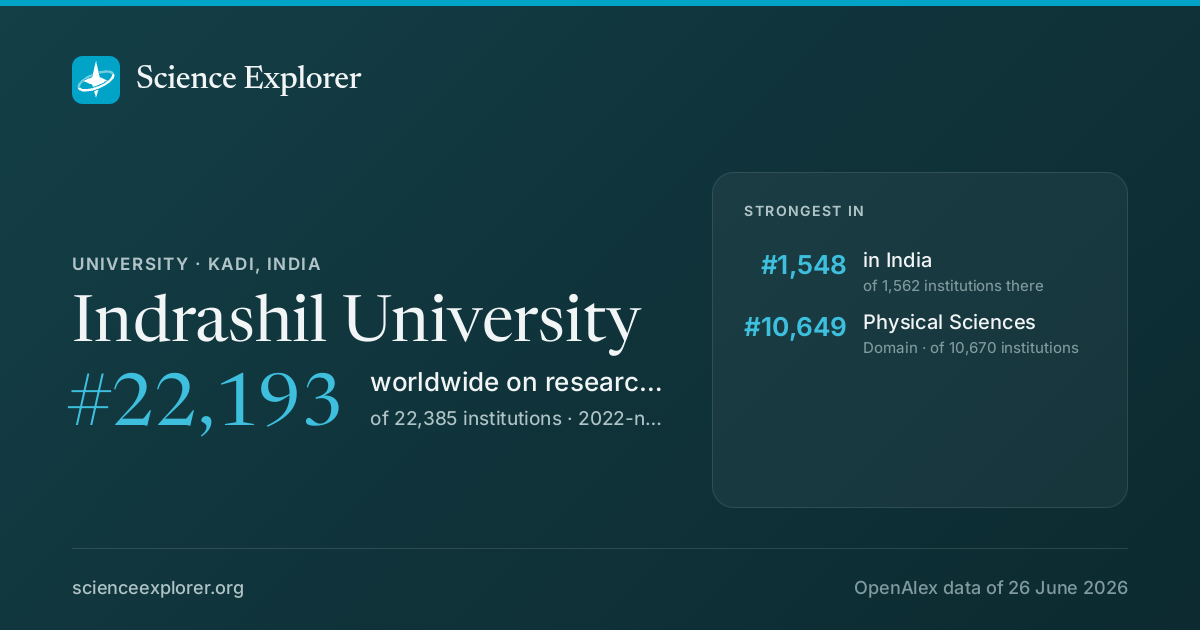
Indrashil University on Science Explorer

A card with Indrashil University's standing and the fields it leads in, for a post or a slide. A link to this page previews as the same card.

Download the card

1200 × 630 PNG, sized for social posts, drawn from the latest snapshot.

Badges for a website1Each links back here and updates with every snapshot

Research measures only: rankings here say nothing about teaching, admissions or student experience. Comparable institutions and collaboration partners have tabs of their own, above.

Discussion

Ask a question or share a note about Indrashil University. Keep it to the research: no personal attacks, advertising or links. Any reader can report a post, which collapses it for everyone until it is opened.