Institut Català de la Salut
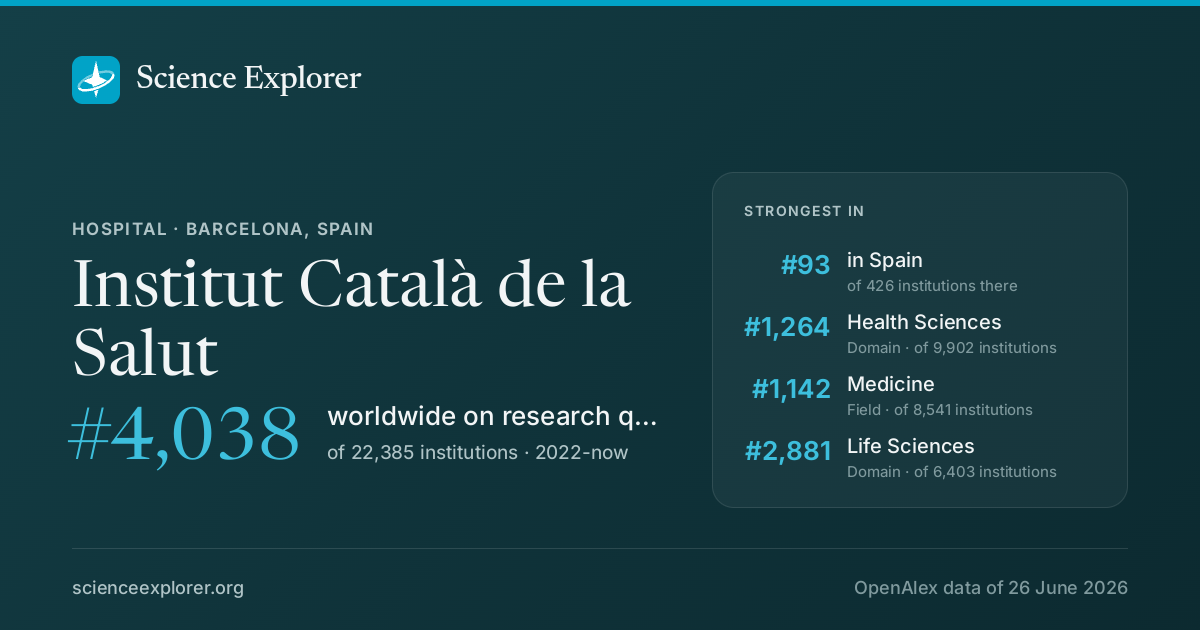
In research, Institut Català de la Salut stands highest in Health Sciences (#1,264 of 9,902 worldwide), Medicine (#1,142 of 8,541 worldwide) and Life Sciences (#2,881 of 6,403 worldwide), 2022-now. Relative to its size it is most specialised in Cardiology and Cardiovascular Medicine (Cardiology and Cardiovascular Medicine is 5.8× its share of world research).
- World rank, 2022-now
- #4,038 of 22,385 · #3,400 all time
- Rank in Spain
- #93 of 426
- Research works
- 4.1k ▲ 7% vs 2018-21
- Citations
- 60k 14.4 per fractional work
- Top-10% rate
- 7.8% all institutions 10.0%
- vs its own fields
- 0.90× 1.00× is exactly expected
- Open access
- 41% world 40%
- International
- 12% world 18%
What is Institut Català de la Salut known for in research?
The fields where it stands highest, 2022-now, ranked among every institution above the floor in each field.
| Field | World rank | Where that sits | Top-10% rate | Works | All time |
|---|---|---|---|---|---|
| Health SciencesDomain | #1,264 of 9,902 | 7.4% | 652 | #1446 | |
| MedicineField | #1,142 of 8,541 | 7.4% | 589 | #1337 | |
| Life SciencesDomain | #2,881 of 6,403 | 8.2% | 85 | #2872 | |
| SurgerySubfield | #845 of 1,532 | 7.6% | 72 | #1205 | |
| Pulmonary and Respiratory MedicineSubfield | #649 of 1,037 | 7.3% | 69 | #689 | |
| Social SciencesDomain | #7,183 of 9,585 | 8.2% | 69 | #6368 |
Each strip is that field's whole ranked pool, with the notch where Institut Català de la Salut sits in it, in the colour of the band that rank falls in. The track under the rate is the rate itself: it carries no average mark, because the average differs by field (from about 6% in Dentistry to 21% in Economics).
Which of those standings moved
The same fields on both windows: where it stood over the whole record, and where it stands in 2022-now. The distance is the story, and it is the one thing the two rank columns above cannot show.
- Health Sciences#1,446 #1,264
- Medicine#1,337 #1,142
- Life Sciences#2,872 #2,881
- Surgery#1,205 #845
- Pulmonary and Respiratory Medicine#689 #649
- Social Sciences#6,368 #7,183
A dot further right is a better standing. Fields it was not ranked in over the whole record are left out.
Which fields of science does Institut Català de la Salut work in?
In 2022-now, 78% of research at Institut Català de la Salut is in Health Sciences, 10% in Life Sciences. Its largest fields are Medicine (70%), Health Professions (7%), Biochemistry, Genetics and Molecular Biology (6%). It does 3.4× the world's share of Health Sciences.
Each ring splits the one inside it: the four domains of science, their fields, their subfields. Size is fractional works in 2022-now. Every slice is a page; the interactive view zooms down to single topics and colours each by how much more of it this institution does than the world.
Its 4 domains and 25 fields, with their numbers
- Health Sciences73878.4%
- Medicine66170.2%
- Health Professions656.9%
- Nursing80.9%
- Dentistry40.4%
- Veterinary10.1%
- Life Sciences9610.2%
- Social Sciences828.7%
- Physical Sciences262.7%
- Engineering80.9%
- Computer Science70.7%
- Environmental Science60.7%
- Mathematics30.3%
- Physics and Astronomy10.1%
- Chemistry10.1%
- Earth and Planetary Sciences00.0%
- Materials Science00.0%
- Chemical Engineering00.0%
What does Institut Català de la Salut specialise in?
Where its research is concentrated relative to its size: Cardiology and Cardiovascular Medicine takes 5.8× the share of its output that it takes of world research.
- Cardiology and Cardiovascular MedicineSubfield · 57.2 works5.8×
Location quotient, a volume reading rather than an impact one. It surfaces small, lopsided specialities.
Field profile
Location quotient across every field it publishes in: outside the ring is more than an institution of this size would be expected to publish, inside it is less.
Rings at 0.5×, 1× and 2×. Widest outward: Medicine, 3.6×. Every wedge is a field page.
All 25 fields, with their numbers
- Medicine3.65×661 works
- Health Professions2.61×65 works
- Immunology and Microbiology2.14×20 works
- Nursing1.78×8 works
- Pharmacology, Toxicology and Pharmaceutics1.21×4 works
- Neuroscience1.10×17 works
- Biochemistry, Genetics and Molecular Biology1.04×52 works
- Psychology0.90×26 works
- Dentistry0.79×4 works
- Veterinary0.49×1 works
- Economics, Econometrics and Finance0.34×7 works
- Decision Sciences0.33×3 works
- Social Sciences0.30×36 works
- Business, Management and Accounting0.26×8 works
- Mathematics0.24×3 works
- Environmental Science0.13×6 works
- Arts and Humanities0.10×3 works
- Computer Science0.09×7 works
- Agricultural and Biological Sciences0.07×3 works
- Engineering0.06×8 works
- Chemistry0.04×0 works
- Earth and Planetary Sciences0.03×0 works
- Physics and Astronomy0.03×1 works
- Chemical Engineering0.02×0 works
- Materials Science0.01×0 works
- Medicine 3.6×
- Health Professions 2.6×
- Immunology and Microbiology 2.1×
- Nursing 1.8×
- Pharmacology, Toxicology and Pharmaceutics 1.2×
- Neuroscience 1.1×
- Biochemistry, Genetics and Molecular Biology 1.0×
- Psychology 0.9×
- Dentistry 0.8×
- Veterinary 0.5×
- Economics, Econometrics and Finance 0.3×
- Decision Sciences 0.3×
- Social Sciences 0.3×
- Business, Management and Accounting 0.3×
- Mathematics 0.2×
- Environmental Science 0.1×
- Arts and Humanities 0.1×
- Computer Science 0.1×
- Agricultural and Biological Sciences 0.1×
- Engineering 0.1×
- Chemistry 0.0×
- Earth and Planetary Sciences 0.0×
- Physics and Astronomy 0.0×
- Chemical Engineering 0.0×
- Materials Science 0.0×
Who are the top researchers at Institut Català de la Salut?
Ranked on the quality score, Francesc Fina, Ermengol Coma and Queralt Miró Catalina lead among researchers whose main affiliation is Institut Català de la Salut.
- 1
Francesc Fina
 Spain · #340,127 worldwide
1.7k citations · 70 works
- 2
Ermengol Coma
Spain · #372,671 worldwide
1.4k citations · 101 works
- 3
Queralt Miró Catalina
Spain · #493,970 worldwide
939 citations · 77 works
- 4
Josep Vidal‐Alaball
Spain · #513,244 worldwide
4.2k citations · 259 works
- 5
Montserrat Martínez
Spain · #571,441 worldwide
356 citations · 28 works
- 6
Manuel Medina
Spain · #650,014 worldwide
1.9k citations · 67 works
- 7
Anna Ruiz‐Comellas
Spain · #733,701 worldwide
738 citations · 54 works
- 8
Francesc López Seguí
Spain · #797,305 worldwide
2.4k citations · 123 works
- 9
Anna Escalé-Besa
Spain · #1,074,893 worldwide
301 citations · 19 works
- 10
Núria Nadal
Spain · #1,276,960 worldwide
942 citations · 20 works
Which keywords describe research at Institut Català de la Salut?
By fractional works in 2022-now, weighted toward what it does more of than the world: Epidemiology, Quality of Life, Diagnosis, Clinical Practice Guidelines, Cardiovascular Disease, Treatment, Risk Factors and Primary Care.
- Geriatric Assessment
- Quality Improvement
- Aging Population
- Cognitive Impairment
- SARS-CoV-2
- Surgery
- Health Promotion
- Echocardiography
- Genetic Mutations
- Complications
- Heart Failure
- Clinical Trials
- Global Burden
- COVID-19
- Chemotherapy
- Mental Health
- Clinical Practice Guidelines
- Treatment
- Diagnosis
- Quality of Life
- Epidemiology
- Cardiovascular Disease
- Inflammation
- Risk Factors
- Public Health
- Management
- Pandemic
- Mortality
- Primary Care
- Guidelines
- Immunotherapy
- Obesity
- Social Support
- Medical Education
- Healthcare Quality
- Critical Care
- Myocardial Infarction
- Clinical Outcomes
- Chronic Disease Management
- Laparoscopic Repair
Size is fractional works in 2022-now in the topics tagged with each word; colour is the word's share of this institution's work against its share of the world's. The 40 words are chosen for being large and distinctive. Each links to the topic it comes from most.
All 40 words, with their numbers
- Epidemiology130▲ 3.5×127 topics
- Quality of Life53▲ 3.9×46 topics
- Cardiovascular Disease43▲ 4.0×33 topics
- Diagnosis42▲ 4.8×39 topics
- Inflammation42▲ 2.1×68 topics
- Treatment40▲ 3.4×46 topics
- Risk Factors35▲ 3.4×32 topics
- Clinical Practice Guidelines34▲ 6.5×14 topics
- Public Health31▲ 2.2×46 topics
- Mental Health28▲ 2.1×29 topics
- Management27▲ 3.5×27 topics
- Chemotherapy26▲ 3.9×24 topics
- Pandemic26▲ 2.8×8 topics
- COVID-1926▲ 2.1×22 topics
- Mortality24▲ 4.5×12 topics
- Global Burden24▲ 4.7×12 topics
- Primary Care24▲ 6.9×13 topics
- Clinical Trials24▲ 3.8×16 topics
- Guidelines24▲ 5.3×11 topics
- Heart Failure23▲ 5.5×13 topics
- Immunotherapy22▲ 3.3×19 topics
- Complications22▲ 4.6×15 topics
- Obesity21▲ 2.8×22 topics
- Genetic Mutations18▲ 4.3×19 topics
- Social Support18▲ 3.5×16 topics
- Echocardiography18▲ 6.7×8 topics
- Medical Education17▲ 6.8×13 topics
- Health Promotion17▲ 5.6×11 topics
- Healthcare Quality16▲ 17×5 topics
- Surgery16▲ 4.8×9 topics
- Critical Care15▲ 6.5×8 topics
- SARS-CoV-215▲ 5.2×6 topics
- Myocardial Infarction15▲ 6.6×7 topics
- Cognitive Impairment14▲ 6.0×10 topics
- Clinical Outcomes14▲ 6.8×5 topics
- Aging Population13▲ 16×4 topics
- Chronic Disease Management13▲ 7.0×5 topics
- Quality Improvement13▲ 7.0×8 topics
- Laparoscopic Repair12▲ 33×2 topics
- Geriatric Assessment12▲ 18×2 topics
Which research topics does Institut Català de la Salut publish most on?
By volume in 2022-now: Aging, Health, and Disability, Pharmaceutical Practices and Patient Outcomes, Long-Term Effects of COVID-19 and Acute Ischemic Stroke Management.
Area is fractional works; colour is the subfield each topic belongs to.
- 1 Aging, Health, and Disability Public Health, Environmental and Occupational Health 9 works
- 2 Pharmaceutical Practices and Patient Outcomes Geriatrics and Gerontology 8 works
- 3 Long-Term Effects of COVID-19 Neurology 8 works
- 4 Acute Ischemic Stroke Management Epidemiology 8 works
- 5 Chronic Disease Management Strategies Epidemiology 8 works
- 6 Hernia repair and management Surgery 8 works
- 7 COVID-19 Clinical Research Studies Infectious Diseases 8 works
- 8 COVID-19 and healthcare impacts Oncology 7 works
- 9 Obstructive Sleep Apnea Research Physiology 7 works
- 10 Pleural and Pulmonary Diseases Pulmonary and Respiratory Medicine 6 works
How open and international is its research?
Against the world's own shares: the tick on each track. Both are shares of its output, so they sit on one scale and can be read against each other as well as against the world.
World: 40% of research is openly available.
World: 18% is written across borders.
How has Institut Català de la Salut's research output changed?
Output in 2022-2025 was 7% higher than in 2018-2021.
The same series as a ribbon: one cell per year, darker for more. The line above answers how much; this answers when.
Its share of all research
Growing output can still be a shrinking share: all of science grows. This is Institut Català de la Salut as a percentage of every work published that year, 0.0036% in 2024.
Fractional works of Institut Català de la Salut over all fractional works that year. How the balance of science has shifted.
How much of it reaches the world top 10%
Year by year, against all institutions in the same year.
Of each year's output, the share that reached the world's 10% most cited for its field and year. Peak 10.4% in 1999.
Other research institutions in Barcelona
- Universitat de Barcelona
- Universitat Politècnica de Catalunya
- Universitat Pompeu Fabra
- CERCA Institution
- Vall d'Hebron Hospital Universitari
- Hospital de Sant Pau
- Universitat Oberta de Catalunya
- Institució Catalana de Recerca i Estudis Avançats

Share Institut Català de la Salut's ranking
Badges for a website1Each links back here and updates with every snapshot

Research measures only: rankings here say nothing about teaching, admissions or student experience. Comparable institutions and collaboration partners have tabs of their own, above.
Discussion
Ask a question or share a note about Institut Català de la Salut. Posts are plain text and can be reported.