Science Explorer Back to mapMap
Discussion
Archive · Sulaymaniyah · Iraq

Iraq Virtual Science Library

World rank, 2022-now
#20,876
of 22,385
Rank in Iraq
#64
of 67
Research works
87
▲ 484% vs 2018-21
Citations
126
1.4 per fractional work
Top-10% rate
4.8%
all institutions 10.0%
vs its own fields
0.94×
1.00× is exactly expected
Open access
87%
world 40%
International
22%
world 18%

Which fields of science does Iraq Virtual Science Library work in?

In 2022-now, 55% of research at Iraq Virtual Science Library is in Health Sciences, 19% in Life Sciences. Its largest fields are Medicine (51%), Biochemistry, Genetics and Molecular Biology (8%), Social Sciences (7%). It does 2.2× the world's share of Health Sciences.

Health Sciences: 40 fractional works · 55.3% of its workMedicine: 37 fractional works · 51.2% of its workSurgery: 8 fractional works · 11.6% of its workPulmonary and Respiratory Medicine: 5 fractional works · 6.4% of its workRadiology, Nuclear Medicine and Imaging: 2 fractional works · 3.0% of its workPathology and Forensic Medicine: 2 fractional works · 2.9% of its workDermatology: 2 fractional works · 2.8% of its workEndocrinology, Diabetes and Metabolism: 2 fractional works · 2.4% of its workOncology: 2 fractional works · 2.3% of its workEpidemiology: 2 fractional works · 2.1% of its workPhysiology: 1 fractional works · 1.9% of its workInfectious Diseases: 1 fractional works · 1.8% of its workPublic Health, Environmental and Occupational Health: 1 fractional works · 1.8% of its workOtorhinolaryngology: 1 fractional works · 1.4% of its workRheumatology: 1 fractional works · 1.3% of its workGenetics: 1 fractional works · 1.1% of its workNeurology: 1 fractional works · 1.0% of its workObstetrics and Gynecology: 1 fractional works · 1.0% of its workPediatrics, Perinatology and Child Health: 1 fractional works · 0.9% of its workCardiology and Cardiovascular Medicine: 1 fractional works · 0.8% of its workUrology: 0 fractional works · 0.6% of its workEmergency Medicine: 0 fractional works · 0.6% of its workGeriatrics and Gerontology: 0 fractional works · 0.4% of its workHealth Informatics: 0 fractional works · 0.3% of its workPsychiatry and Mental health: 0 fractional works · 0.3% of its workNephrology: 0 fractional works · 0.3% of its workOphthalmology: 0 fractional works · 0.3% of its workAnesthesiology and Pain Medicine: 0 fractional works · 0.3% of its workGastroenterology: 0 fractional works · 0.3% of its workRehabilitation: 0 fractional works · 0.2% of its workSmaller subfields together: 1 fractional works · 1.1% of its workDentistry: 1 fractional works · 2.0% of its workPeriodontics: 1 fractional works · 1.1% of its workOral Surgery: 0 fractional works · 0.5% of its workOrthodontics: 0 fractional works · 0.3% of its workSmaller subfields together: 0 fractional works · 0.2% of its workVeterinary: 1 fractional works · 1.0% of its workSmall Animals: 1 fractional works · 1.0% of its workHealth Professions: 0 fractional works · 0.6% of its workGeneral Health Professions: 0 fractional works · 0.3% of its workPharmacy: 0 fractional works · 0.2% of its workSmaller subfields together: 0 fractional works · 0.1% of its workNursing: 0 fractional works · 0.5% of its workNutrition and Dietetics: 0 fractional works · 0.5% of its workLife Sciences: 14 fractional works · 18.7% of its workBiochemistry, Genetics and Molecular Biology: 6 fractional works · 8.2% of its workGenetics: 2 fractional works · 2.9% of its workMolecular Biology: 2 fractional works · 2.6% of its workCancer Research: 1 fractional works · 0.8% of its workBiotechnology: 0 fractional works · 0.7% of its workMolecular Medicine: 0 fractional works · 0.6% of its workEndocrinology: 0 fractional works · 0.3% of its workCell Biology: 0 fractional works · 0.3% of its workSmaller subfields together: 0 fractional works · 0.1% of its workAgricultural and Biological Sciences: 4 fractional works · 6.1% of its workPlant Science: 2 fractional works · 2.6% of its workAnimal Science and Zoology: 1 fractional works · 1.2% of its workAgronomy and Crop Science: 1 fractional works · 0.8% of its workEcology, Evolution, Behavior and Systematics: 0 fractional works · 0.6% of its workInsect Science: 0 fractional works · 0.3% of its workAquatic Science: 0 fractional works · 0.2% of its workFood Science: 0 fractional works · 0.2% of its workSmaller subfields together: 0 fractional works · 0.2% of its workImmunology and Microbiology: 2 fractional works · 3.3% of its workImmunology: 1 fractional works · 1.2% of its workParasitology: 1 fractional works · 1.2% of its workMicrobiology: 0 fractional works · 0.5% of its workApplied Microbiology and Biotechnology: 0 fractional works · 0.2% of its workVirology: 0 fractional works · 0.2% of its workPharmacology, Toxicology and Pharmaceutics: 0 fractional works · 0.6% of its workPharmacology: 0 fractional works · 0.6% of its workSmaller subfields together: 0 fractional works · 0.0% of its workNeuroscience: 0 fractional works · 0.4% of its workCellular and Molecular Neuroscience: 0 fractional works · 0.2% of its workSmaller subfields together: 0 fractional works · 0.2% of its workSocial Sciences: 10 fractional works · 13.2% of its workSocial Sciences: 5 fractional works · 7.2% of its workSociology and Political Science: 1 fractional works · 1.7% of its workLaw: 1 fractional works · 1.3% of its workPolitical Science and International Relations: 1 fractional works · 1.3% of its workEducation: 1 fractional works · 0.8% of its workGender Studies: 0 fractional works · 0.5% of its workTransportation: 0 fractional works · 0.5% of its workAnthropology: 0 fractional works · 0.5% of its workSmaller subfields together: 0 fractional works · 0.4% of its workArts and Humanities: 3 fractional works · 4.4% of its workArcheology: 2 fractional works · 2.1% of its workLanguage and Linguistics: 1 fractional works · 1.2% of its workMuseology: 0 fractional works · 0.5% of its workReligious studies: 0 fractional works · 0.5% of its workSmaller subfields together: 0 fractional works · 0.1% of its workBusiness, Management and Accounting: 1 fractional works · 0.8% of its workManagement of Technology and Innovation: 0 fractional works · 0.3% of its workSmaller subfields together: 0 fractional works · 0.5% of its workPsychology: 0 fractional works · 0.6% of its workSocial Psychology: 0 fractional works · 0.5% of its workSmaller subfields together: 0 fractional works · 0.2% of its workDecision Sciences: 0 fractional works · 0.2% of its workPhysical Sciences: 9 fractional works · 12.7% of its workEngineering: 3 fractional works · 3.8% of its workBuilding and Construction: 1 fractional works · 1.3% of its workBiomedical Engineering: 1 fractional works · 0.8% of its workAerospace Engineering: 0 fractional works · 0.6% of its workCivil and Structural Engineering: 0 fractional works · 0.6% of its workOcean Engineering: 0 fractional works · 0.2% of its workSmaller subfields together: 0 fractional works · 0.2% of its workEnvironmental Science: 2 fractional works · 2.9% of its workEnvironmental Engineering: 1 fractional works · 1.1% of its workManagement, Monitoring, Policy and Law: 0 fractional works · 0.5% of its workHealth, Toxicology and Mutagenesis: 0 fractional works · 0.5% of its workPollution: 0 fractional works · 0.3% of its workGlobal and Planetary Change: 0 fractional works · 0.2% of its workSmaller subfields together: 0 fractional works · 0.3% of its workComputer Science: 2 fractional works · 2.2% of its workArtificial Intelligence: 1 fractional works · 1.3% of its workInformation Systems: 0 fractional works · 0.6% of its workSmaller subfields together: 0 fractional works · 0.3% of its workPhysics and Astronomy: 1 fractional works · 1.1% of its workStatistical and Nonlinear Physics: 1 fractional works · 0.9% of its workSmaller subfields together: 0 fractional works · 0.2% of its workMaterials Science: 1 fractional works · 1.0% of its workBiomaterials: 0 fractional works · 0.4% of its workMaterials Chemistry: 0 fractional works · 0.3% of its workSmaller subfields together: 0 fractional works · 0.3% of its workMathematics: 1 fractional works · 0.9% of its workModeling and Simulation: 0 fractional works · 0.6% of its workSmaller subfields together: 0 fractional works · 0.3% of its workEarth and Planetary Sciences: 0 fractional works · 0.5% of its workPaleontology: 0 fractional works · 0.2% of its workSmaller subfields together: 0 fractional works · 0.2% of its workChemistry: 0 fractional works · 0.4% of its workOrganic Chemistry: 0 fractional works · 0.4% of its workALL ITS WORKIraq VirtualScience Library73fractional works, 2022-now
Life Sciences19%Physical Sciences13%Health Sciences55%Social Sciences13%

Each ring splits the one inside it: the four domains of science, their fields, their subfields. Size is fractional works in 2022-now. Every slice is a page; the interactive view zooms down to single topics and colours each by how much more of it this institution does than the world.

Its 4 domains and 23 fields, with their numbers
    1. Medicine3751.2%
    2. Dentistry12.0%
    3. Veterinary11.0%
    4. Health Professions00.6%
    5. Nursing00.5%
    1. Biochemistry, Genetics and Molecular Biology68.2%
    2. Agricultural and Biological Sciences46.1%
    3. Immunology and Microbiology23.3%
    4. Pharmacology, Toxicology and Pharmaceutics00.6%
    5. Neuroscience00.4%
    1. Social Sciences57.2%
    2. Arts and Humanities34.4%
    3. Business, Management and Accounting10.8%
    4. Psychology00.6%
    5. Decision Sciences00.2%
    1. Engineering33.8%
    2. Environmental Science22.9%
    3. Computer Science22.2%
    4. Physics and Astronomy11.1%
    5. Materials Science11.0%
    6. Mathematics10.9%
    7. Earth and Planetary Sciences00.5%
    8. Chemistry00.4%
All of science, and how each field's share has moved since 1950: the Science domain explorer

Field profile

Location quotient across every field it publishes in: outside the ring is more than an institution of this size would be expected to publish, inside it is less.

Agricultural and Biological Sciences: 1.29× its world share, 4 worksAgricultural and Bio…Biochemistry, Genetics and Molecular Biology: 1.54× its world share, 6 worksBiochemistry, Geneti…Immunology and Microbiology: 3.28× its world share, 2 worksImmunology and Micro…Neuroscience: 0.24× its world share, 0 worksNeurosciencePharmacology, Toxicology and Pharmaceutics: 1.79× its world share, 0 worksPharmacology, Toxico…Chemistry: 0.24× its world share, 0 worksChemistryComputer Science: 0.28× its world share, 2 worksComputer ScienceEarth and Planetary Sciences: 0.29× its world share, 0 worksEarth and Planetary …Engineering: 0.25× its world share, 3 worksEngineeringEnvironmental Science: 0.58× its world share, 2 worksEnvironmental ScienceMaterials Science: 0.29× its world share, 1 worksMaterials ScienceMathematics: 0.78× its world share, 1 worksMathematicsPhysics and Astronomy: 0.48× its world share, 1 worksPhysics and AstronomyDentistry: 4.21× its world share, 2 worksDentistryHealth Professions: 0.22× its world share, 0 worksHealth ProfessionsMedicine: 2.66× its world share, 37 worksMedicineNursing: 1.05× its world share, 0 worksNursingVeterinary: 7.40× its world share, 1 worksVeterinaryArts and Humanities: 1.51× its world share, 3 worksArts and HumanitiesBusiness, Management and Accounting: 0.25× its world share, 1 worksBusiness, Management…Decision Sciences: 0.25× its world share, 0 worksDecision SciencesPsychology: 0.21× its world share, 0 worksPsychologySocial Sciences: 0.57× its world share, 5 worksSocial Sciences1×world share
more than its size predictsabout as predictedless

Rings at 0.5×, 1× and 2×. Widest outward: Veterinary, 7.4×. Every wedge is a field page.

All 23 fields, with their numbers
  1. Veterinary7.40×1 works
  2. Dentistry4.21×2 works
  3. Immunology and Microbiology3.28×2 works
  4. Medicine2.66×37 works
  5. Pharmacology, Toxicology and Pharmaceutics1.79×0 works
  6. Biochemistry, Genetics and Molecular Biology1.54×6 works
  7. Arts and Humanities1.51×3 works
  8. Agricultural and Biological Sciences1.29×4 works
  9. Nursing1.05×0 works
  10. Mathematics0.78×1 works
  11. Environmental Science0.58×2 works
  12. Social Sciences0.57×5 works
  13. Physics and Astronomy0.48×1 works
  14. Earth and Planetary Sciences0.29×0 works
  15. Materials Science0.29×1 works
  16. Computer Science0.28×2 works
  17. Engineering0.25×3 works
  18. Business, Management and Accounting0.25×1 works
  19. Decision Sciences0.25×0 works
  20. Neuroscience0.24×0 works
  21. Chemistry0.24×0 works
  22. Health Professions0.22×0 works
  23. Psychology0.21×0 works

What are the most cited papers from Iraq Virtual Science Library?

The most cited paper from Iraq Virtual Science Library is "The genetic history of the Southern Arc: A bridge between West Asia and Europe" (Iosif Lazaridis et al., 2022), with 200 citations. Next come "Forecasting the effects of smoking prevalence scenarios on years of life lost and life expectancy from 2022 to 2050: a systematic analysis for the Global Burden of Disease Study 2021" (148) and "A genetic probe into the ancient and medieval history of Southern Europe and West Asia" (127).

Most cited papers
#PaperReleasedCitations
1 The genetic history of the Southern Arc: A bridge between West Asia and Europe Iosif Lazaridis et al. · Science Open access206 authors 25 Aug 2022 200
2 Forecasting the effects of smoking prevalence scenarios on years of life lost and life expectancy from 2022 to 2050: a systematic analysis for the Global Burden of Disease Study 2021 Dana Bryazka et al. · The Lancet Public Health Open access1,009 authors Oct 2024 148
3 A genetic probe into the ancient and medieval history of Southern Europe and West Asia Iosif Lazaridis et al. · Science Open access206 authors 25 Aug 2022 127
4 Ancient DNA from Mesopotamia suggests distinct Pre-Pottery and Pottery Neolithic migrations into Anatolia Iosif Lazaridis et al. · Science Open access206 authors 25 Aug 2022 44
5 Soil and Groundwater Pollution Assessment and Delineation of Intensity Risk Map in Sulaymaniyah City, NE of Iraq Diary Ali Mohammed Amin Al Manmi, Twana O. Abdullah, Peshawa Al‐Jaf et al. · Water Open access 17 Oct 2019 32
All 60 most cited papers, with filters and sorting

Which keywords describe research at Iraq Virtual Science Library?

By fractional works in 2022-now, weighted toward what it does more of than the world: Epidemiology, Treatment, Prognostic Factors, Complications, Ultrasound, Breast Cancer, Children and Inflammation.

▲ more of its work than of the world's◆ about the world's share▼ less than the world's

Size is fractional works in 2022-now in the topics tagged with each word; colour is the word's share of this institution's work against its share of the world's. The 40 words are chosen for being large and distinctive. Each links to the topic it comes from most.

All 40 words, with their numbers
  1. Epidemiology8▲ 2.7×48 topics
  2. Treatment4▲ 4.7×17 topics
  3. Inflammation3▲ 2.0×18 topics
  4. Machine Learning2◆ 0.97×11 topics
  5. Diagnosis2▲ 3.4×13 topics
  6. Complications2▲ 5.9×7 topics
  7. Prognostic Factors2▲ 6.6×10 topics
  8. Public Health2▲ 1.76×9 topics
  9. Quality of Life2▲ 1.84×12 topics
  10. Breast Cancer2▲ 9.6×5 topics
  11. Genetic Mutations2▲ 5.5×10 topics
  12. Immunotherapy2▲ 3.5×7 topics
  13. Ultrasound2▲ 23×2 topics
  14. Genetics2▲ 3.2×12 topics
  15. Children2▲ 9.8×3 topics
  16. Radiotherapy2▲ 5.6×6 topics
  17. Chemotherapy2▲ 3.0×8 topics
  18. Management2▲ 2.6×7 topics
  19. Surgical Management2▲ 5.0×10 topics
  20. Artificial Neural Networks1▲ 4.1×4 topics
  21. Pathogenesis1▲ 3.8×9 topics
  22. Thyroid Carcinoma1▲ 38×2 topics
  23. Treatment Guidelines1▲ 8.9×4 topics
  24. Endoscopic Surgery1▲ 19×3 topics
  25. Human Rights1▲ 1.73×6 topics
  26. Antibiotic Resistance1▲ 4.3×5 topics
  27. Antioxidant1▲ 2.3×5 topics
  28. BRAF Mutation1▲ 23×2 topics
  29. Guidelines1▲ 3.4×7 topics
  30. Molecular Genetics1▲ 32×2 topics
  31. Differentiated Thyroid Cancer1▲ 38×1 topic
  32. Forecasting1▲ 7.8×3 topics
  33. Global Governance1▲ 6.1×5 topics
  34. Molecular Characterization1▲ 8.3×4 topics
  35. Surgery1▲ 4.5×7 topics
  36. Thyroid Nodules1▲ 38×1 topic
  37. Cholangiocarcinoma1▲ 17×2 topics
  38. Foreign Bodies1▲ 133×1 topic
  39. Ingestion1▲ 133×1 topic
  40. Prognostic Markers1▲ 12×3 topics

Which research topics does Iraq Virtual Science Library publish most on?

By volume in 2022-now: Thyroid Cancer Diagnosis and Treatment, Foreign Body Medical Cases, Gallbladder and Bile Duct Disorders and Ancient Near East History.

  1. 1 Thyroid Cancer Diagnosis and Treatment Endocrinology, Diabetes and Metabolism 1 works
  2. 2 Foreign Body Medical Cases Radiology, Nuclear Medicine and Imaging 1 works
  3. 3 Gallbladder and Bile Duct Disorders Pulmonary and Respiratory Medicine 1 works
  4. 4 Ancient Near East History Archeology 1 works
  5. 5 Sinusitis and nasal conditions Otorhinolaryngology 1 works
  6. 6 Breast Lesions and Carcinomas Pathology and Forensic Medicine 1 works
  7. 7 Identification and Quantification in Food Molecular Biology 1 works
  8. 8 Peripheral Nerve Disorders Radiology, Nuclear Medicine and Imaging 1 works
  9. 9 Head and Neck Surgical Oncology Surgery 1 works
  10. 10 Pediatric Hepatobiliary Diseases and Treatments Surgery 1 works

How open and international is its research?

Against the world's own shares: the tick on each track. Both are shares of its output, so they sit on one scale and can be read against each other as well as against the world.

openly available87.1%not open12.9%

World: 40% of research is openly available.

with international co-authors22.4%domestic only77.6%

World: 18% is written across borders.

How has Iraq Virtual Science Library's research output changed?

Output in 2022-2025 was 484% higher than in 2018-2021.

still counting201520202025
grewheldshrank

The same series as a ribbon: one cell per year, darker for more. The line above answers how much; this answers when.

Its share of all research

Growing output can still be a shrinking share: all of science grows. This is Iraq Virtual Science Library as a percentage of every work published that year, 0.00031% in 2024.

still counting0.00020%0.00040%0.00060%Iraq Virtual Science Library0.00055% in 20252020

Fractional works of Iraq Virtual Science Library over all fractional works that year. How the balance of science has shifted.

Other research institutions in Sulaymaniyah

All research institutions in Sulaymaniyah

Share Iraq Virtual Science Library's ranking
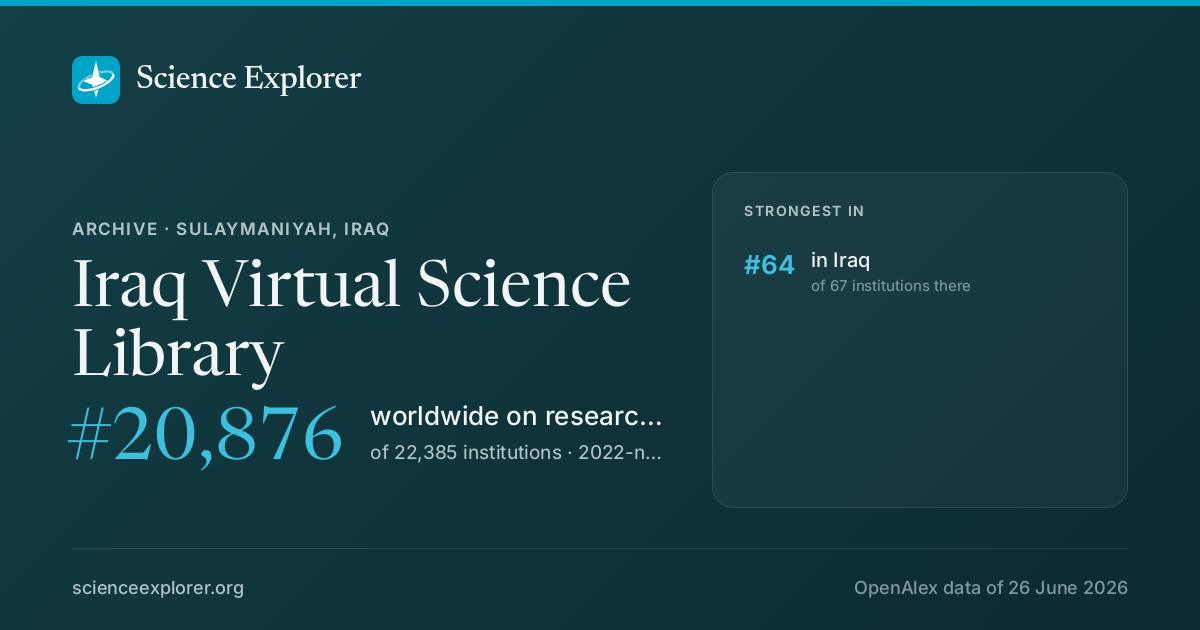
Iraq Virtual Science Library on Science Explorer

A card with Iraq Virtual Science Library's standing and the fields it leads in, for a post or a slide. A link to this page previews as the same card.

Download the card

1200 × 630 PNG, sized for social posts, drawn from the latest snapshot.

Badges for a website1Each links back here and updates with every snapshot

Research measures only: rankings here say nothing about teaching, admissions or student experience. Comparable institutions and collaboration partners have tabs of their own, above.

Discussion

Ask a question or share a note about Iraq Virtual Science Library. Posts are plain text and can be reported.