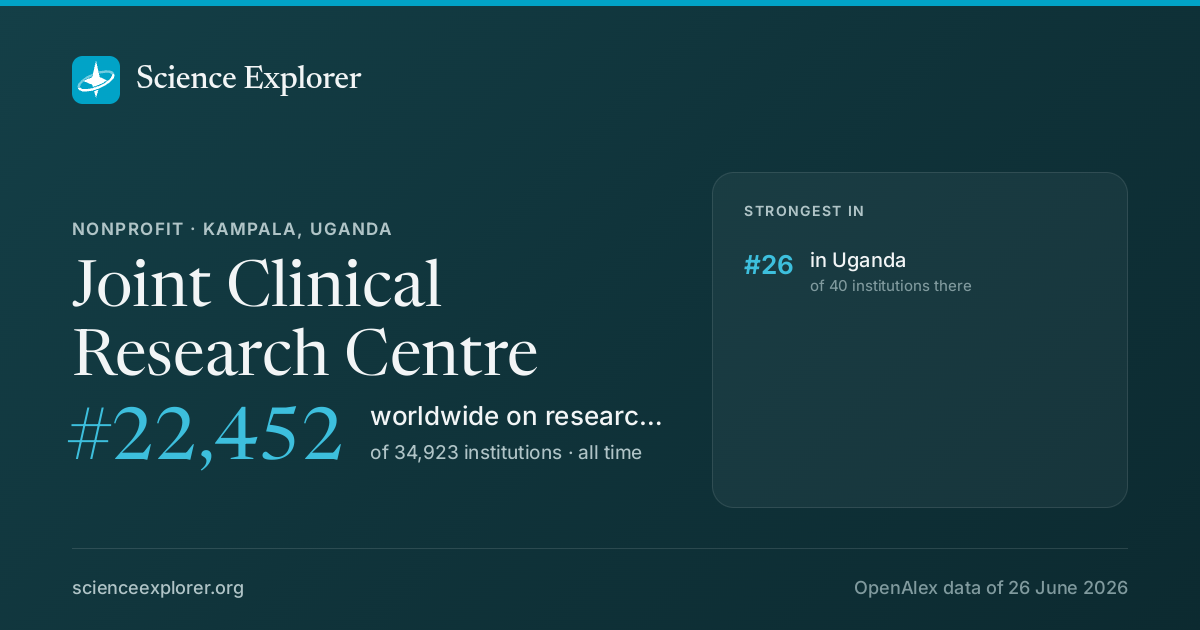
- World rank, all time
- #22,452 of 34,923
- Rank in Uganda
- #26 of 40
- Research works
- 170 ▲ 39% vs 2018-21
- Citations
- 4.1k 23.9 per fractional work
- Top-10% rate
- 10.9% all institutions 10.0%
- vs its own fields
- 1.03× 1.00× is exactly expected
- Open access
- 74% world 40%
- International
- 64% world 18%
Which fields of science does Joint Clinical Research Centre work in?
In 2022-now, 73% of research at Joint Clinical Research Centre is in Health Sciences, 11% in Social Sciences. Its largest fields are Medicine (64%), Social Sciences (7%), Health Professions (7%). It does 2.7× the world's share of Health Sciences.
Each ring splits the one inside it: the four domains of science, their fields, their subfields. Size is fractional works in 2022-now. Every slice is a page; the interactive view zooms down to single topics and colours each by how much more of it this institution does than the world.
Its 4 domains and 21 fields, with their numbers
- Health Sciences3673.3%
- Medicine3163.8%
- Health Professions36.6%
- Nursing12.7%
- Dentistry00.2%
- Social Sciences511.2%
- Life Sciences510.9%
- Physical Sciences24.6%
- Computer Science12.0%
- Environmental Science11.3%
- Energy00.5%
- Engineering00.5%
- Chemistry00.2%
- Physics and Astronomy00.1%
- Mathematics00.0%
Field profile
Location quotient across every field it publishes in: outside the ring is more than an institution of this size would be expected to publish, inside it is less.
Rings at 0.5×, 1× and 2×. Widest outward: Immunology and Microbiology, 6.5×. Every wedge is a field page.
All 21 fields, with their numbers
- Immunology and Microbiology6.50×3 works
- Nursing5.58×1 works
- Medicine3.32×31 works
- Health Professions2.51×3 works
- Pharmacology, Toxicology and Pharmaceutics1.25×0 works
- Economics, Econometrics and Finance1.10×1 works
- Biochemistry, Genetics and Molecular Biology0.58×2 works
- Social Sciences0.55×3 works
- Energy0.50×0 works
- Psychology0.40×1 works
- Dentistry0.35×0 works
- Computer Science0.26×1 works
- Environmental Science0.25×1 works
- Neuroscience0.24×0 works
- Chemistry0.15×0 works
- Business, Management and Accounting0.13×0 works
- Agricultural and Biological Sciences0.10×0 works
- Physics and Astronomy0.06×0 works
- Arts and Humanities0.06×0 works
- Engineering0.03×0 works
- Mathematics0.03×0 works
- Immunology and Microbiology 6.5×
- Nursing 5.6×
- Medicine 3.3×
- Health Professions 2.5×
- Pharmacology, Toxicology and Pharmaceutics 1.2×
- Economics, Econometrics and Finance 1.1×
- Biochemistry, Genetics and Molecular Biology 0.6×
- Social Sciences 0.6×
- Energy 0.5×
- Psychology 0.4×
- Dentistry 0.3×
- Computer Science 0.3×
- Environmental Science 0.2×
- Neuroscience 0.2×
- Chemistry 0.1×
- Business, Management and Accounting 0.1×
- Agricultural and Biological Sciences 0.1×
- Physics and Astronomy 0.1×
- Arts and Humanities 0.1×
- Engineering 0.0×
- Mathematics 0.0×
Who are the top researchers at Joint Clinical Research Centre?
Ranked on the quality score, Cissy M Kityo, Henry Mugerwa and Peter N. Mugyenyi lead among researchers whose main affiliation is Joint Clinical Research Centre.
- 1
Cissy M Kityo
 Uganda · #370,161 worldwide
11k citations · 315 works
- 2
Henry Mugerwa
Uganda · #467,704 worldwide
1.5k citations · 76 works
- 3
Peter N. Mugyenyi
Uganda · #556,819 worldwide
8.7k citations · 205 works
- 4
Abbas Lugemwa
Uganda · #617,954 worldwide
1.4k citations · 37 works
- 5
Shafic Makumbi
Uganda · #675,863 worldwide
460 citations · 21 works
- 6
Elizabeth Kaudha
Uganda · #888,171 worldwide
625 citations · 26 works
- 7
Immaculate Nankya
Uganda · #991,919 worldwide
1.7k citations · 62 works
- 8
Grace Mirembe
Uganda · #1,165,507 worldwide
1.3k citations · 37 works
- 9
Victor Musiime
Uganda · #1,494,798 worldwide
3.6k citations · 234 works
- 10
Caroline Otike
Uganda · #1,548,049 worldwide
264 citations · 33 works
Which keywords describe research at Joint Clinical Research Centre?
By fractional works in 2022-now, weighted toward what it does more of than the world: Antiretroviral Therapy, HIV Infection, Immune Response, Drug Resistance, Vaccine, Inflammation, Epidemiology and Viral Load.
- Global Burden of Disease
- Vaccine Development
- Social Determinants of Health
- Pulmonary Hypertension
- Tuberculosis
- Maternal Mortality
- Genetic Diversity
- neurocognitive disorders
- Treatment
- Antibodies
- Integrase Inhibitors
- Lipodystrophy
- Bone Mineral Density
- Aging
- Preexposure Prophylaxis
- Mortality Rates
- Cardiovascular Disease
- Drug Resistance
- Inflammation
- Epidemiology
- Antiretroviral Therapy
- HIV Infection
- Immune Response
- Vaccine
- Viral Load
- HIV Transmission
- Insulin Resistance
- Myocardial Infarction
- HIV
- Metabolic Abnormalities
- Nucleoside Analogues
- Immune Activation
- AIDS
- Diagnosis
- Child Development
- Mycobacterium tuberculosis
- Anemia
- Sickle-cell Disease
- Thalassemia
- Ethical Considerations
Size is fractional works in 2022-now in the topics tagged with each word; colour is the word's share of this institution's work against its share of the world's. The 40 words are chosen for being large and distinctive. Each links to the topic it comes from most.
All 40 words, with their numbers
- Antiretroviral Therapy12▲ 153×6 topics
- Epidemiology6▲ 3.2×36 topics
- HIV Infection6▲ 122×4 topics
- Inflammation5▲ 4.9×15 topics
- Immune Response4▲ 16×11 topics
- Drug Resistance4▲ 31×5 topics
- Vaccine4▲ 22×9 topics
- Cardiovascular Disease4▲ 7.2×9 topics
- Viral Load4▲ 105×2 topics
- Mortality Rates4▲ 84×2 topics
- HIV Transmission4▲ 103×1 topic
- Preexposure Prophylaxis4▲ 160×1 topic
- Insulin Resistance4▲ 17×3 topics
- Aging3▲ 12×4 topics
- Myocardial Infarction3▲ 28×3 topics
- Bone Mineral Density3▲ 82×2 topics
- HIV3▲ 74×4 topics
- Lipodystrophy3▲ 306×1 topic
- Metabolic Abnormalities3▲ 306×1 topic
- Integrase Inhibitors3▲ 264×1 topic
- Nucleoside Analogues3▲ 264×1 topic
- Antibodies2▲ 83×2 topics
- Immune Activation2▲ 58×2 topics
- Treatment2▲ 3.9×9 topics
- AIDS2▲ 181×1 topic
- neurocognitive disorders2▲ 181×1 topic
- Diagnosis2▲ 4.6×7 topics
- Genetic Diversity2▲ 7.1×4 topics
- Child Development1▲ 7.0×3 topics
- Maternal Mortality1▲ 12×4 topics
- Mycobacterium tuberculosis1▲ 49×1 topic
- Tuberculosis1▲ 52×1 topic
- Anemia1▲ 24×3 topics
- Pulmonary Hypertension1▲ 17×2 topics
- Sickle-cell Disease1▲ 53×1 topic
- Social Determinants of Health1▲ 10×2 topics
- Thalassemia1▲ 53×1 topic
- Vaccine Development1▲ 9.2×5 topics
- Ethical Considerations1▲ 6.2×3 topics
- Global Burden of Disease1▲ 8.4×2 topics
Which research topics does Joint Clinical Research Centre publish most on?
By volume in 2022-now: HIV/AIDS Research and Interventions, HIV-related health complications and treatments, HIV/AIDS drug development and treatment and HIV Research and Treatment.
Area is fractional works; colour is the subfield each topic belongs to.
- 1 HIV/AIDS Research and Interventions Infectious Diseases 4 works
- 2 HIV-related health complications and treatments Emergency Medicine 3 works
- 3 HIV/AIDS drug development and treatment Infectious Diseases 3 works
- 4 HIV Research and Treatment Virology 2 works
- 5 Tuberculosis Research and Epidemiology Infectious Diseases 1 works
- 6 Hemoglobinopathies and Related Disorders Genetics 1 works
- 7 Child Nutrition and Water Access Nutrition and Dietetics 1 works
- 8 Global Maternal and Child Health Pediatrics, Perinatology and Child Health 1 works
- 9 Adolescent Sexual and Reproductive Health General Health Professions 1 works
- 10 Diabetes, Cardiovascular Risks, and Lipoproteins Endocrinology, Diabetes and Metabolism 0 works
How open and international is its research?
Against the world's own shares: the tick on each track. Both are shares of its output, so they sit on one scale and can be read against each other as well as against the world.
World: 40% of research is openly available.
World: 18% is written across borders.
How has Joint Clinical Research Centre's research output changed?
Output in 2022-2025 was 39% higher than in 2018-2021.
The same series as a ribbon: one cell per year, darker for more. The line above answers how much; this answers when.
Its share of all research
Growing output can still be a shrinking share: all of science grows. This is Joint Clinical Research Centre as a percentage of every work published that year, 0.00016% in 2024.
Fractional works of Joint Clinical Research Centre over all fractional works that year. How the balance of science has shifted.
Other research institutions in Kampala
- Makerere University
- Kampala International University
- Kyambogo University
- Centers for Disease Control and Prevention
- National Agricultural Research Organisation
- Mulago Hospital
- Ministry of Health
- Victoria University
Share Joint Clinical Research Centre's ranking
Badges for a website1Each links back here and updates with every snapshot

Research measures only: rankings here say nothing about teaching, admissions or student experience. Comparable institutions and collaboration partners have tabs of their own, above.
Discussion
Ask a question or share a note about Joint Clinical Research Centre. Posts are plain text and can be reported.