Lander Institute
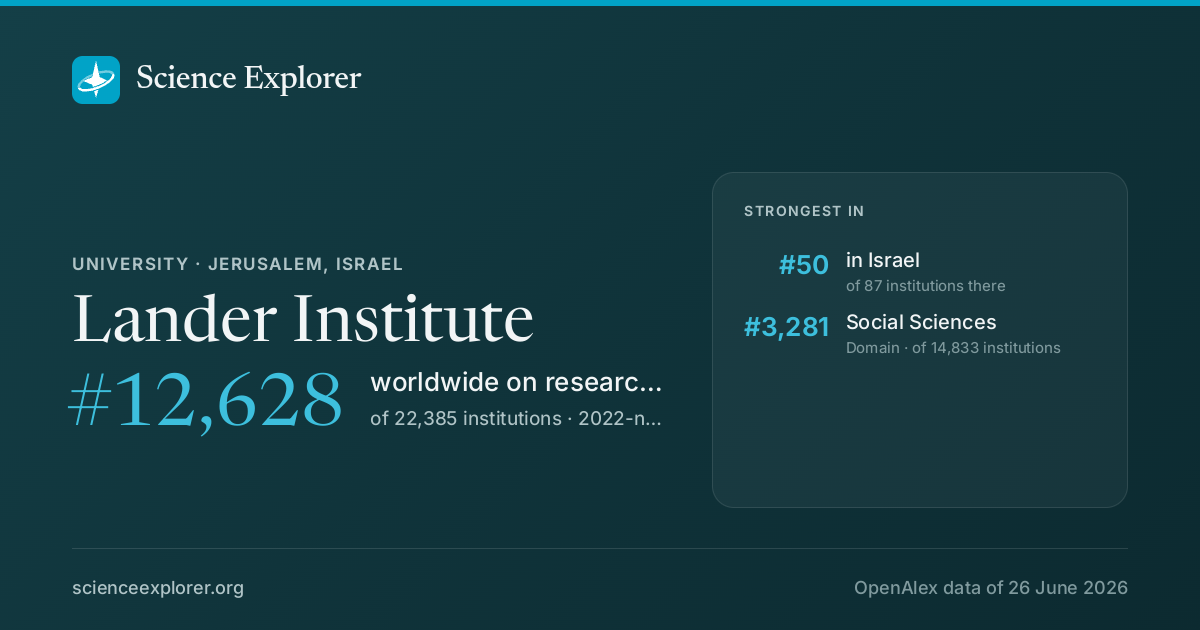
In research, Lander Institute stands highest in Social Sciences (#3,281 of 14,833 worldwide), over all time.
- World rank, 2022-now
- #12,628 of 22,385 · #2,179 all time
- Rank in Israel
- #50 of 87
- Research works
- 406 ▲ 21% vs 2018-21
- Citations
- 7.5k 18.4 per fractional work
- Top-10% rate
- 22.1% all institutions 10.0%
- vs its own fields
- 1.09× 1.00× is exactly expected
- Open access
- 69% world 40%
- International
- 44% world 18%
What is Lander Institute known for in research?
The fields where it stands highest, over all time, ranked among every institution above the floor in each field.
| Field | World rank | Where that sits | Top-10% rate | Works |
|---|---|---|---|---|
| Social SciencesDomain | #3,281 of 14,833 | 1.4% | 224 |
Each strip is that field's whole ranked pool, with the notch where Lander Institute sits in it, in the colour of the band that rank falls in. The track under the rate is the rate itself: it carries no average mark, because the average differs by field (from about 6% in Dentistry to 21% in Economics).
Which fields of science does Lander Institute work in?
In 2022-now, 45% of research at Lander Institute is in Health Sciences, 40% in Life Sciences. Its largest fields are Medicine (44%), Biochemistry, Genetics and Molecular Biology (29%), Immunology and Microbiology (9%). It does 2.6× the world's share of Life Sciences.
Each ring splits the one inside it: the four domains of science, their fields, their subfields. Size is fractional works in 2022-now. Every slice is a page; the interactive view zooms down to single topics and colours each by how much more of it this institution does than the world.
Its 4 domains and 22 fields, with their numbers
- Health Sciences3745.0%
- Medicine3643.8%
- Health Professions10.8%
- Dentistry00.3%
- Veterinary00.1%
- Life Sciences3340.3%
- Physical Sciences1012.6%
- Physics and Astronomy78.6%
- Computer Science11.2%
- Engineering10.8%
- Chemistry10.7%
- Environmental Science10.7%
- Materials Science00.3%
- Earth and Planetary Sciences00.1%
- Mathematics00.1%
- Social Sciences22.1%
- Social Sciences11.0%
- Decision Sciences00.5%
- Arts and Humanities00.3%
- Psychology00.2%
- Economics, Econometrics and Finance00.2%
Field profile
Location quotient across every field it publishes in: outside the ring is more than an institution of this size would be expected to publish, inside it is less.
Rings at 0.5×, 1× and 2×. Widest outward: Immunology and Microbiology, 9.0×. Every wedge is a field page.
All 22 fields, with their numbers
- Immunology and Microbiology8.99×7 works
- Biochemistry, Genetics and Molecular Biology5.48×24 works
- Physics and Astronomy3.86×7 works
- Medicine2.28×36 works
- Pharmacology, Toxicology and Pharmaceutics1.48×0 works
- Neuroscience0.74×1 works
- Dentistry0.70×0 works
- Veterinary0.60×0 works
- Chemistry0.48×1 works
- Decision Sciences0.47×0 works
- Health Professions0.29×1 works
- Computer Science0.15×1 works
- Environmental Science0.14×1 works
- Mathematics0.09×0 works
- Arts and Humanities0.09×0 works
- Earth and Planetary Sciences0.08×0 works
- Materials Science0.08×0 works
- Social Sciences0.08×1 works
- Agricultural and Biological Sciences0.07×0 works
- Economics, Econometrics and Finance0.07×0 works
- Engineering0.06×1 works
- Psychology0.06×0 works
- Immunology and Microbiology 9.0×
- Biochemistry, Genetics and Molecular Biology 5.5×
- Physics and Astronomy 3.9×
- Medicine 2.3×
- Pharmacology, Toxicology and Pharmaceutics 1.5×
- Neuroscience 0.7×
- Dentistry 0.7×
- Veterinary 0.6×
- Chemistry 0.5×
- Decision Sciences 0.5×
- Health Professions 0.3×
- Computer Science 0.1×
- Environmental Science 0.1×
- Mathematics 0.1×
- Arts and Humanities 0.1×
- Earth and Planetary Sciences 0.1×
- Materials Science 0.1×
- Social Sciences 0.1×
- Agricultural and Biological Sciences 0.1×
- Economics, Econometrics and Finance 0.1×
- Engineering 0.1×
- Psychology 0.1×
Who are the top researchers at Lander Institute?
Ranked on the quality score, A. J. Morton, Elizabeth Tait and Ursula Kelly lead among researchers whose main affiliation is Lander Institute.
- 1
A. J. Morton
 Israel · #1,163,155 worldwide
4.8k citations · 40 works
- 2
Elizabeth Tait
Israel · #1,730,383 worldwide
634 citations · 94 works
- 3
Ursula Kelly
Israel · #2,091,061 worldwide
388 citations · 31 works
- 4
Neil Fraser
Israel · #2,569,982 worldwide
2.3k citations · 143 works
- 5
Nuala O'Donnell
Israel · #3,131,334 worldwide
144 citations · 47 works
- 6
J. W. McGilvray
Israel · #3,323,594 worldwide
344 citations · 43 works
- 7
Naḥem Ilan
Israel · #3,698,750 worldwide
5 citations · 17 works
- 8
Frank J. Harrigan
Israel · #3,818,987 worldwide
584 citations · 70 works
- 9
Neil Dourmashkin
Israel · #4,305,547 worldwide
269 citations · 52 works
- 10
Richard Brooks
Israel · #4,373,875 worldwide
0 citations · 15 works
Which keywords describe research at Lander Institute?
By fractional works in 2022-now, weighted toward what it does more of than the world: Cancer, Immunotherapy, Tumor Microenvironment, Biomarkers, Immunity, Inflammation, Targeted Therapy and Innate Immunity.
- Molecular Biology
- Accretion Disks
- Hormone Therapy
- Astronomical Instrumentation
- Homologous Recombination
- Vaccine Adjuvants
- Dendritic Cells
- Cancer Genomics
- Cell-Free DNA
- Prostate Cancer
- Immune Checkpoint Blockade
- Chemotherapy
- Star Formation
- Genetic Mutations
- Cancer Therapy
- Oxidative Stress
- Innate Immunity
- Immunity
- Tumor Microenvironment
- Immunotherapy
- Cancer
- Inflammation
- Biomarkers
- Targeted Therapy
- Cell Death
- Genomic Instability
- Clinical Trials
- Cancer Immunotherapy
- Apoptosis
- Gene Expression
- PD-1 and PD-L1
- Precision Medicine
- Antigen Presentation
- Mutational Signatures
- Tumor Antigen
- Genomic Profiling
- Androgen Receptor
- Black Holes
- Spectrograph
- Metastatic Prostate Cancer
Size is fractional works in 2022-now in the topics tagged with each word; colour is the word's share of this institution's work against its share of the world's. The 40 words are chosen for being large and distinctive. Each links to the topic it comes from most.
All 40 words, with their numbers
- Cancer7▲ 6.7×30 topics
- Immunotherapy6▲ 11×11 topics
- Inflammation6▲ 3.3×37 topics
- Tumor Microenvironment5▲ 14×8 topics
- Biomarkers4▲ 7.7×8 topics
- Immunity4▲ 12×7 topics
- Targeted Therapy4▲ 20×4 topics
- Innate Immunity4▲ 13×6 topics
- Cell Death3▲ 17×6 topics
- Oxidative Stress3▲ 2.5×20 topics
- Genomic Instability3▲ 35×3 topics
- Cancer Therapy3▲ 6.7×9 topics
- Clinical Trials3▲ 5.6×7 topics
- Genetic Mutations3▲ 8.7×11 topics
- Cancer Immunotherapy3▲ 24×3 topics
- Star Formation3▲ 64×2 topics
- Apoptosis3▲ 10×15 topics
- Chemotherapy3▲ 4.6×12 topics
- Gene Expression3▲ 5.2×10 topics
- Immune Checkpoint Blockade3▲ 28×1 topic
- PD-1 and PD-L13▲ 28×1 topic
- Prostate Cancer3▲ 24×4 topics
- Precision Medicine3▲ 6.5×5 topics
- Cell-Free DNA2▲ 31×2 topics
- Antigen Presentation2▲ 31×2 topics
- Cancer Genomics2▲ 40×1 topic
- Mutational Signatures2▲ 40×1 topic
- Dendritic Cells2▲ 29×2 topics
- Tumor Antigen2▲ 41×1 topic
- Vaccine Adjuvants2▲ 41×1 topic
- Genomic Profiling2▲ 23×2 topics
- Homologous Recombination2▲ 50×2 topics
- Androgen Receptor2▲ 30×2 topics
- Astronomical Instrumentation2▲ 67×1 topic
- Black Holes2▲ 23×2 topics
- Hormone Therapy2▲ 25×2 topics
- Spectrograph2▲ 67×1 topic
- Accretion Disks2▲ 42×2 topics
- Metastatic Prostate Cancer2▲ 51×1 topic
- Molecular Biology2▲ 51×1 topic
Which research topics does Lander Institute publish most on?
By volume in 2022-now: Cancer Immunotherapy and Biomarkers, Cancer Genomics and Diagnostics, Immunotherapy and Immune Responses and Astronomy and Astrophysical Research.
Area is fractional works; colour is the subfield each topic belongs to.
- 1 Cancer Immunotherapy and Biomarkers Oncology 3 works
- 2 Cancer Genomics and Diagnostics Cancer Research 2 works
- 3 Immunotherapy and Immune Responses Immunology 2 works
- 4 Astronomy and Astrophysical Research Instrumentation 2 works
- 5 Prostate Cancer Treatment and Research Pulmonary and Respiratory Medicine 2 works
- 6 Galaxies: Formation, Evolution, Phenomena Astronomy and Astrophysics 2 works
- 7 Astrophysics and Star Formation Studies Astronomy and Astrophysics 1 works
- 8 Epigenetics and DNA Methylation Molecular Biology 1 works
- 9 PARP inhibition in cancer therapy Oncology 1 works
- 10 Cancer Cells and Metastasis Oncology 1 works
How open and international is its research?
Against the world's own shares: the tick on each track. Both are shares of its output, so they sit on one scale and can be read against each other as well as against the world.
World: 40% of research is openly available.
World: 18% is written across borders.
How has Lander Institute's research output changed?
Output in 2022-2025 was 21% higher than in 2018-2021.
The same series as a ribbon: one cell per year, darker for more. The line above answers how much; this answers when.
Its share of all research
Growing output can still be a shrinking share: all of science grows. This is Lander Institute as a percentage of every work published that year, 0.00028% in 2024.
Fractional works of Lander Institute over all fractional works that year. How the balance of science has shifted.
Other research institutions in Jerusalem
- Hebrew University of Jerusalem
- Hadassah Academic College
- Jerusalem College of Technology
- Israel Ministry of Health
- Israel Antiquities Authority
- Office of the Chief Scientist
- Geological Survey of Israel
- Jerusalem Institute for Israel Studies


Share Lander Institute's ranking
Badges for a website1Each links back here and updates with every snapshot

Research measures only: rankings here say nothing about teaching, admissions or student experience. Comparable institutions and collaboration partners have tabs of their own, above.
Discussion
Ask a question or share a note about Lander Institute. Posts are plain text and can be reported.